ScienceFreePrintable

Earthquake Science Fundamentals

A free science worksheet ready for your classroom. Open in Kuraplan to grab the print-ready PDF, customize it for your students, or generate a fresh version in seconds.
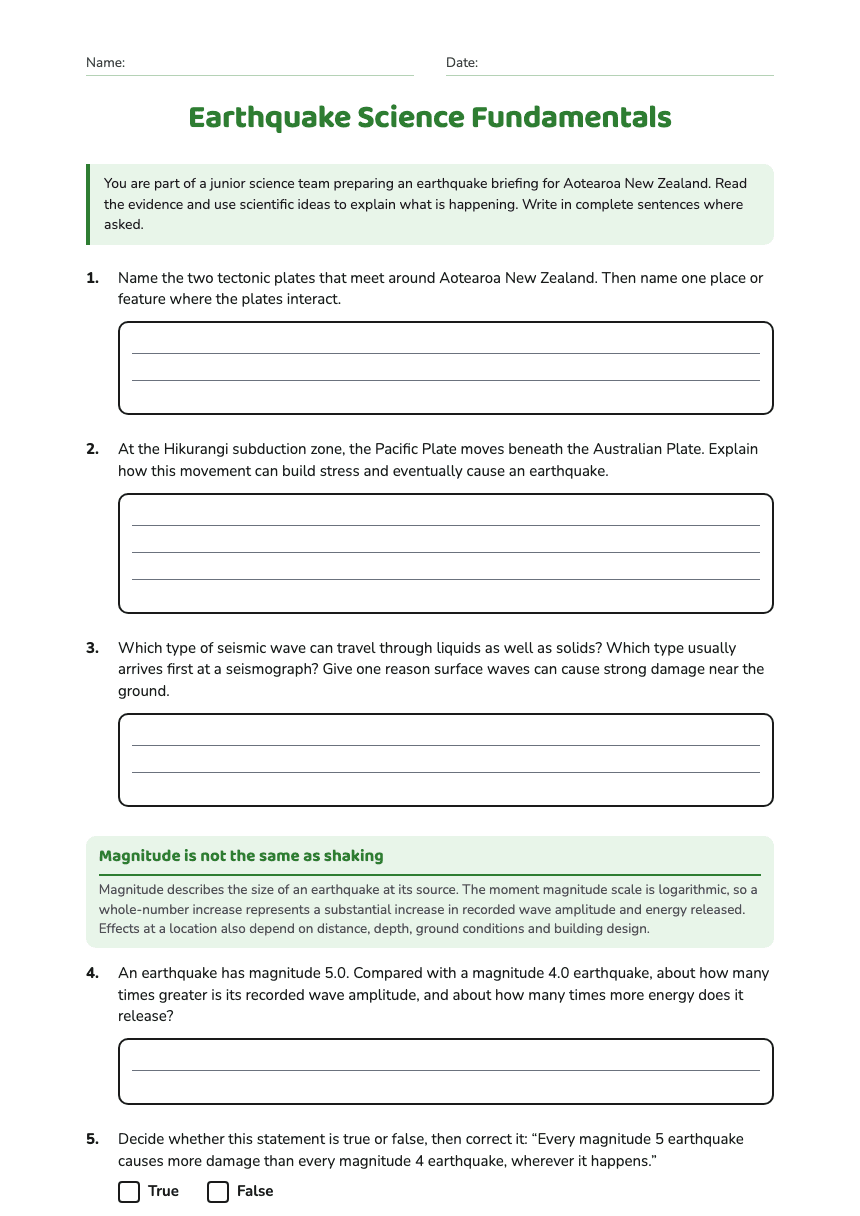
Earthquake Science Fundamentals worksheet preview
Name:Date:

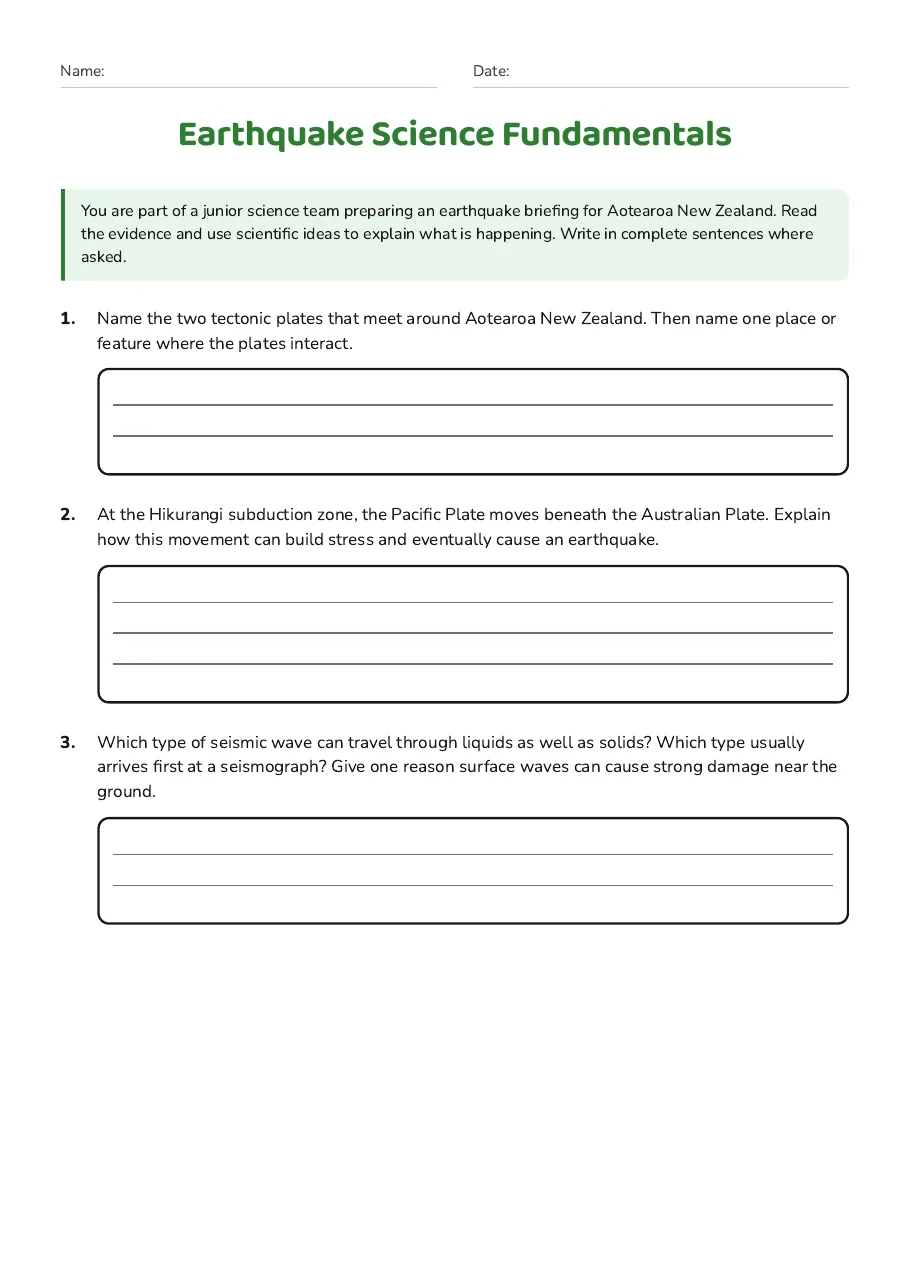
Earthquake Science Fundamentals

You are part of a junior science team preparing an earthquake briefing for Aotearoa New Zealand. Read the evidence and use scientific ideas to explain what is happening. Write in complete sentences where asked.
1.Name the two tectonic plates that meet around Aotearoa New Zealand. Then name one place or feature where the plates interact.
2.At the Hikurangi subduction zone, the Pacific Plate moves beneath the Australian Plate. Explain how this movement can build stress and eventually cause an earthquake.
3.Which type of seismic wave can travel through liquids as well as solids? Which type usually arrives first at a seismograph? Give one reason surface waves can cause strong damage near the ground.

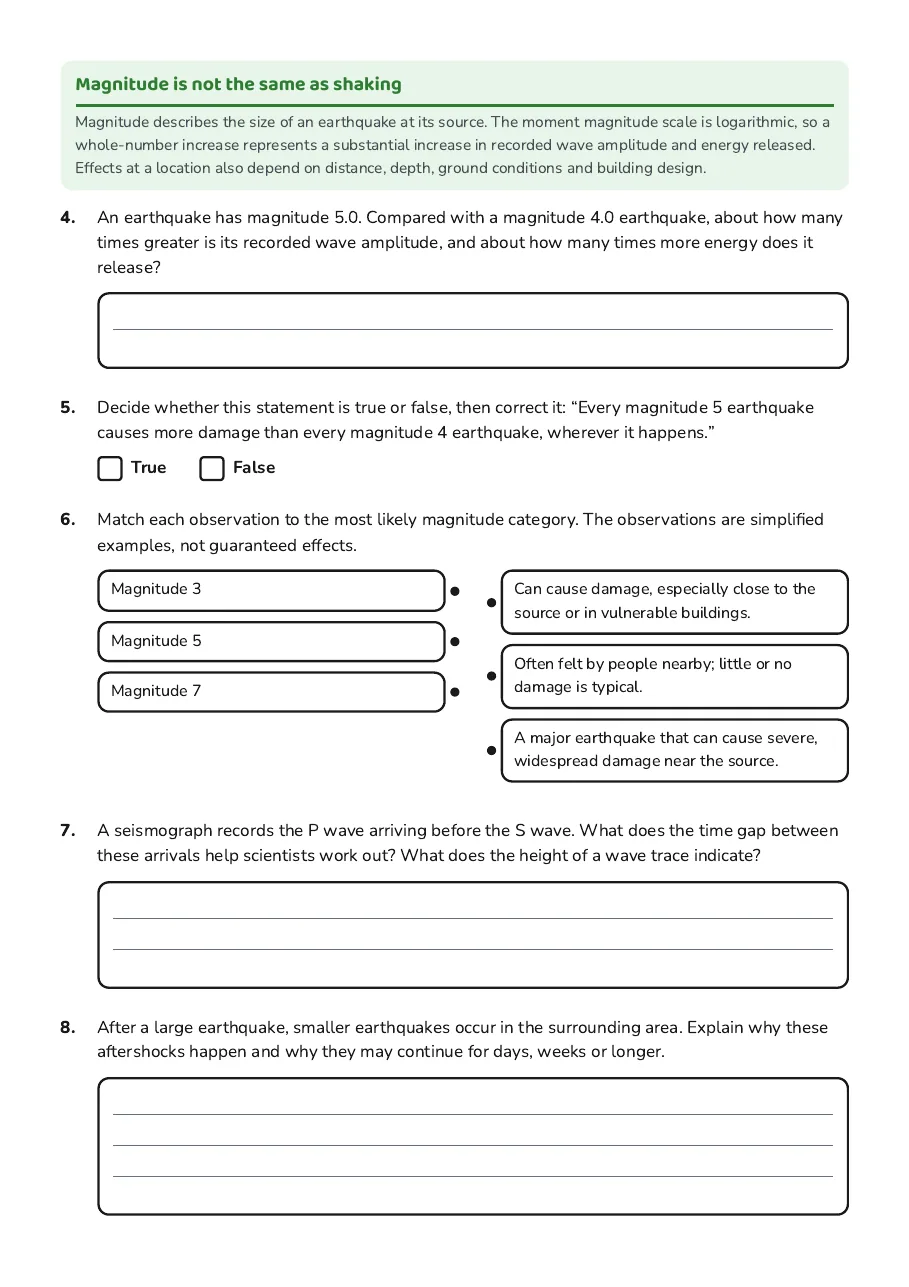
Magnitude is not the same as shaking

Magnitude describes the size of an earthquake at its source. The moment magnitude scale is logarithmic, so a whole-number increase represents a substantial increase in recorded wave amplitude and energy released. Effects at a location also depend on distance, depth, ground conditions and building design.

4.An earthquake has magnitude 5.0. Compared with a magnitude 4.0 earthquake, about how many times greater is its recorded wave amplitude, and about how many times more energy does it release?
5.Decide whether this statement is true or false, then correct it: “Every magnitude 5 earthquake causes more damage than every magnitude 4 earthquake, wherever it happens.”
TrueFalse
6.Match each observation to the most likely magnitude category. The observations are simplified examples, not guaranteed effects.
  • Magnitude 3
  • Magnitude 5
  • Magnitude 7
  • Can cause damage, especially close to the source or in vulnerable buildings.
  • Often felt by people nearby; little or no damage is typical.
  • A major earthquake that can cause severe, widespread damage near the source.
7.A seismograph records the P wave arriving before the S wave. What does the time gap between these arrivals help scientists work out? What does the height of a wave trace indicate?
8.After a large earthquake, smaller earthquakes occur in the surrounding area. Explain why these aftershocks happen and why they may continue for days, weeks or longer.
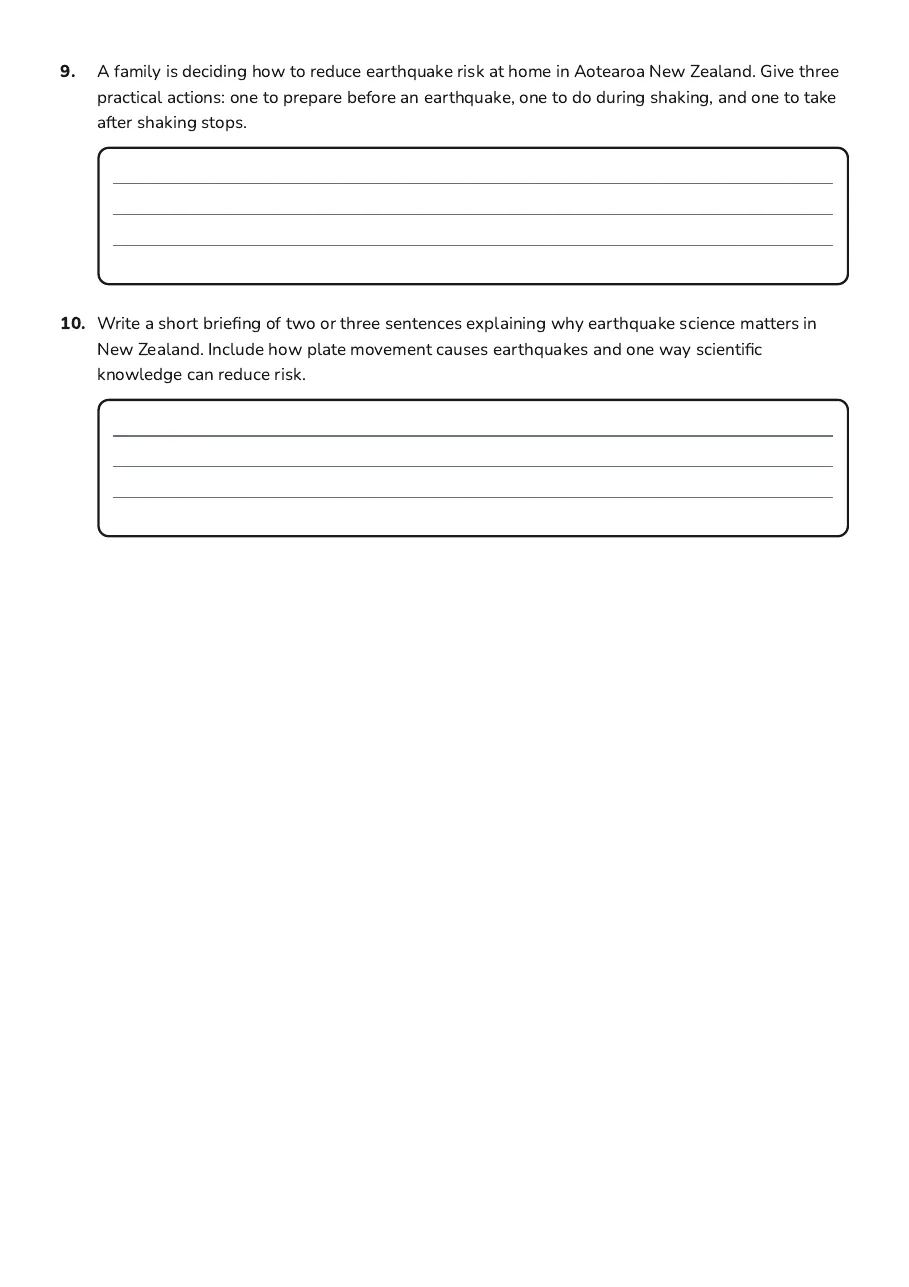
9.A family is deciding how to reduce earthquake risk at home in Aotearoa New Zealand. Give three practical actions: one to prepare before an earthquake, one to do during shaking, and one to take after shaking stops.
10.Write a short briefing of two or three sentences explaining why earthquake science matters in New Zealand. Include how plate movement causes earthquakes and one way scientific knowledge can reduce risk.

3 printable pages

  • Earthquake Science Fundamentals, page 1 of 3: You are part of a junior science team preparing an earthquake briefing for Aotearoa New…

    Page 1

  • Earthquake Science Fundamentals, page 2 of 3: Magnitude is not the same as shaking

    Page 2

  • Earthquake Science Fundamentals, page 3 of 3: 9. A family is deciding how to reduce earthquake risk at home in Aotearoa New Zealand.…

    Page 3

About This Worksheet

Free in Kuraplan

Sign up free, grab the PDF, and customize it for your class.

Print-Ready

Formatted for standard paper. Clean layout, easy to read.

AI-Generated

Created with Kuraplan's AI, designed for real classroom use.

For Teachers & Parents

Use in classrooms, for homework, tutoring, or homeschool.

Need a custom version of this worksheet?

Kuraplan's AI generates custom worksheets in seconds — differentiated for every learner, aligned to your curriculum.

Generate Custom Worksheets — Free
No credit card Curriculum-aligned Under 60 seconds