ScienceFreePrintable

Electricity Basics Introduction

A free science worksheet ready for your classroom. Open in Kuraplan to grab the print-ready PDF, customize it for your students, or generate a fresh version in seconds.
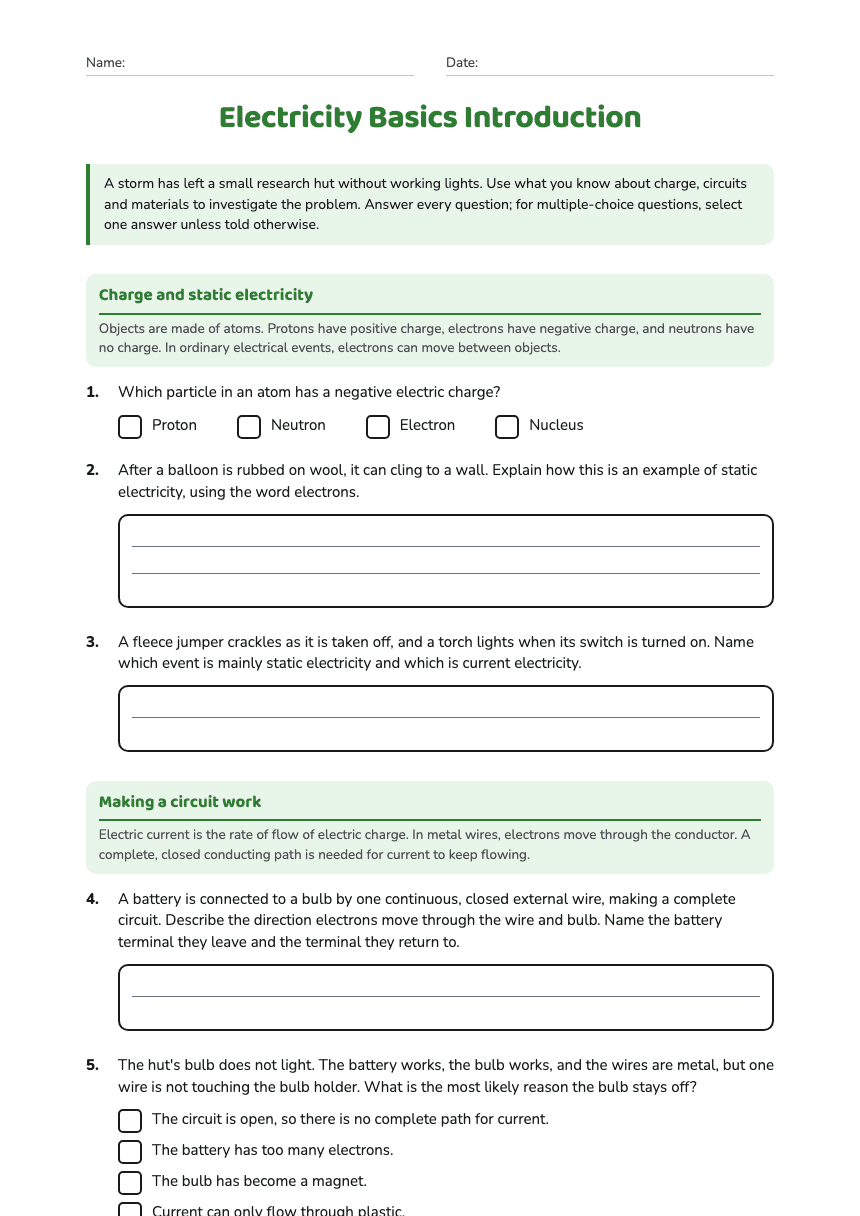
Electricity Basics Introduction worksheet preview
Name:Date:

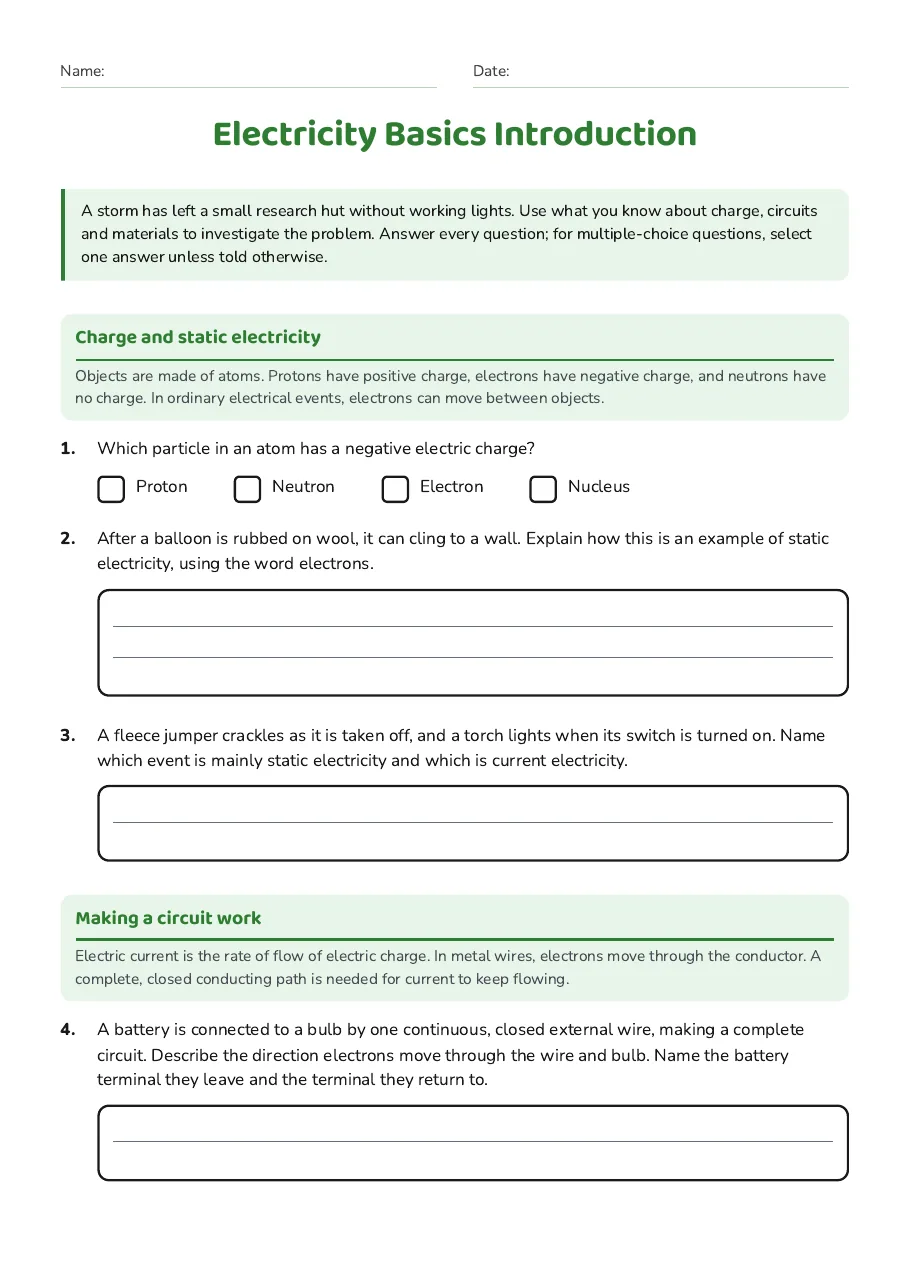
Electricity Basics Introduction

A storm has left a small research hut without working lights. Use what you know about charge, circuits and materials to investigate the problem. Answer every question; for multiple-choice questions, select one answer unless told otherwise.

Charge and static electricity

Objects are made of atoms. Protons have positive charge, electrons have negative charge, and neutrons have no charge. In ordinary electrical events, electrons can move between objects.

1.Which particle in an atom has a negative electric charge?
  • Proton
  • Neutron
  • Electron
  • Nucleus
2.After a balloon is rubbed on wool, it can cling to a wall. Explain how this is an example of static electricity, using the word electrons.
3.A fleece jumper crackles as it is taken off, and a torch lights when its switch is turned on. Name which event is mainly static electricity and which is current electricity.

Making a circuit work

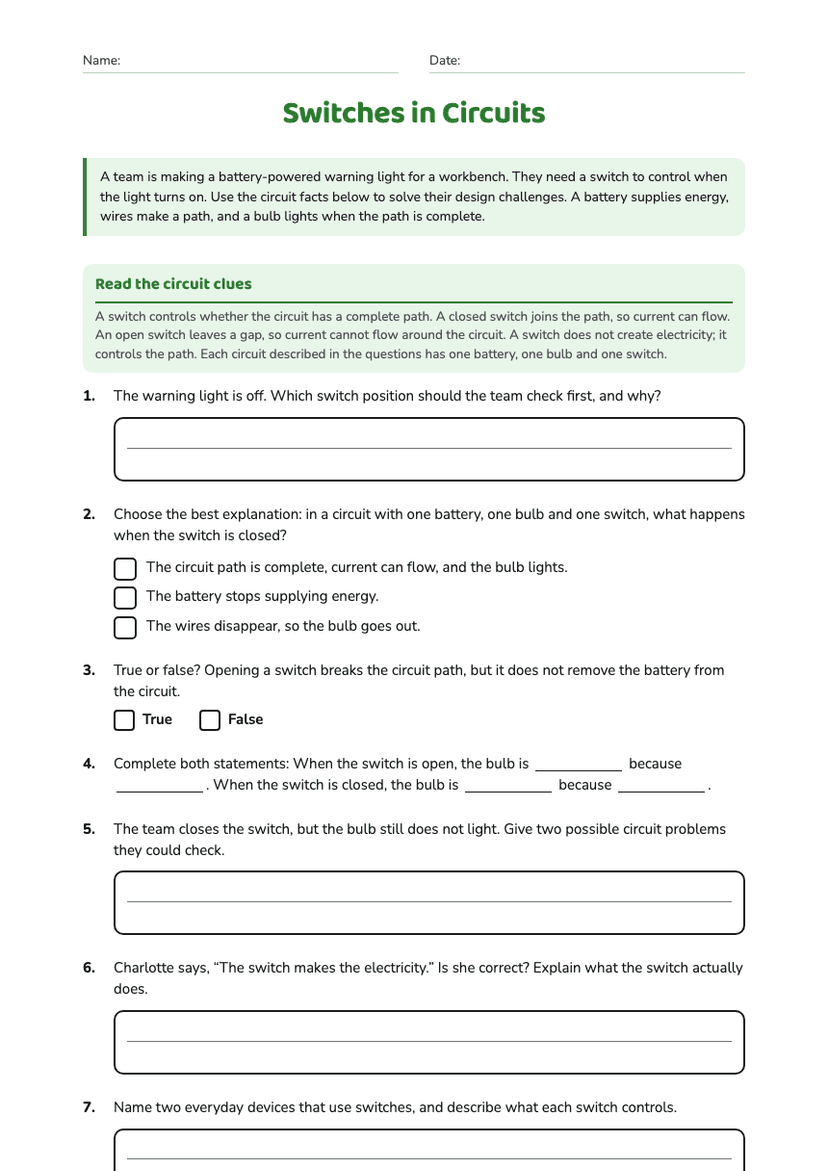
Electric current is the rate of flow of electric charge. In metal wires, electrons move through the conductor. A complete, closed conducting path is needed for current to keep flowing.

4.A battery is connected to a bulb by one continuous, closed external wire, making a complete circuit. Describe the direction electrons move through the wire and bulb. Name the battery terminal they leave and the terminal they return to.
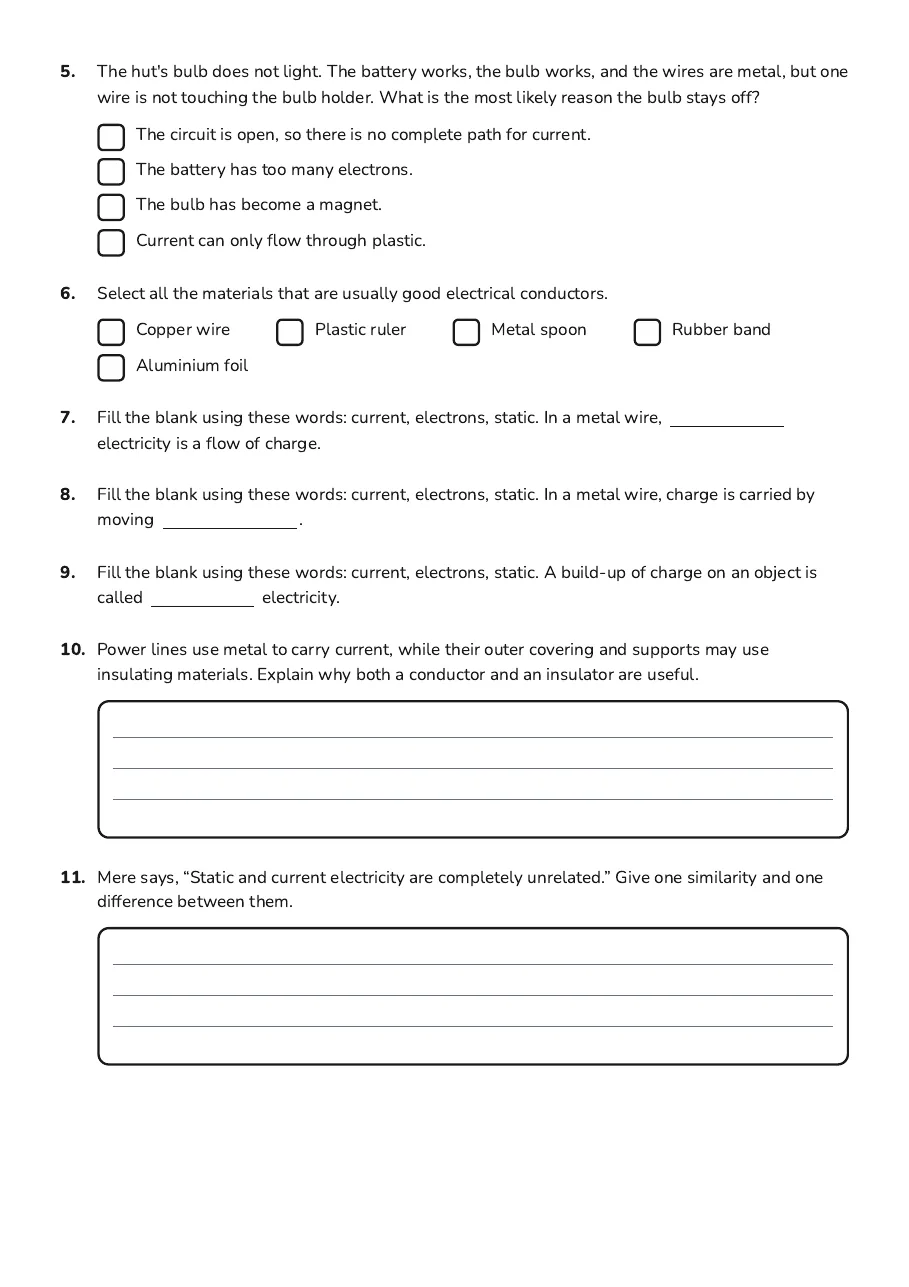
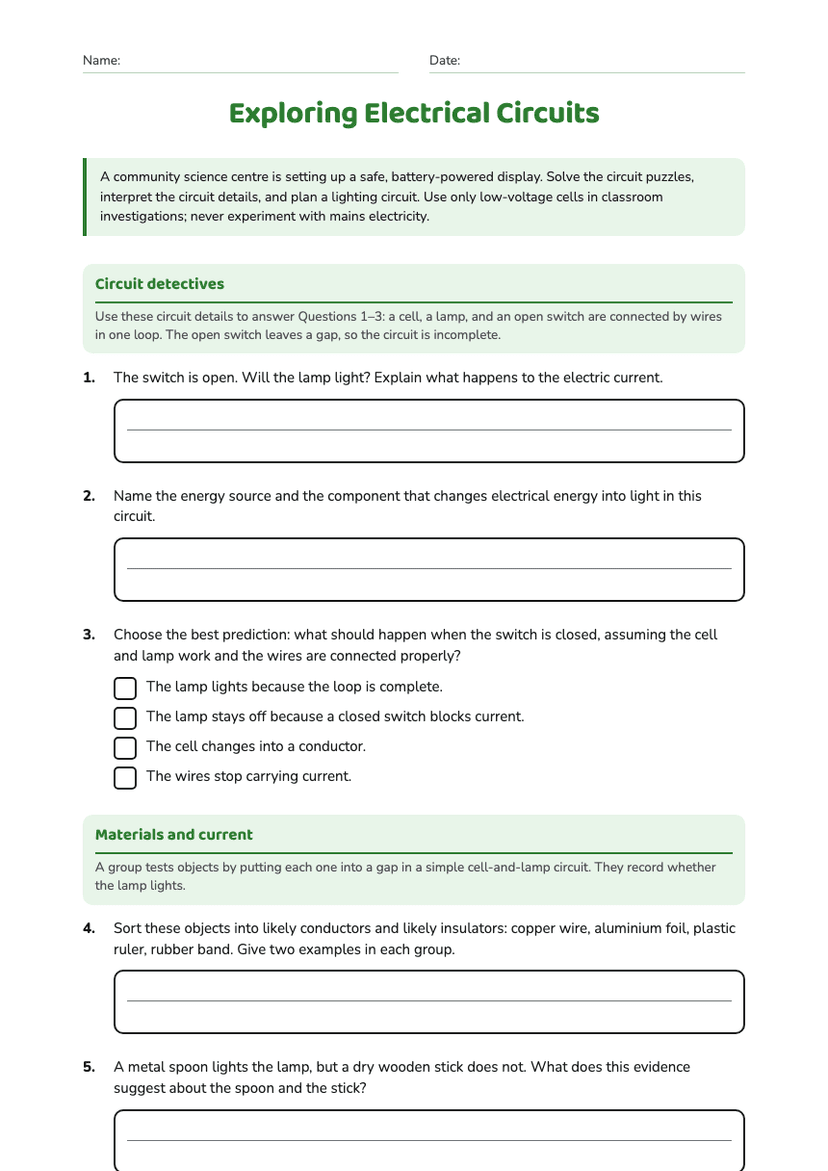
5.The hut's bulb does not light. The battery works, the bulb works, and the wires are metal, but one wire is not touching the bulb holder. What is the most likely reason the bulb stays off?
  • The circuit is open, so there is no complete path for current.
  • The battery has too many electrons.
  • The bulb has become a magnet.
  • Current can only flow through plastic.
6.Select all the materials that are usually good electrical conductors.
  • Copper wire
  • Plastic ruler
  • Metal spoon
  • Rubber band
  • Aluminium foil
7.Fill the blank using these words: current, electrons, static. In a metal wire, electricity is a flow of charge.
8.Fill the blank using these words: current, electrons, static. In a metal wire, charge is carried by moving .
9.Fill the blank using these words: current, electrons, static. A build-up of charge on an object is called electricity.
10.Power lines use metal to carry current, while their outer covering and supports may use insulating materials. Explain why both a conductor and an insulator are useful.
11.Mere says, “Static and current electricity are completely unrelated.” Give one similarity and one difference between them.

2 printable pages

  • Electricity Basics Introduction, page 1 of 2: Charge and static electricity, Making a circuit work

    Page 1

  • Electricity Basics Introduction, page 2 of 2: 5. The hut's bulb does not light. The battery works, the bulb works, and the wires are…

    Page 2

About This Worksheet

Free in Kuraplan

Sign up free, grab the PDF, and customize it for your class.

Print-Ready

Formatted for standard paper. Clean layout, easy to read.

AI-Generated

Created with Kuraplan's AI, designed for real classroom use.

For Teachers & Parents

Use in classrooms, for homework, tutoring, or homeschool.

Need a custom version of this worksheet?

Kuraplan's AI generates custom worksheets in seconds — differentiated for every learner, aligned to your curriculum.

Generate Custom Worksheets — Free
No credit card Curriculum-aligned Under 60 seconds