Environmental History Moments
A free english worksheet ready for your classroom. Open in Kuraplan to grab the print-ready PDF, customize it for your students, or generate a fresh version in seconds.
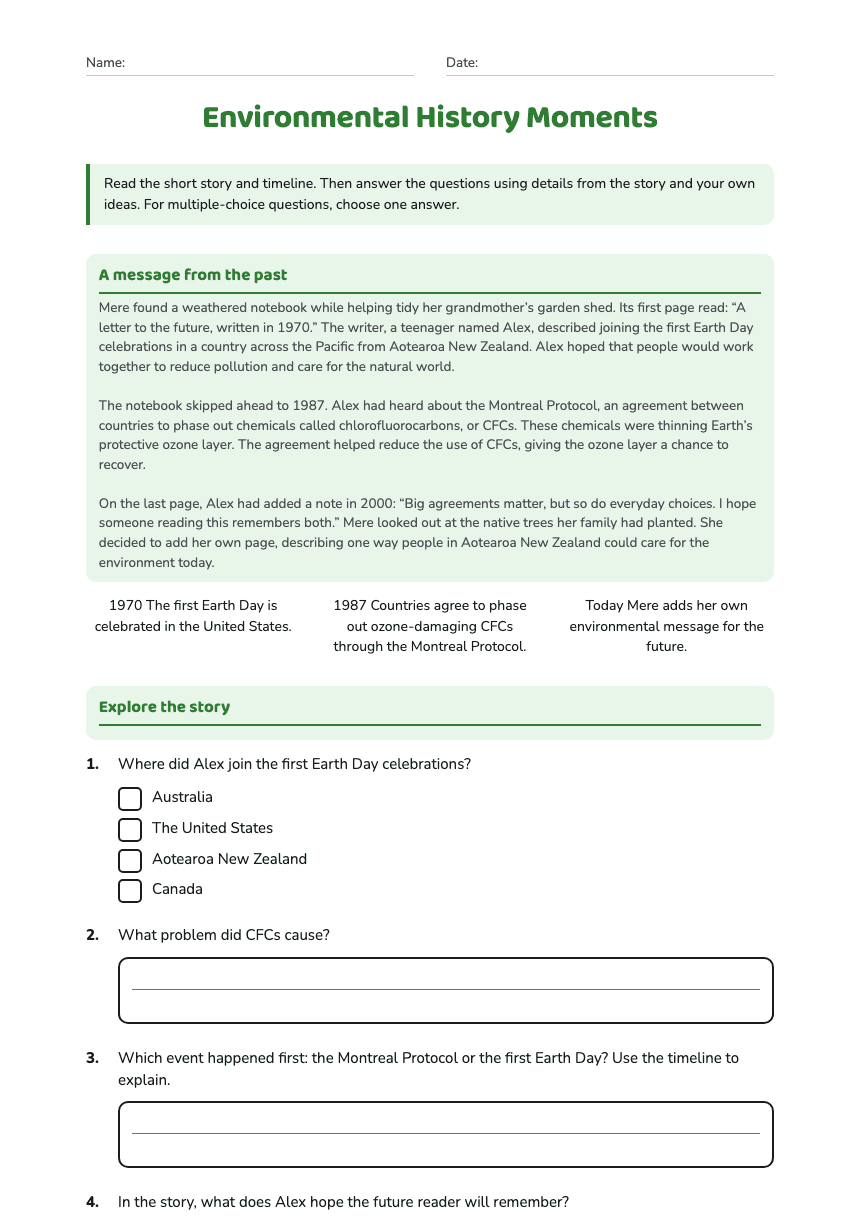
Environmental History Moments
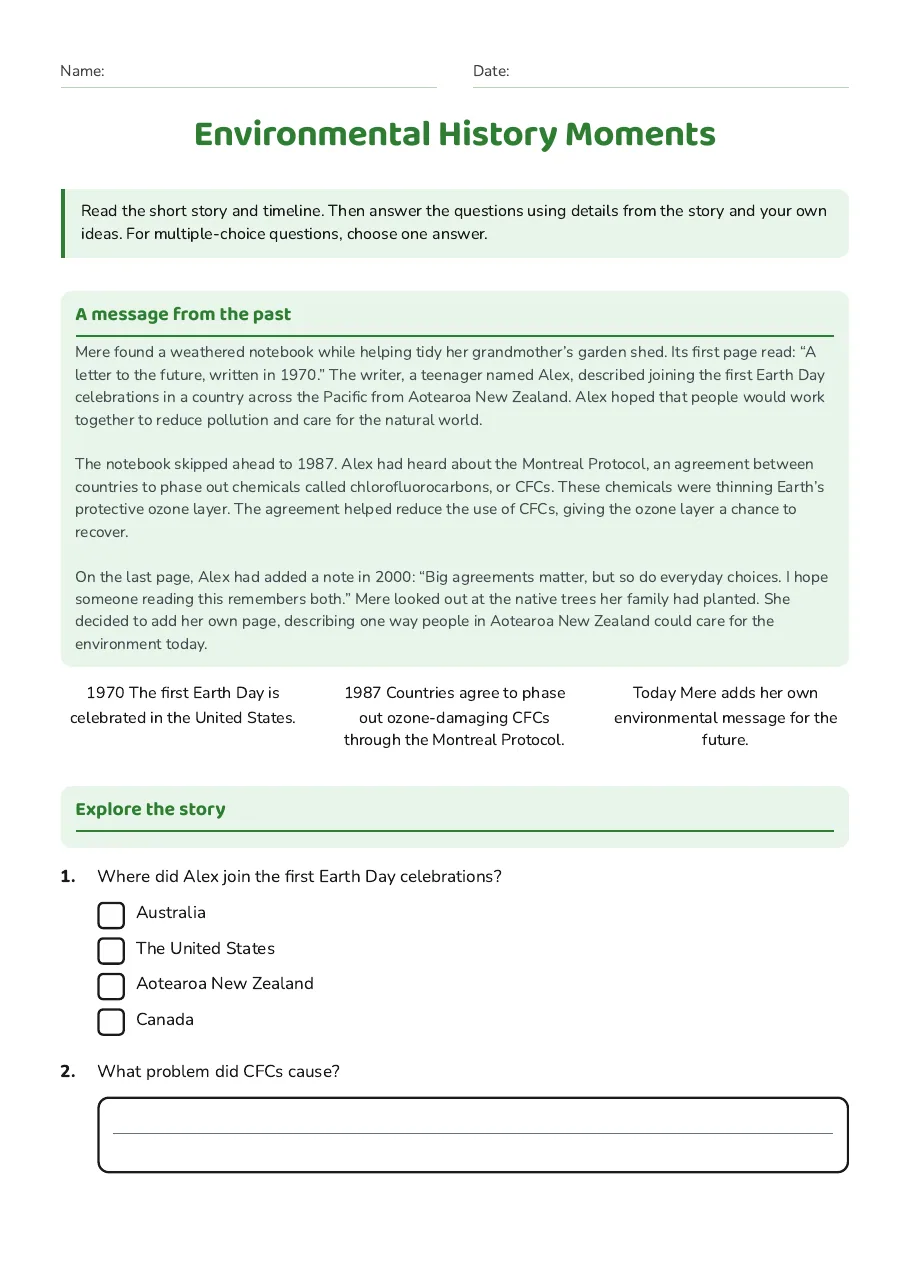
A message from the past
Mere found a weathered notebook while helping tidy her grandmother’s garden shed. Its first page read: “A letter to the future, written in 1970.” The writer, a teenager named Alex, described joining the first Earth Day celebrations in a country across the Pacific from Aotearoa New Zealand. Alex hoped that people would work together to reduce pollution and care for the natural world. The notebook skipped ahead to 1987. Alex had heard about the Montreal Protocol, an agreement between countries to phase out chemicals called chlorofluorocarbons, or CFCs. These chemicals were thinning Earth’s protective ozone layer. The agreement helped reduce the use of CFCs, giving the ozone layer a chance to recover. On the last page, Alex had added a note in 2000: “Big agreements matter, but so do everyday choices. I hope someone reading this remembers both.” Mere looked out at the native trees her family had planted. She decided to add her own page, describing one way people in Aotearoa New Zealand could care for the environment today.
1970 The first Earth Day is celebrated in the United States.
1987 Countries agree to phase out ozone-damaging CFCs through the Montreal Protocol.
Today Mere adds her own environmental message for the future.
Explore the story
- Australia
- The United States
- Aotearoa New Zealand
- Canada
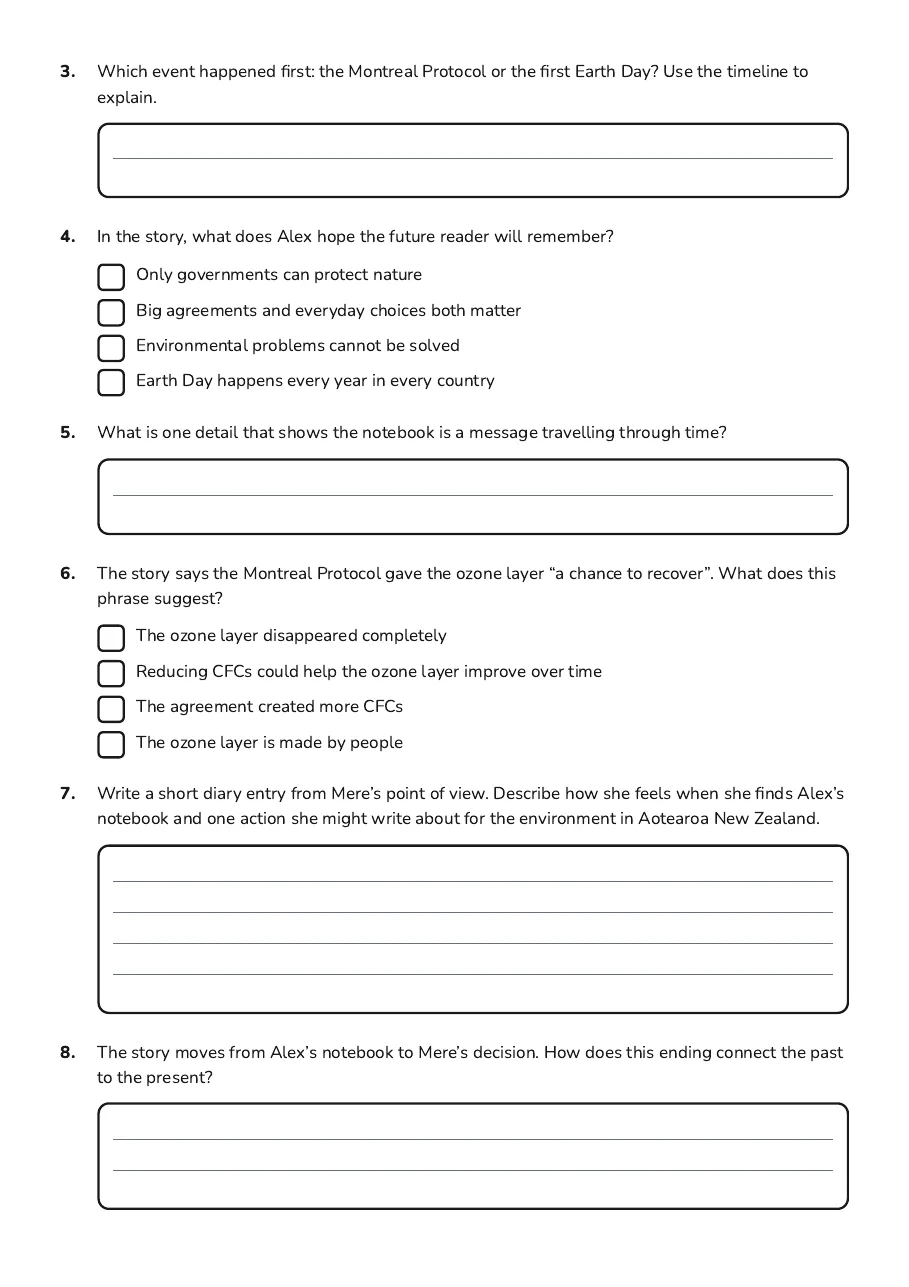
- Only governments can protect nature
- Big agreements and everyday choices both matter
- Environmental problems cannot be solved
- Earth Day happens every year in every country
- The ozone layer disappeared completely
- Reducing CFCs could help the ozone layer improve over time
- The agreement created more CFCs
- The ozone layer is made by people
3 printable pages
Page 1
Page 2
Page 3
About This Worksheet
Free in Kuraplan
Sign up free, grab the PDF, and customize it for your class.
Print-Ready
Formatted for standard paper. Clean layout, easy to read.
AI-Generated
Created with Kuraplan's AI, designed for real classroom use.
For Teachers & Parents
Use in classrooms, for homework, tutoring, or homeschool.
Need a custom version of this worksheet?
Kuraplan's AI generates custom worksheets in seconds — differentiated for every learner, aligned to your curriculum.
Generate Custom Worksheets — Free