Fluid Properties and Behaviour
A free science worksheet ready for your classroom. Open in Kuraplan to grab the print-ready PDF, customize it for your students, or generate a fresh version in seconds.
Fluid Properties and Behaviour
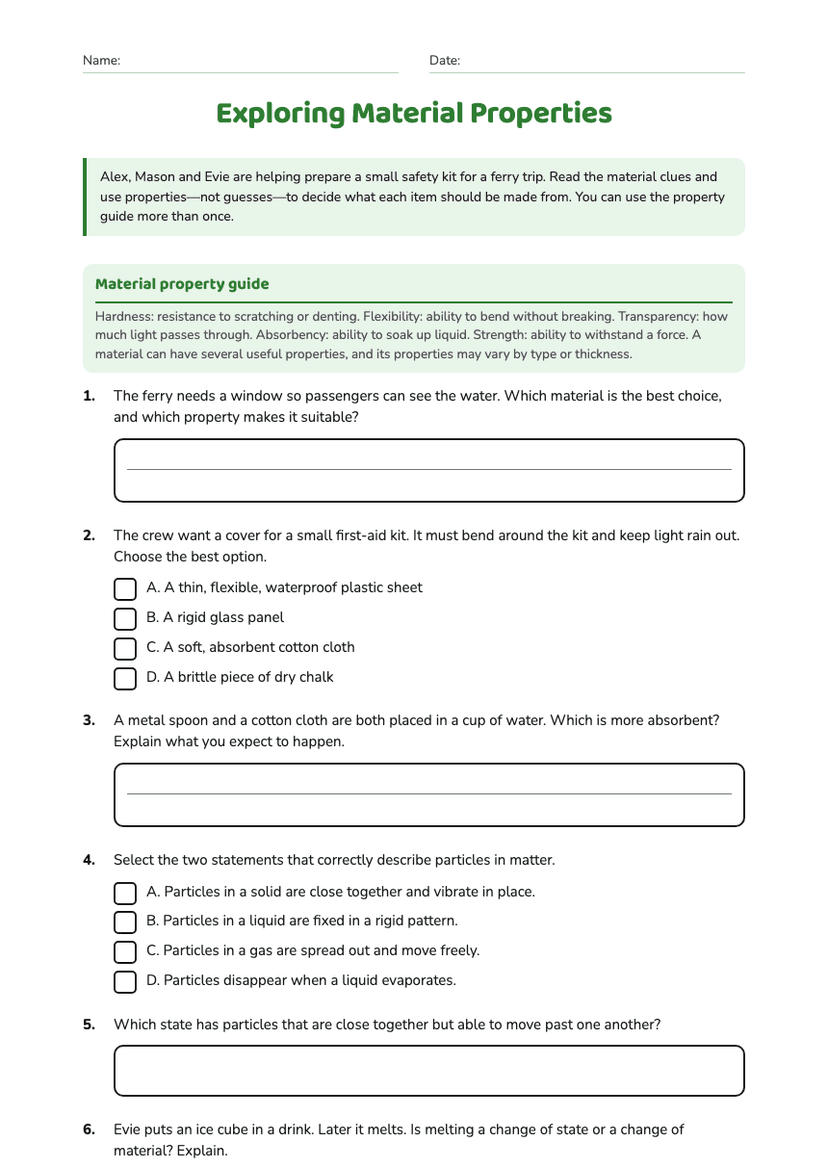
📚 Part 1: Fluid Properties and Principles
🔍 Part 2: Real-World Identification Problems
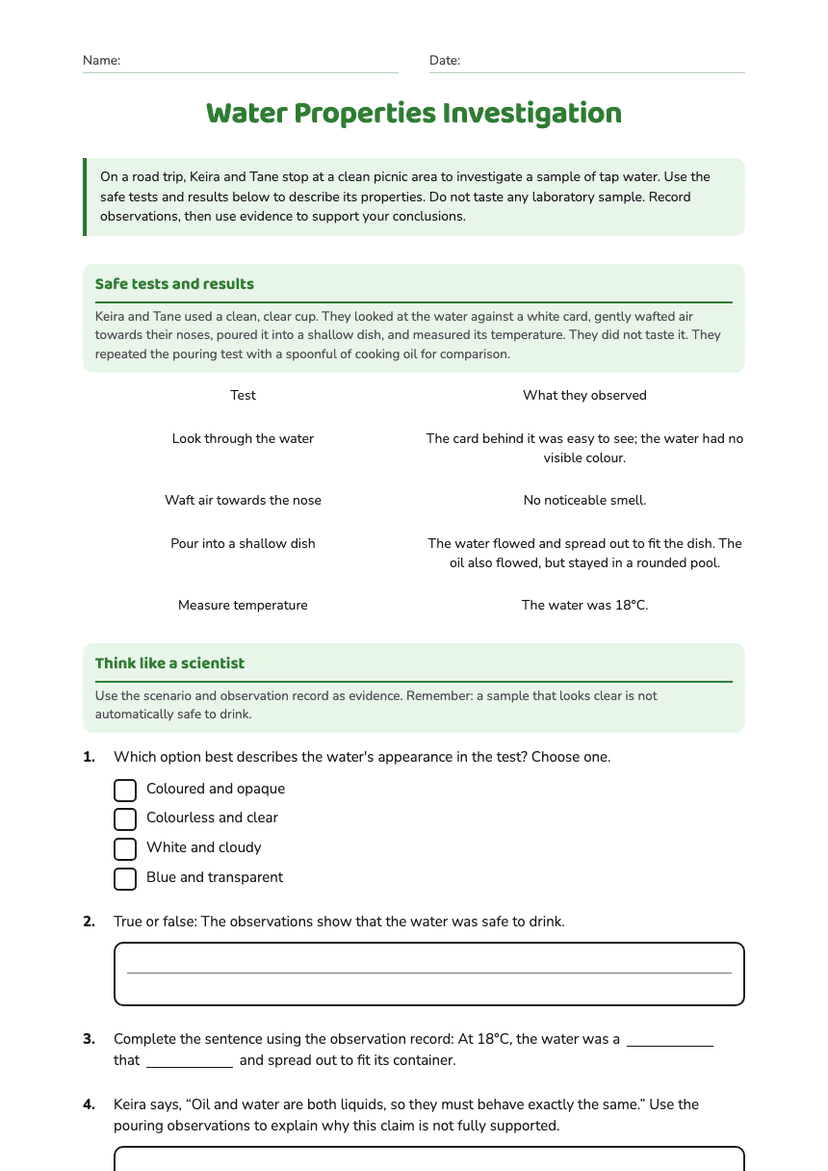
Key Answer: Viscosity
Key Answer: The boat floats because the buoyant force exerted by the water equals the weight of the boat.
Key Answer: When pressure is applied on the brake pedal, it is transmitted equally through the brake fluid to all parts of the braking system.
Key Answer: Oil has higher viscosity than water, so it flows more slowly.
🔗 Part 3: Matching Activity
Terms:
____ Viscosity
____ Density
____ Pressure
____ Buoyancy
____ Archimedes' Principle
____ Pascal's Law
____ Bernoulli's Principle
____ Fluid
Definitions:
A. A substance that can flow and take the shape of its container
B. The upward force exerted by a fluid on an immersed object
C. The mass per unit volume of a substance
D. A fluid's resistance to flow
E. Force applied per unit area
F. States that pressure applied to a confined fluid is transmitted equally in all directions
G. States that the buoyant force equals the weight of displaced fluid
H. States that as fluid speed increases, pressure decreases
✏️ Part 4: Definitions and Explanations
When you squeeze a balloon filled with air, you are demonstrating _____________ law. The pressure you apply is transmitted _____________ throughout the air inside the balloon.
Honey has _____________ viscosity than water, which means it flows _____________ than water.
🔬 Part 5: Applications and Analysis
About This Worksheet
Free in Kuraplan
Sign up free, grab the PDF, and customize it for your class.
Print-Ready
Formatted for standard paper. Clean layout, easy to read.
AI-Generated
Created with Kuraplan's AI, designed for real classroom use.
For Teachers & Parents
Use in classrooms, for homework, tutoring, or homeschool.
Need a custom version of this worksheet?
Kuraplan's AI generates custom worksheets in seconds — differentiated for every learner, aligned to your curriculum.
Generate Custom Worksheets — Free