ScienceFreePrintable

Friction Force Exploration

A free science worksheet ready for your classroom. Open in Kuraplan to grab the print-ready PDF, customize it for your students, or generate a fresh version in seconds.

Friction Force Exploration worksheet preview
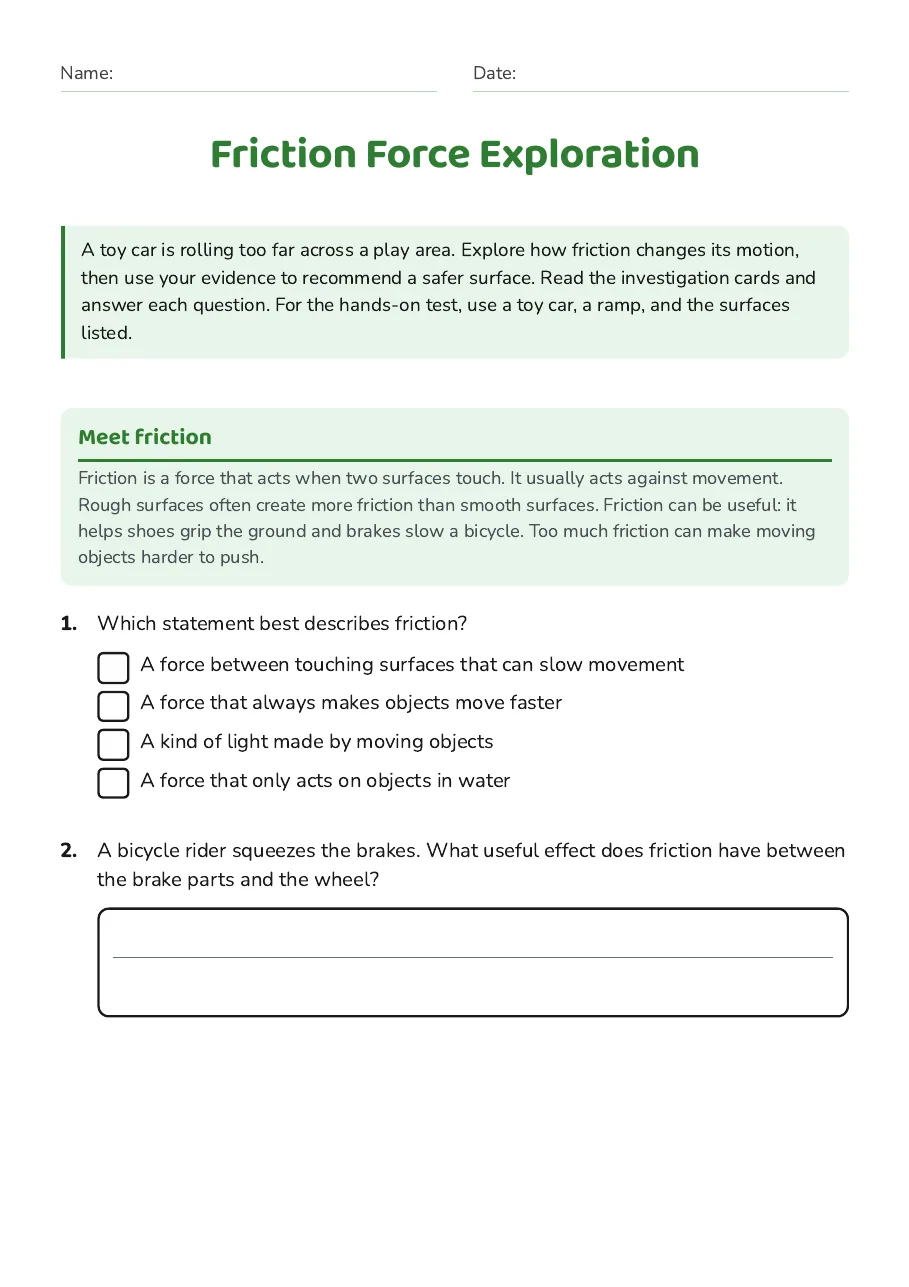
Name:Date:

Friction Force Exploration

A toy car is rolling too far across a play area. Explore how friction changes its motion, then use your evidence to recommend a safer surface. Read the investigation cards and answer each question. For the hands-on test, use a toy car, a ramp, and the surfaces listed.

Meet friction

Friction is a force that acts when two surfaces touch. It usually acts against movement. Rough surfaces often create more friction than smooth surfaces. Friction can be useful: it helps shoes grip the ground and brakes slow a bicycle. Too much friction can make moving objects harder to push.

1.Which statement best describes friction?
  • A force between touching surfaces that can slow movement
  • A force that always makes objects move faster
  • A kind of light made by moving objects
  • A force that only acts on objects in water
2.A bicycle rider squeezes the brakes. What useful effect does friction have between the brake parts and the wheel?
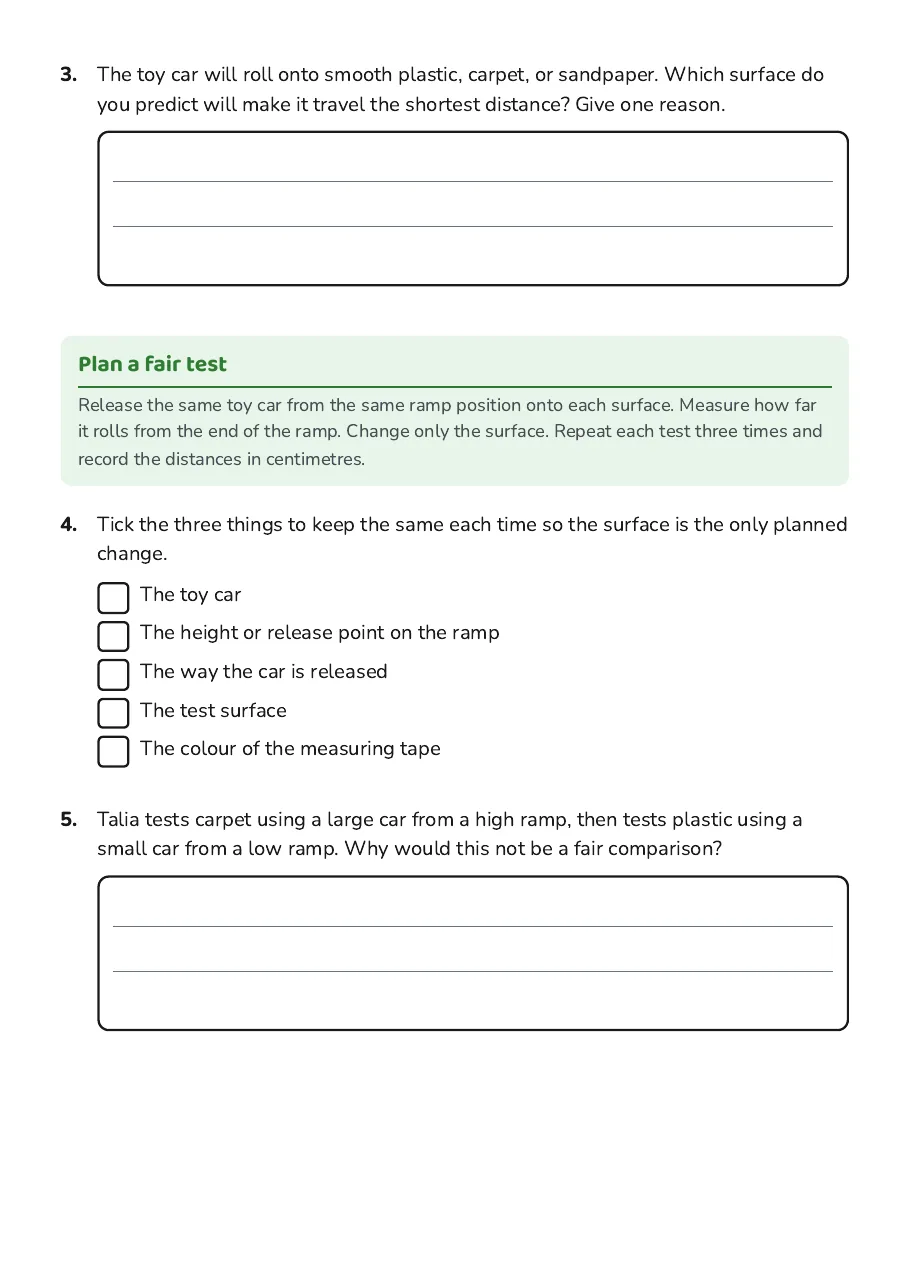
3.The toy car will roll onto smooth plastic, carpet, or sandpaper. Which surface do you predict will make it travel the shortest distance? Give one reason.

Plan a fair test

Release the same toy car from the same ramp position onto each surface. Measure how far it rolls from the end of the ramp. Change only the surface. Repeat each test three times and record the distances in centimetres.

4.Tick the three things to keep the same each time so the surface is the only planned change.
  • The toy car
  • The height or release point on the ramp
  • The way the car is released
  • The test surface
  • The colour of the measuring tape
5.Talia tests carpet using a large car from a high ramp, then tests plastic using a small car from a low ramp. Why would this not be a fair comparison?
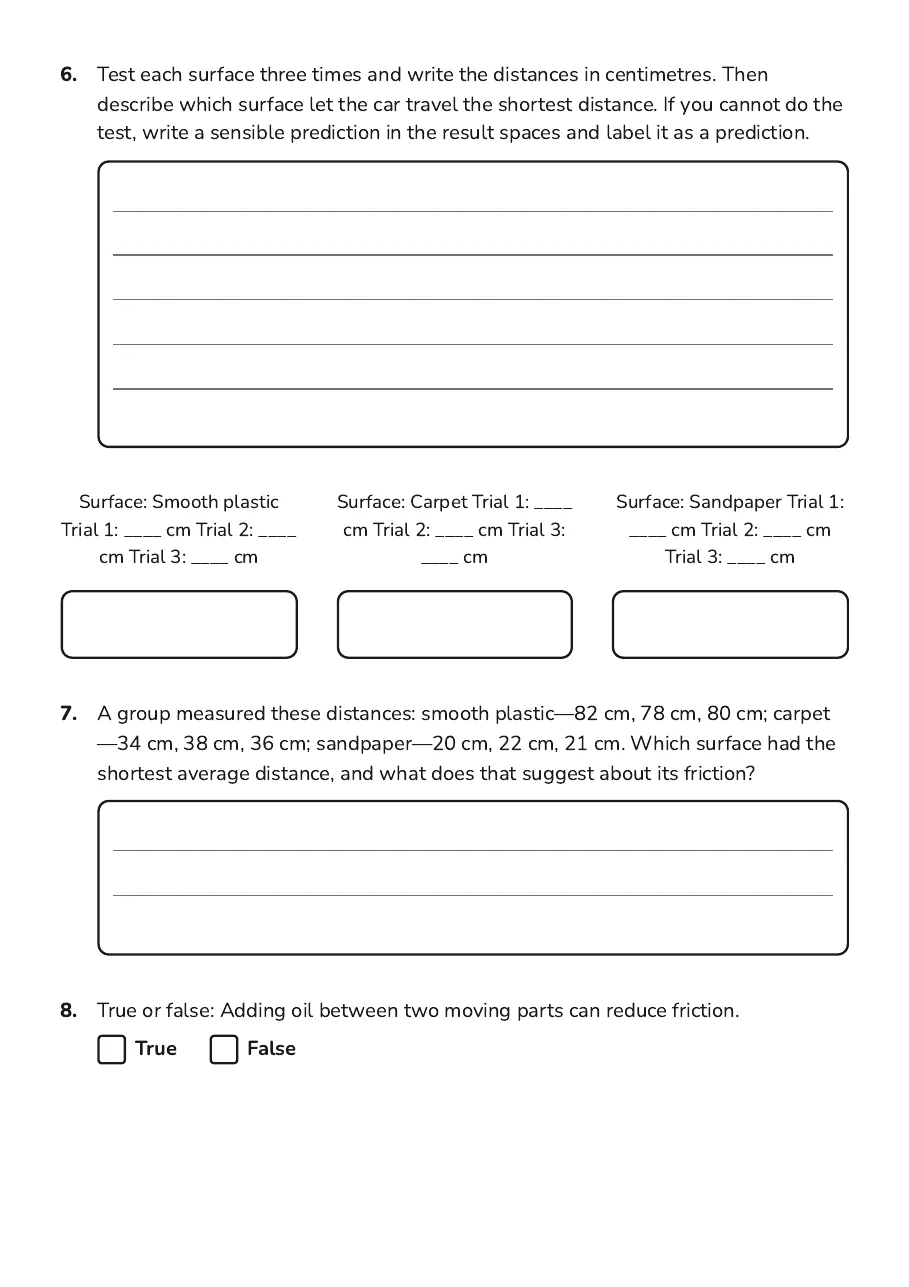
6.Test each surface three times and write the distances in centimetres. Then describe which surface let the car travel the shortest distance. If you cannot do the test, write a sensible prediction in the result spaces and label it as a prediction.

Surface: Smooth plastic Trial 1: ____ cm Trial 2: ____ cm Trial 3: ____ cm

Surface: Carpet Trial 1: ____ cm Trial 2: ____ cm Trial 3: ____ cm

Surface: Sandpaper Trial 1: ____ cm Trial 2: ____ cm Trial 3: ____ cm

7.A group measured these distances: smooth plastic—82 cm, 78 cm, 80 cm; carpet—34 cm, 38 cm, 36 cm; sandpaper—20 cm, 22 cm, 21 cm. Which surface had the shortest average distance, and what does that suggest about its friction?
8.True or false: Adding oil between two moving parts can reduce friction.
TrueFalse
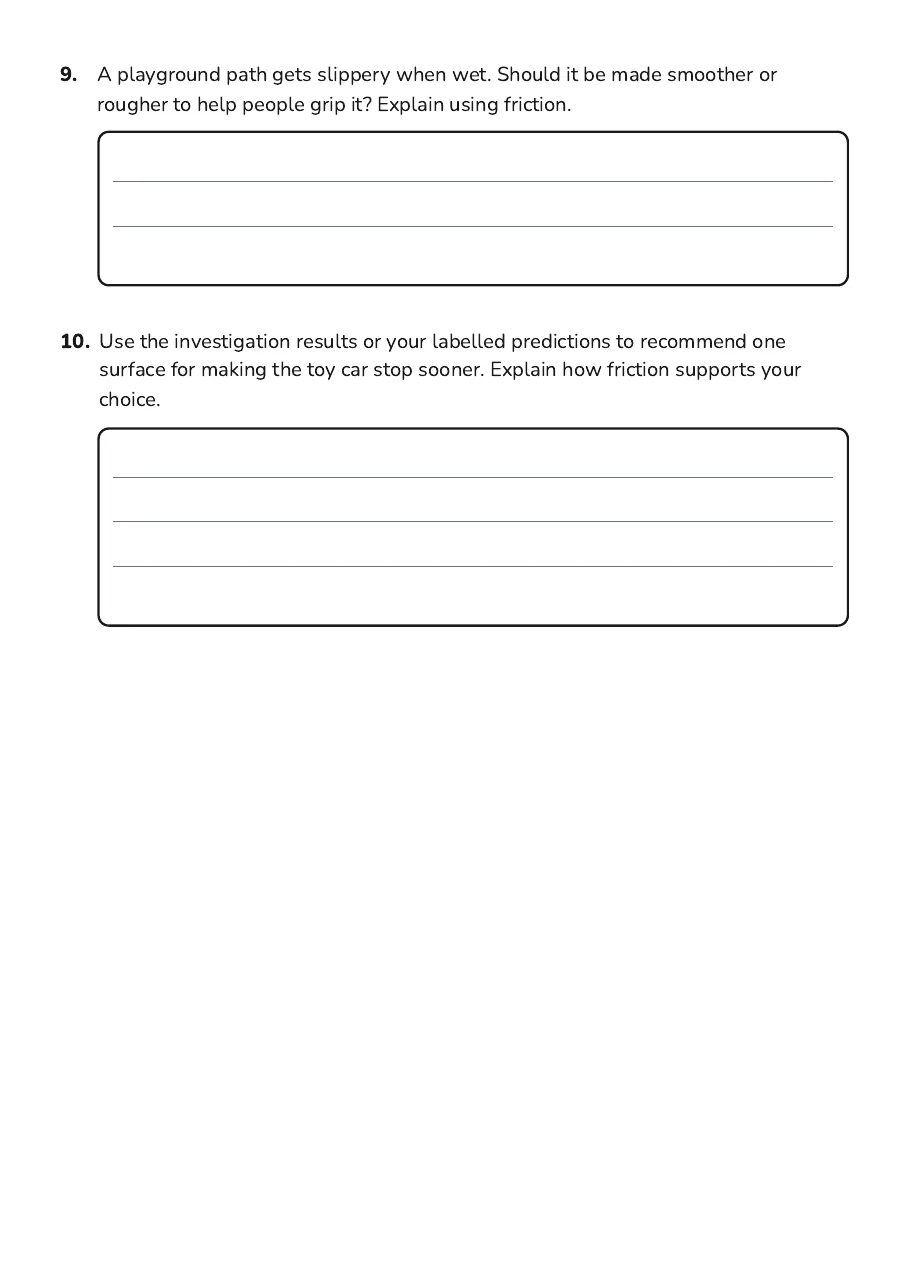
9.A playground path gets slippery when wet. Should it be made smoother or rougher to help people grip it? Explain using friction.
10.Use the investigation results or your labelled predictions to recommend one surface for making the toy car stop sooner. Explain how friction supports your choice.

4 printable pages

  • Friction Force Exploration, page 1 of 4: Meet friction

    Page 1

  • Friction Force Exploration, page 2 of 4: Plan a fair test

    Page 2

  • Friction Force Exploration, page 3 of 4: 6. Test each surface three times and write the distances in centimetres. Then

    Page 3

  • Friction Force Exploration, page 4 of 4: 9. A playground path gets slippery when wet. Should it be made smoother or

    Page 4

About This Worksheet

Free in Kuraplan

Sign up free, grab the PDF, and customize it for your class.

Print-Ready

Formatted for standard paper. Clean layout, easy to read.

AI-Generated

Created with Kuraplan's AI, designed for real classroom use.

For Teachers & Parents

Use in classrooms, for homework, tutoring, or homeschool.

Need a custom version of this worksheet?

Kuraplan's AI generates custom worksheets in seconds — differentiated for every learner, aligned to your curriculum.

Generate Custom Worksheets — Free
No credit card Curriculum-aligned Under 60 seconds