ScienceFreePrintable

Gas Exchange in Organisms

A free science worksheet ready for your classroom. Open in Kuraplan to grab the print-ready PDF, customize it for your students, or generate a fresh version in seconds.
Gas Exchange in Organisms worksheet preview
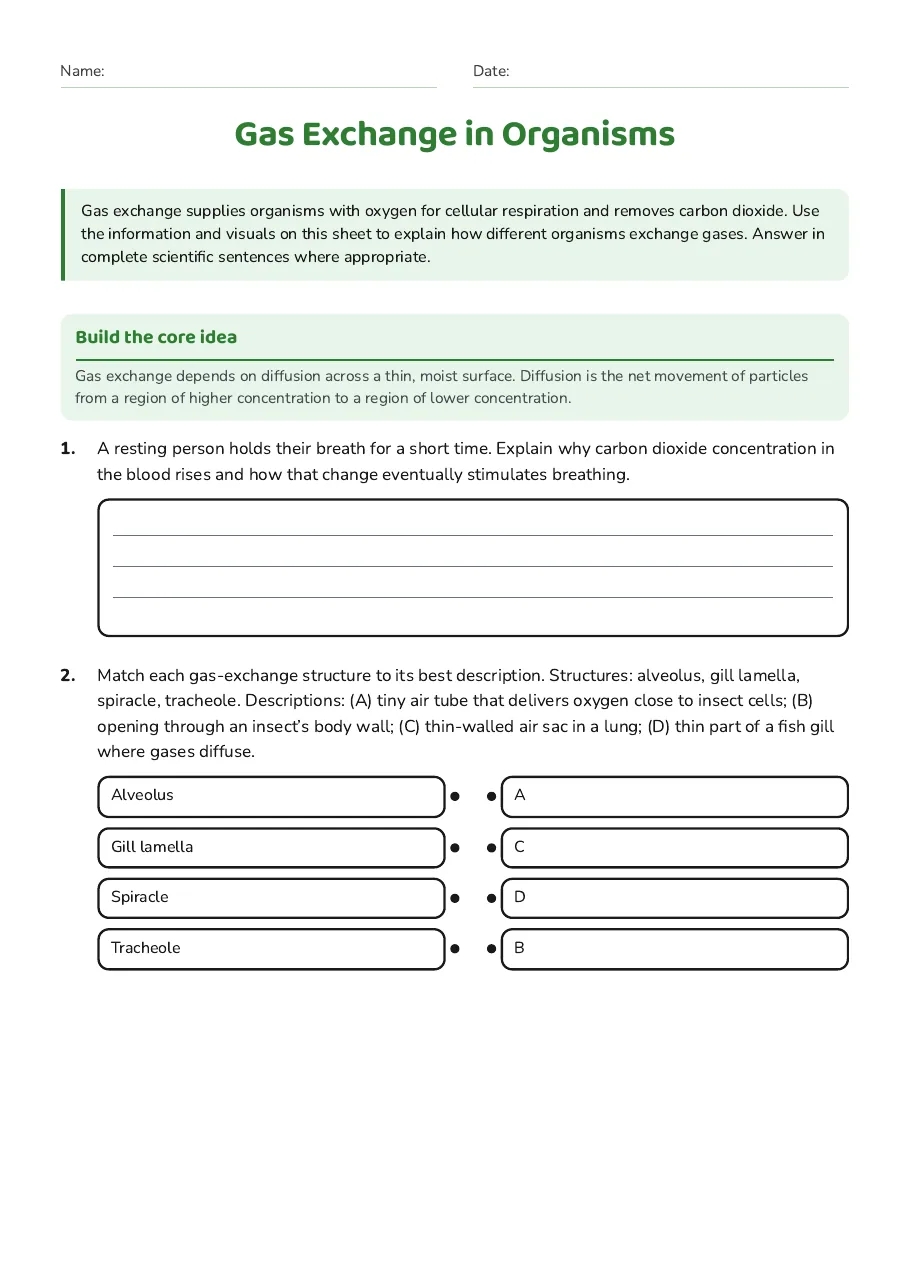
Name:Date:

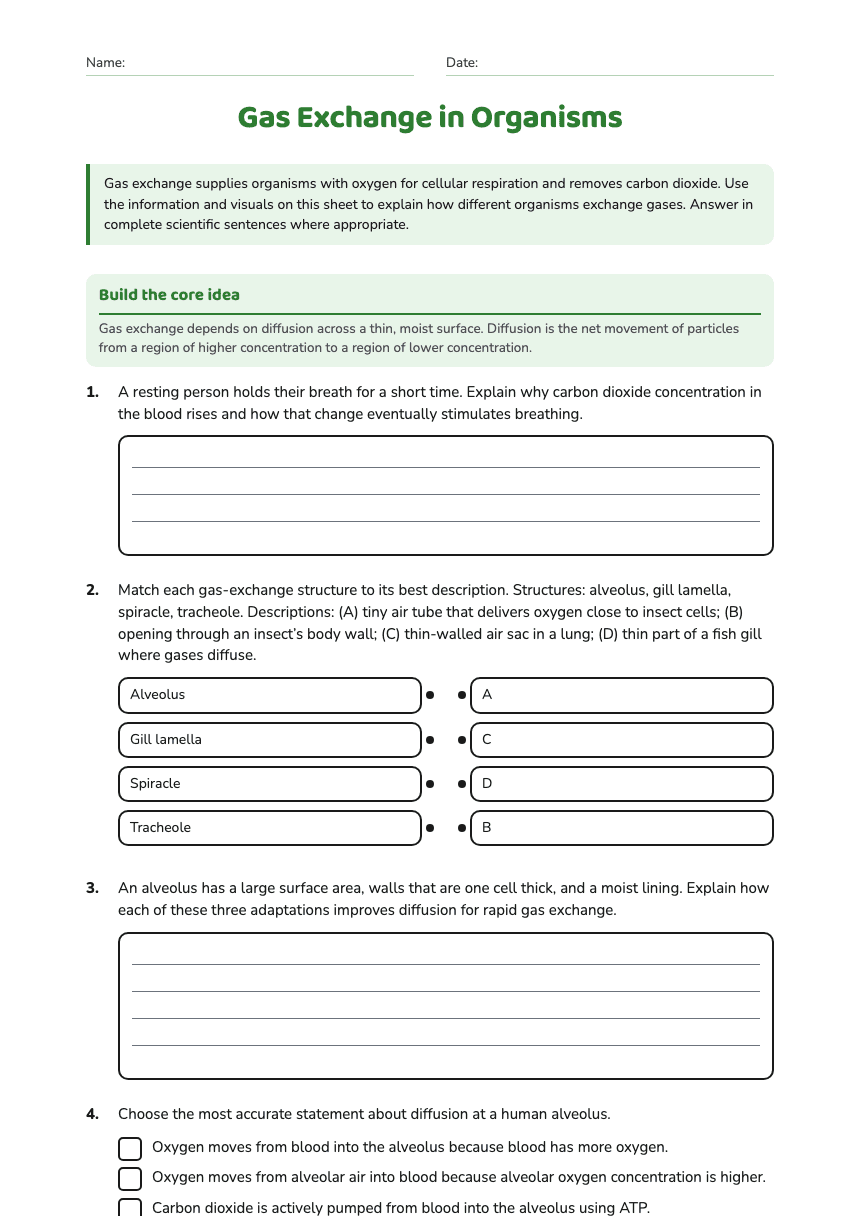
Gas Exchange in Organisms

Gas exchange supplies organisms with oxygen for cellular respiration and removes carbon dioxide. Use the information and visuals on this sheet to explain how different organisms exchange gases. Answer in complete scientific sentences where appropriate.

Build the core idea

Gas exchange depends on diffusion across a thin, moist surface. Diffusion is the net movement of particles from a region of higher concentration to a region of lower concentration.

1.A resting person holds their breath for a short time. Explain why carbon dioxide concentration in the blood rises and how that change eventually stimulates breathing.
2.Match each gas-exchange structure to its best description. Structures: alveolus, gill lamella, spiracle, tracheole. Descriptions: (A) tiny air tube that delivers oxygen close to insect cells; (B) opening through an insect’s body wall; (C) thin-walled air sac in a lung; (D) thin part of a fish gill where gases diffuse.
  • Alveolus
  • Gill lamella
  • Spiracle
  • Tracheole
  • A
  • C
  • D
  • B
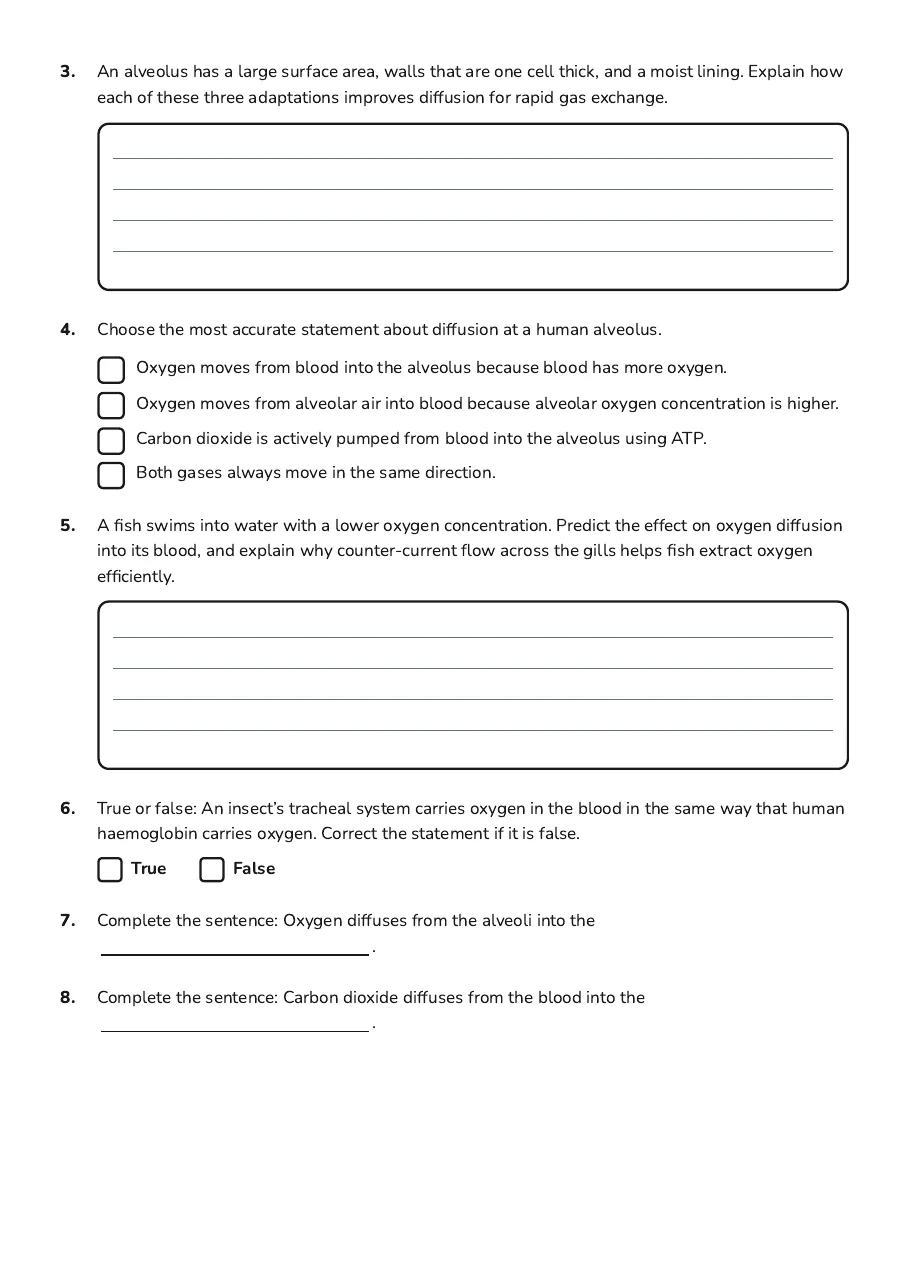
3.An alveolus has a large surface area, walls that are one cell thick, and a moist lining. Explain how each of these three adaptations improves diffusion for rapid gas exchange.
4.Choose the most accurate statement about diffusion at a human alveolus.
  • Oxygen moves from blood into the alveolus because blood has more oxygen.
  • Oxygen moves from alveolar air into blood because alveolar oxygen concentration is higher.
  • Carbon dioxide is actively pumped from blood into the alveolus using ATP.
  • Both gases always move in the same direction.
5.A fish swims into water with a lower oxygen concentration. Predict the effect on oxygen diffusion into its blood, and explain why counter-current flow across the gills helps fish extract oxygen efficiently.
6.True or false: An insect’s tracheal system carries oxygen in the blood in the same way that human haemoglobin carries oxygen. Correct the statement if it is false.
TrueFalse
7.Complete the sentence: Oxygen diffuses from the alveoli into the .
8.Complete the sentence: Carbon dioxide diffuses from the blood into the .

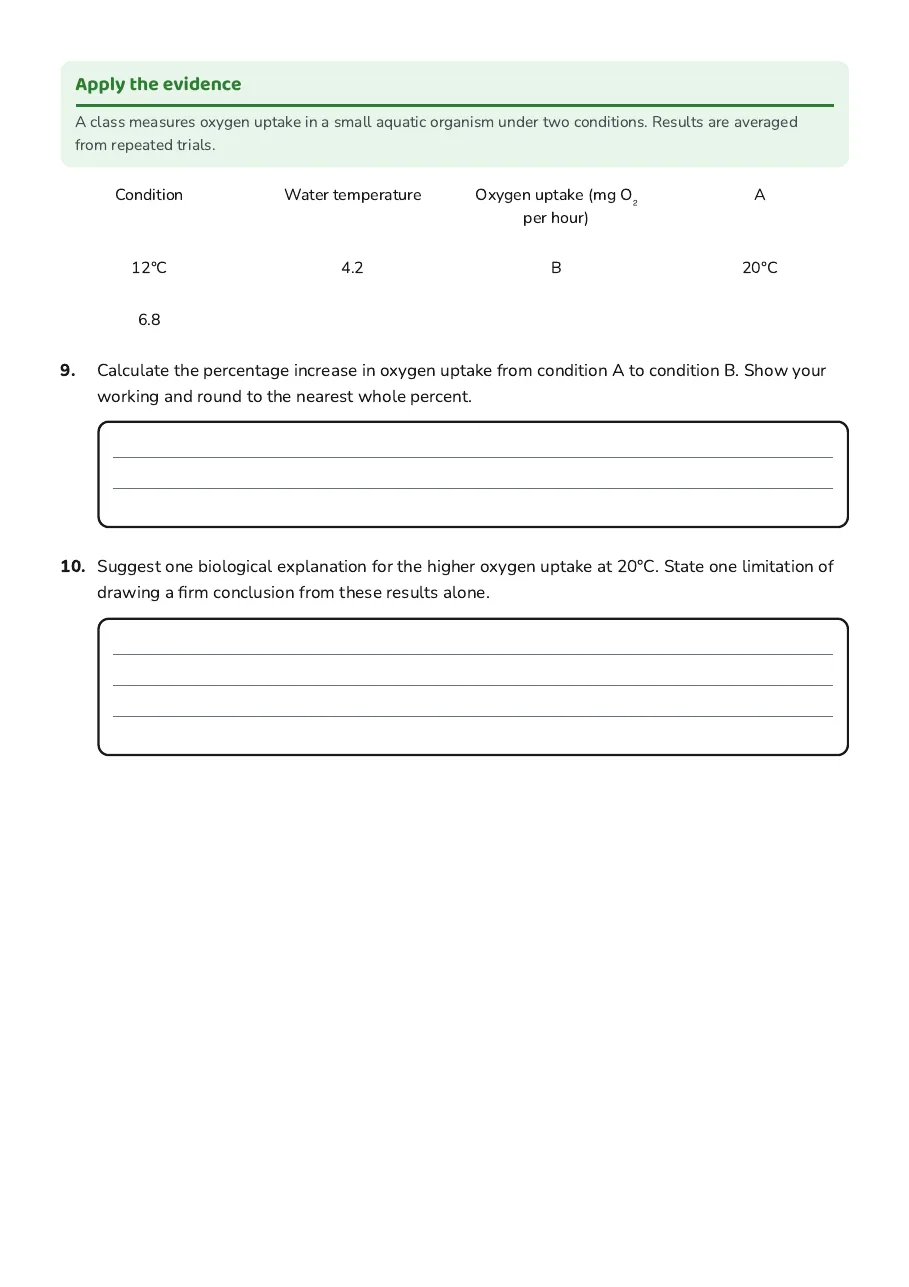
Apply the evidence

A class measures oxygen uptake in a small aquatic organism under two conditions. Results are averaged from repeated trials.

Condition

Water temperature

Oxygen uptake (mg O₂ per hour)

A

12°C

4.2

B

20°C

6.8

9.Calculate the percentage increase in oxygen uptake from condition A to condition B. Show your working and round to the nearest whole percent.
10.Suggest one biological explanation for the higher oxygen uptake at 20°C. State one limitation of drawing a firm conclusion from these results alone.

3 printable pages

  • Gas Exchange in Organisms, page 1 of 3: Build the core idea

    Page 1

  • Gas Exchange in Organisms, page 2 of 3: 3. An alveolus has a large surface area, walls that are one cell thick, and a moist…

    Page 2

  • Gas Exchange in Organisms, page 3 of 3: Apply the evidence

    Page 3

About This Worksheet

Free in Kuraplan

Sign up free, grab the PDF, and customize it for your class.

Print-Ready

Formatted for standard paper. Clean layout, easy to read.

AI-Generated

Created with Kuraplan's AI, designed for real classroom use.

For Teachers & Parents

Use in classrooms, for homework, tutoring, or homeschool.

Need a custom version of this worksheet?

Kuraplan's AI generates custom worksheets in seconds — differentiated for every learner, aligned to your curriculum.

Generate Custom Worksheets — Free
No credit card Curriculum-aligned Under 60 seconds