ScienceFreePrintable

Gravitational Potential Energy Investigation

A free science worksheet ready for your classroom. Open in Kuraplan to grab the print-ready PDF, customize it for your students, or generate a fresh version in seconds.
Gravitational Potential Energy Investigation worksheet preview
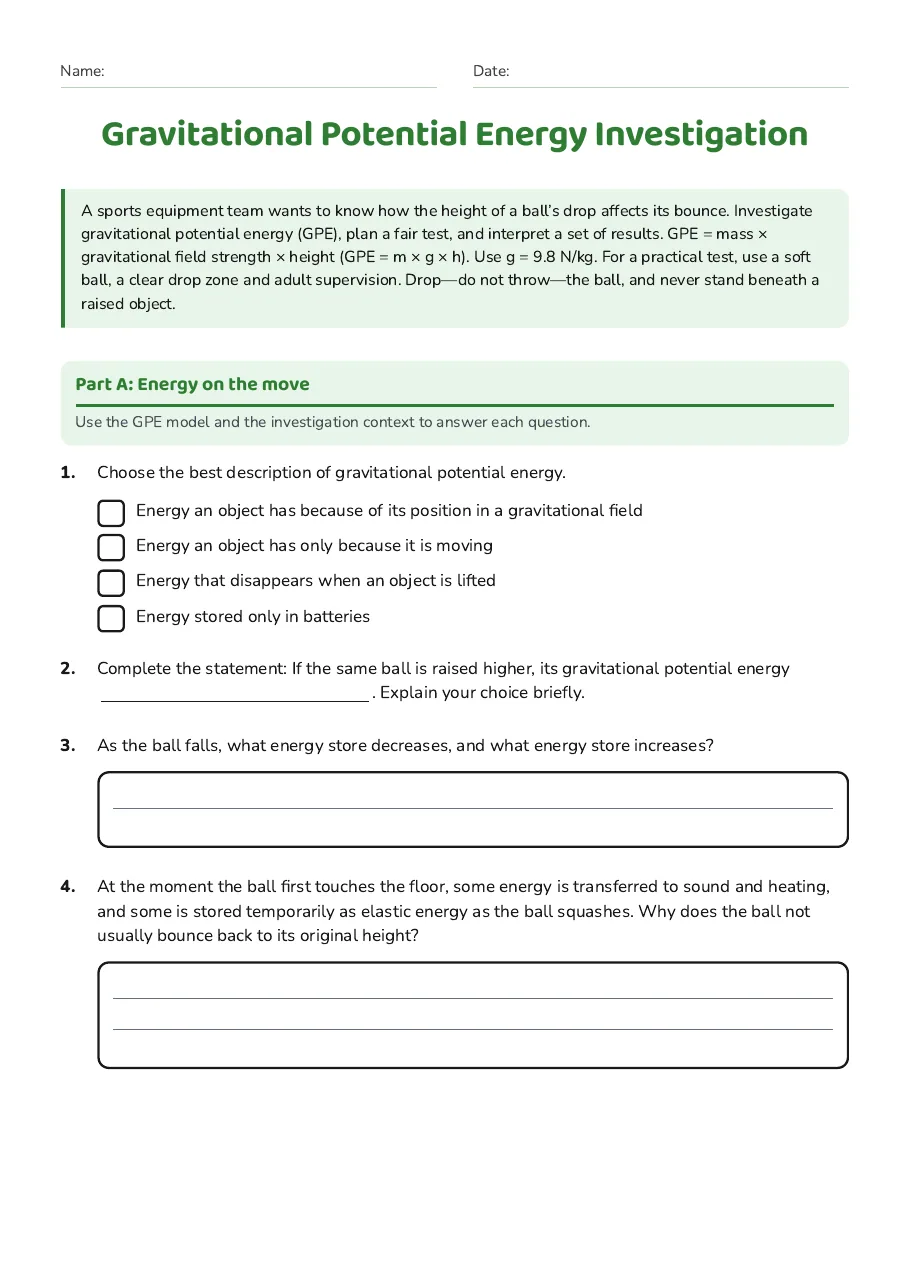
Name:Date:

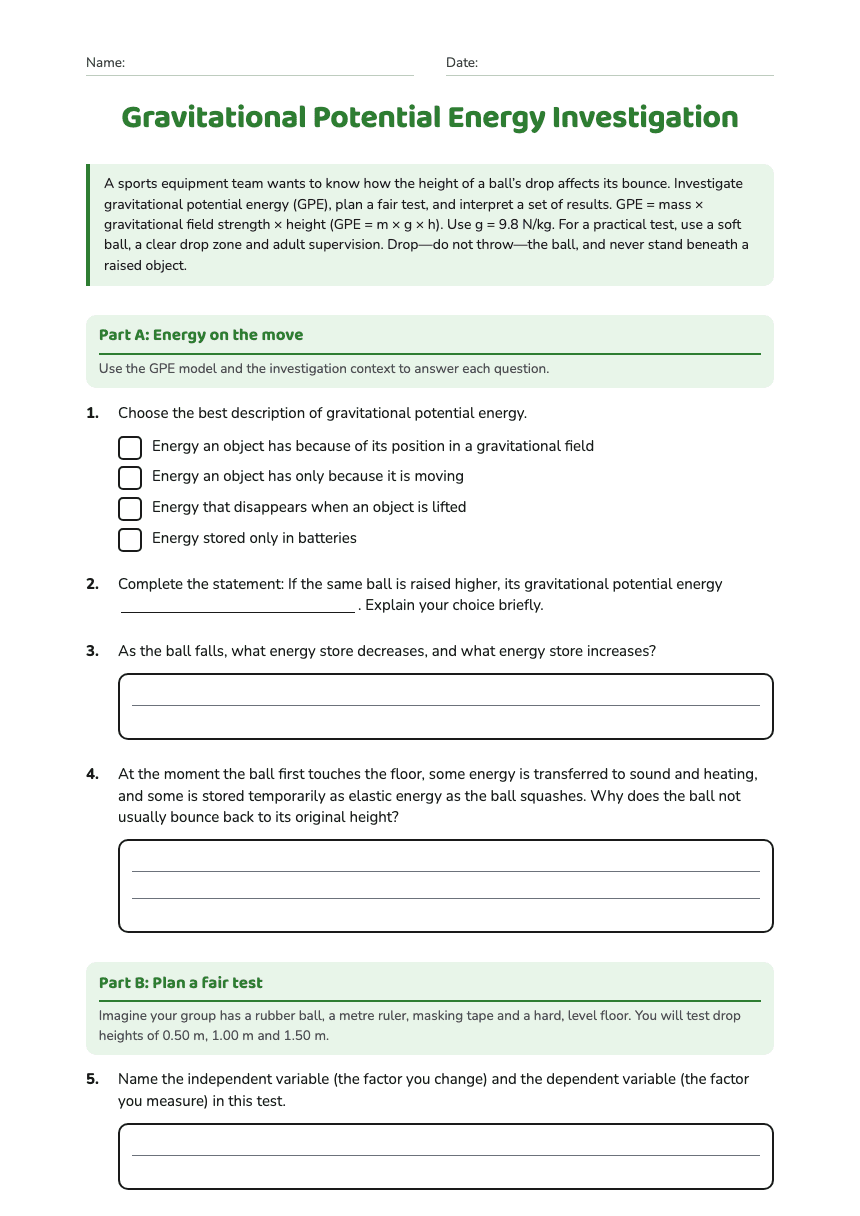
Gravitational Potential Energy Investigation

A sports equipment team wants to know how the height of a ball’s drop affects its bounce. Investigate gravitational potential energy (GPE), plan a fair test, and interpret a set of results. GPE = mass × gravitational field strength × height (GPE = m × g × h). Use g = 9.8 N/kg. For a practical test, use a soft ball, a clear drop zone and adult supervision. Drop—do not throw—the ball, and never stand beneath a raised object.

Part A: Energy on the move

Use the GPE model and the investigation context to answer each question.

1.Choose the best description of gravitational potential energy.
  • Energy an object has because of its position in a gravitational field
  • Energy an object has only because it is moving
  • Energy that disappears when an object is lifted
  • Energy stored only in batteries
2.Complete the statement: If the same ball is raised higher, its gravitational potential energy . Explain your choice briefly.
3.As the ball falls, what energy store decreases, and what energy store increases?
4.At the moment the ball first touches the floor, some energy is transferred to sound and heating, and some is stored temporarily as elastic energy as the ball squashes. Why does the ball not usually bounce back to its original height?

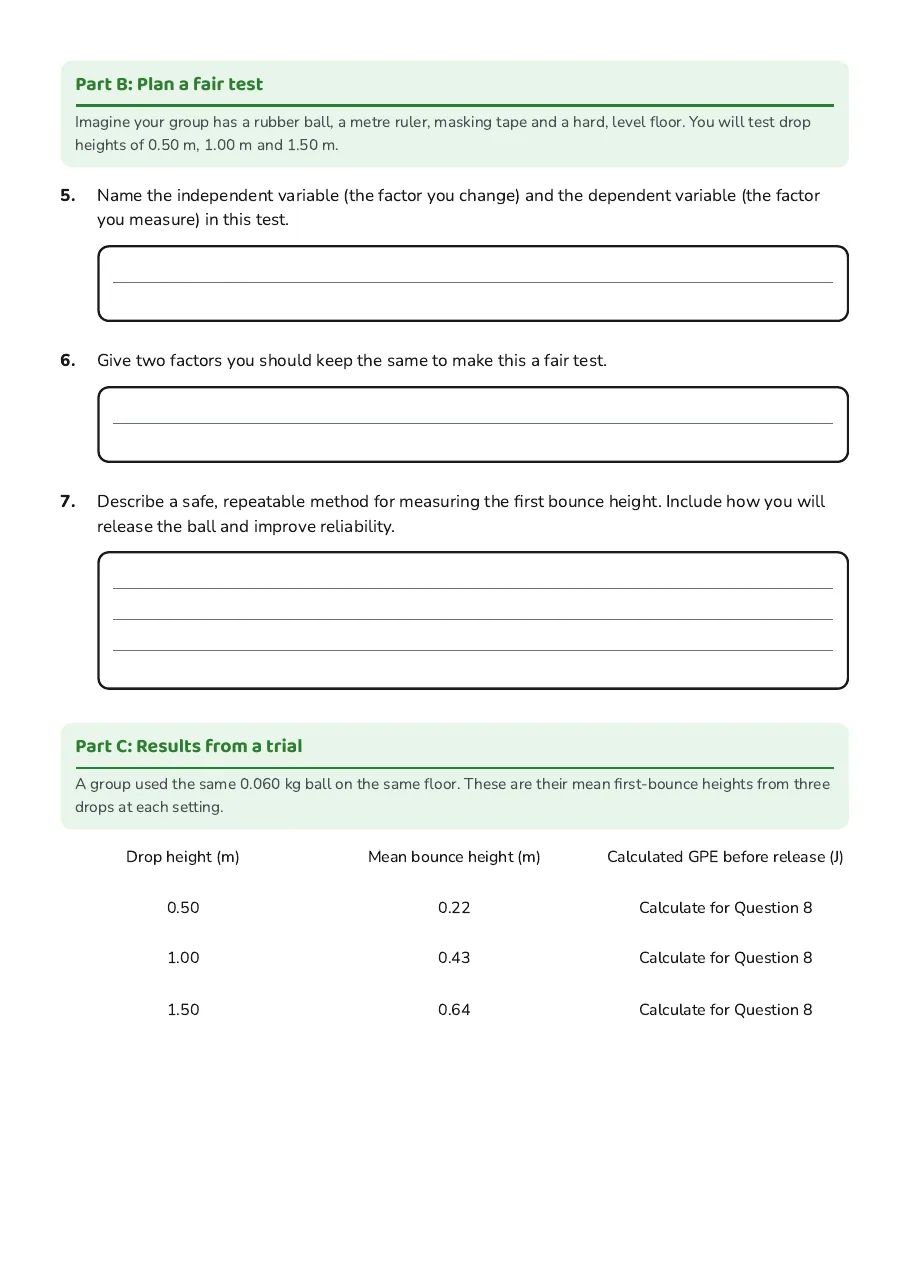
Part B: Plan a fair test

Imagine your group has a rubber ball, a metre ruler, masking tape and a hard, level floor. You will test drop heights of 0.50 m, 1.00 m and 1.50 m.

5.Name the independent variable (the factor you change) and the dependent variable (the factor you measure) in this test.
6.Give two factors you should keep the same to make this a fair test.
7.Describe a safe, repeatable method for measuring the first bounce height. Include how you will release the ball and improve reliability.

Part C: Results from a trial

A group used the same 0.060 kg ball on the same floor. These are their mean first-bounce heights from three drops at each setting.

Drop height (m)

Mean bounce height (m)

Calculated GPE before release (J)

0.50

0.22

Calculate for Question 8

1.00

0.43

Calculate for Question 8

1.50

0.64

Calculate for Question 8

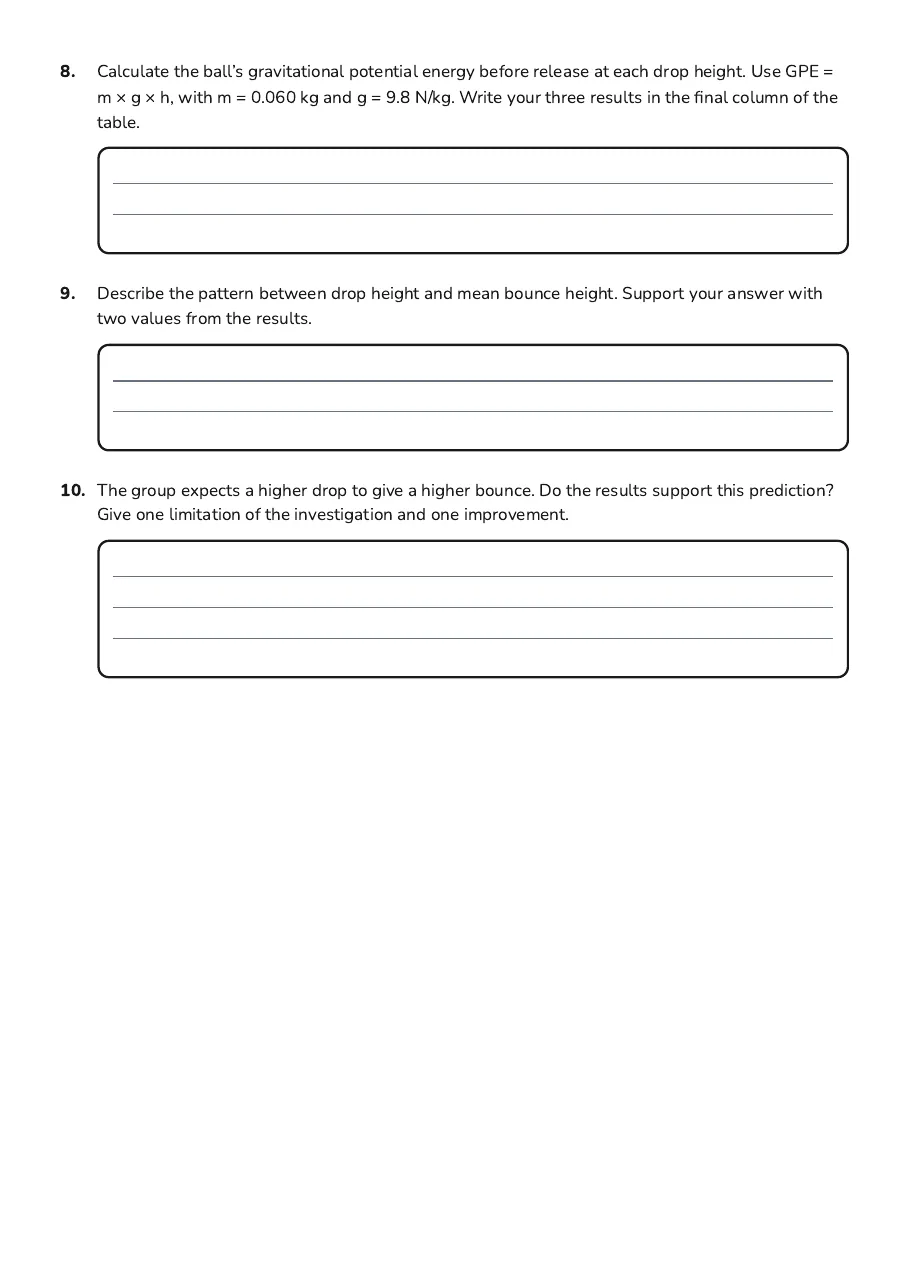
8.Calculate the ball’s gravitational potential energy before release at each drop height. Use GPE = m × g × h, with m = 0.060 kg and g = 9.8 N/kg. Write your three results in the final column of the table.
9.Describe the pattern between drop height and mean bounce height. Support your answer with two values from the results.
10.The group expects a higher drop to give a higher bounce. Do the results support this prediction? Give one limitation of the investigation and one improvement.

3 printable pages

  • Gravitational Potential Energy Investigation, page 1 of 3: Part A: Energy on the move

    Page 1

  • Gravitational Potential Energy Investigation, page 2 of 3: Part B: Plan a fair test, Part C: Results from a trial

    Page 2

  • Gravitational Potential Energy Investigation, page 3 of 3: 8. Calculate the ball’s gravitational potential energy before release at each drop…

    Page 3

About This Worksheet

Free in Kuraplan

Sign up free, grab the PDF, and customize it for your class.

Print-Ready

Formatted for standard paper. Clean layout, easy to read.

AI-Generated

Created with Kuraplan's AI, designed for real classroom use.

For Teachers & Parents

Use in classrooms, for homework, tutoring, or homeschool.

Need a custom version of this worksheet?

Kuraplan's AI generates custom worksheets in seconds — differentiated for every learner, aligned to your curriculum.

Generate Custom Worksheets — Free
No credit card Curriculum-aligned Under 60 seconds