ScienceFreePrintable

Iodine Number Calculations

A free science worksheet ready for your classroom. Open in Kuraplan to grab the print-ready PDF, customize it for your students, or generate a fresh version in seconds.
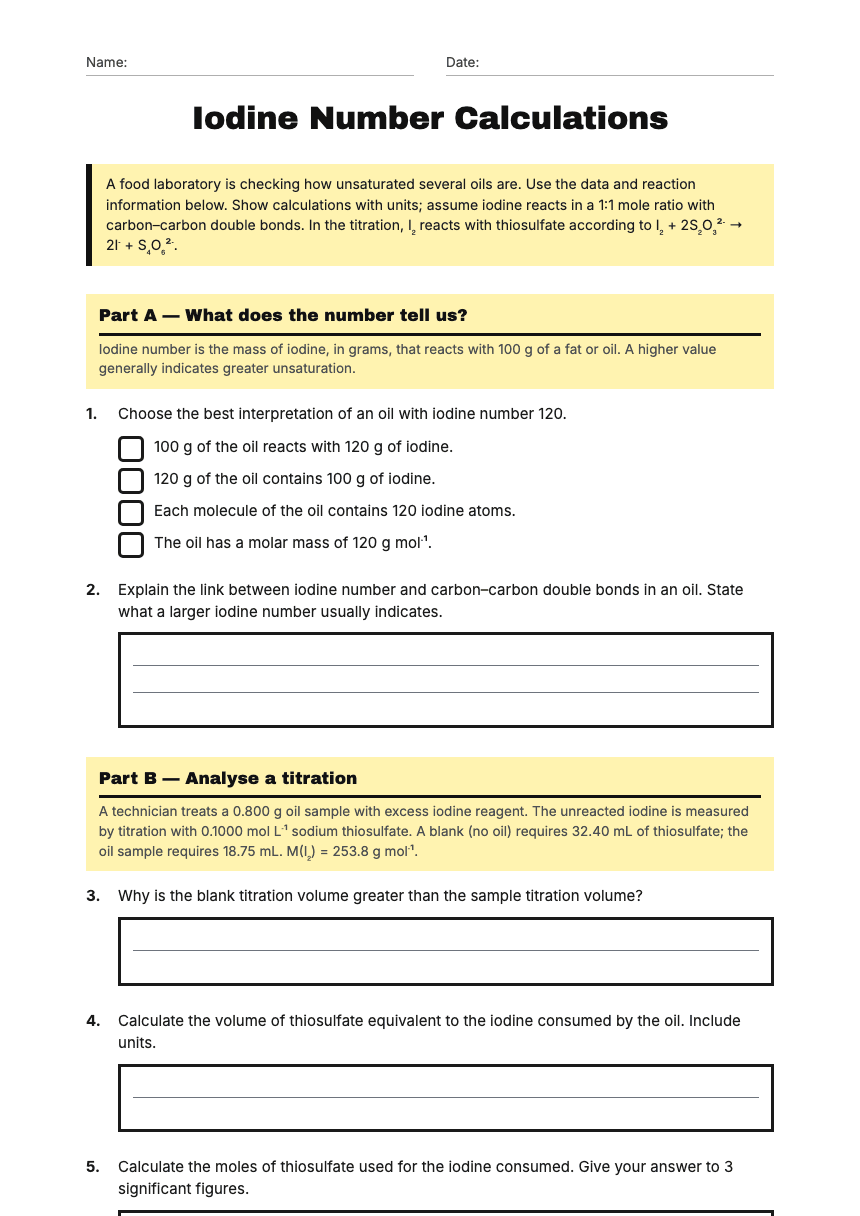
Iodine Number Calculations worksheet preview
Name:Date:

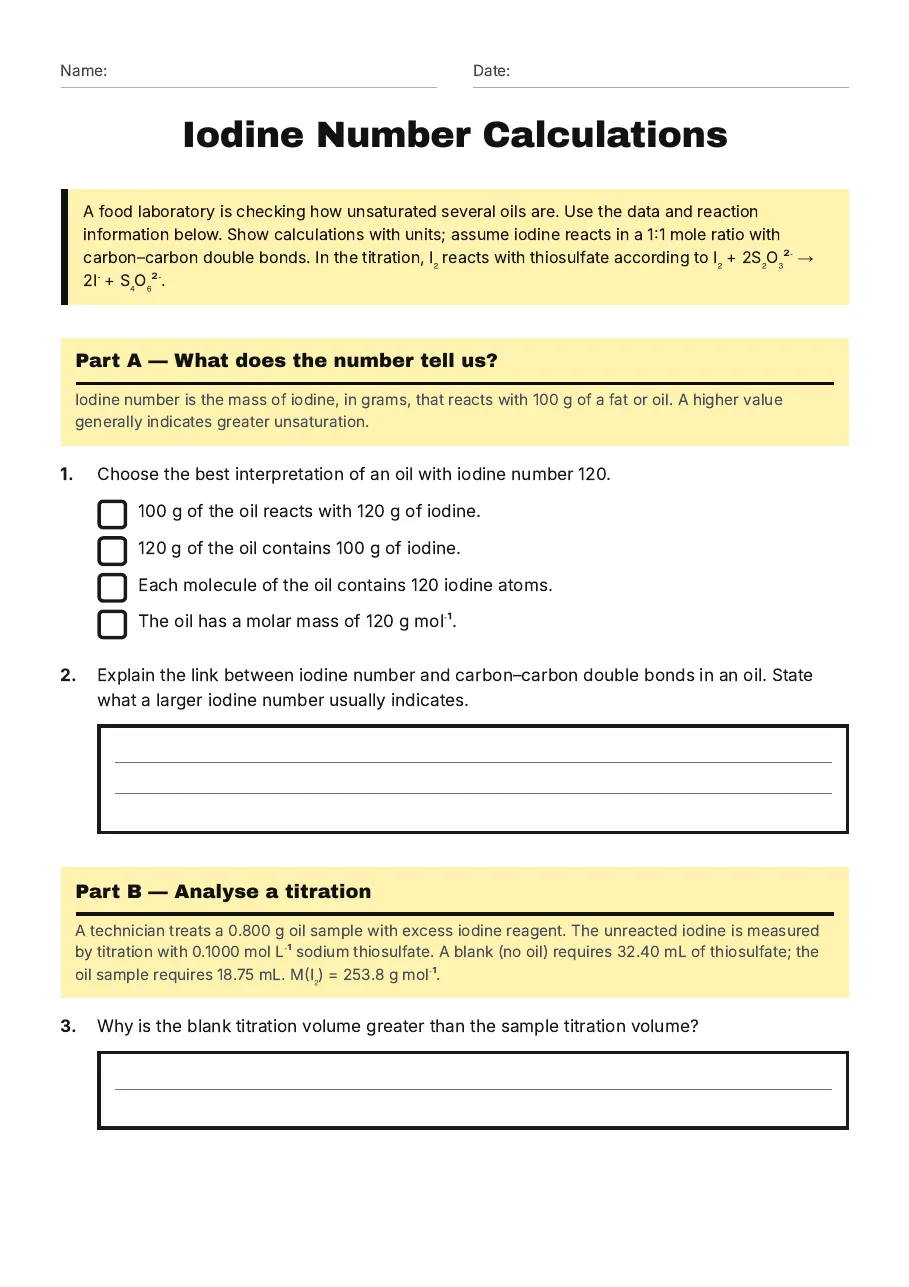
Iodine Number Calculations

A food laboratory is checking how unsaturated several oils are. Use the data and reaction information below. Show calculations with units; assume iodine reacts in a 1:1 mole ratio with carbon–carbon double bonds. In the titration, I₂ reacts with thiosulfate according to I₂ + 2S₂O₃²⁻ → 2I⁻ + S₄O₆²⁻.

Part A — What does the number tell us?

Iodine number is the mass of iodine, in grams, that reacts with 100 g of a fat or oil. A higher value generally indicates greater unsaturation.

1.Choose the best interpretation of an oil with iodine number 120.
  • 100 g of the oil reacts with 120 g of iodine.
  • 120 g of the oil contains 100 g of iodine.
  • Each molecule of the oil contains 120 iodine atoms.
  • The oil has a molar mass of 120 g mol⁻¹.
2.Explain the link between iodine number and carbon–carbon double bonds in an oil. State what a larger iodine number usually indicates.

Part B — Analyse a titration

A technician treats a 0.800 g oil sample with excess iodine reagent. The unreacted iodine is measured by titration with 0.1000 mol L⁻¹ sodium thiosulfate. A blank (no oil) requires 32.40 mL of thiosulfate; the oil sample requires 18.75 mL. M(I₂) = 253.8 g mol⁻¹.

3.Why is the blank titration volume greater than the sample titration volume?
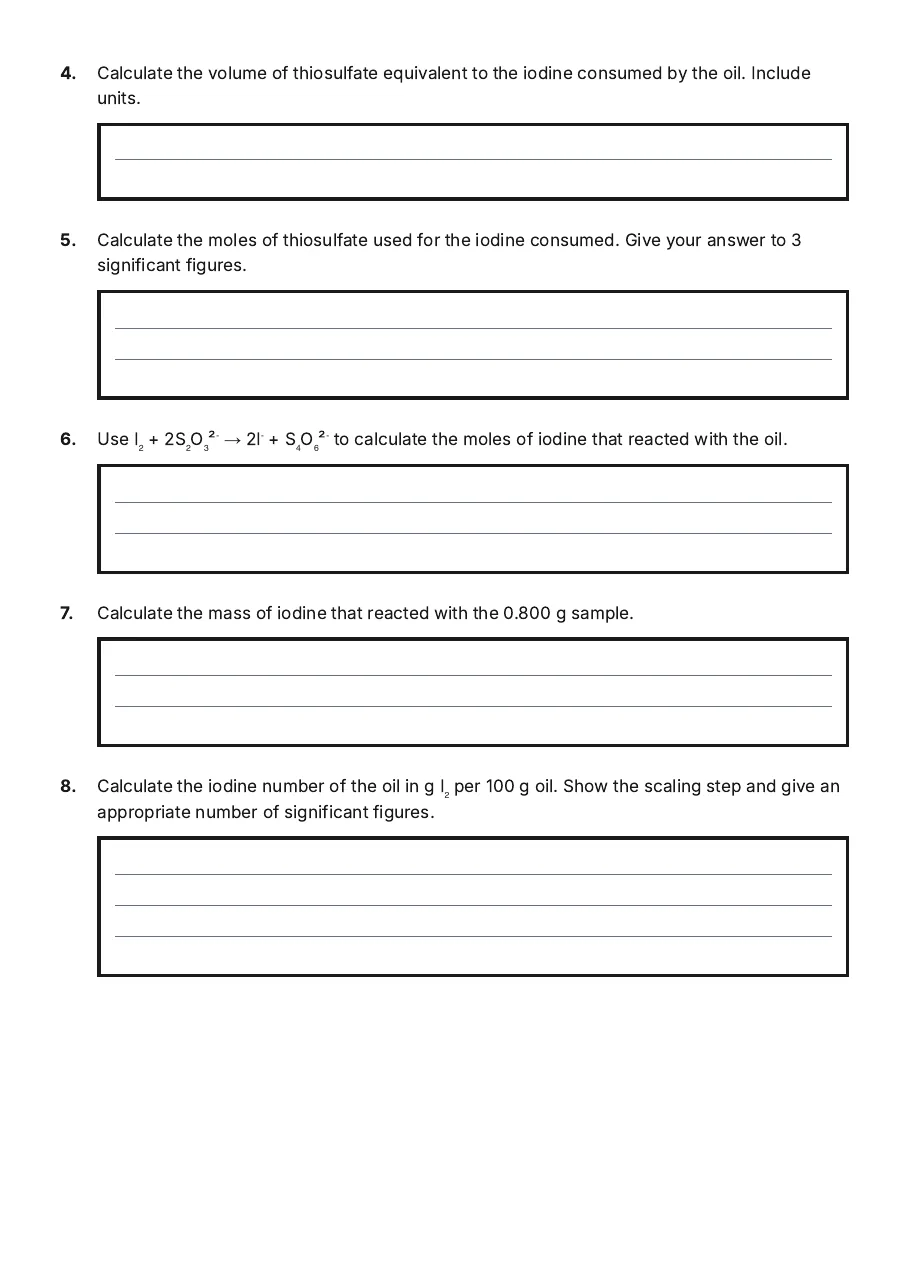
4.Calculate the volume of thiosulfate equivalent to the iodine consumed by the oil. Include units.
5.Calculate the moles of thiosulfate used for the iodine consumed. Give your answer to 3 significant figures.
6.Use I₂ + 2S₂O₃²⁻ → 2I⁻ + S₄O₆²⁻ to calculate the moles of iodine that reacted with the oil.
7.Calculate the mass of iodine that reacted with the 0.800 g sample.
8.Calculate the iodine number of the oil in g I₂ per 100 g oil. Show the scaling step and give an appropriate number of significant figures.

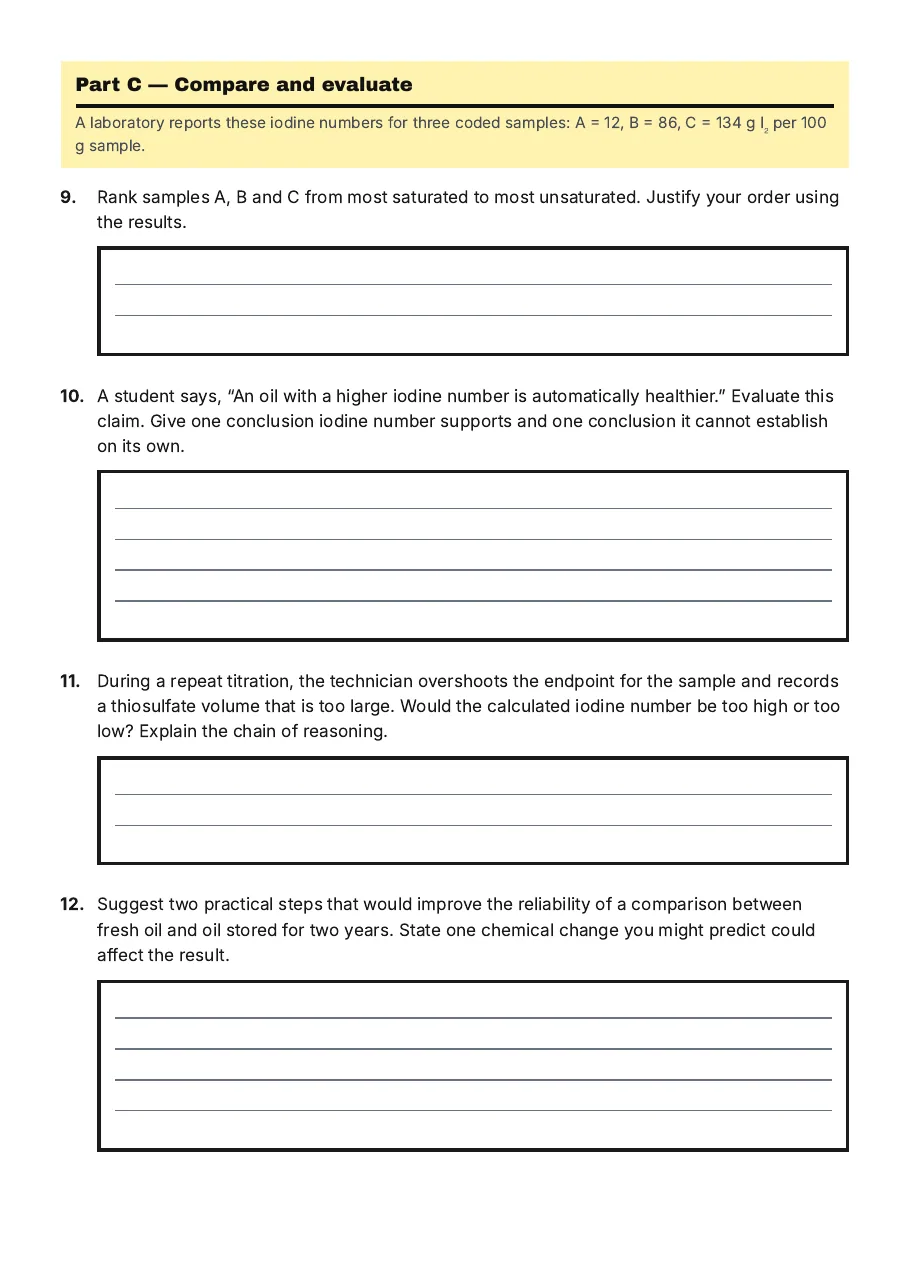
Part C — Compare and evaluate

A laboratory reports these iodine numbers for three coded samples: A = 12, B = 86, C = 134 g I₂ per 100 g sample.

9.Rank samples A, B and C from most saturated to most unsaturated. Justify your order using the results.
10.A student says, “An oil with a higher iodine number is automatically healthier.” Evaluate this claim. Give one conclusion iodine number supports and one conclusion it cannot establish on its own.
11.During a repeat titration, the technician overshoots the endpoint for the sample and records a thiosulfate volume that is too large. Would the calculated iodine number be too high or too low? Explain the chain of reasoning.
12.Suggest two practical steps that would improve the reliability of a comparison between fresh oil and oil stored for two years. State one chemical change you might predict could affect the result.

3 printable pages

  • Iodine Number Calculations, page 1 of 3: Part A — What does the number tell us?, Part B — Analyse a titration

    Page 1

  • Iodine Number Calculations, page 2 of 3: 4. Calculate the volume of thiosulfate equivalent to the iodine consumed by the oil.…

    Page 2

  • Iodine Number Calculations, page 3 of 3: Part C — Compare and evaluate

    Page 3

About This Worksheet

Free in Kuraplan

Sign up free, grab the PDF, and customize it for your class.

Print-Ready

Formatted for standard paper. Clean layout, easy to read.

AI-Generated

Created with Kuraplan's AI, designed for real classroom use.

For Teachers & Parents

Use in classrooms, for homework, tutoring, or homeschool.

Need a custom version of this worksheet?

Kuraplan's AI generates custom worksheets in seconds — differentiated for every learner, aligned to your curriculum.

Generate Custom Worksheets — Free
No credit card Curriculum-aligned Under 60 seconds