Justice Approaches: Compare & Contrast
A free social sciences worksheet ready for your classroom. Open in Kuraplan to grab the print-ready PDF, customize it for your students, or generate a fresh version in seconds.
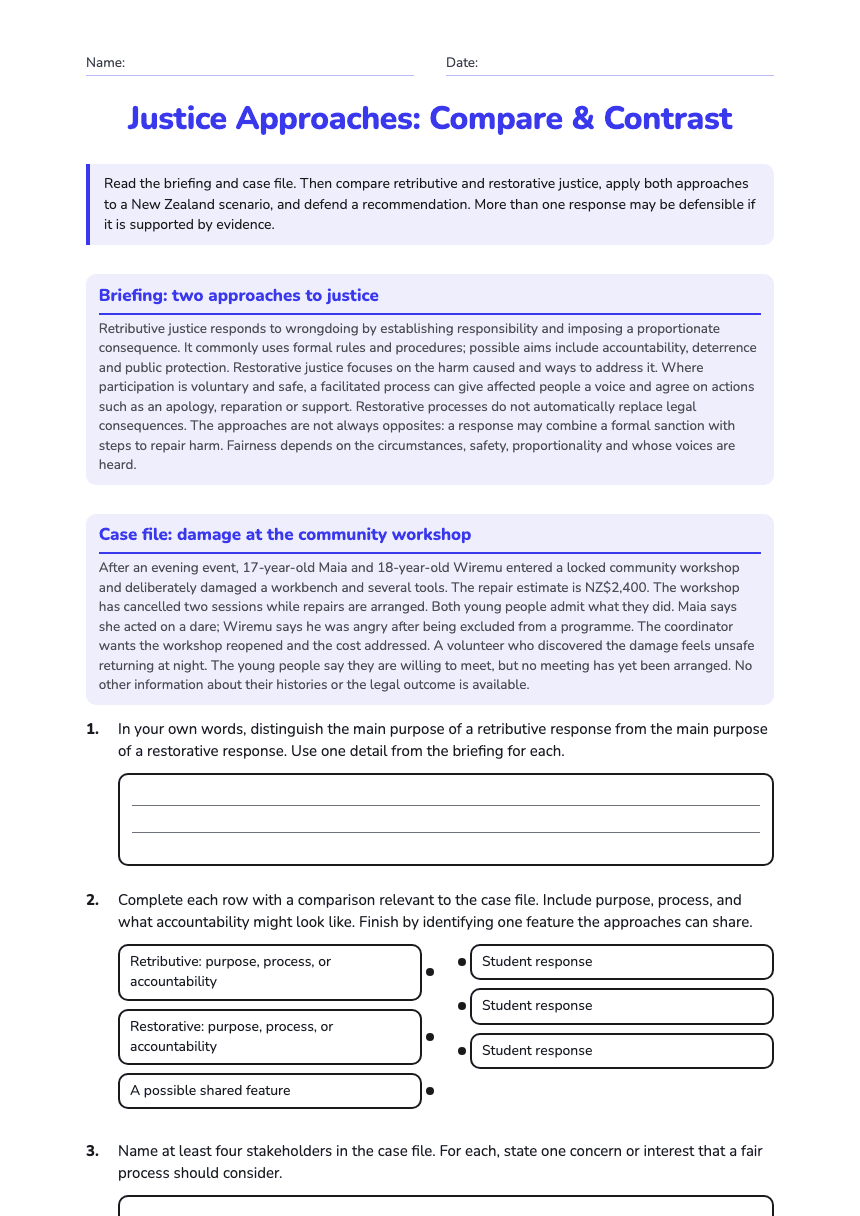
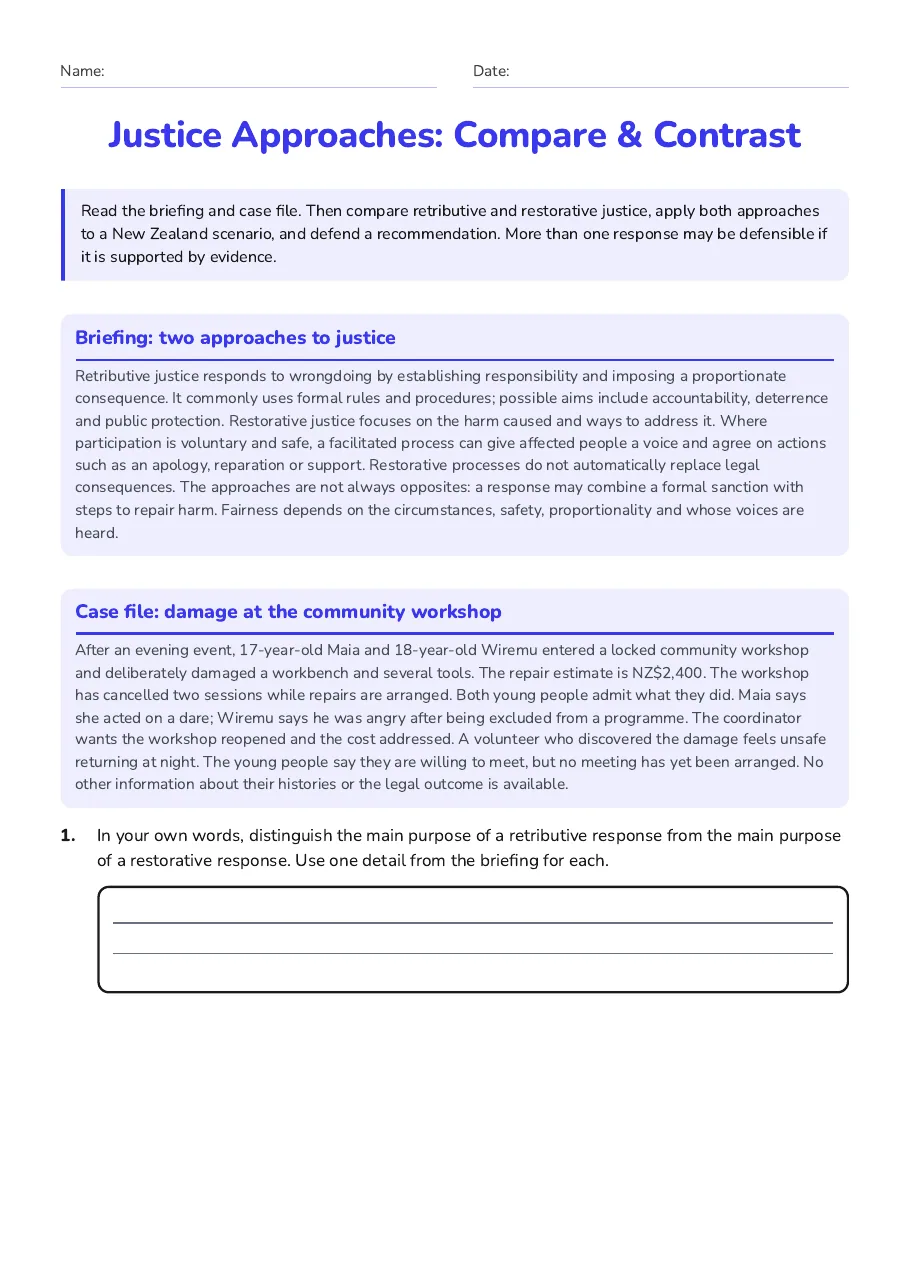
Justice Approaches: Compare & Contrast
Briefing: two approaches to justice
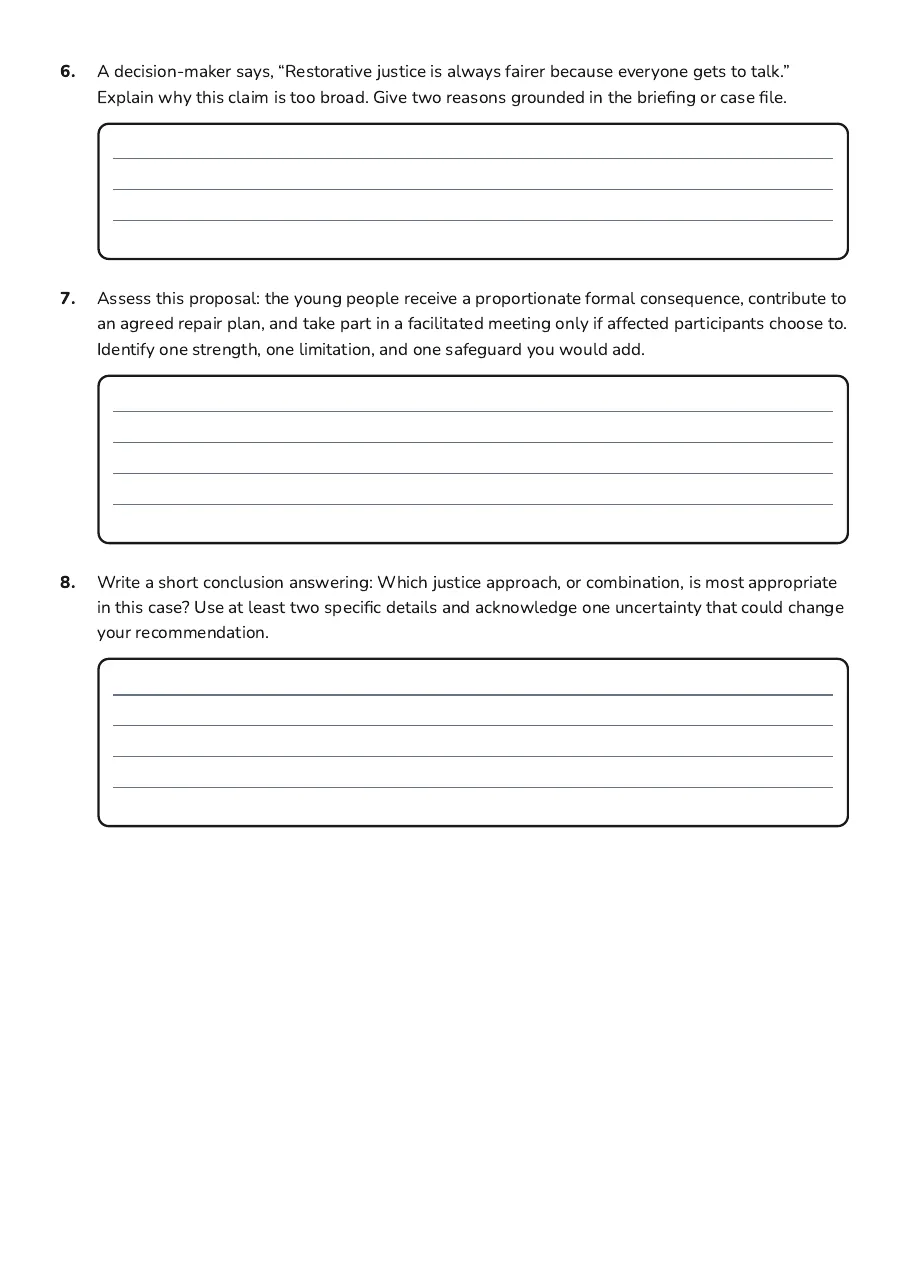
Retributive justice responds to wrongdoing by establishing responsibility and imposing a proportionate consequence. It commonly uses formal rules and procedures; possible aims include accountability, deterrence and public protection. Restorative justice focuses on the harm caused and ways to address it. Where participation is voluntary and safe, a facilitated process can give affected people a voice and agree on actions such as an apology, reparation or support. Restorative processes do not automatically replace legal consequences. The approaches are not always opposites: a response may combine a formal sanction with steps to repair harm. Fairness depends on the circumstances, safety, proportionality and whose voices are heard.
Case file: damage at the community workshop
After an evening event, 17-year-old Maia and 18-year-old Wiremu entered a locked community workshop and deliberately damaged a workbench and several tools. The repair estimate is NZ$2,400. The workshop has cancelled two sessions while repairs are arranged. Both young people admit what they did. Maia says she acted on a dare; Wiremu says he was angry after being excluded from a programme. The coordinator wants the workshop reopened and the cost addressed. A volunteer who discovered the damage feels unsafe returning at night. The young people say they are willing to meet, but no meeting has yet been arranged. No other information about their histories or the legal outcome is available.
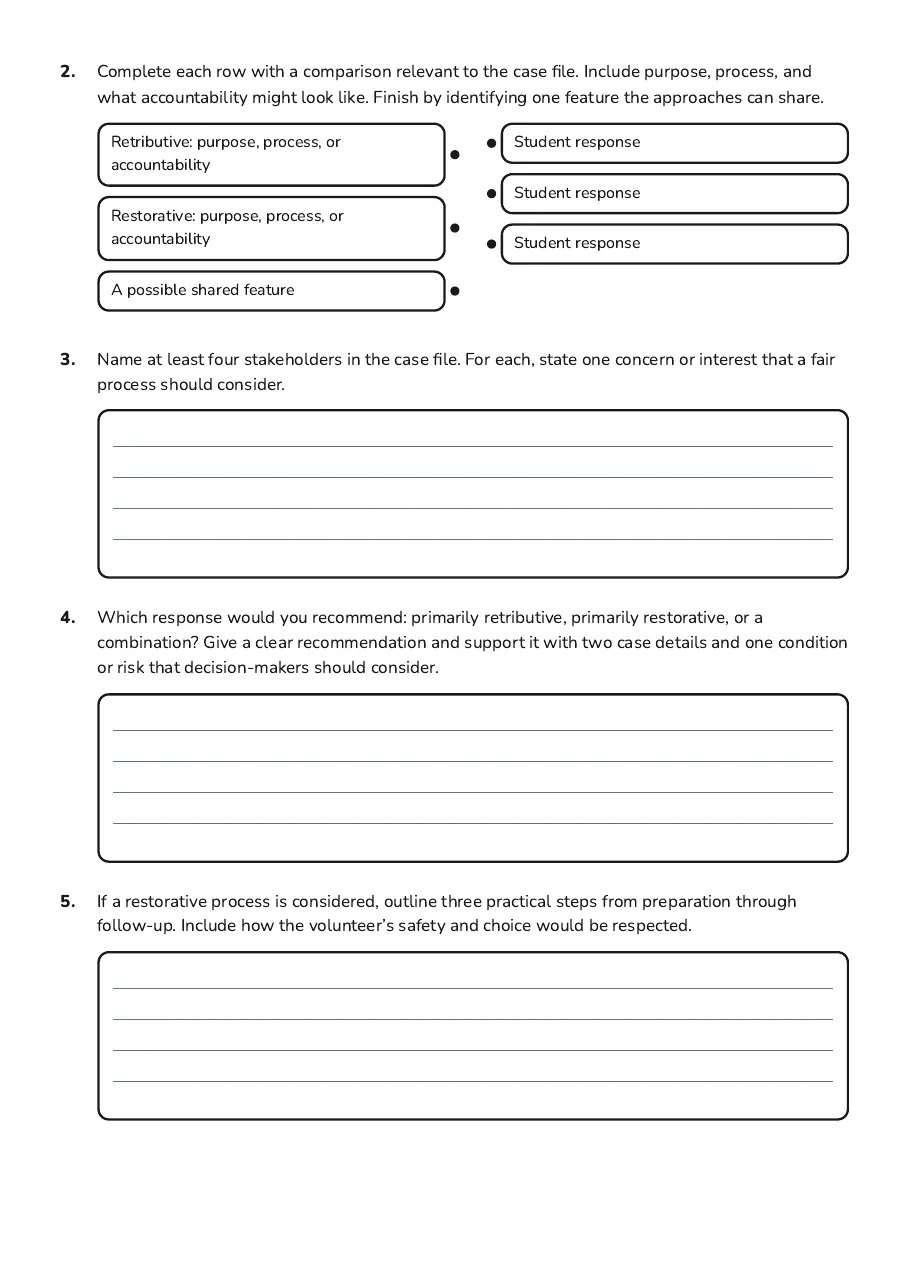
- Retributive: purpose, process, or accountability
- Restorative: purpose, process, or accountability
- A possible shared feature
- Student response
- Student response
- Student response
3 printable pages
Page 1
Page 2
Page 3
About This Worksheet
Free in Kuraplan
Sign up free, grab the PDF, and customize it for your class.
Print-Ready
Formatted for standard paper. Clean layout, easy to read.
AI-Generated
Created with Kuraplan's AI, designed for real classroom use.
For Teachers & Parents
Use in classrooms, for homework, tutoring, or homeschool.
Need a custom version of this worksheet?
Kuraplan's AI generates custom worksheets in seconds — differentiated for every learner, aligned to your curriculum.
Generate Custom Worksheets — Free