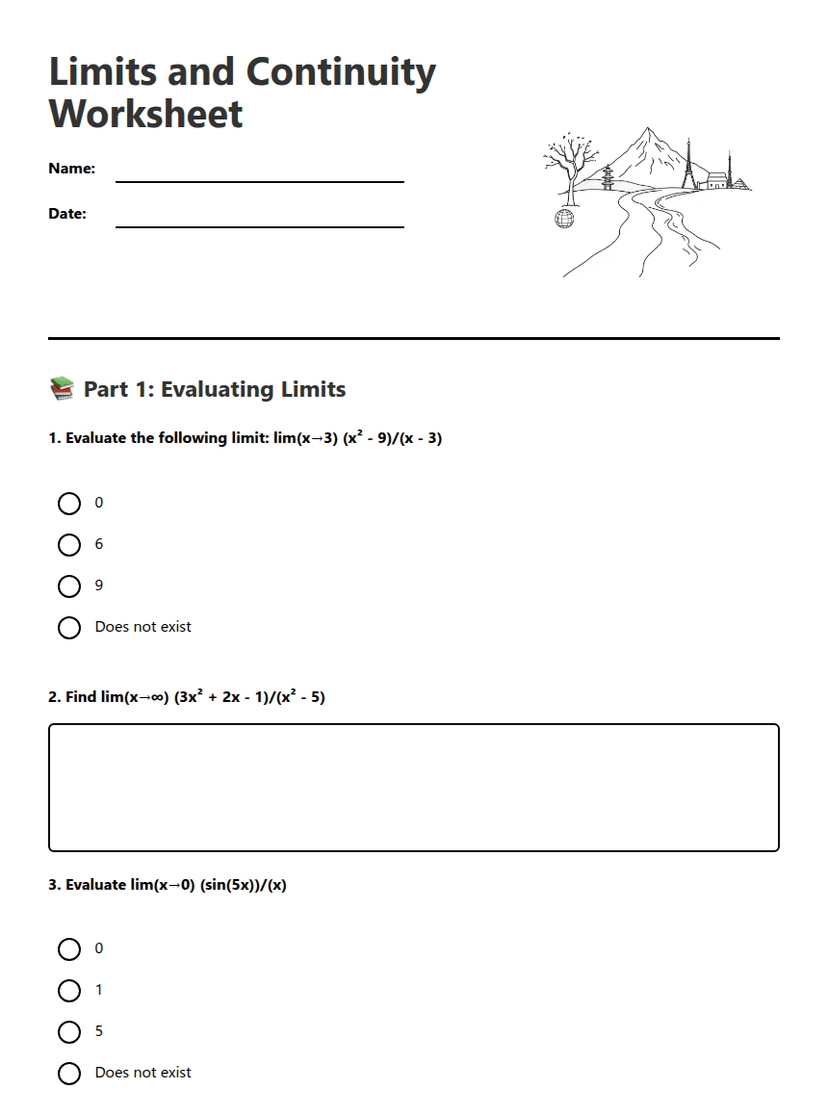
Limits and Continuity Guide
A free mathematics worksheet ready for your classroom. Open in Kuraplan to grab the print-ready PDF, customize it for your students, or generate a fresh version in seconds.
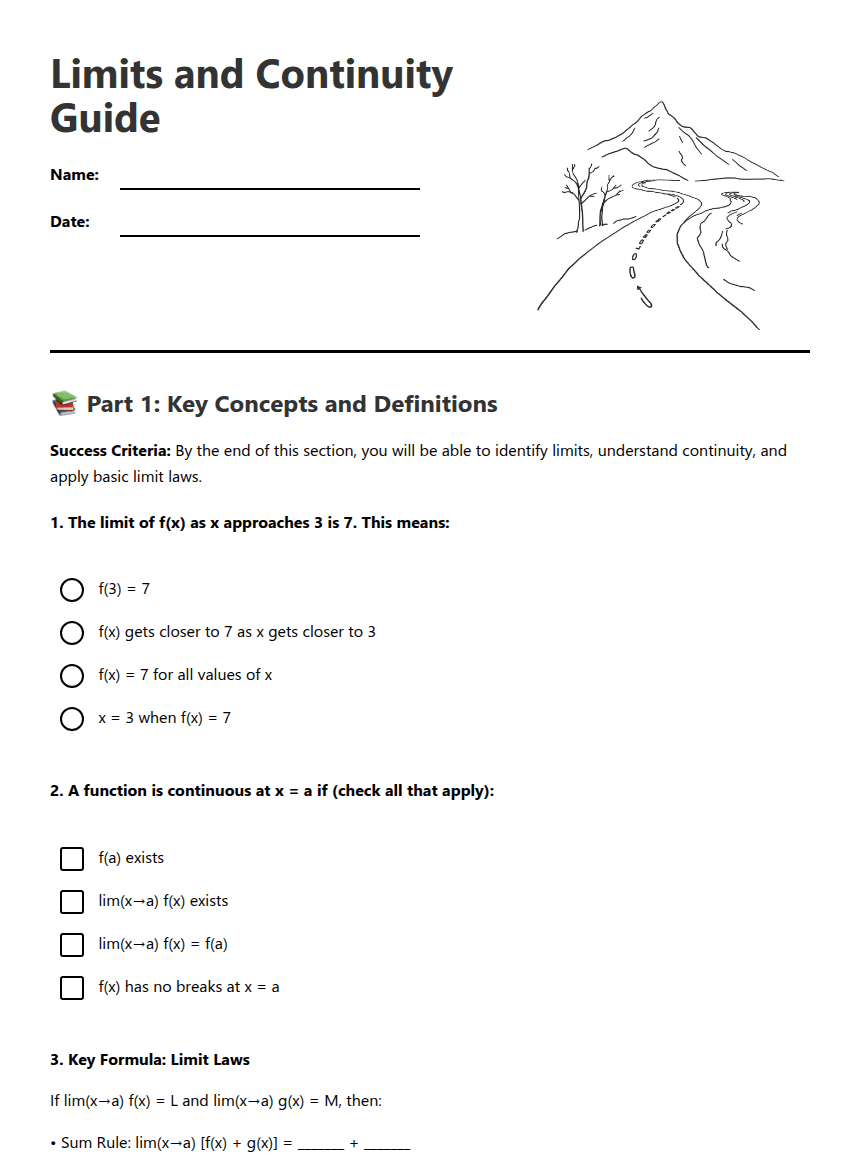
Limits and Continuity Practice Paper 1

📚 Part 1: Key Concepts and Definitions
Success Criteria: By the end of this section, you will be able to identify limits, understand continuity, and apply basic limit laws.
If lim(x→a) f(x) = L and lim(x→a) g(x) = M, then:
• Sum Rule: lim(x→a) [f(x) + g(x)] = _______ + _______
• Product Rule: lim(x→a) [f(x) × g(x)] = _______ × _______
• Quotient Rule: lim(x→a) [f(x) ÷ g(x)] = _______ ÷ _______ (if M ≠ 0)
✏️ Part 2: Problem Solving
Success Criteria: You will calculate limits algebraically and graphically, identify points of discontinuity.
Hint for differentiation: Factor the numerator first. Advanced learners: Try L'Hôpital's rule as an alternative method.
a) lim(x→2⁻) f(x) = _______
b) lim(x→2⁺) f(x) = _______
c) f(2) = _______
d) Is f(x) continuous at x = 2? Explain:
Extension Activity: Advanced learners should also sketch the continuous function that "removes" this discontinuity.
🎯 Part 3: Application and Reflection
Success Criteria: You will apply limit concepts to real-world problems and reflect on your understanding.
v(2) = lim(h→0) [h(2+h) - h(2)]/h
Differentiation Support: Start by substituting the values, then expand and simplify step by step.
Confidence level: 1 __ 2 __ 3 __ 4 __ 5
Dyslexia-Friendly Note: This worksheet uses clear fonts, consistent spacing, and bullet points for easier reading. Key terms are in bold for emphasis.
Extension Challenge: Research epsilon-delta definition of limits and write a brief explanation of how it provides a rigorous foundation for calculus.
About This Worksheet
Free in Kuraplan
Sign up free, grab the PDF, and customize it for your class.
Print-Ready
Formatted for standard paper. Clean layout, easy to read.
AI-Generated
Created with Kuraplan's AI, designed for real classroom use.
For Teachers & Parents
Use in classrooms, for homework, tutoring, or homeschool.
Need a custom version of this worksheet?
Kuraplan's AI generates custom worksheets in seconds — differentiated for every learner, aligned to your curriculum.
Generate Custom Worksheets — Free