Living vs Non-Living Characteristics
A free science worksheet ready for your classroom. Open in Kuraplan to grab the print-ready PDF, customize it for your students, or generate a fresh version in seconds.
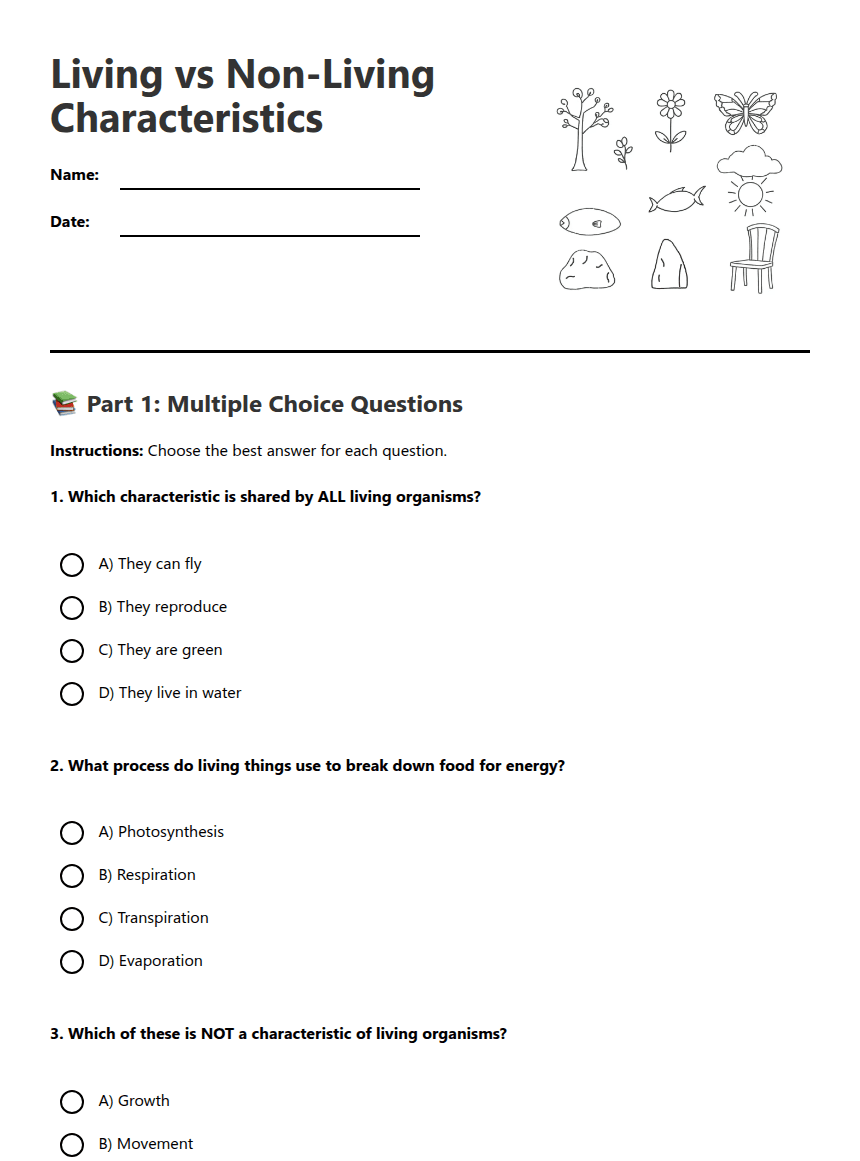
Living vs Non-Living CharacteristicsWorksheet|Grade9|B-1

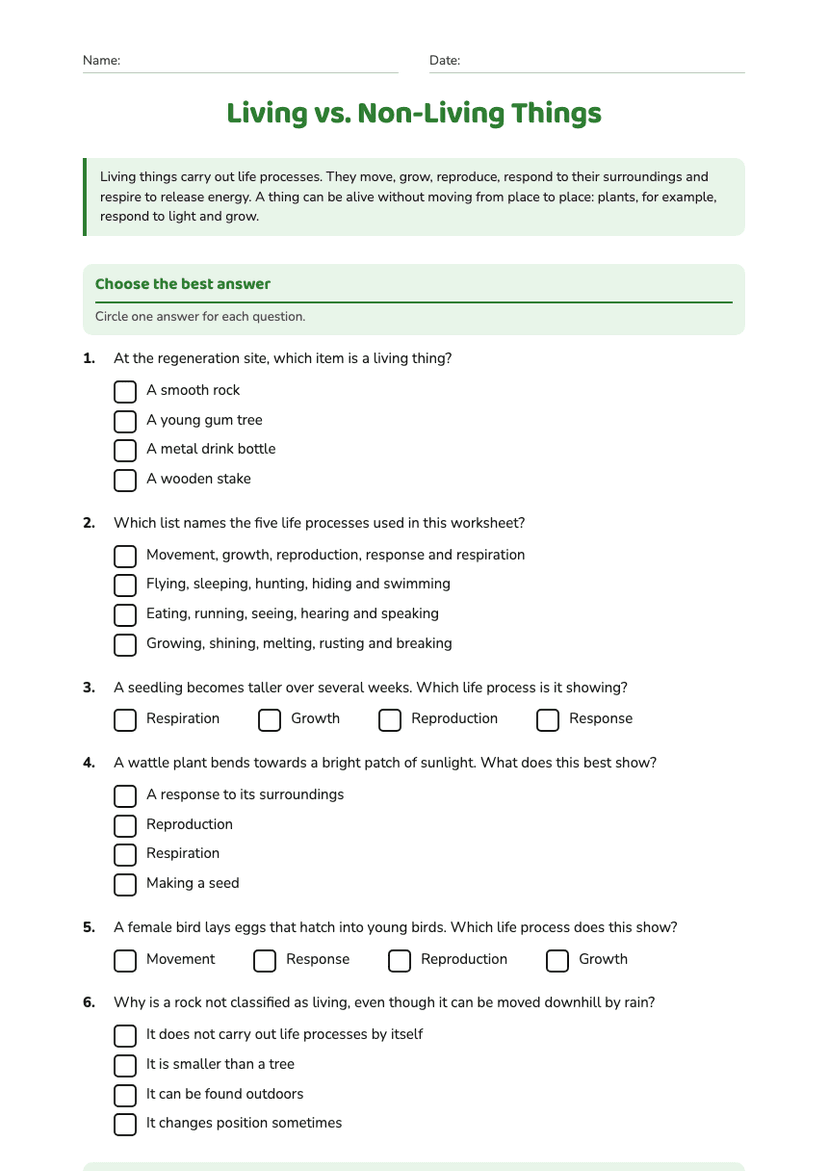
📚 Part 1: Multiple Choice Questions
Instructions: Choose the best answer for each question.
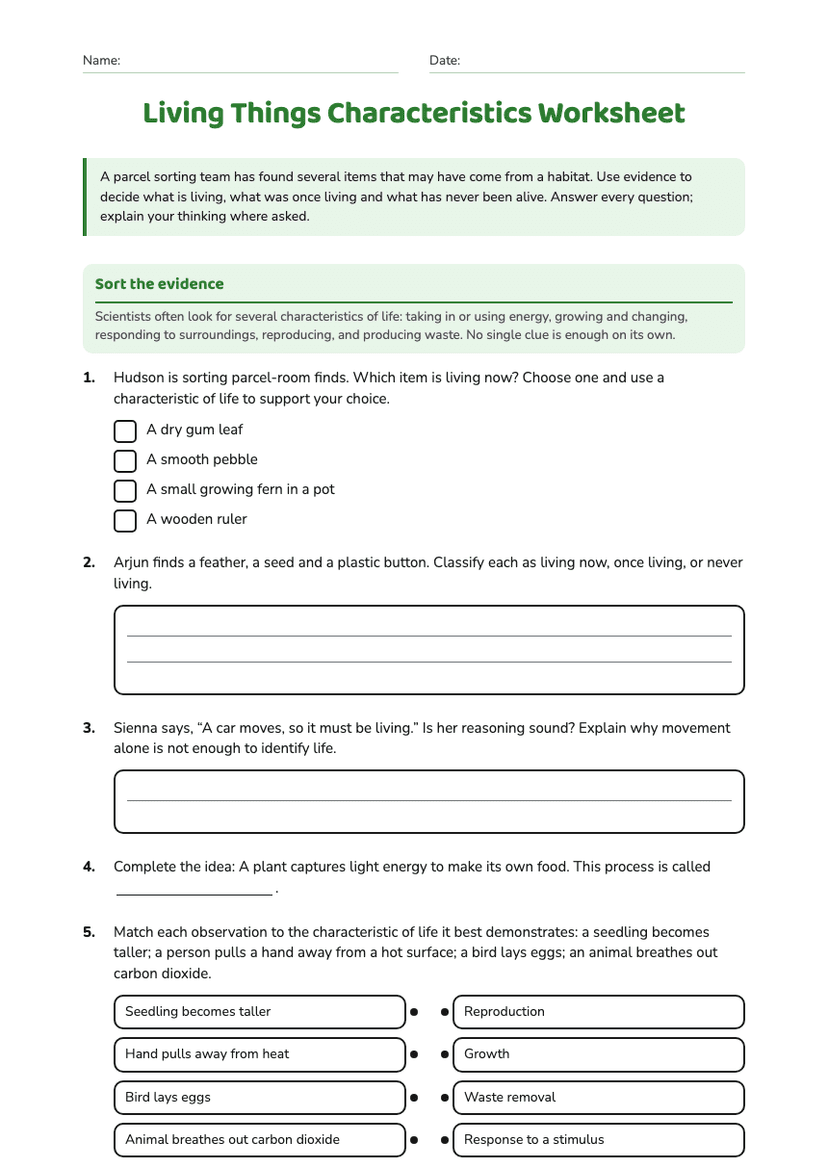
✏️ Part 2: Classification and Analysis
Instructions: Classify each item and explain your reasoning.
a) Mushroom: _____ b) Car: _____ c) Bacteria: _____ d) Crystal: _____
M: _________________ R: _________________ S: _________________
G: _________________ R: _________________ E: _________________
N: _________________
1. _________________________________________________
2. _________________________________________________
3. _________________________________________________
🔬 Answer Key
Part 1 - Multiple Choice:
1. B) They reproduce
2. B) Respiration
3. C) Made of plastic
4. A) Homeostasis
5. C) They do not grow or develop
6. Made of cells, Require nutrition, Excrete waste products, Show irritability
Part 2 - Sample Answers:
7. a) L b) NL c) L d) NL
8. Non-living - viruses lack cellular structure and cannot carry out life processes independently
9. Movement, Respiration, Sensitivity, Growth, Reproduction, Excretion, Nutrition
10. Fire lacks cellular structure, doesn't maintain homeostasis, and doesn't truly reproduce
11. Plants: photosynthesis (make own food); Animals: consume other organisms
12. Examples: sweating/shivering, breathing rate changes, blood sugar regulation
Success Criteria: Students can identify and explain the seven characteristics of life, distinguish between living and non-living things, and apply knowledge to classify organisms.
About This Worksheet
Free in Kuraplan
Sign up free, grab the PDF, and customize it for your class.
Print-Ready
Formatted for standard paper. Clean layout, easy to read.
AI-Generated
Created with Kuraplan's AI, designed for real classroom use.
For Teachers & Parents
Use in classrooms, for homework, tutoring, or homeschool.
Need a custom version of this worksheet?
Kuraplan's AI generates custom worksheets in seconds — differentiated for every learner, aligned to your curriculum.
Generate Custom Worksheets — Free