Māori Storytelling and Treaty
A free english worksheet ready for your classroom. Open in Kuraplan to grab the print-ready PDF, customize it for your students, or generate a fresh version in seconds.
Māori Storytelling and Treaty
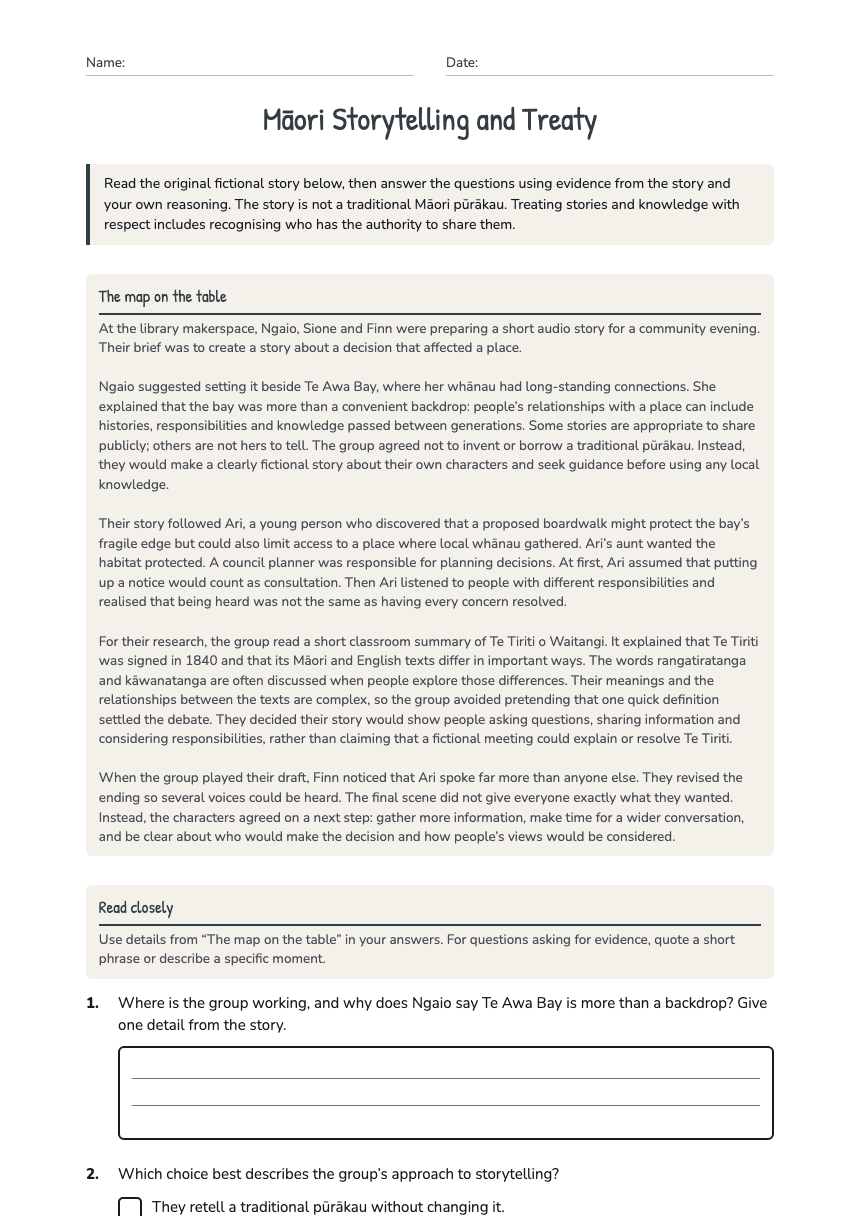
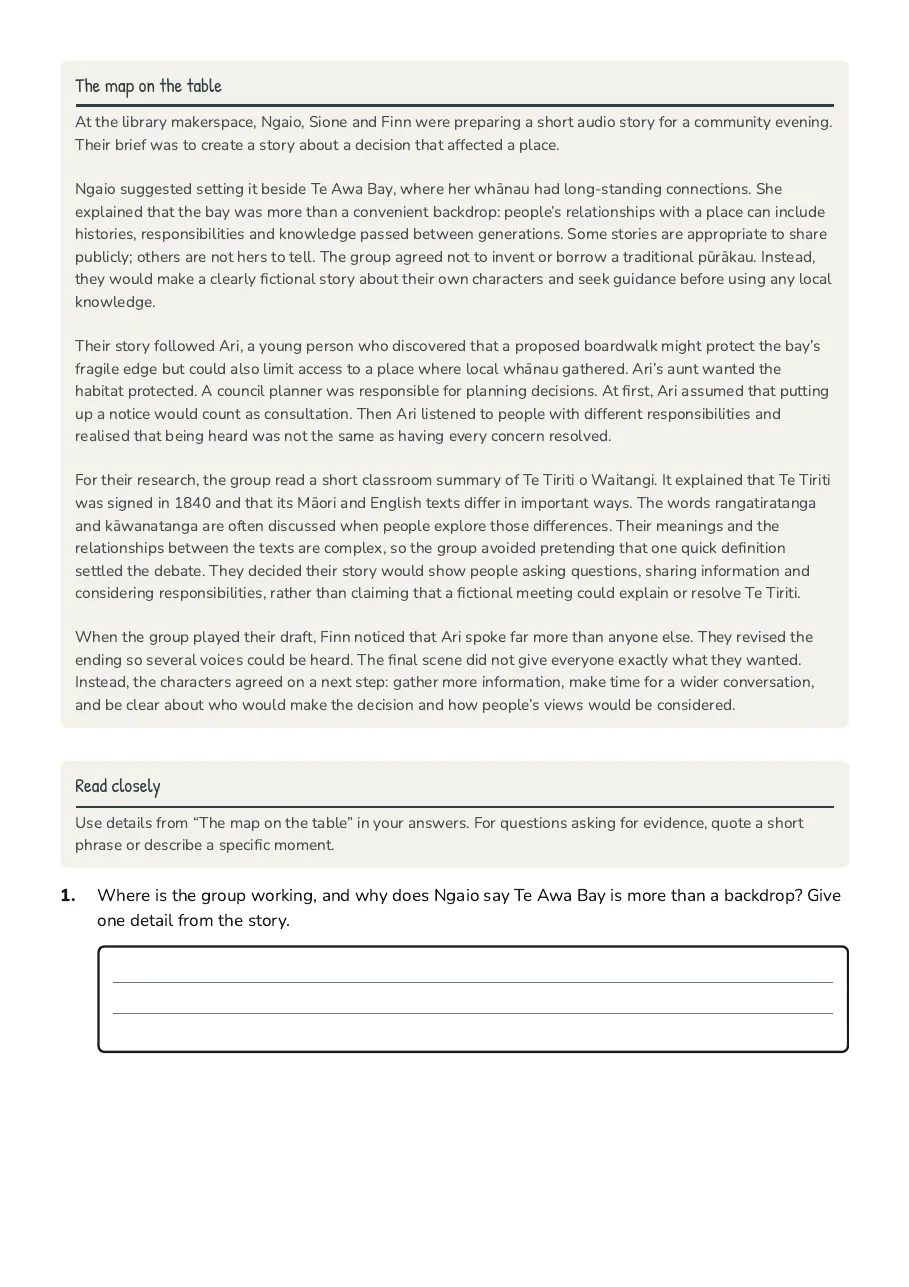
The map on the table
At the library makerspace, Ngaio, Sione and Finn were preparing a short audio story for a community evening. Their brief was to create a story about a decision that affected a place. Ngaio suggested setting it beside Te Awa Bay, where her whānau had long-standing connections. She explained that the bay was more than a convenient backdrop: people’s relationships with a place can include histories, responsibilities and knowledge passed between generations. Some stories are appropriate to share publicly; others are not hers to tell. The group agreed not to invent or borrow a traditional pūrākau. Instead, they would make a clearly fictional story about their own characters and seek guidance before using any local knowledge. Their story followed Ari, a young person who discovered that a proposed boardwalk might protect the bay’s fragile edge but could also limit access to a place where local whānau gathered. Ari’s aunt wanted the habitat protected. A council planner was responsible for planning decisions. At first, Ari assumed that putting up a notice would count as consultation. Then Ari listened to people with different responsibilities and realised that being heard was not the same as having every concern resolved. For their research, the group read a short classroom summary of Te Tiriti o Waitangi. It explained that Te Tiriti was signed in 1840 and that its Māori and English texts differ in important ways. The words rangatiratanga and kāwanatanga are often discussed when people explore those differences. Their meanings and the relationships between the texts are complex, so the group avoided pretending that one quick definition settled the debate. They decided their story would show people asking questions, sharing information and considering responsibilities, rather than claiming that a fictional meeting could explain or resolve Te Tiriti. When the group played their draft, Finn noticed that Ari spoke far more than anyone else. They revised the ending so several voices could be heard. The final scene did not give everyone exactly what they wanted. Instead, the characters agreed on a next step: gather more information, make time for a wider conversation, and be clear about who would make the decision and how people’s views would be considered.
Read closely
Use details from “The map on the table” in your answers. For questions asking for evidence, quote a short phrase or describe a specific moment.
- They retell a traditional pūrākau without changing it.
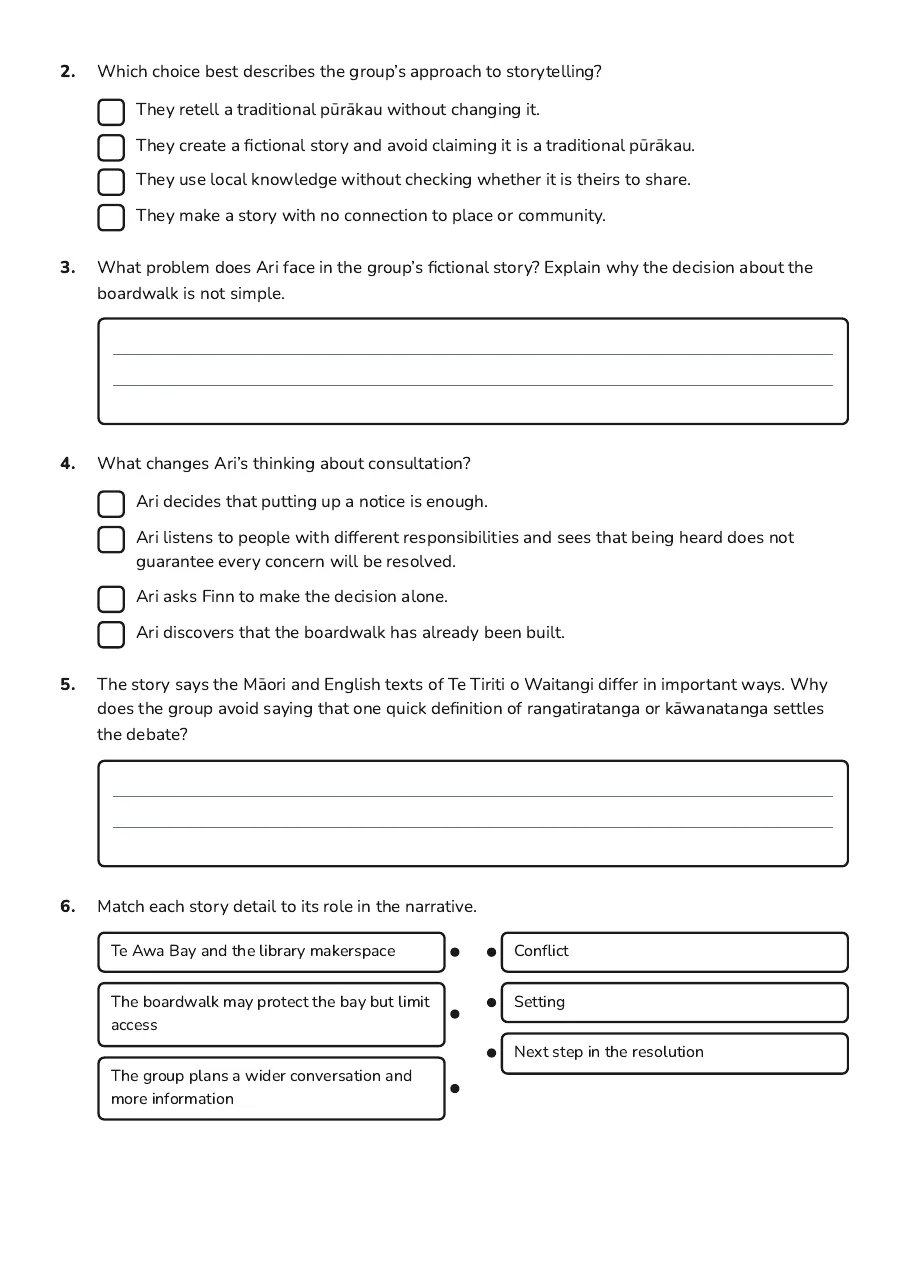
- They create a fictional story and avoid claiming it is a traditional pūrākau.
- They use local knowledge without checking whether it is theirs to share.
- They make a story with no connection to place or community.
- Ari decides that putting up a notice is enough.
- Ari listens to people with different responsibilities and sees that being heard does not guarantee every concern will be resolved.
- Ari asks Finn to make the decision alone.
- Ari discovers that the boardwalk has already been built.
- Te Awa Bay and the library makerspace
- The boardwalk may protect the bay but limit access
- The group plans a wider conversation and more information
- Conflict
- Setting
- Next step in the resolution
4 printable pages

Page 1
Page 2
Page 3
Page 4
About This Worksheet
Free in Kuraplan
Sign up free, grab the PDF, and customize it for your class.
Print-Ready
Formatted for standard paper. Clean layout, easy to read.
AI-Generated
Created with Kuraplan's AI, designed for real classroom use.
For Teachers & Parents
Use in classrooms, for homework, tutoring, or homeschool.
Need a custom version of this worksheet?
Kuraplan's AI generates custom worksheets in seconds — differentiated for every learner, aligned to your curriculum.
Generate Custom Worksheets — Free