PEFreePrintable

Muscle Movement Analysis Worksheet

A free pe worksheet ready for your classroom. Open in Kuraplan to grab the print-ready PDF, customize it for your students, or generate a fresh version in seconds.

Muscle Movement Analysis Worksheet worksheet preview
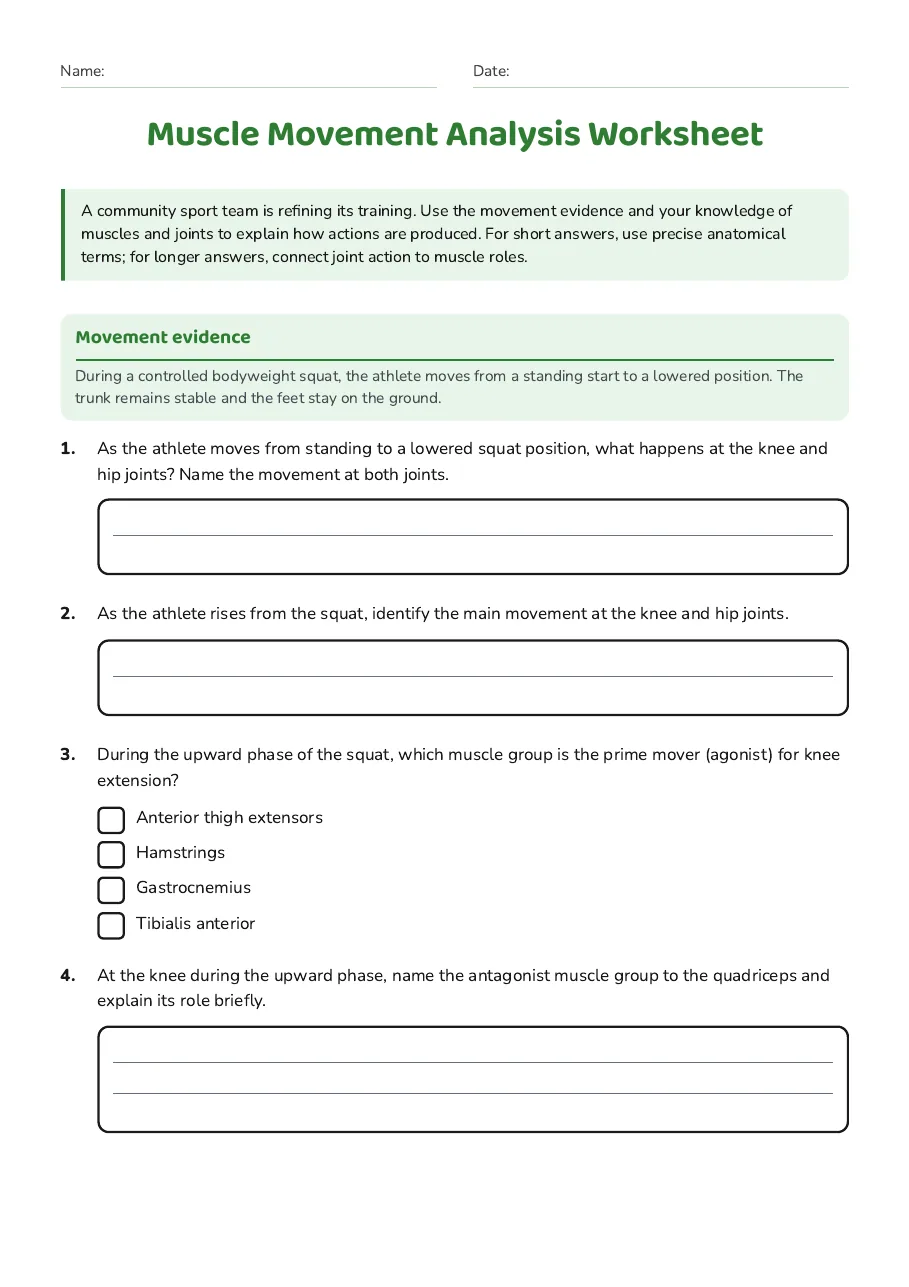
Name:Date:

Muscle Movement Analysis Worksheet

A community sport team is refining its training. Use the movement evidence and your knowledge of muscles and joints to explain how actions are produced. For short answers, use precise anatomical terms; for longer answers, connect joint action to muscle roles.

Movement evidence

During a controlled bodyweight squat, the athlete moves from a standing start to a lowered position. The trunk remains stable and the feet stay on the ground.

1.As the athlete moves from standing to a lowered squat position, what happens at the knee and hip joints? Name the movement at both joints.
2.As the athlete rises from the squat, identify the main movement at the knee and hip joints.
3.During the upward phase of the squat, which muscle group is the prime mover (agonist) for knee extension?
  • Anterior thigh extensors
  • Hamstrings
  • Gastrocnemius
  • Tibialis anterior
4.At the knee during the upward phase, name the antagonist muscle group to the quadriceps and explain its role briefly.

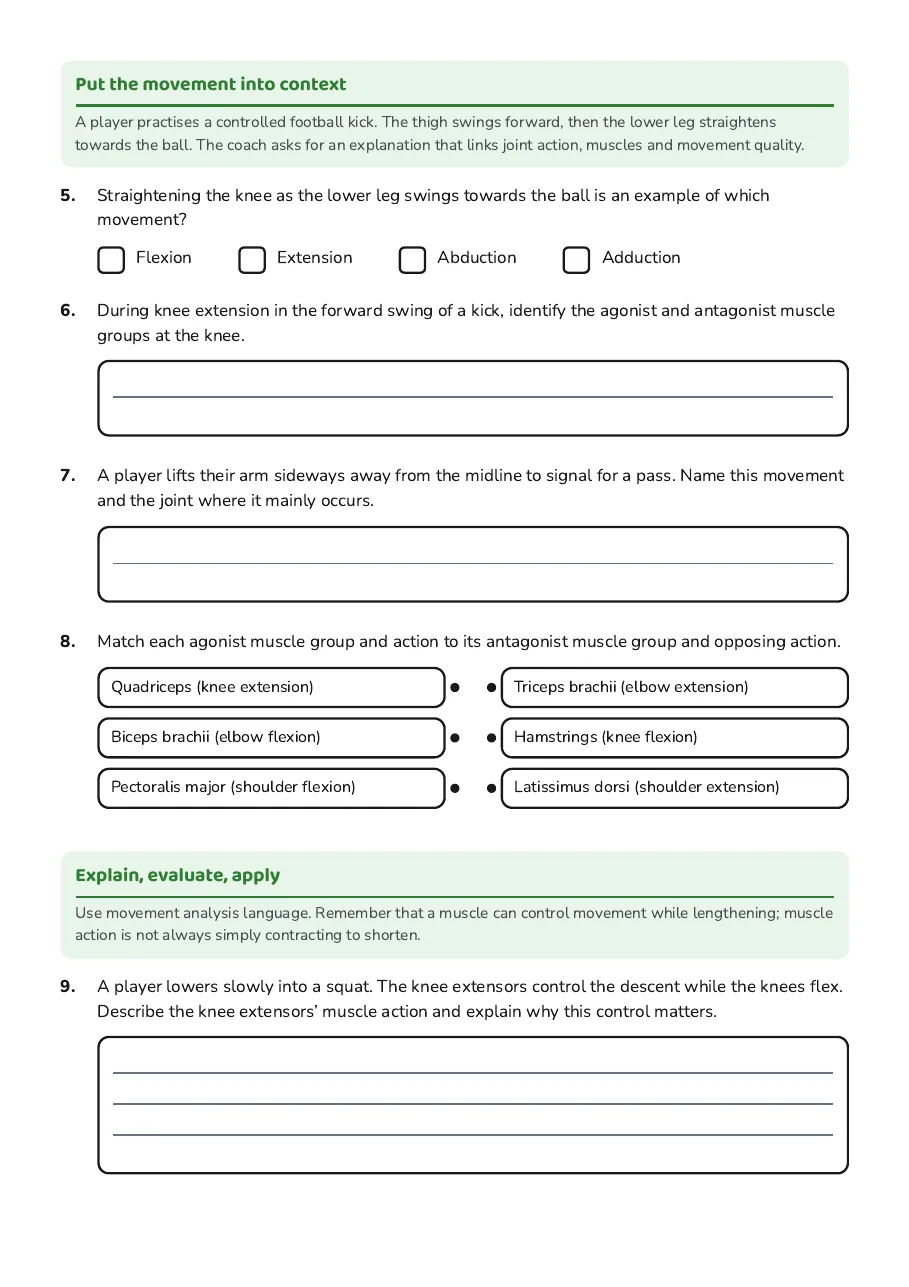
Put the movement into context

A player practises a controlled football kick. The thigh swings forward, then the lower leg straightens towards the ball. The coach asks for an explanation that links joint action, muscles and movement quality.

5.Straightening the knee as the lower leg swings towards the ball is an example of which movement?
  • Flexion
  • Extension
  • Abduction
  • Adduction
6.During knee extension in the forward swing of a kick, identify the agonist and antagonist muscle groups at the knee.
7.A player lifts their arm sideways away from the midline to signal for a pass. Name this movement and the joint where it mainly occurs.
8.Match each agonist muscle group and action to its antagonist muscle group and opposing action.
  • Quadriceps (knee extension)
  • Biceps brachii (elbow flexion)
  • Pectoralis major (shoulder flexion)
  • Triceps brachii (elbow extension)
  • Hamstrings (knee flexion)
  • Latissimus dorsi (shoulder extension)

Explain, evaluate, apply

Use movement analysis language. Remember that a muscle can control movement while lengthening; muscle action is not always simply contracting to shorten.

9.A player lowers slowly into a squat. The knee extensors control the descent while the knees flex. Describe the knee extensors’ muscle action and explain why this control matters.
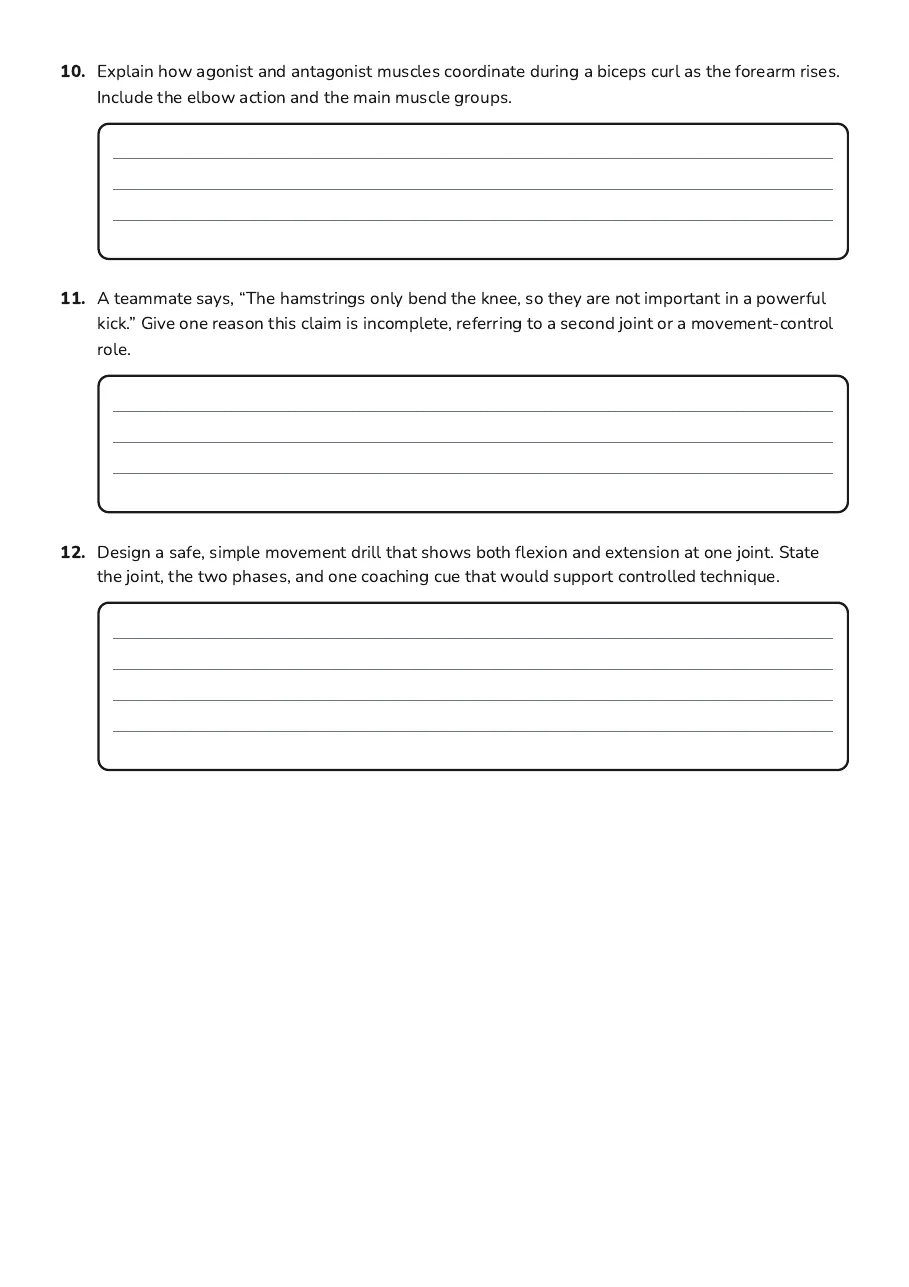
10.Explain how agonist and antagonist muscles coordinate during a biceps curl as the forearm rises. Include the elbow action and the main muscle groups.
11.A teammate says, “The hamstrings only bend the knee, so they are not important in a powerful kick.” Give one reason this claim is incomplete, referring to a second joint or a movement-control role.
12.Design a safe, simple movement drill that shows both flexion and extension at one joint. State the joint, the two phases, and one coaching cue that would support controlled technique.

3 printable pages

  • Muscle Movement Analysis Worksheet, page 1 of 3: Movement evidence

    Page 1

  • Muscle Movement Analysis Worksheet, page 2 of 3: Put the movement into context, Explain, evaluate, apply

    Page 2

  • Muscle Movement Analysis Worksheet, page 3 of 3: 10. Explain how agonist and antagonist muscles coordinate during a biceps curl as the…

    Page 3

About This Worksheet

Free in Kuraplan

Sign up free, grab the PDF, and customize it for your class.

Print-Ready

Formatted for standard paper. Clean layout, easy to read.

AI-Generated

Created with Kuraplan's AI, designed for real classroom use.

For Teachers & Parents

Use in classrooms, for homework, tutoring, or homeschool.

Need a custom version of this worksheet?

Kuraplan's AI generates custom worksheets in seconds — differentiated for every learner, aligned to your curriculum.

Generate Custom Worksheets — Free
No credit card Curriculum-aligned Under 60 seconds