Native Title Act Glossary
A free social sciences worksheet ready for your classroom. Open in Kuraplan to grab the print-ready PDF, customize it for your students, or generate a fresh version in seconds.

Native Title Act Glossary
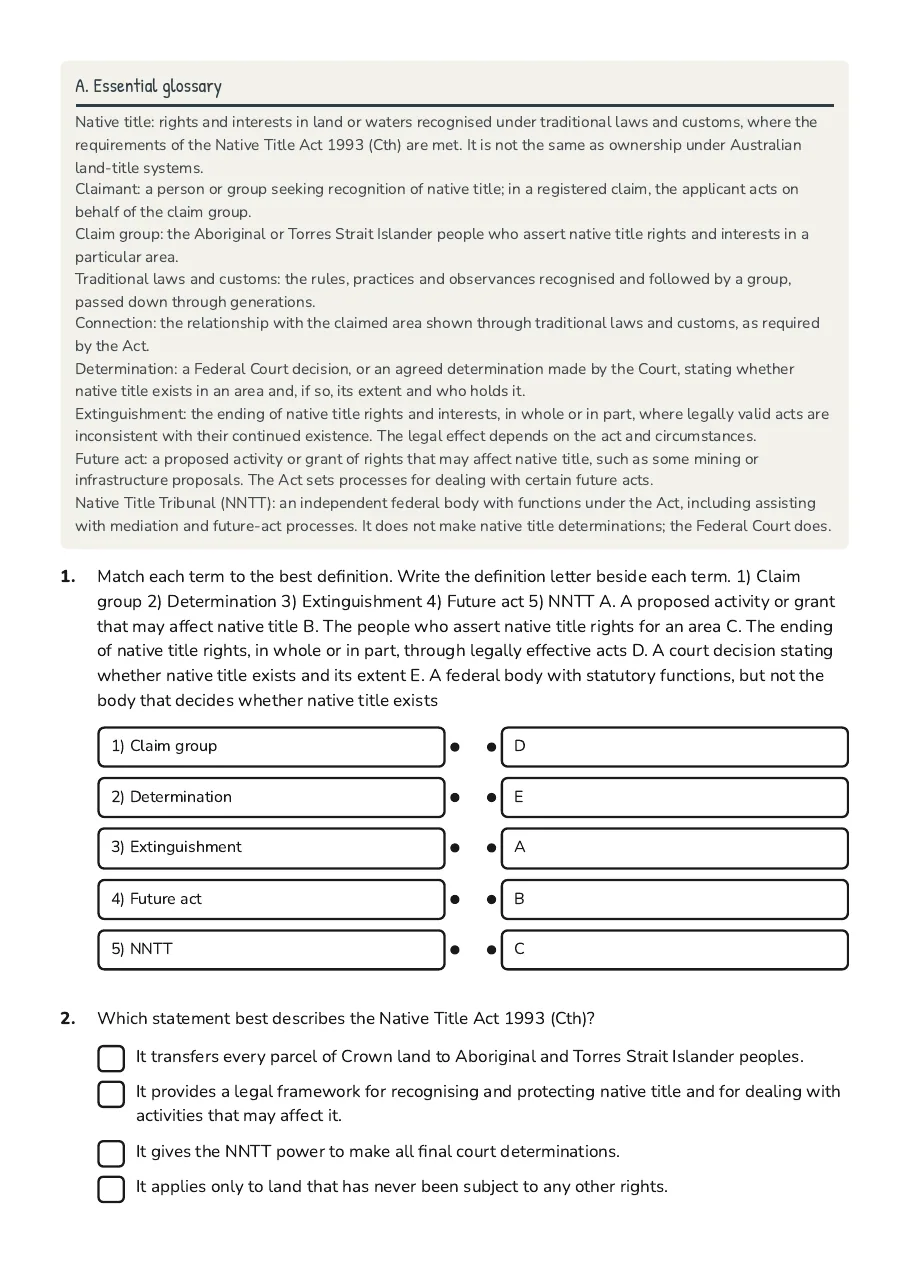
A. Essential glossary
Native title: rights and interests in land or waters recognised under traditional laws and customs, where the requirements of the Native Title Act 1993 (Cth) are met. It is not the same as ownership under Australian land-title systems. Claimant: a person or group seeking recognition of native title; in a registered claim, the applicant acts on behalf of the claim group. Claim group: the Aboriginal or Torres Strait Islander people who assert native title rights and interests in a particular area. Traditional laws and customs: the rules, practices and observances recognised and followed by a group, passed down through generations. Connection: the relationship with the claimed area shown through traditional laws and customs, as required by the Act. Determination: a Federal Court decision, or an agreed determination made by the Court, stating whether native title exists in an area and, if so, its extent and who holds it. Extinguishment: the ending of native title rights and interests, in whole or in part, where legally valid acts are inconsistent with their continued existence. The legal effect depends on the act and circumstances. Future act: a proposed activity or grant of rights that may affect native title, such as some mining or infrastructure proposals. The Act sets processes for dealing with certain future acts. Native Title Tribunal (NNTT): an independent federal body with functions under the Act, including assisting with mediation and future-act processes. It does not make native title determinations; the Federal Court does.
- 1) Claim group
- 2) Determination
- 3) Extinguishment
- 4) Future act
- 5) NNTT
- D
- E
- A
- B
- C
- It transfers every parcel of Crown land to Aboriginal and Torres Strait Islander peoples.
- It provides a legal framework for recognising and protecting native title and for dealing with activities that may affect it.
- It gives the NNTT power to make all final court determinations.
- It applies only to land that has never been subject to any other rights.
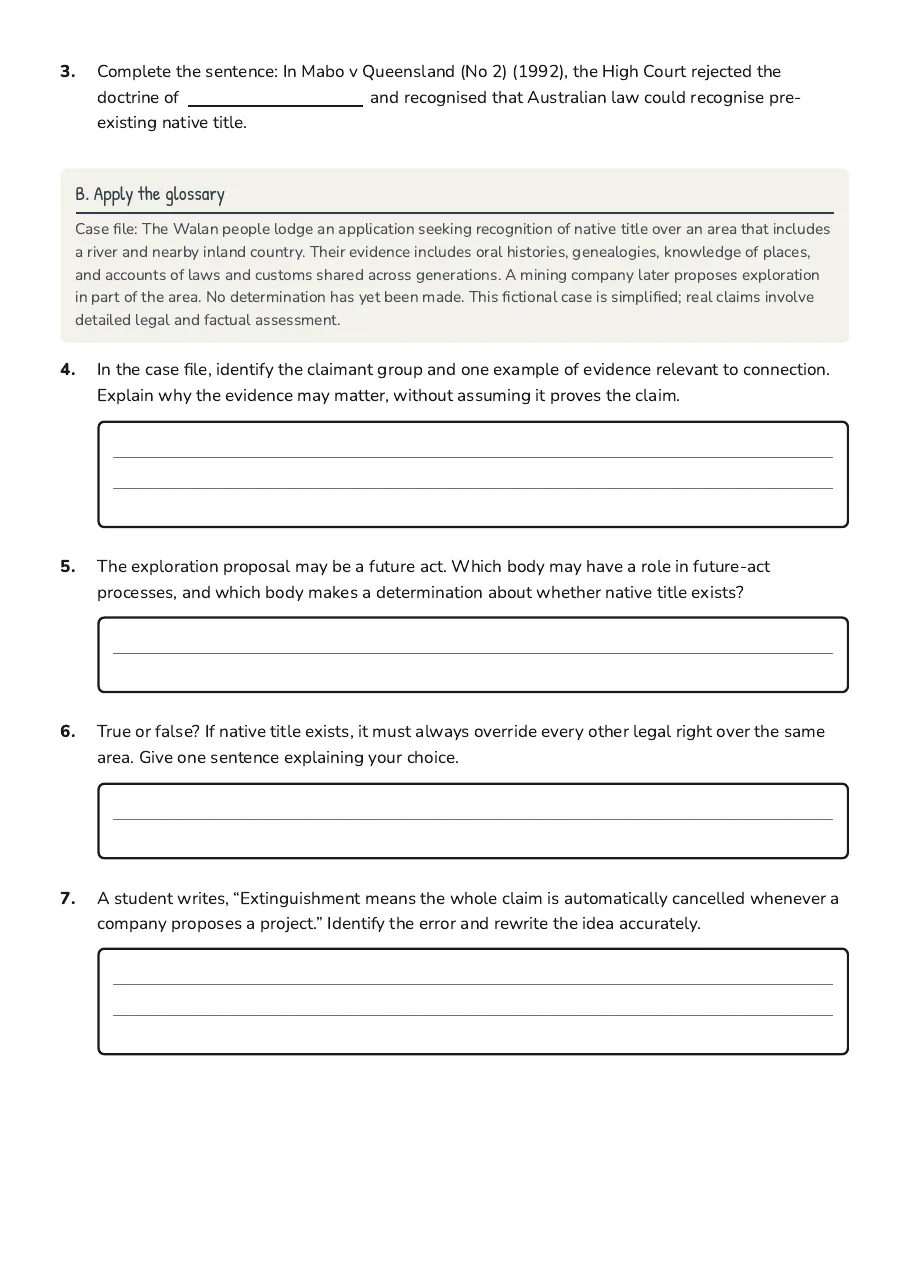
B. Apply the glossary
Case file: The Walan people lodge an application seeking recognition of native title over an area that includes a river and nearby inland country. Their evidence includes oral histories, genealogies, knowledge of places, and accounts of laws and customs shared across generations. A mining company later proposes exploration in part of the area. No determination has yet been made. This fictional case is simplified; real claims involve detailed legal and factual assessment.
4 printable pages

Page 1
Page 2
Page 3
Page 4
About This Worksheet
Free in Kuraplan
Sign up free, grab the PDF, and customize it for your class.
Print-Ready
Formatted for standard paper. Clean layout, easy to read.
AI-Generated
Created with Kuraplan's AI, designed for real classroom use.
For Teachers & Parents
Use in classrooms, for homework, tutoring, or homeschool.
Need a custom version of this worksheet?
Kuraplan's AI generates custom worksheets in seconds — differentiated for every learner, aligned to your curriculum.
Generate Custom Worksheets — FreeMore Social Sciences Worksheets
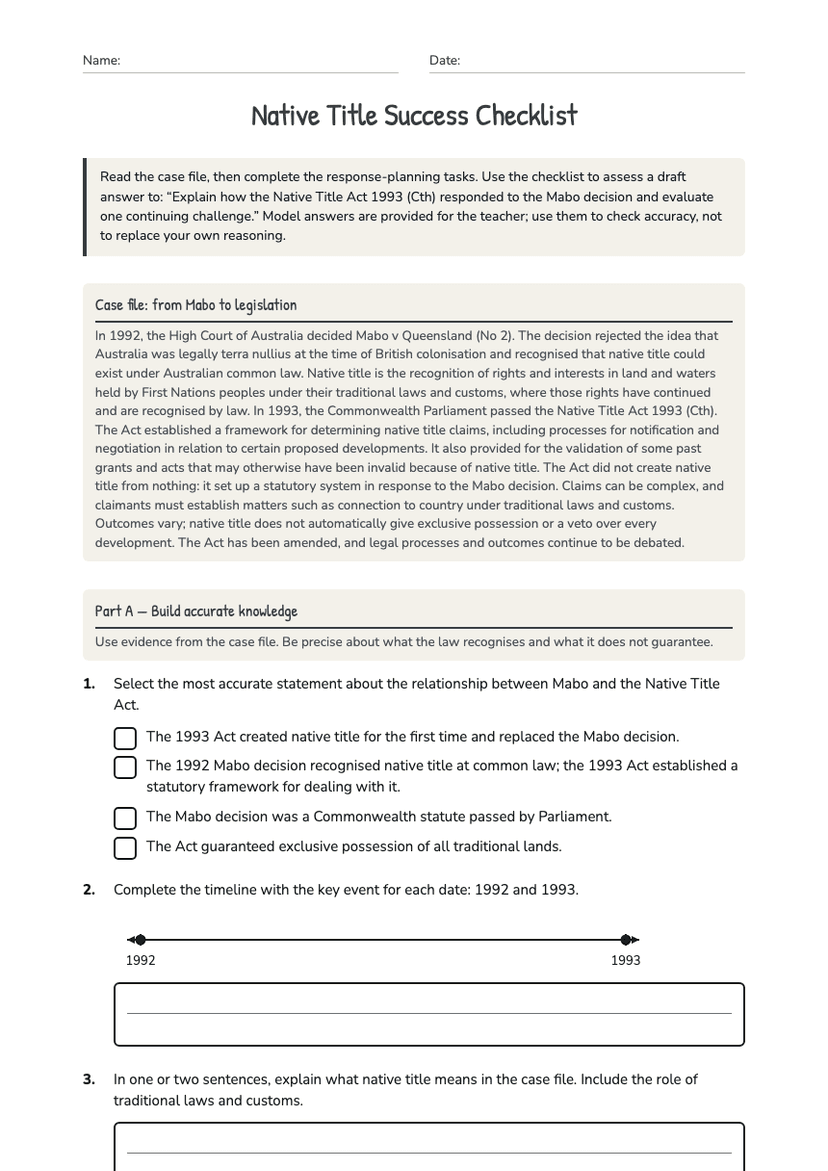
Native Title Success Checklist
Free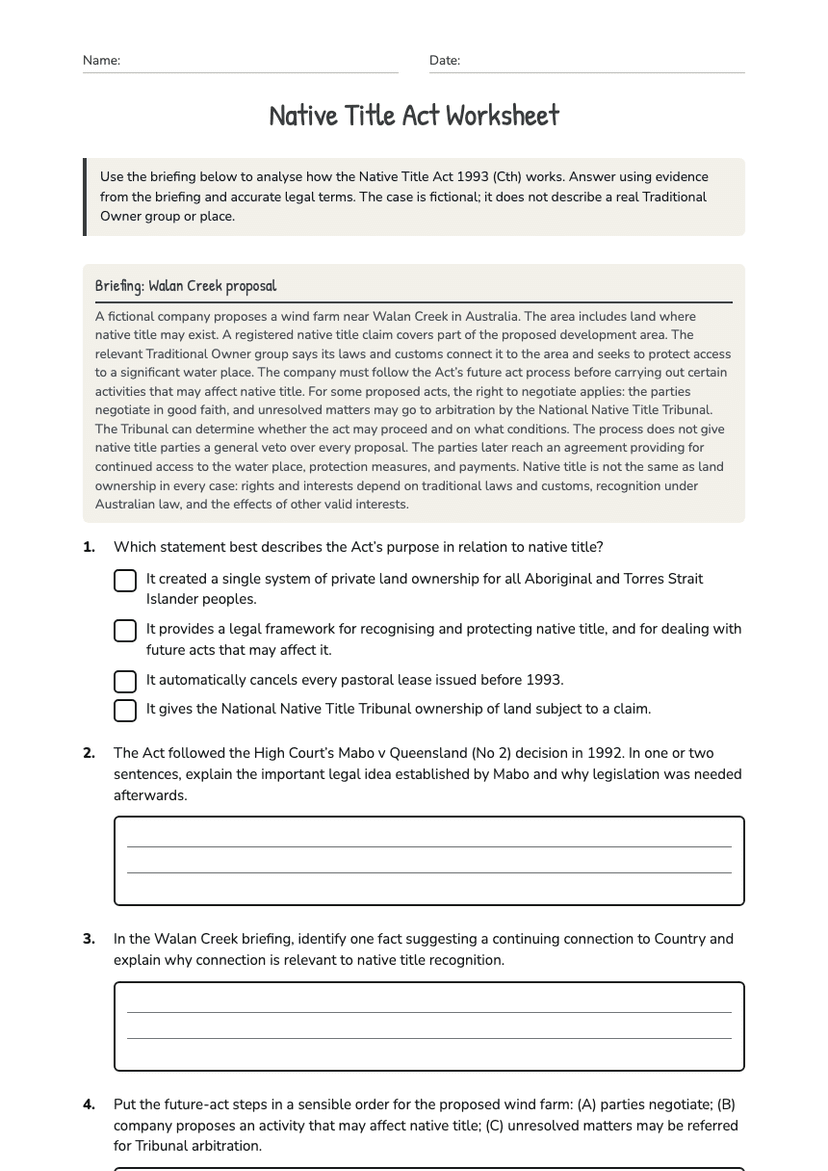
Native Title Act Worksheet
Free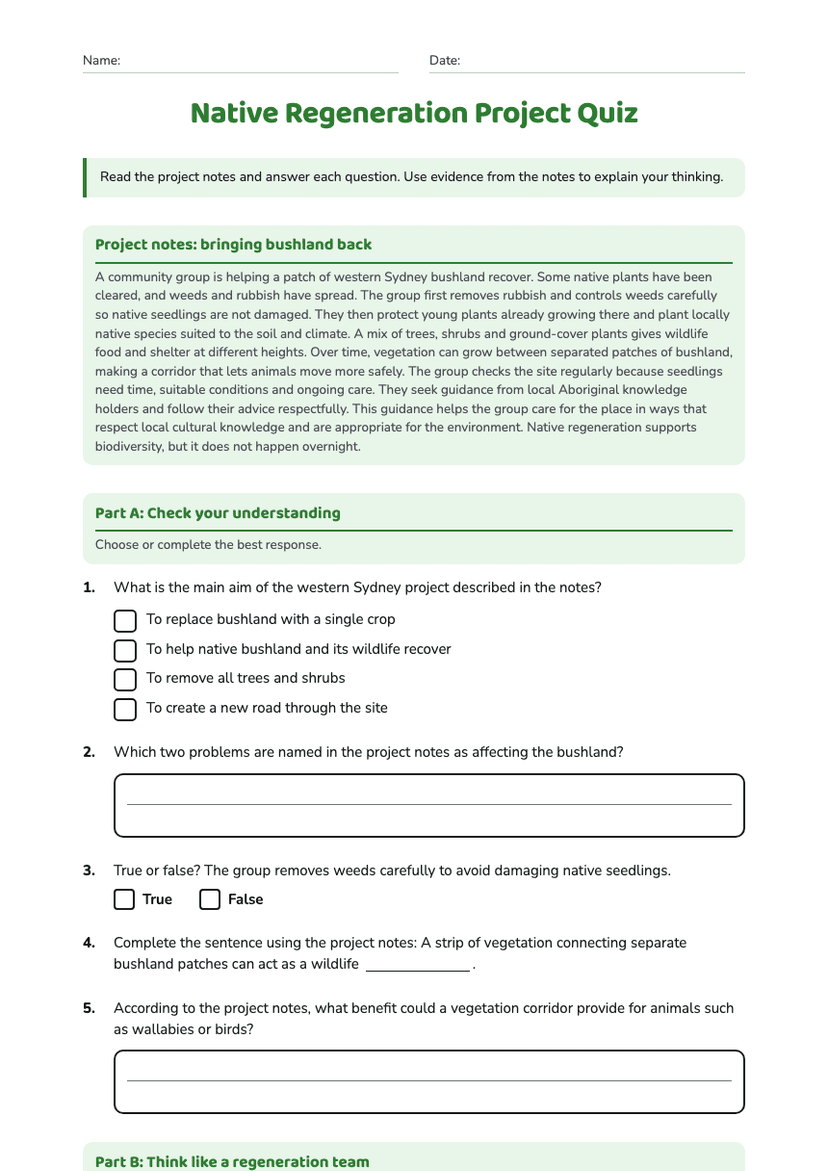
Native Regeneration Project Quiz
Free
Imaginative Texts Features
Free
Exploring Imaginative Texts
Free
Imaginative Narrative Introduction
Free
Native Title Act Summary
Free