ScienceFreePrintable

Negative Feedback Mechanisms

A free science worksheet ready for your classroom. Open in Kuraplan to grab the print-ready PDF, customize it for your students, or generate a fresh version in seconds.
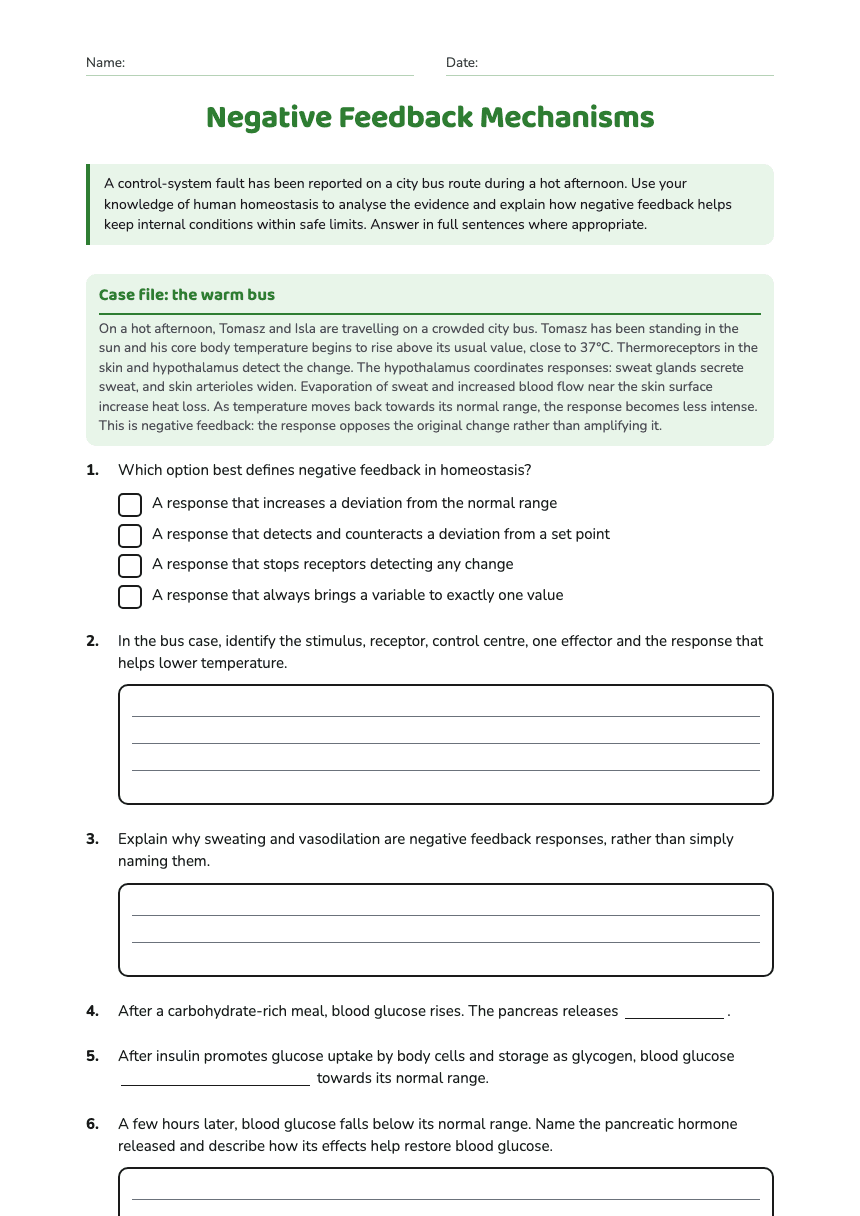
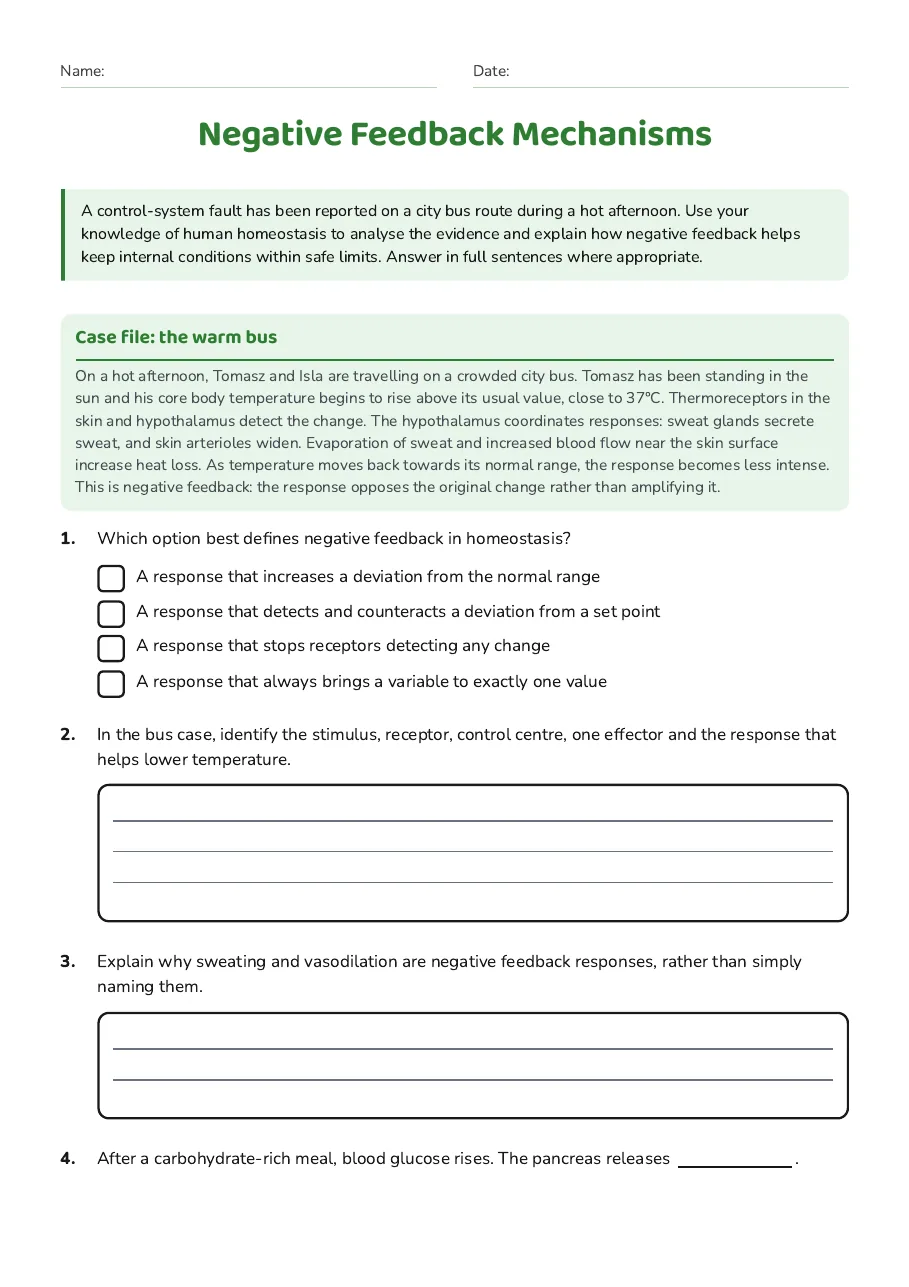
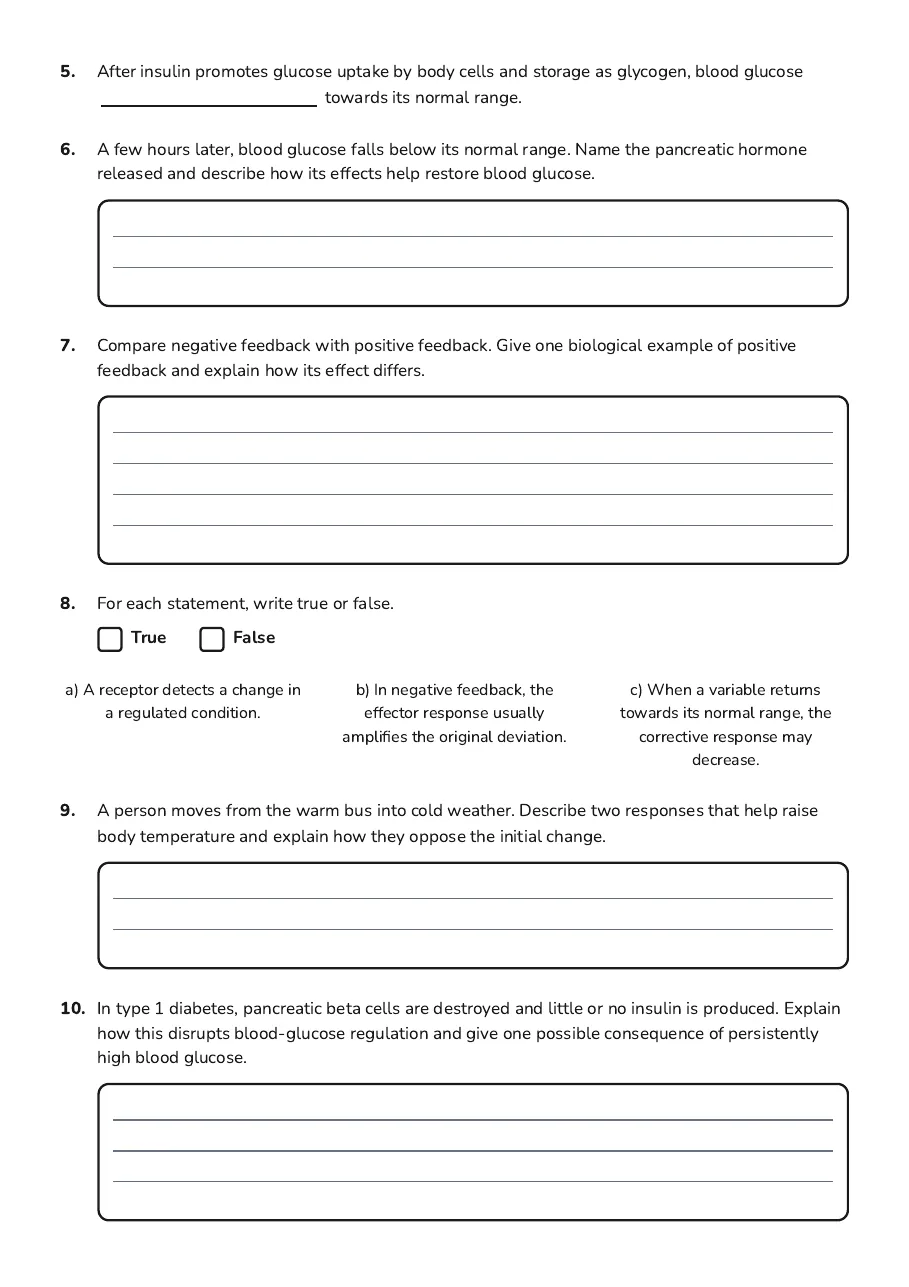
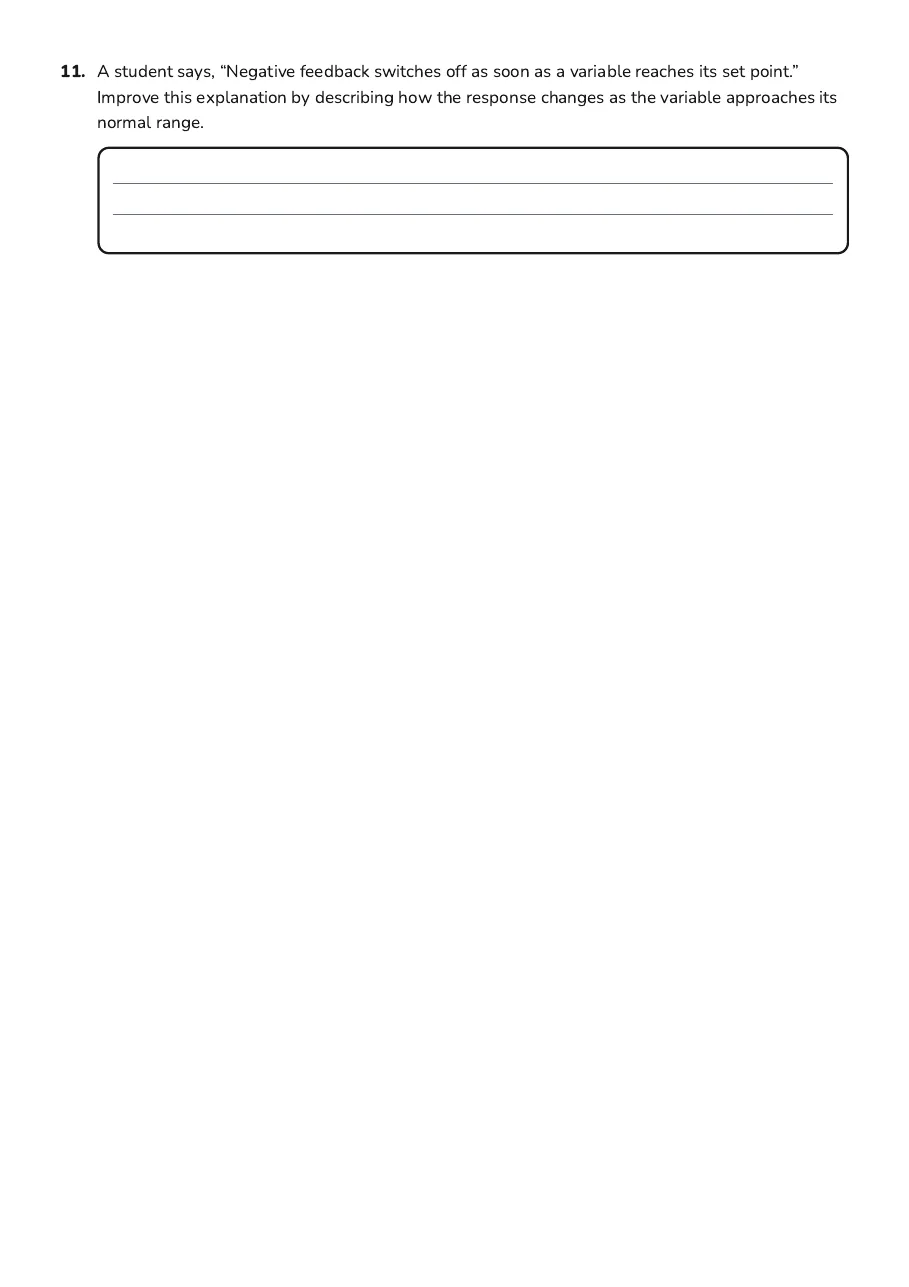
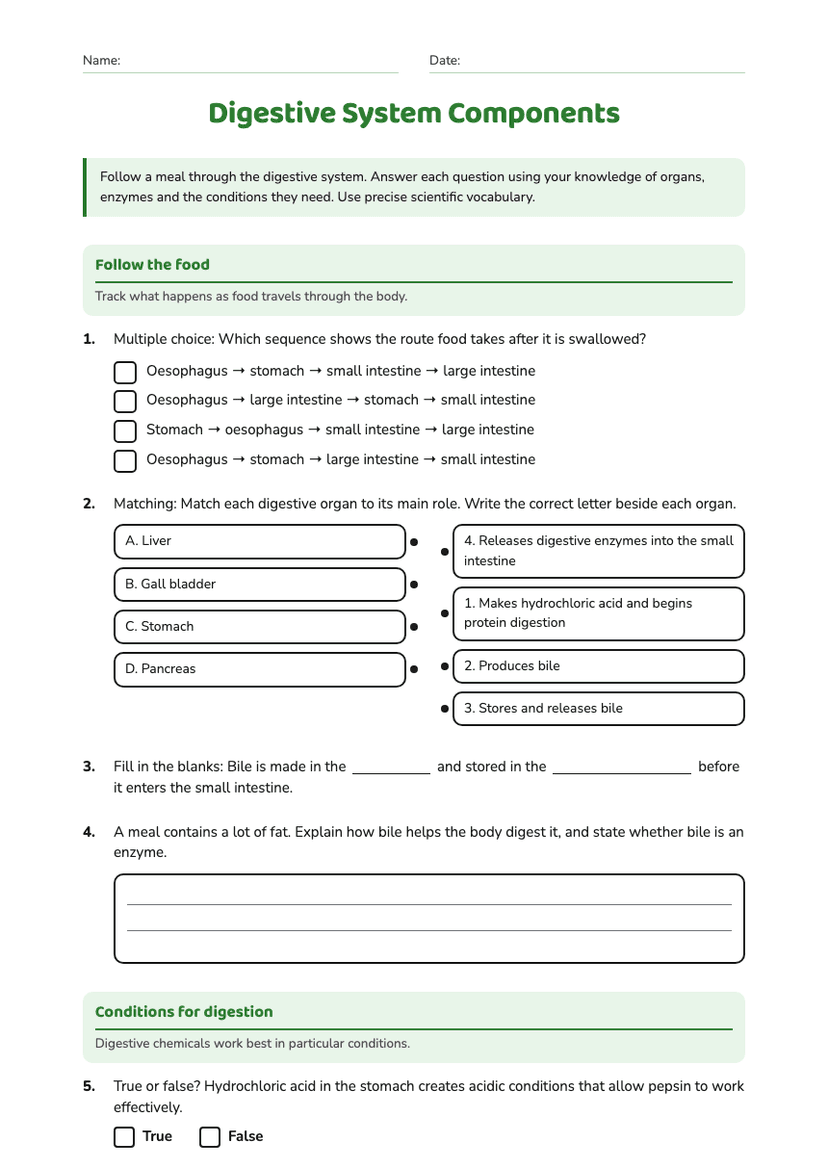
Negative Feedback Mechanisms worksheet preview
Name:Date:

Negative Feedback Mechanisms

A control-system fault has been reported on a city bus route during a hot afternoon. Use your knowledge of human homeostasis to analyse the evidence and explain how negative feedback helps keep internal conditions within safe limits. Answer in full sentences where appropriate.

Case file: the warm bus

On a hot afternoon, Tomasz and Isla are travelling on a crowded city bus. Tomasz has been standing in the sun and his core body temperature begins to rise above its usual value, close to 37°C. Thermoreceptors in the skin and hypothalamus detect the change. The hypothalamus coordinates responses: sweat glands secrete sweat, and skin arterioles widen. Evaporation of sweat and increased blood flow near the skin surface increase heat loss. As temperature moves back towards its normal range, the response becomes less intense. This is negative feedback: the response opposes the original change rather than amplifying it.

1.Which option best defines negative feedback in homeostasis?
  • A response that increases a deviation from the normal range
  • A response that detects and counteracts a deviation from a set point
  • A response that stops receptors detecting any change
  • A response that always brings a variable to exactly one value
2.In the bus case, identify the stimulus, receptor, control centre, one effector and the response that helps lower temperature.
3.Explain why sweating and vasodilation are negative feedback responses, rather than simply naming them.
4.After a carbohydrate-rich meal, blood glucose rises. The pancreas releases .
5.After insulin promotes glucose uptake by body cells and storage as glycogen, blood glucose towards its normal range.
6.A few hours later, blood glucose falls below its normal range. Name the pancreatic hormone released and describe how its effects help restore blood glucose.
7.Compare negative feedback with positive feedback. Give one biological example of positive feedback and explain how its effect differs.
8.For each statement, write true or false.
TrueFalse

a) A receptor detects a change in a regulated condition.

b) In negative feedback, the effector response usually amplifies the original deviation.

c) When a variable returns towards its normal range, the corrective response may decrease.

9.A person moves from the warm bus into cold weather. Describe two responses that help raise body temperature and explain how they oppose the initial change.
10.In type 1 diabetes, pancreatic beta cells are destroyed and little or no insulin is produced. Explain how this disrupts blood-glucose regulation and give one possible consequence of persistently high blood glucose.
11.A student says, “Negative feedback switches off as soon as a variable reaches its set point.” Improve this explanation by describing how the response changes as the variable approaches its normal range.

3 printable pages

  • Negative Feedback Mechanisms, page 1 of 3: Case file: the warm bus

    Page 1

  • Negative Feedback Mechanisms, page 2 of 3: 5. After insulin promotes glucose uptake by body cells and storage as glycogen, blood…

    Page 2

  • Negative Feedback Mechanisms, page 3 of 3: 11. A student says, “Negative feedback switches off as soon as a variable reaches its set…

    Page 3

About This Worksheet

Free in Kuraplan

Sign up free, grab the PDF, and customize it for your class.

Print-Ready

Formatted for standard paper. Clean layout, easy to read.

AI-Generated

Created with Kuraplan's AI, designed for real classroom use.

For Teachers & Parents

Use in classrooms, for homework, tutoring, or homeschool.

Need a custom version of this worksheet?

Kuraplan's AI generates custom worksheets in seconds — differentiated for every learner, aligned to your curriculum.

Generate Custom Worksheets — Free
No credit card Curriculum-aligned Under 60 seconds