MathsFreePrintable

Probability Foundations Worksheets

A free maths worksheet ready for your classroom. Open in Kuraplan to grab the print-ready PDF, customize it for your students, or generate a fresh version in seconds.
Probability Foundations Worksheets worksheet preview
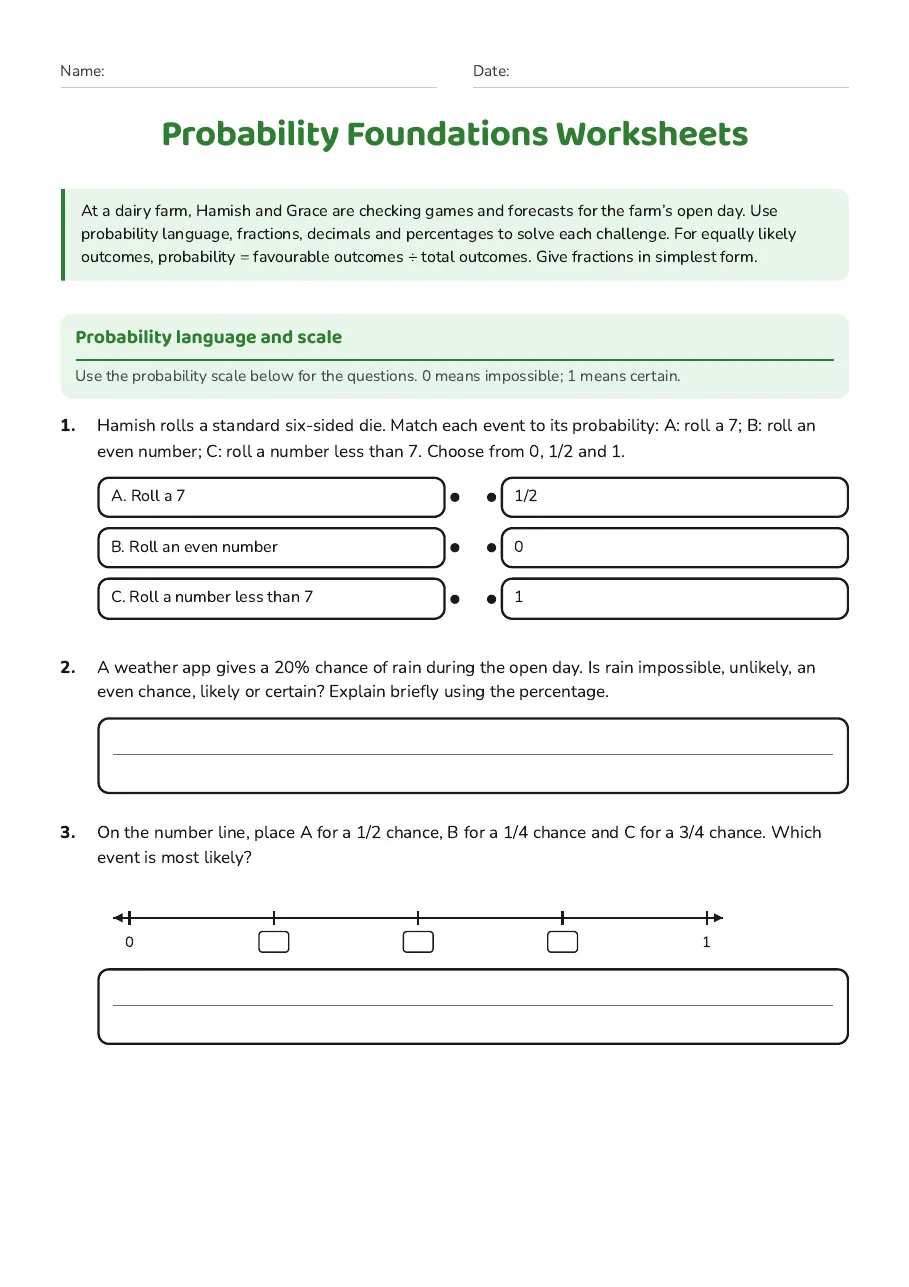
Name:Date:

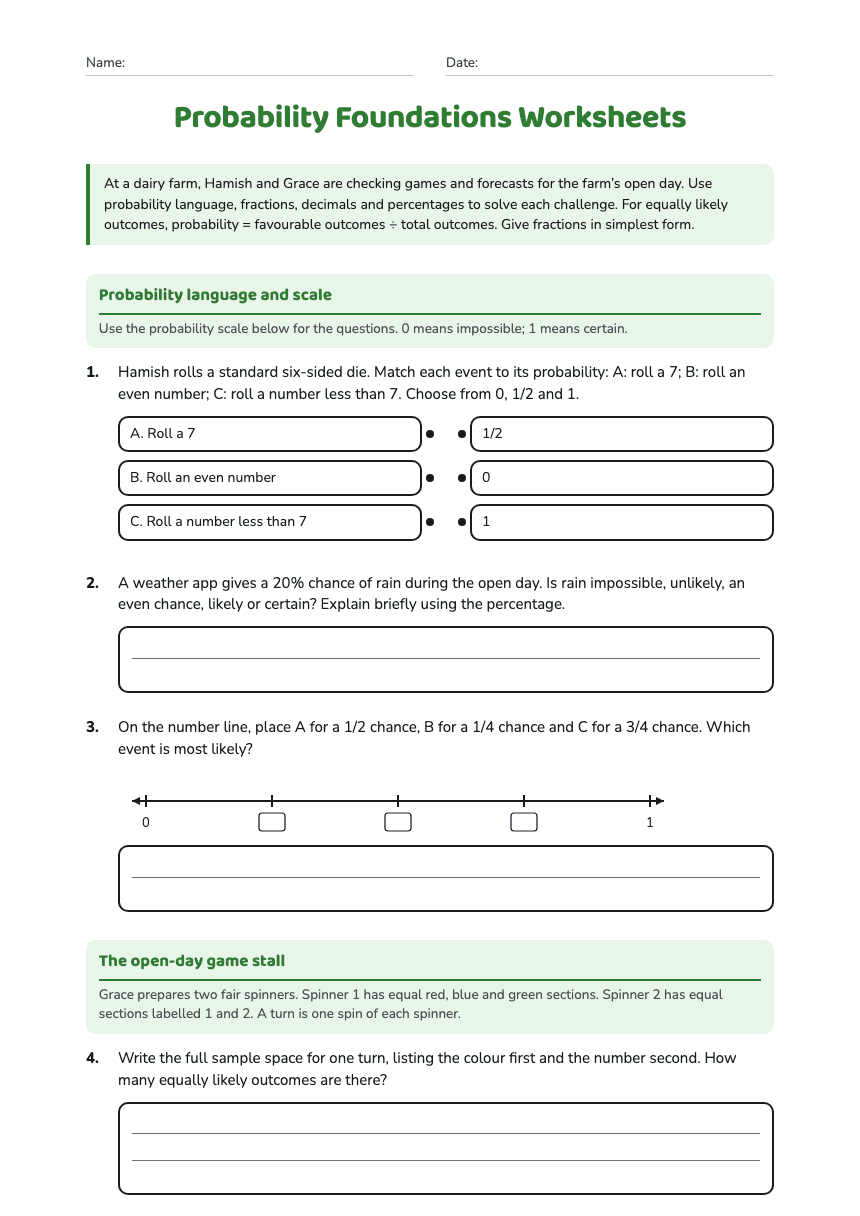
Probability Foundations Worksheets

At a dairy farm, Hamish and Grace are checking games and forecasts for the farm’s open day. Use probability language, fractions, decimals and percentages to solve each challenge. For equally likely outcomes, probability = favourable outcomes ÷ total outcomes. Give fractions in simplest form.

Probability language and scale

Use the probability scale below for the questions. 0 means impossible; 1 means certain.

1.Hamish rolls a standard six-sided die. Match each event to its probability: A: roll a 7; B: roll an even number; C: roll a number less than 7. Choose from 0, 1/2 and 1.
  • A. Roll a 7
  • B. Roll an even number
  • C. Roll a number less than 7
  • 1/2
  • 0
  • 1
2.A weather app gives a 20% chance of rain during the open day. Is rain impossible, unlikely, an even chance, likely or certain? Explain briefly using the percentage.
3.On the number line, place A for a 1/2 chance, B for a 1/4 chance and C for a 3/4 chance. Which event is most likely?
01

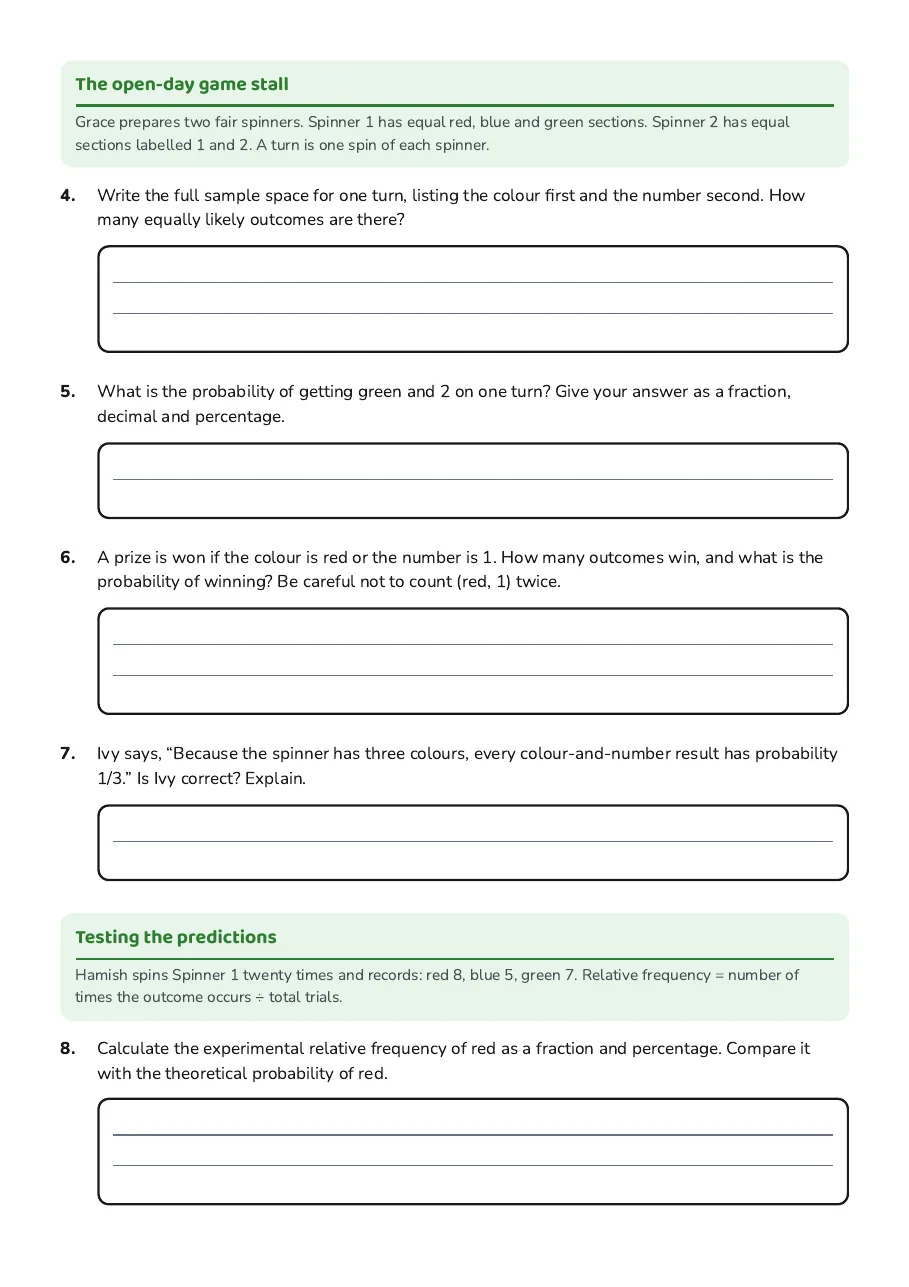
The open-day game stall

Grace prepares two fair spinners. Spinner 1 has equal red, blue and green sections. Spinner 2 has equal sections labelled 1 and 2. A turn is one spin of each spinner.

4.Write the full sample space for one turn, listing the colour first and the number second. How many equally likely outcomes are there?
5.What is the probability of getting green and 2 on one turn? Give your answer as a fraction, decimal and percentage.
6.A prize is won if the colour is red or the number is 1. How many outcomes win, and what is the probability of winning? Be careful not to count (red, 1) twice.
7.Ivy says, “Because the spinner has three colours, every colour-and-number result has probability 1/3.” Is Ivy correct? Explain.

Testing the predictions

Hamish spins Spinner 1 twenty times and records: red 8, blue 5, green 7. Relative frequency = number of times the outcome occurs ÷ total trials.

8.Calculate the experimental relative frequency of red as a fraction and percentage. Compare it with the theoretical probability of red.
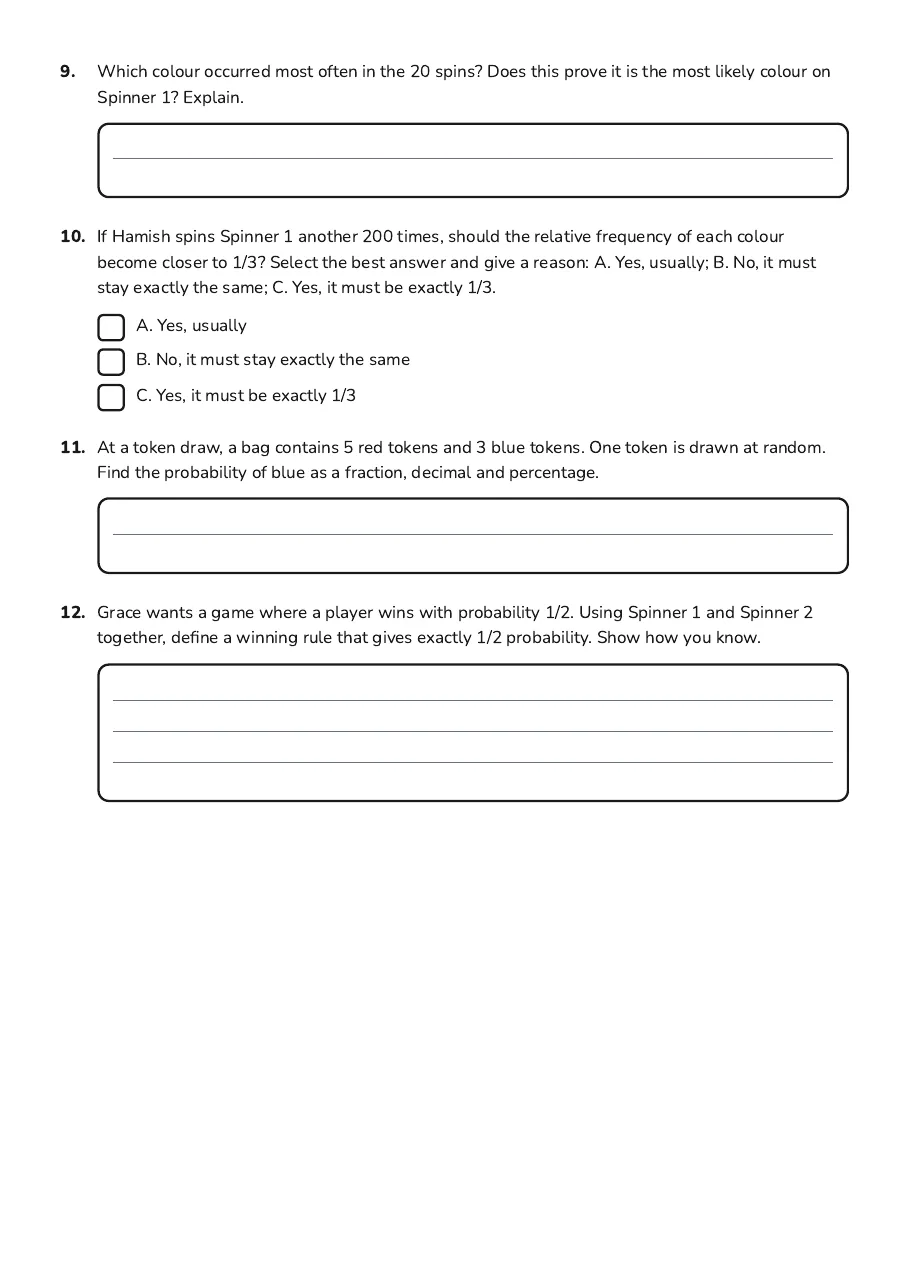
9.Which colour occurred most often in the 20 spins? Does this prove it is the most likely colour on Spinner 1? Explain.
10.If Hamish spins Spinner 1 another 200 times, should the relative frequency of each colour become closer to 1/3? Select the best answer and give a reason: A. Yes, usually; B. No, it must stay exactly the same; C. Yes, it must be exactly 1/3.
  • A. Yes, usually
  • B. No, it must stay exactly the same
  • C. Yes, it must be exactly 1/3
11.At a token draw, a bag contains 5 red tokens and 3 blue tokens. One token is drawn at random. Find the probability of blue as a fraction, decimal and percentage.
12.Grace wants a game where a player wins with probability 1/2. Using Spinner 1 and Spinner 2 together, define a winning rule that gives exactly 1/2 probability. Show how you know.

3 printable pages

  • Probability Foundations Worksheets, page 1 of 3: Probability language and scale

    Page 1

  • Probability Foundations Worksheets, page 2 of 3: The open-day game stall, Testing the predictions

    Page 2

  • Probability Foundations Worksheets, page 3 of 3: 9. Which colour occurred most often in the 20 spins? Does this prove it is the most…

    Page 3

About This Worksheet

Free in Kuraplan

Sign up free, grab the PDF, and customize it for your class.

Print-Ready

Formatted for standard paper. Clean layout, easy to read.

AI-Generated

Created with Kuraplan's AI, designed for real classroom use.

For Teachers & Parents

Use in classrooms, for homework, tutoring, or homeschool.

Need a custom version of this worksheet?

Kuraplan's AI generates custom worksheets in seconds — differentiated for every learner, aligned to your curriculum.

Generate Custom Worksheets — Free
No credit card Curriculum-aligned Under 60 seconds