Rock Cycle Explorations
A free science worksheet ready for your classroom. Open in Kuraplan to grab the print-ready PDF, customize it for your students, or generate a fresh version in seconds.
Rock Cycle Explorations
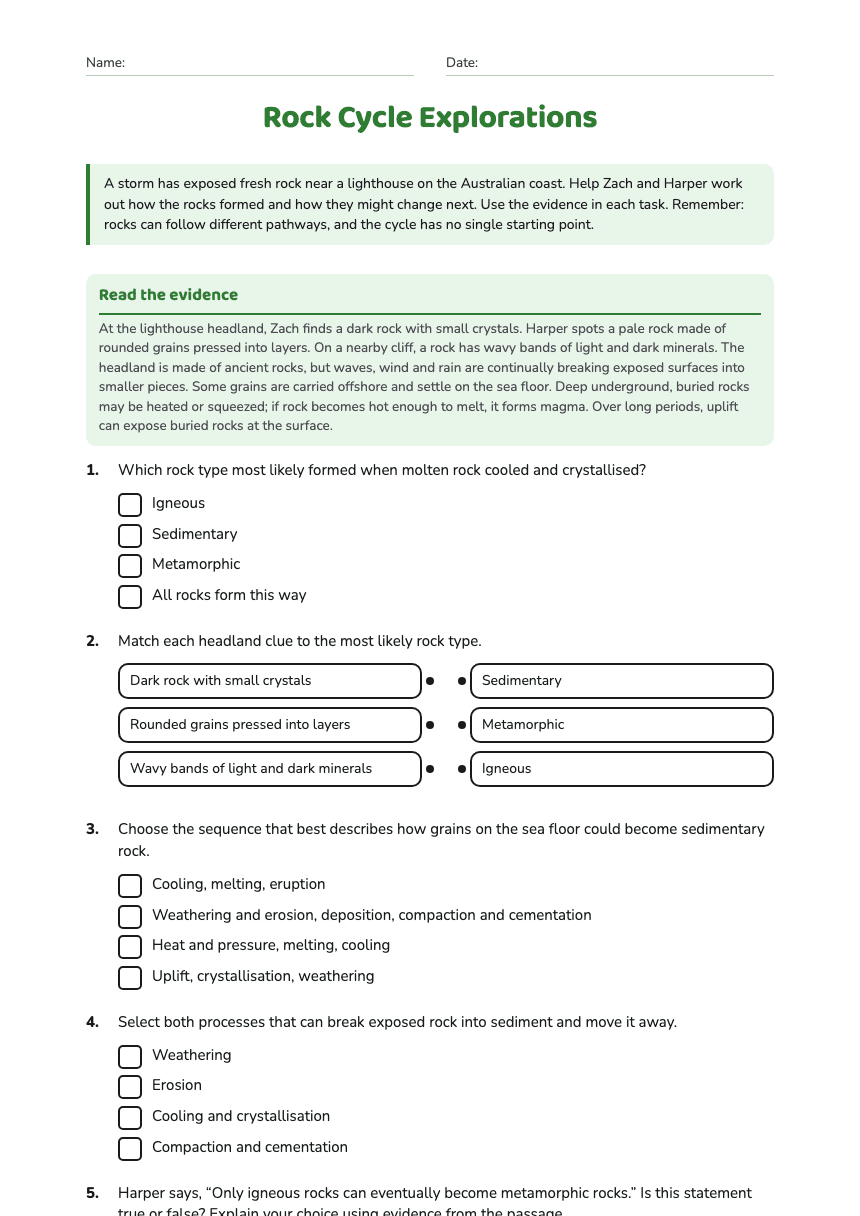
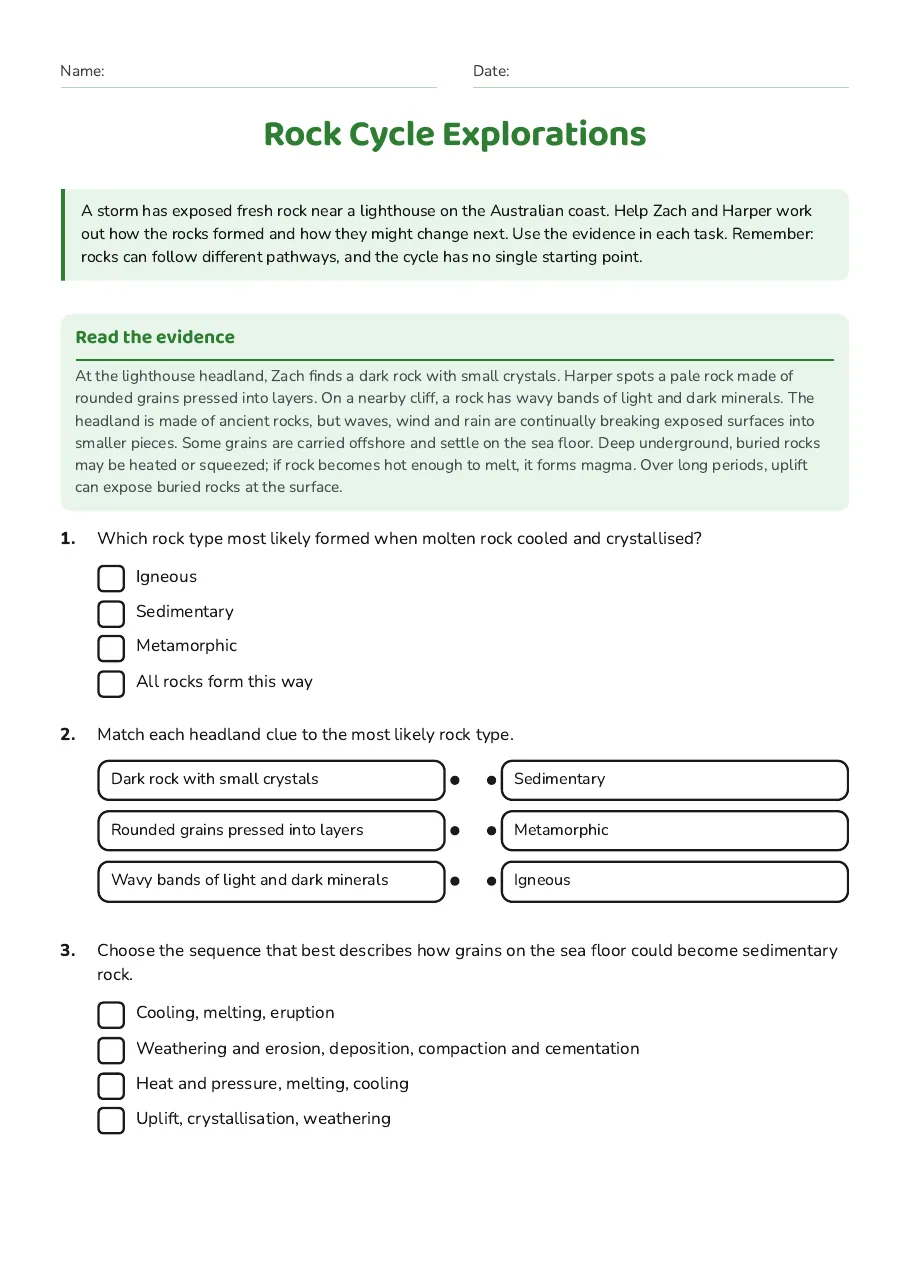
Read the evidence
At the lighthouse headland, Zach finds a dark rock with small crystals. Harper spots a pale rock made of rounded grains pressed into layers. On a nearby cliff, a rock has wavy bands of light and dark minerals. The headland is made of ancient rocks, but waves, wind and rain are continually breaking exposed surfaces into smaller pieces. Some grains are carried offshore and settle on the sea floor. Deep underground, buried rocks may be heated or squeezed; if rock becomes hot enough to melt, it forms magma. Over long periods, uplift can expose buried rocks at the surface.
- Igneous
- Sedimentary
- Metamorphic
- All rocks form this way
- Dark rock with small crystals
- Rounded grains pressed into layers
- Wavy bands of light and dark minerals
- Sedimentary
- Metamorphic
- Igneous
- Cooling, melting, eruption
- Weathering and erosion, deposition, compaction and cementation
- Heat and pressure, melting, cooling
- Uplift, crystallisation, weathering
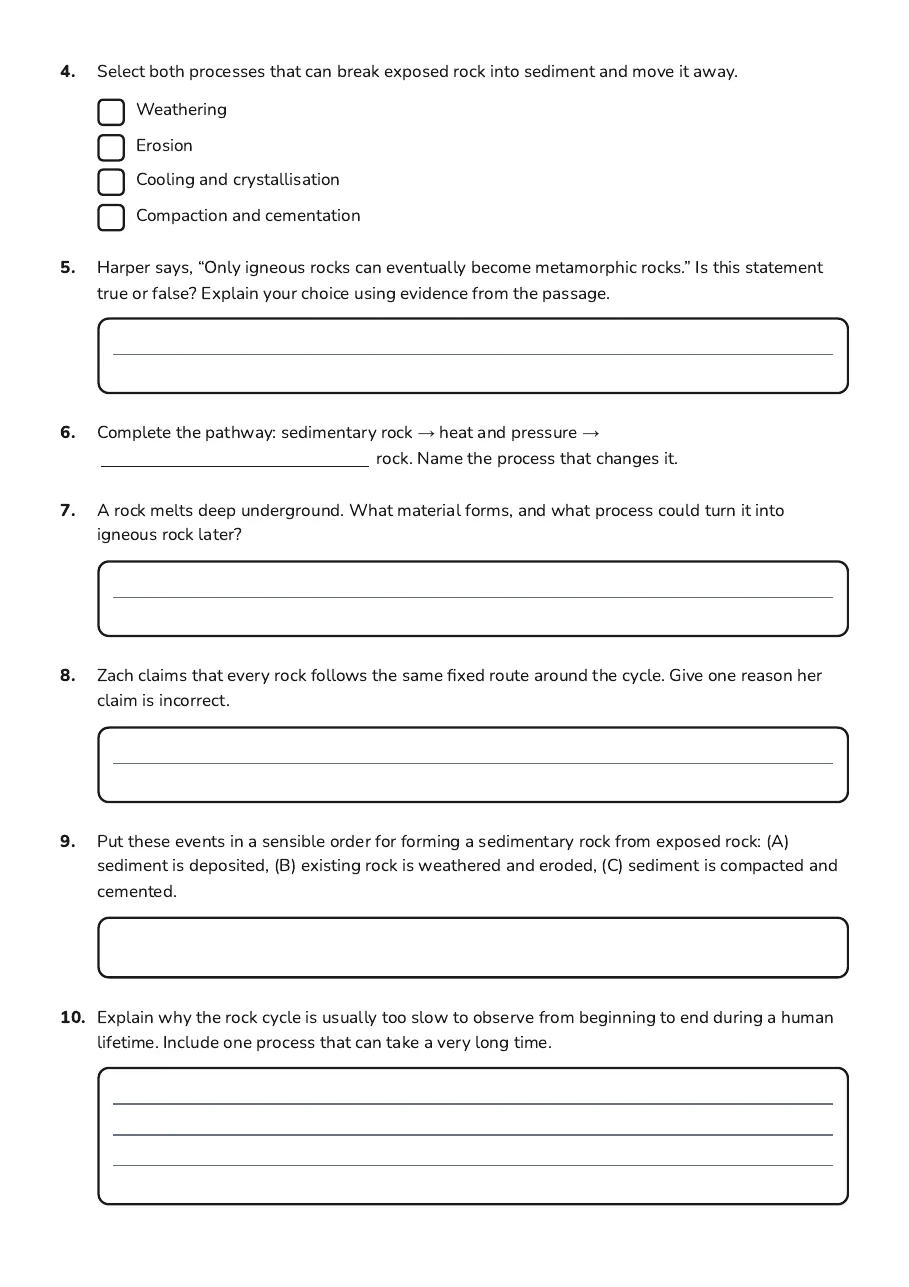
- Weathering
- Erosion
- Cooling and crystallisation
- Compaction and cementation
2 printable pages
Page 1
Page 2
About This Worksheet
Free in Kuraplan
Sign up free, grab the PDF, and customize it for your class.
Print-Ready
Formatted for standard paper. Clean layout, easy to read.
AI-Generated
Created with Kuraplan's AI, designed for real classroom use.
For Teachers & Parents
Use in classrooms, for homework, tutoring, or homeschool.
Need a custom version of this worksheet?
Kuraplan's AI generates custom worksheets in seconds — differentiated for every learner, aligned to your curriculum.
Generate Custom Worksheets — Free