Short Story Analysis
A free english worksheet ready for your classroom. Open in Kuraplan to grab the print-ready PDF, customize it for your students, or generate a fresh version in seconds.
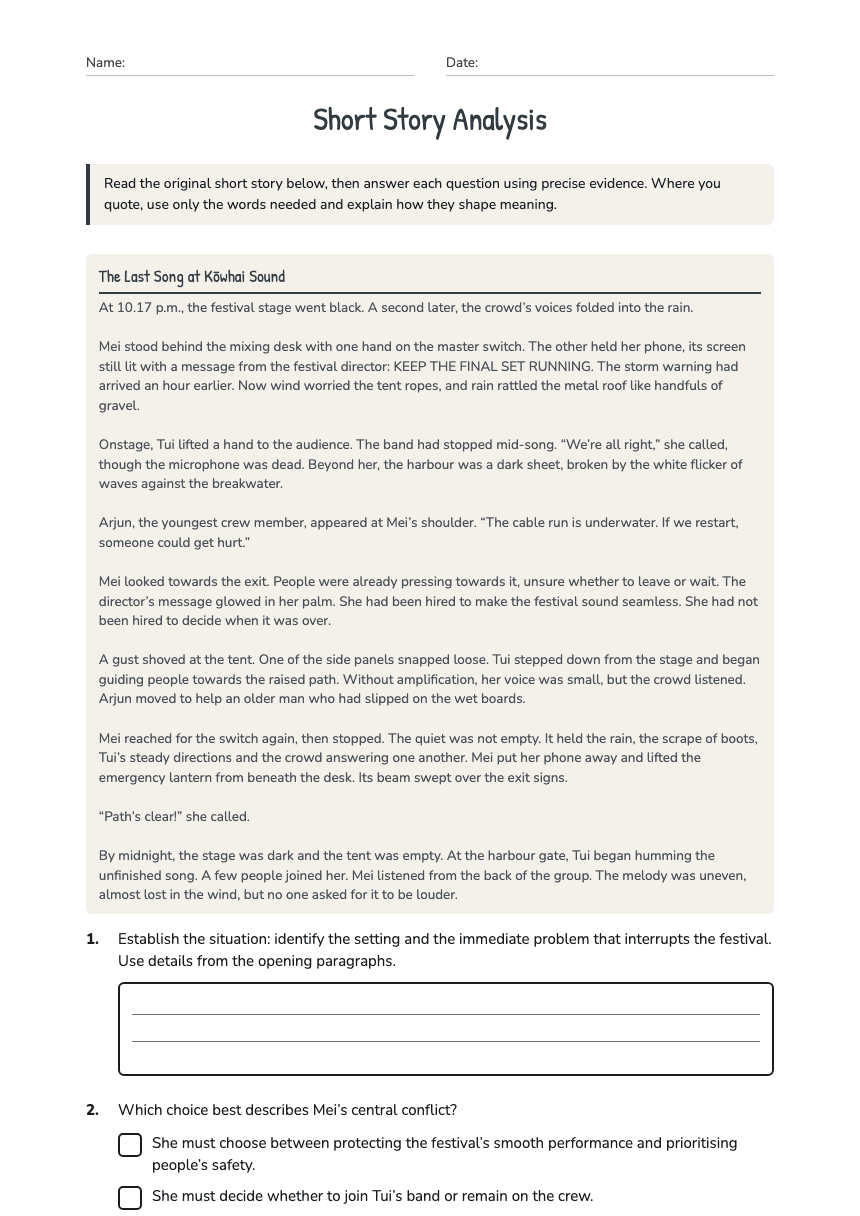
Short Story Analysis
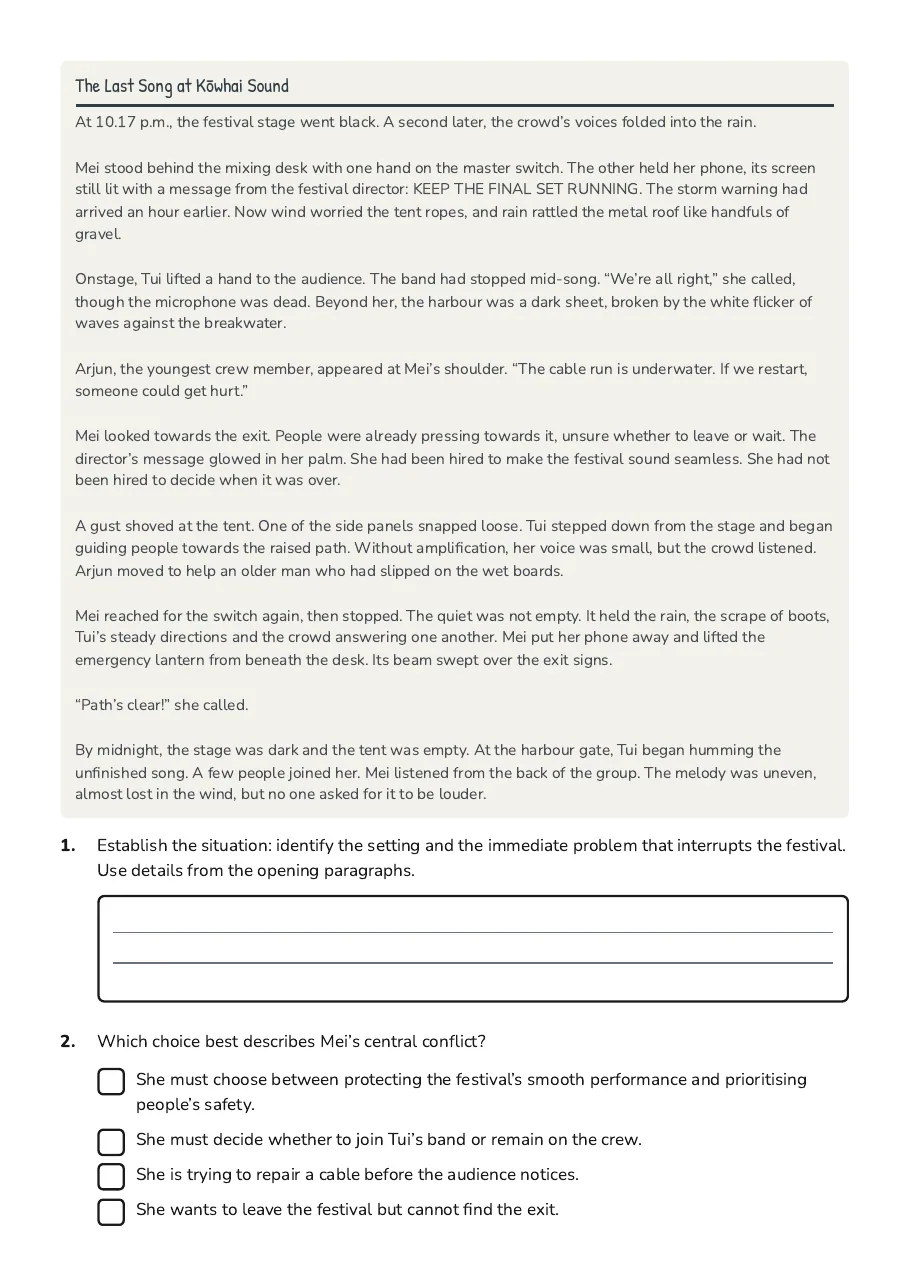
The Last Song at Kōwhai Sound
At 10.17 p.m., the festival stage went black. A second later, the crowd’s voices folded into the rain. Mei stood behind the mixing desk with one hand on the master switch. The other held her phone, its screen still lit with a message from the festival director: KEEP THE FINAL SET RUNNING. The storm warning had arrived an hour earlier. Now wind worried the tent ropes, and rain rattled the metal roof like handfuls of gravel. Onstage, Tui lifted a hand to the audience. The band had stopped mid-song. “We’re all right,” she called, though the microphone was dead. Beyond her, the harbour was a dark sheet, broken by the white flicker of waves against the breakwater. Arjun, the youngest crew member, appeared at Mei’s shoulder. “The cable run is underwater. If we restart, someone could get hurt.” Mei looked towards the exit. People were already pressing towards it, unsure whether to leave or wait. The director’s message glowed in her palm. She had been hired to make the festival sound seamless. She had not been hired to decide when it was over. A gust shoved at the tent. One of the side panels snapped loose. Tui stepped down from the stage and began guiding people towards the raised path. Without amplification, her voice was small, but the crowd listened. Arjun moved to help an older man who had slipped on the wet boards. Mei reached for the switch again, then stopped. The quiet was not empty. It held the rain, the scrape of boots, Tui’s steady directions and the crowd answering one another. Mei put her phone away and lifted the emergency lantern from beneath the desk. Its beam swept over the exit signs. “Path’s clear!” she called. By midnight, the stage was dark and the tent was empty. At the harbour gate, Tui began humming the unfinished song. A few people joined her. Mei listened from the back of the group. The melody was uneven, almost lost in the wind, but no one asked for it to be louder.
- She must choose between protecting the festival’s smooth performance and prioritising people’s safety.
- She must decide whether to join Tui’s band or remain on the crew.
- She is trying to repair a cable before the audience notices.
- She wants to leave the festival but cannot find the exit.
- Being responsible sometimes means rejecting pressure to keep up appearances.
- Technology always makes people less connected.
- Success depends on performing perfectly for an audience.
- Fear can only be overcome by ignoring danger.
4 printable pages

Page 1
Page 2
Page 3
Page 4
About This Worksheet
Free in Kuraplan
Sign up free, grab the PDF, and customize it for your class.
Print-Ready
Formatted for standard paper. Clean layout, easy to read.
AI-Generated
Created with Kuraplan's AI, designed for real classroom use.
For Teachers & Parents
Use in classrooms, for homework, tutoring, or homeschool.
Need a custom version of this worksheet?
Kuraplan's AI generates custom worksheets in seconds — differentiated for every learner, aligned to your curriculum.
Generate Custom Worksheets — Free