ScienceFreePrintable
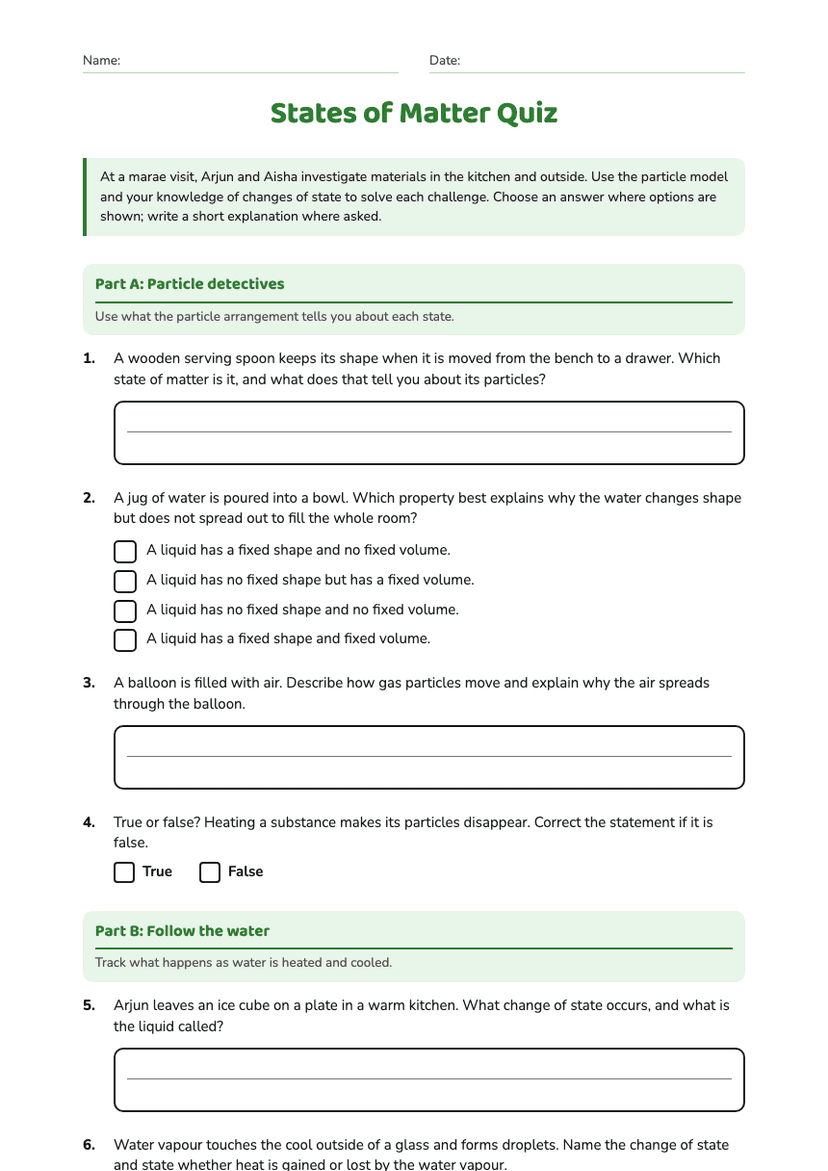
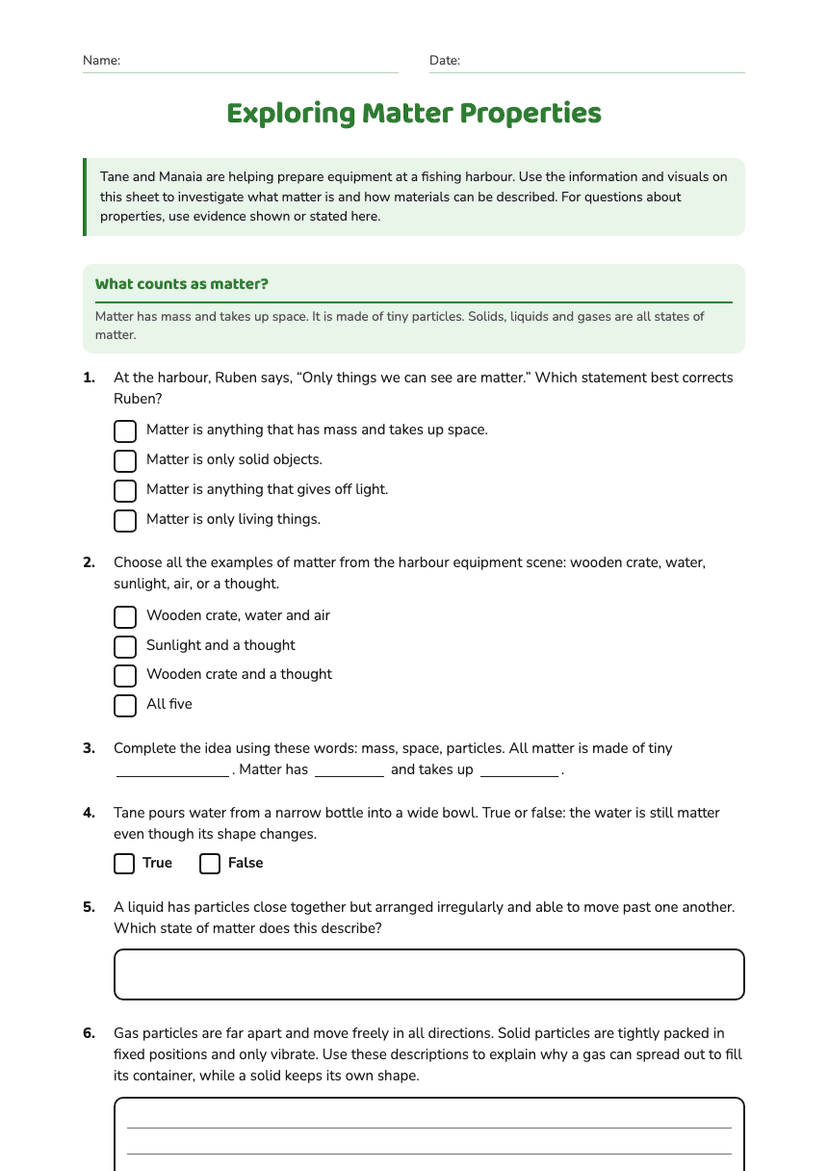
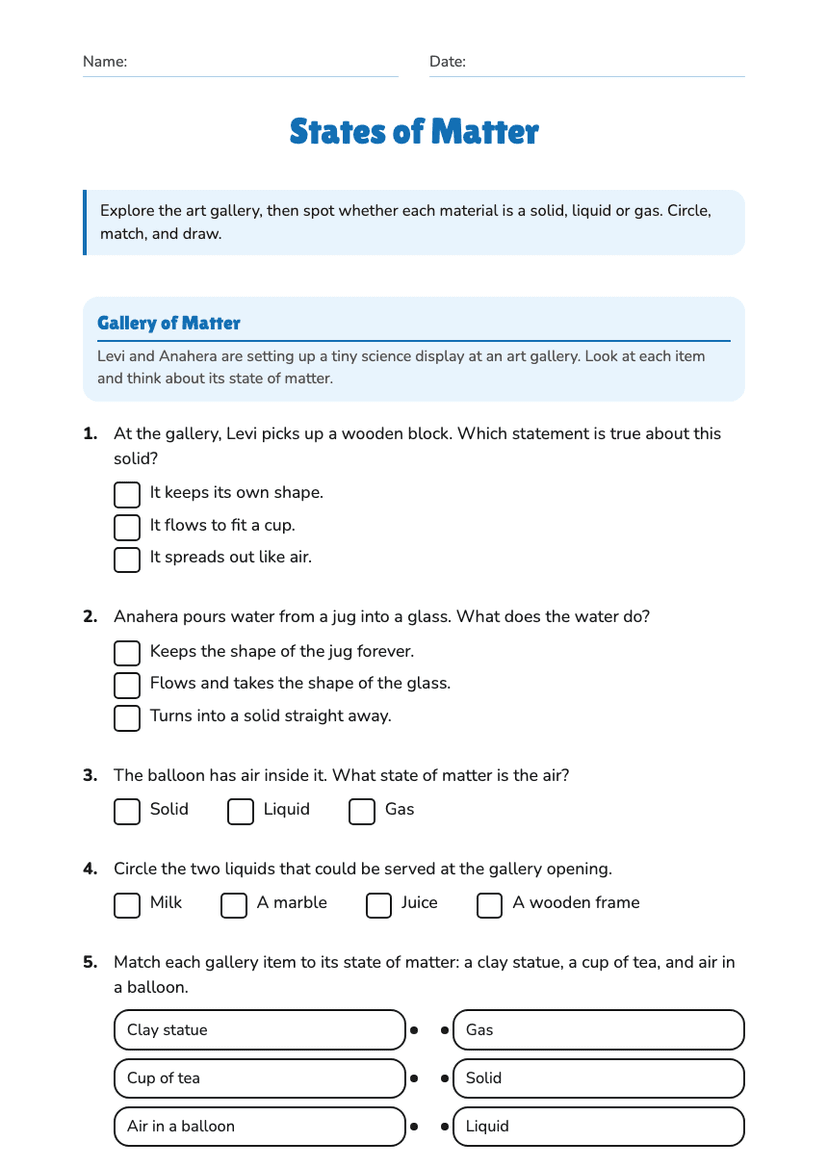
States of Matter
A free science worksheet ready for your classroom. Open in Kuraplan to grab the print-ready PDF, customize it for your students, or generate a fresh version in seconds.
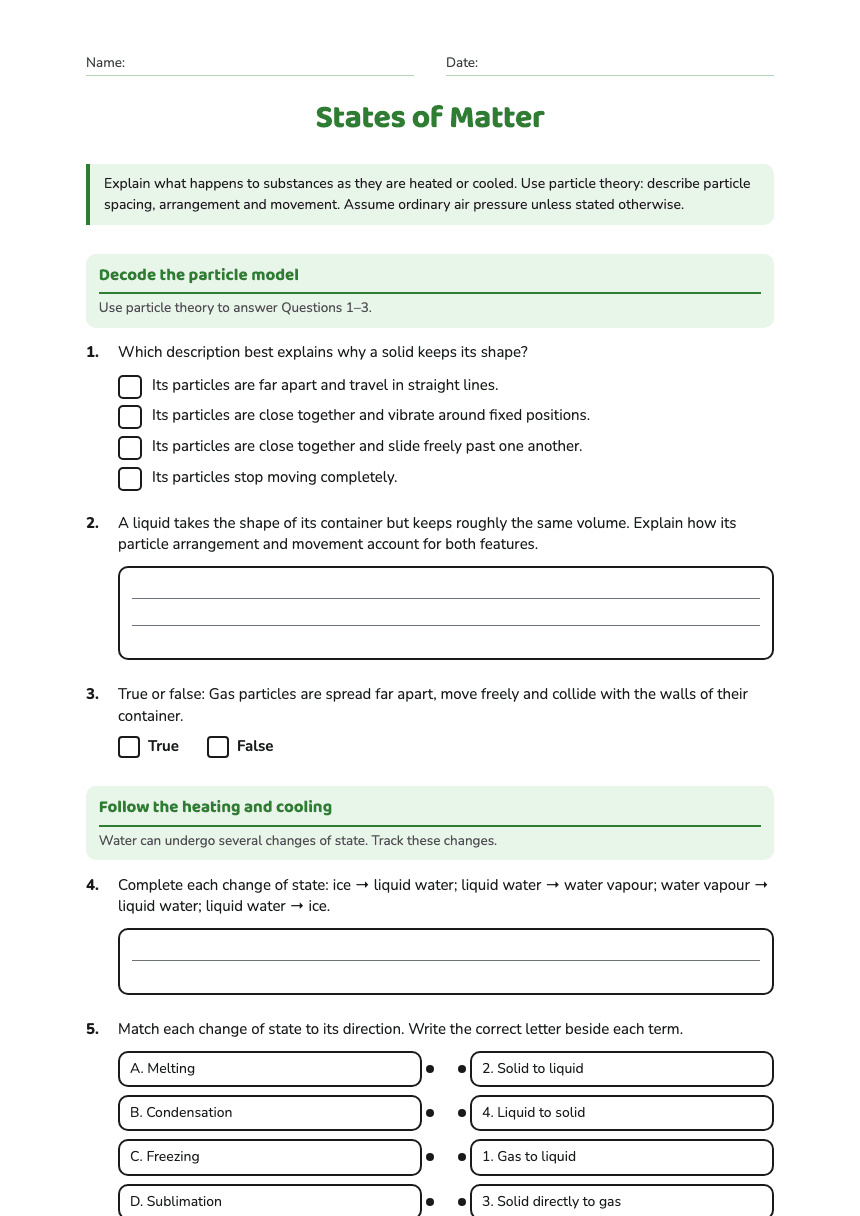
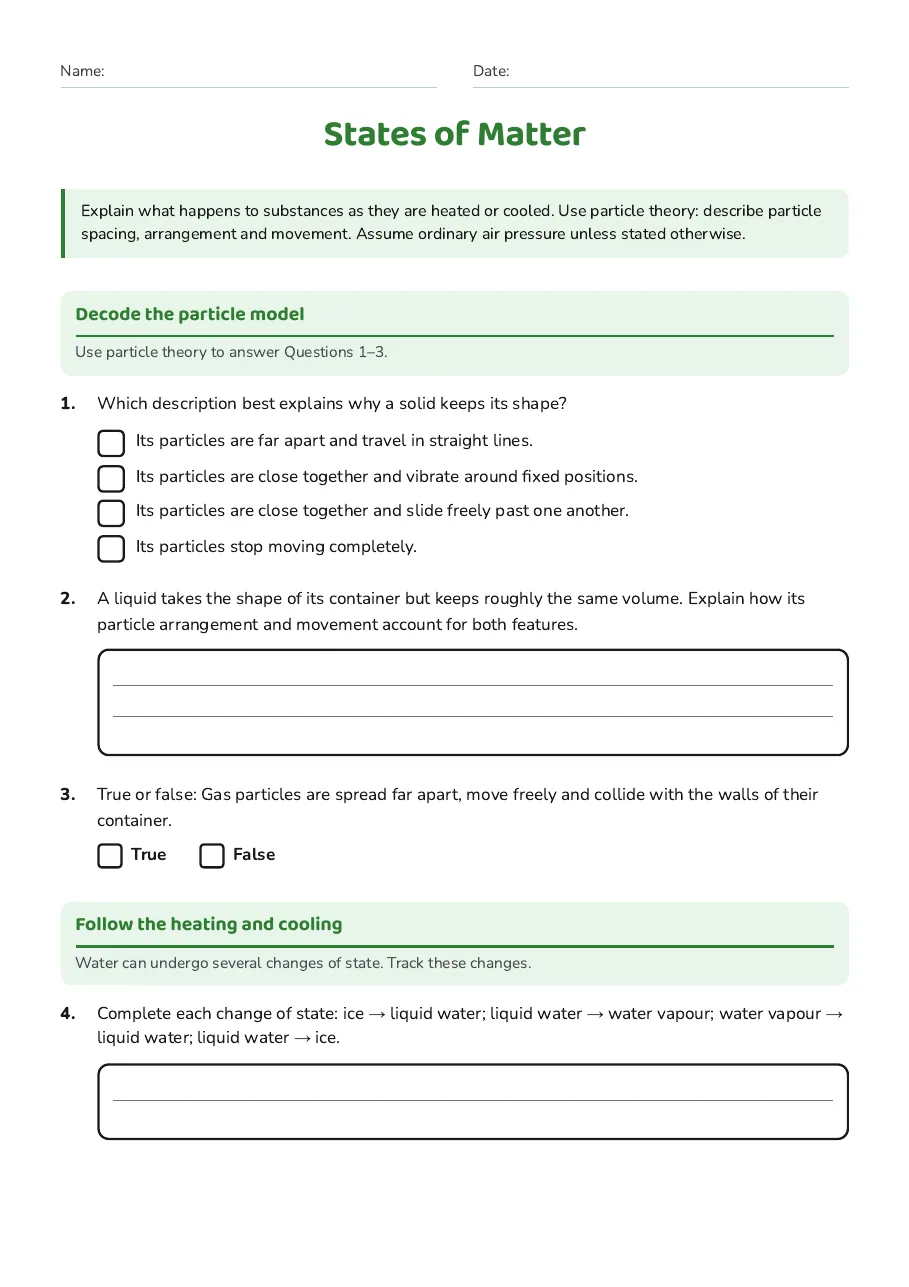
Name:Date:
States of Matter
Explain what happens to substances as they are heated or cooled. Use particle theory: describe particle spacing, arrangement and movement. Assume ordinary air pressure unless stated otherwise.
Decode the particle model
Use particle theory to answer Questions 1–3.
1.Which description best explains why a solid keeps its shape?
- Its particles are far apart and travel in straight lines.
- Its particles are close together and vibrate around fixed positions.
- Its particles are close together and slide freely past one another.
- Its particles stop moving completely.
2.A liquid takes the shape of its container but keeps roughly the same volume. Explain how its particle arrangement and movement account for both features.
3.True or false: Gas particles are spread far apart, move freely and collide with the walls of their container.
TrueFalse
Follow the heating and cooling
Water can undergo several changes of state. Track these changes.
4.Complete each change of state: ice → liquid water; liquid water → water vapour; water vapour → liquid water; liquid water → ice.
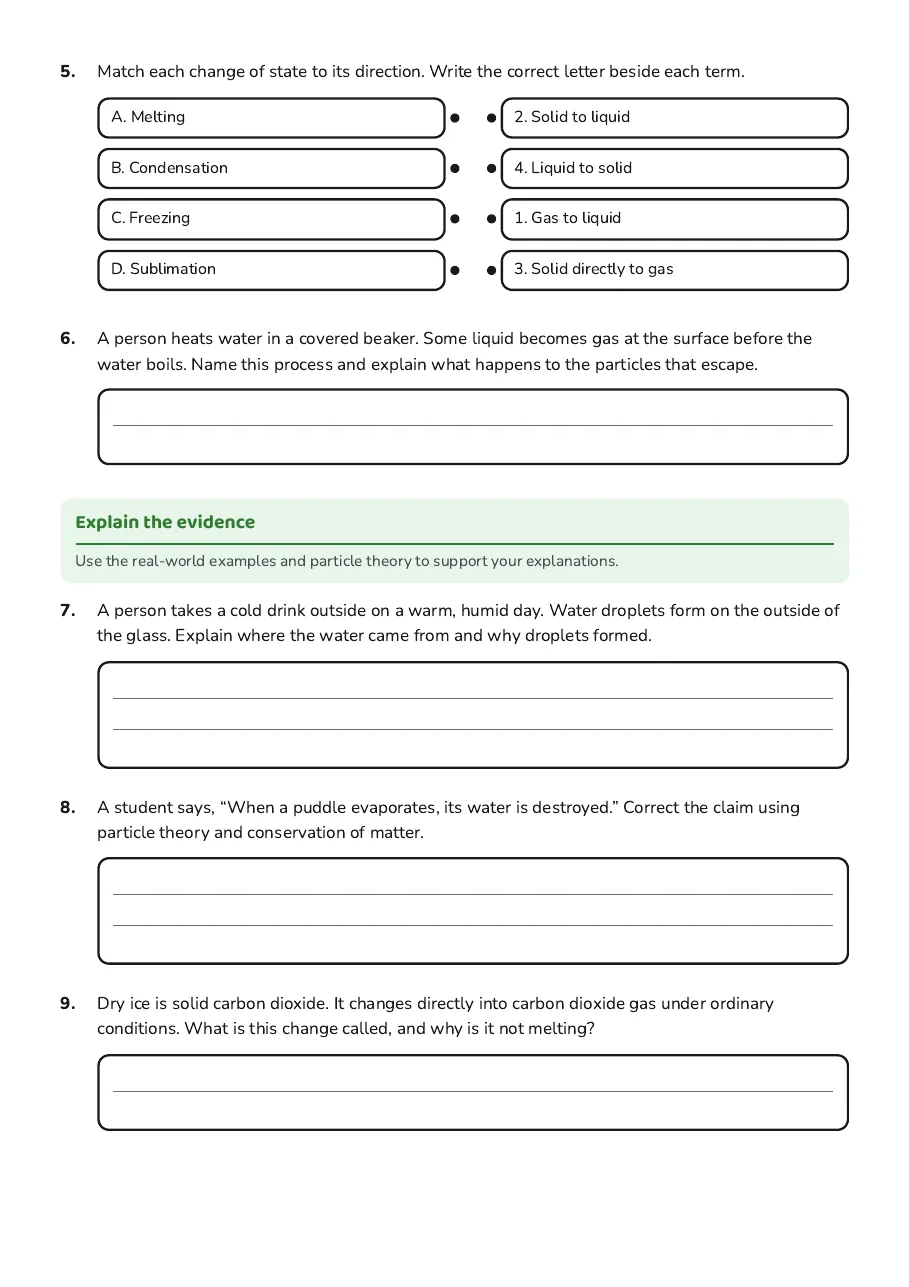
5.Match each change of state to its direction. Write the correct letter beside each term.
- A. Melting
- B. Condensation
- C. Freezing
- D. Sublimation
- 2. Solid to liquid
- 4. Liquid to solid
- 1. Gas to liquid
- 3. Solid directly to gas
6.A person heats water in a covered beaker. Some liquid becomes gas at the surface before the water boils. Name this process and explain what happens to the particles that escape.
Explain the evidence
Use the real-world examples and particle theory to support your explanations.
7.A person takes a cold drink outside on a warm, humid day. Water droplets form on the outside of the glass. Explain where the water came from and why droplets formed.
8.A student says, “When a puddle evaporates, its water is destroyed.” Correct the claim using particle theory and conservation of matter.
9.Dry ice is solid carbon dioxide. It changes directly into carbon dioxide gas under ordinary conditions. What is this change called, and why is it not melting?
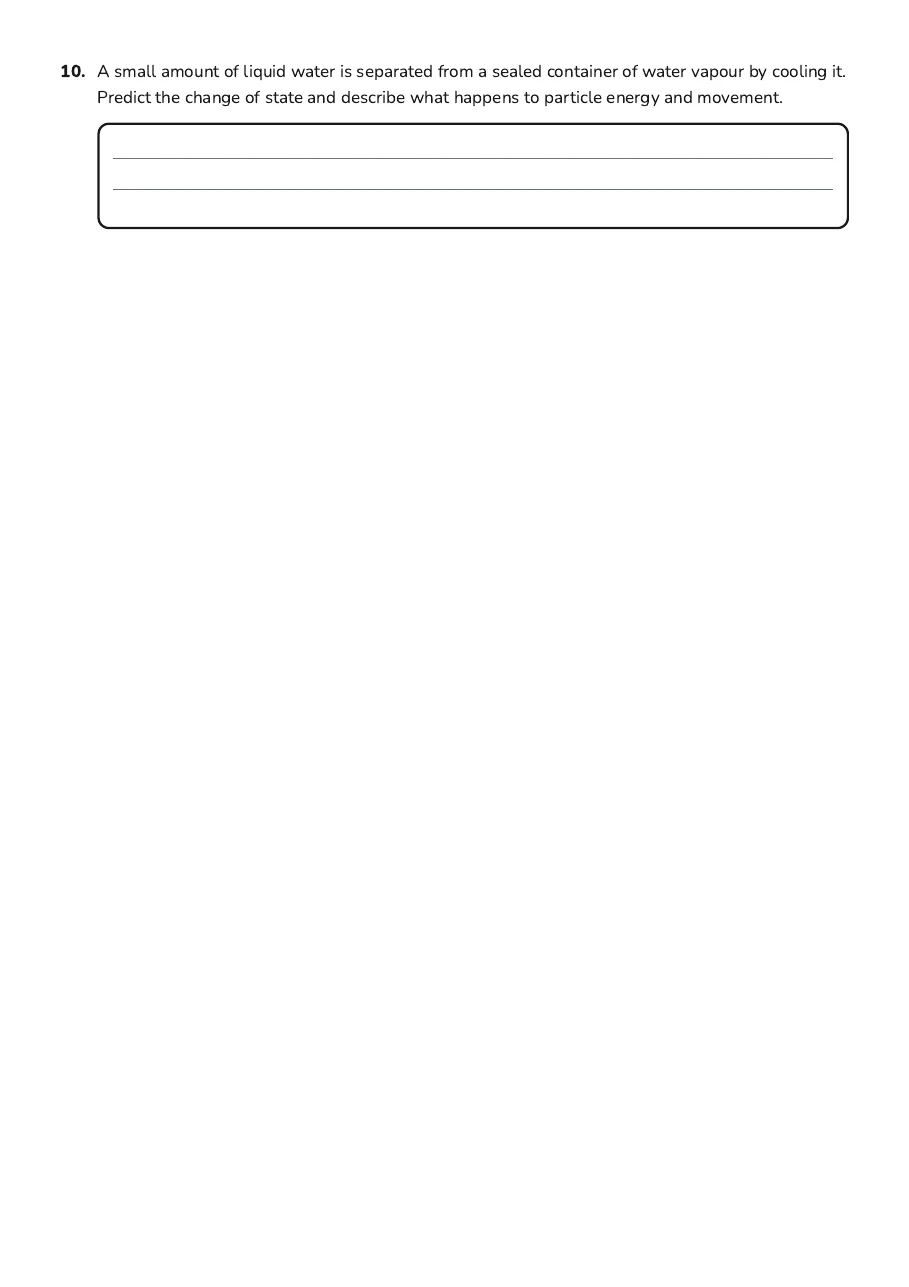
10.A small amount of liquid water is separated from a sealed container of water vapour by cooling it. Predict the change of state and describe what happens to particle energy and movement.
3 printable pages
Page 1
Page 2
Page 3
About This Worksheet
Free in Kuraplan
Sign up free, grab the PDF, and customize it for your class.
Print-Ready
Formatted for standard paper. Clean layout, easy to read.
AI-Generated
Created with Kuraplan's AI, designed for real classroom use.
For Teachers & Parents
Use in classrooms, for homework, tutoring, or homeschool.
Need a custom version of this worksheet?
Kuraplan's AI generates custom worksheets in seconds — differentiated for every learner, aligned to your curriculum.
Generate Custom Worksheets — Free No credit card Curriculum-aligned Under 60 seconds