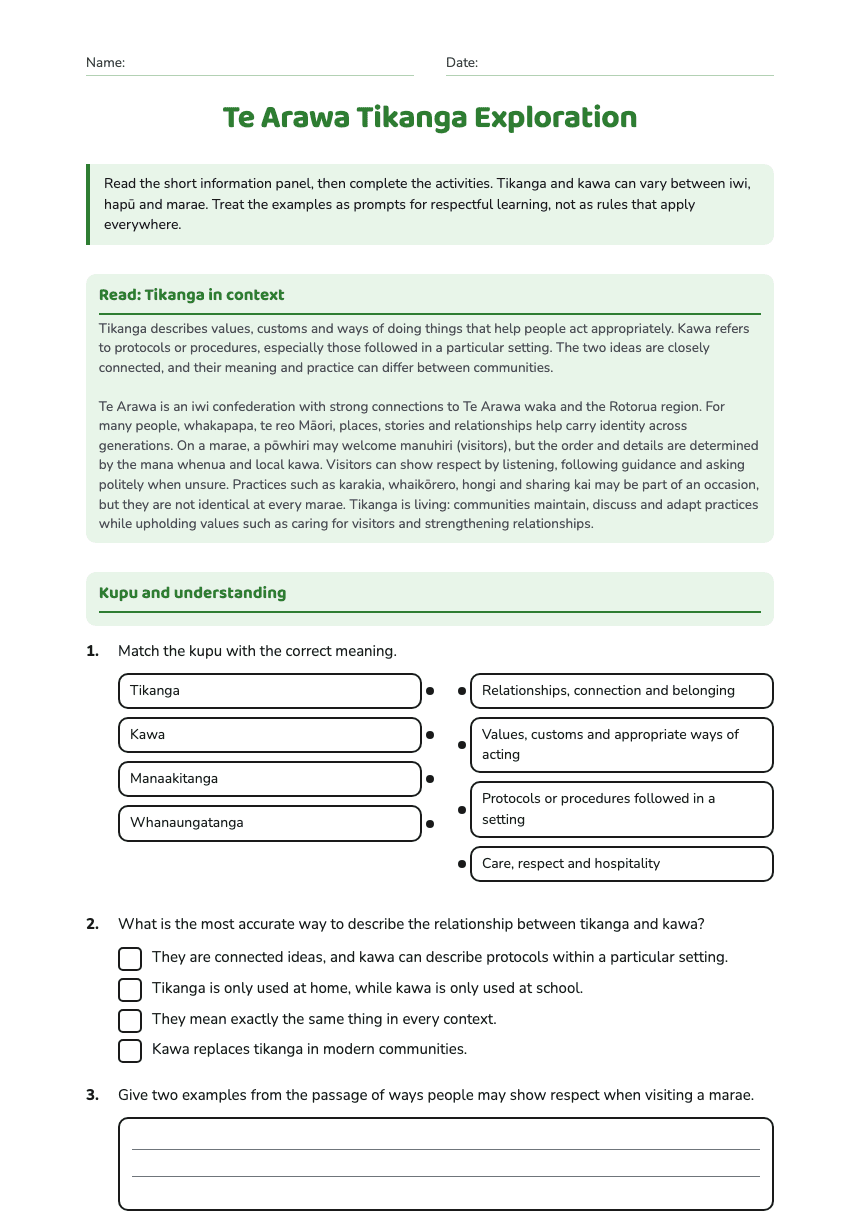
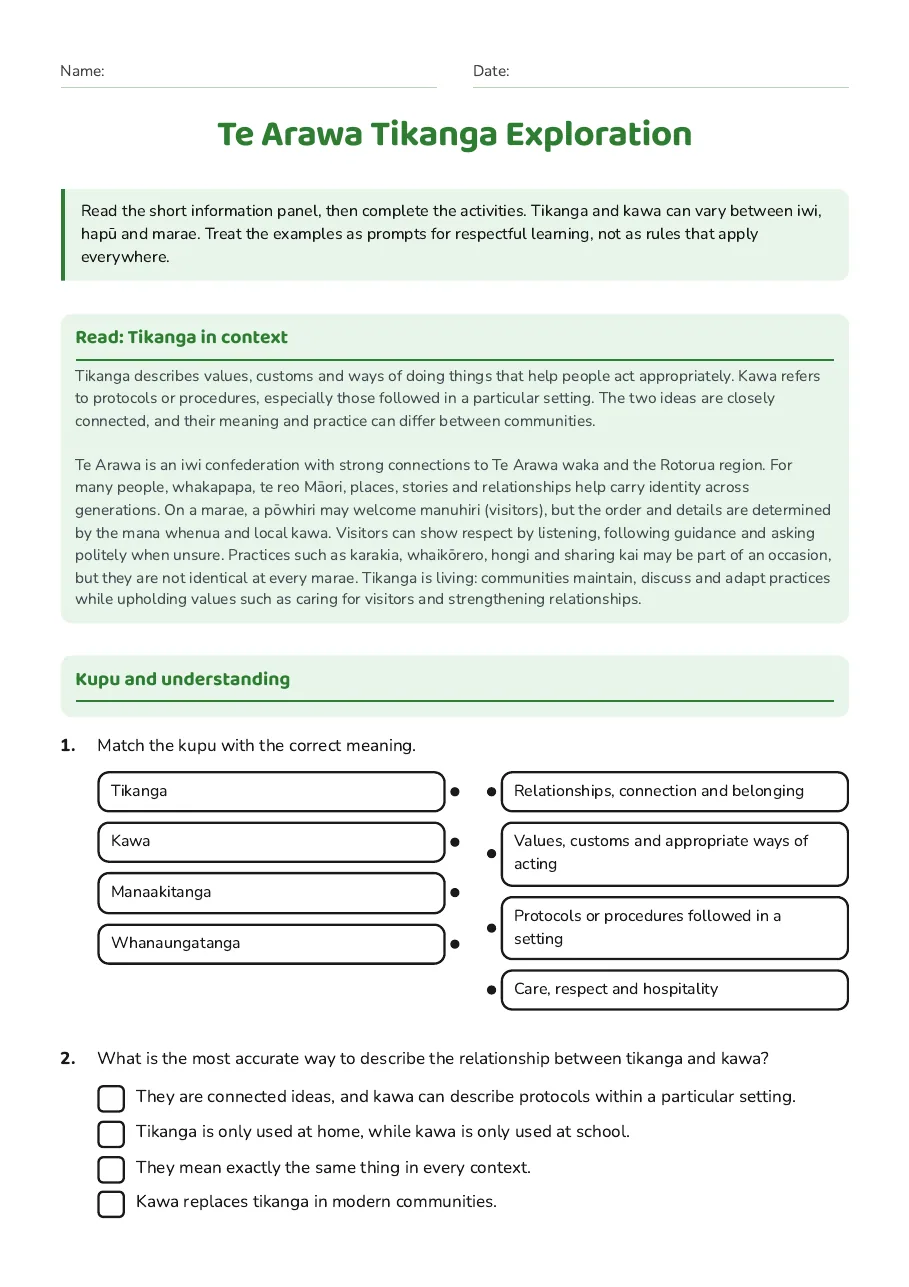
Te Arawa Tikanga Exploration
A free te reo māori worksheet ready for your classroom. Open in Kuraplan to grab the print-ready PDF, customize it for your students, or generate a fresh version in seconds.
Te Arawa Tikanga Exploration
Read: Tikanga in context
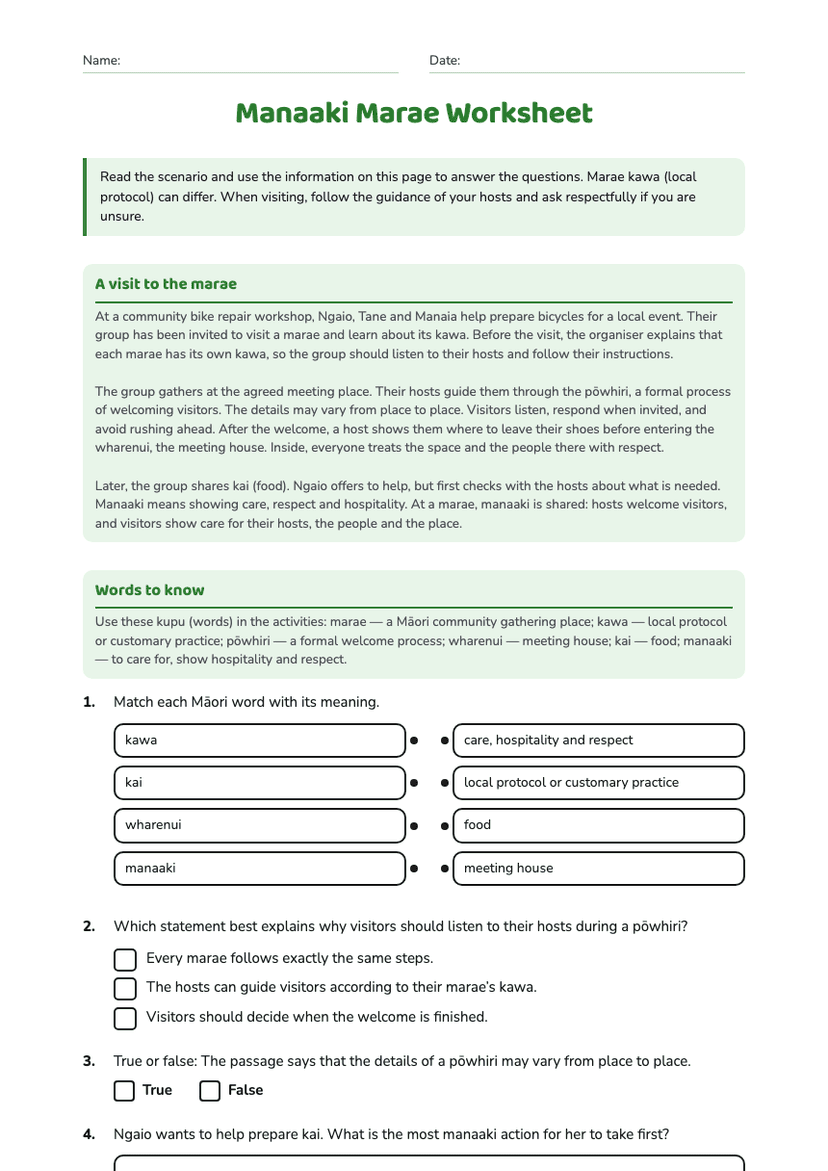
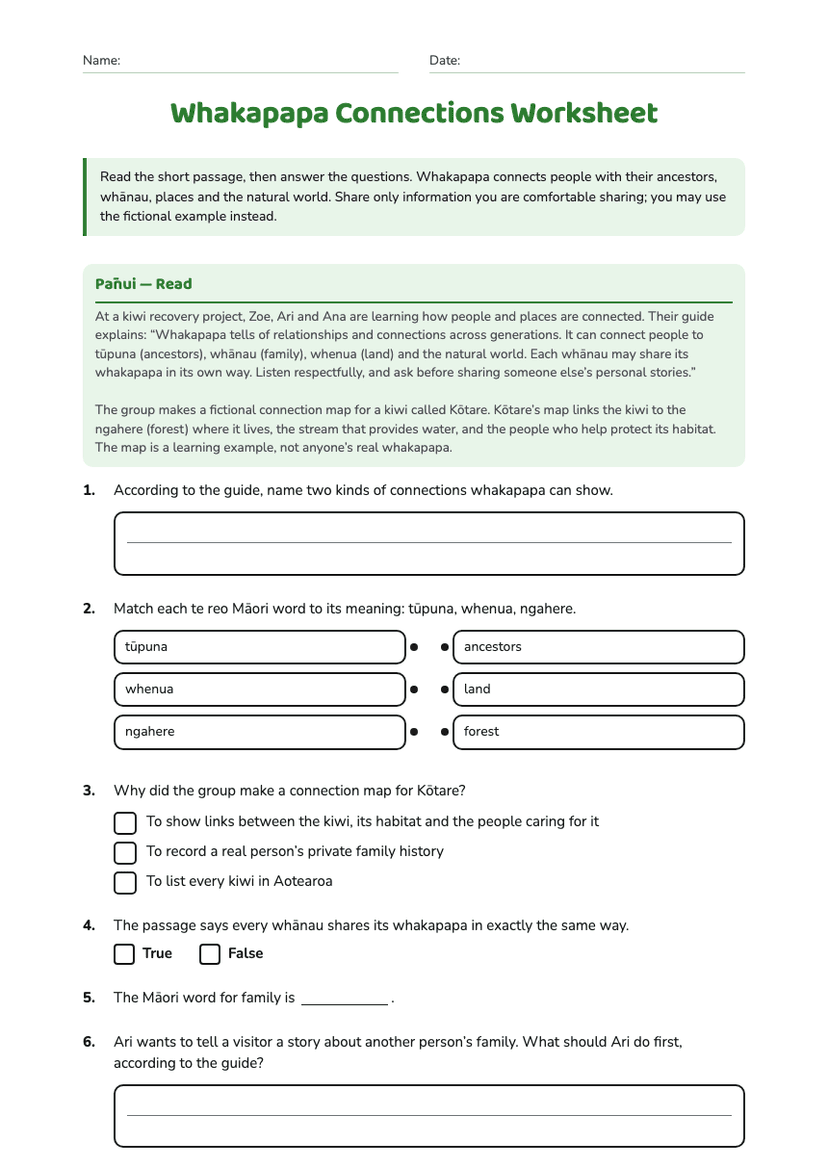
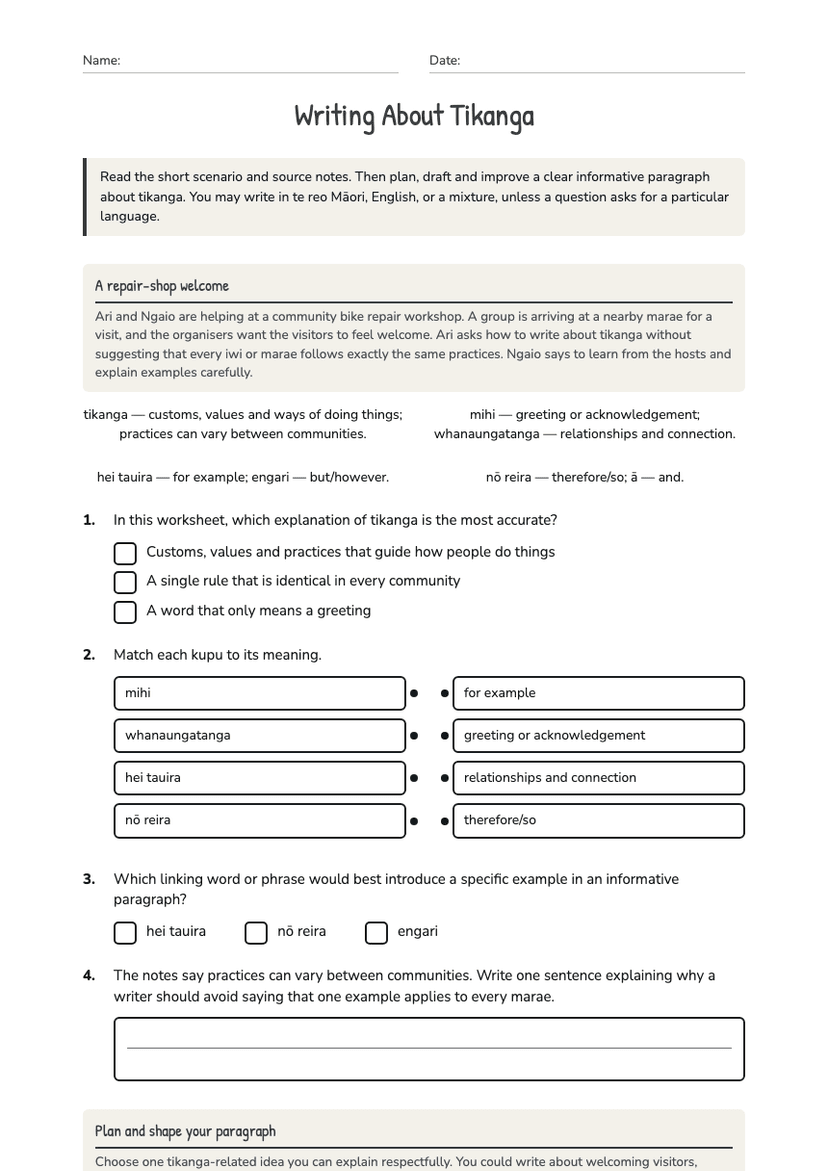
Tikanga describes values, customs and ways of doing things that help people act appropriately. Kawa refers to protocols or procedures, especially those followed in a particular setting. The two ideas are closely connected, and their meaning and practice can differ between communities. Te Arawa is an iwi confederation with strong connections to Te Arawa waka and the Rotorua region. For many people, whakapapa, te reo Māori, places, stories and relationships help carry identity across generations. On a marae, a pōwhiri may welcome manuhiri (visitors), but the order and details are determined by the mana whenua and local kawa. Visitors can show respect by listening, following guidance and asking politely when unsure. Practices such as karakia, whaikōrero, hongi and sharing kai may be part of an occasion, but they are not identical at every marae. Tikanga is living: communities maintain, discuss and adapt practices while upholding values such as caring for visitors and strengthening relationships.
Kupu and understanding
- Tikanga
- Kawa
- Manaakitanga
- Whanaungatanga
- Relationships, connection and belonging
- Values, customs and appropriate ways of acting
- Protocols or procedures followed in a setting
- Care, respect and hospitality
- They are connected ideas, and kawa can describe protocols within a particular setting.
- Tikanga is only used at home, while kawa is only used at school.
- They mean exactly the same thing in every context.
- Kawa replaces tikanga in modern communities.
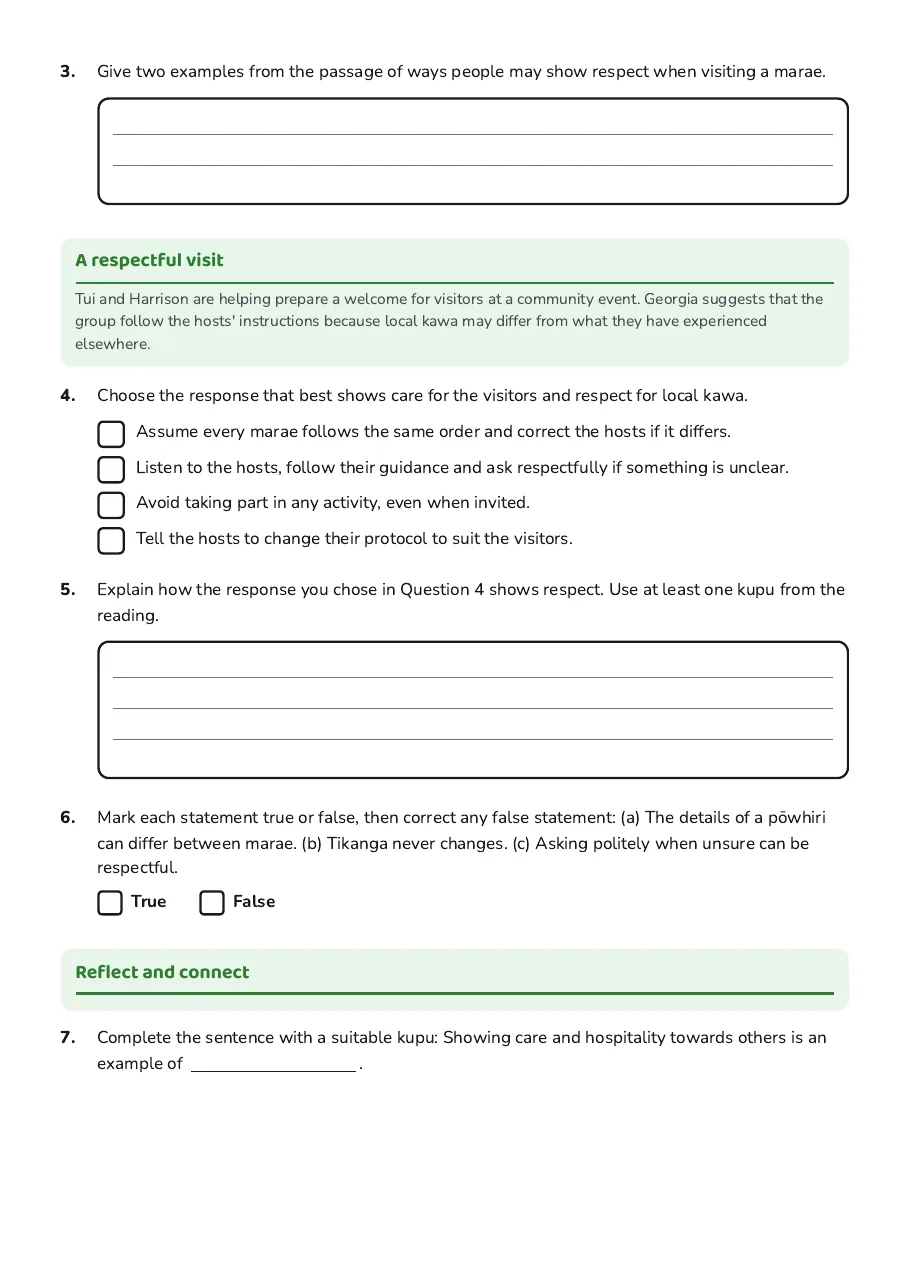
A respectful visit
Tui and Harrison are helping prepare a welcome for visitors at a community event. Georgia suggests that the group follow the hosts' instructions because local kawa may differ from what they have experienced elsewhere.
- Assume every marae follows the same order and correct the hosts if it differs.
- Listen to the hosts, follow their guidance and ask respectfully if something is unclear.
- Avoid taking part in any activity, even when invited.
- Tell the hosts to change their protocol to suit the visitors.
Reflect and connect
3 printable pages
Page 1
Page 2
Page 3
About This Worksheet
Free in Kuraplan
Sign up free, grab the PDF, and customize it for your class.
Print-Ready
Formatted for standard paper. Clean layout, easy to read.
AI-Generated
Created with Kuraplan's AI, designed for real classroom use.
For Teachers & Parents
Use in classrooms, for homework, tutoring, or homeschool.
Need a custom version of this worksheet?
Kuraplan's AI generates custom worksheets in seconds — differentiated for every learner, aligned to your curriculum.
Generate Custom Worksheets — Free