Titanic Construction History
A free english worksheet ready for your classroom. Open in Kuraplan to grab the print-ready PDF, customize it for your students, or generate a fresh version in seconds.
Titanic Construction History
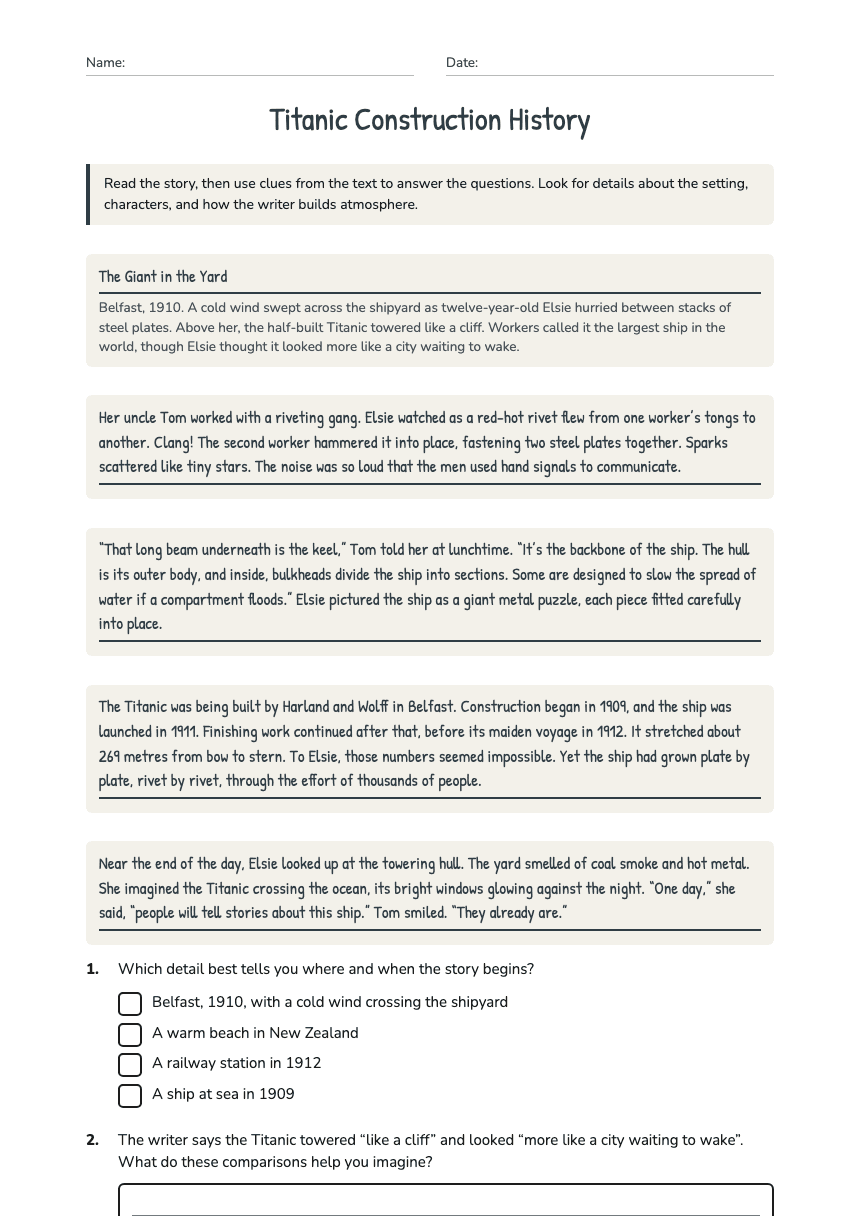
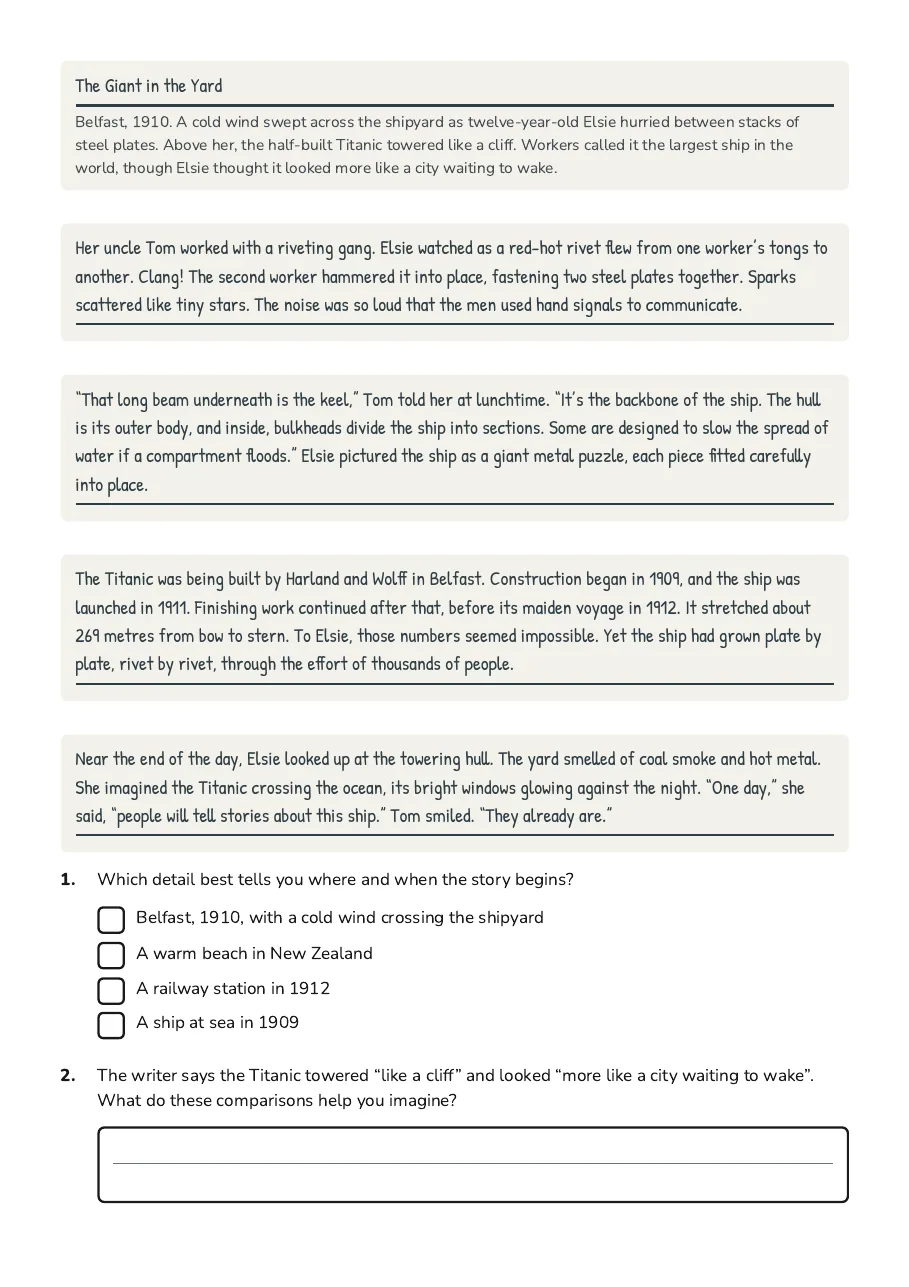
The Giant in the Yard
Belfast, 1910. A cold wind swept across the shipyard as twelve-year-old Elsie hurried between stacks of steel plates. Above her, the half-built Titanic towered like a cliff. Workers called it the largest ship in the world, though Elsie thought it looked more like a city waiting to wake.
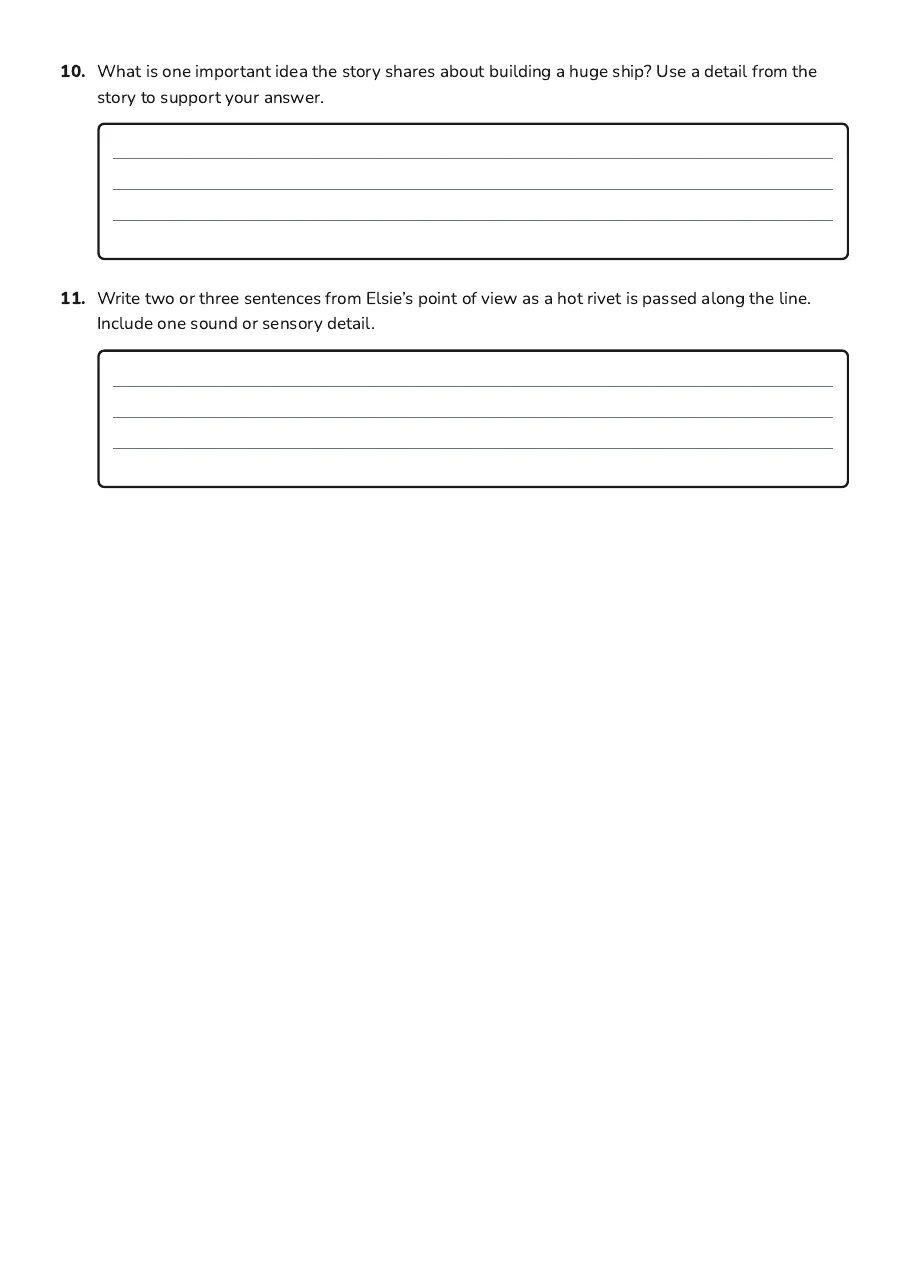
Her uncle Tom worked with a riveting gang. Elsie watched as a red-hot rivet flew from one worker’s tongs to another. Clang! The second worker hammered it into place, fastening two steel plates together. Sparks scattered like tiny stars. The noise was so loud that the men used hand signals to communicate.
“That long beam underneath is the keel,” Tom told her at lunchtime. “It’s the backbone of the ship. The hull is its outer body, and inside, bulkheads divide the ship into sections. Some are designed to slow the spread of water if a compartment floods.” Elsie pictured the ship as a giant metal puzzle, each piece fitted carefully into place.
The Titanic was being built by Harland and Wolff in Belfast. Construction began in 1909, and the ship was launched in 1911. Finishing work continued after that, before its maiden voyage in 1912. It stretched about 269 metres from bow to stern. To Elsie, those numbers seemed impossible. Yet the ship had grown plate by plate, rivet by rivet, through the effort of thousands of people.
Near the end of the day, Elsie looked up at the towering hull. The yard smelled of coal smoke and hot metal. She imagined the Titanic crossing the ocean, its bright windows glowing against the night. “One day,” she said, “people will tell stories about this ship.” Tom smiled. “They already are.”
- Belfast, 1910, with a cold wind crossing the shipyard
- A warm beach in New Zealand
- A railway station in 1912
- A ship at sea in 1909
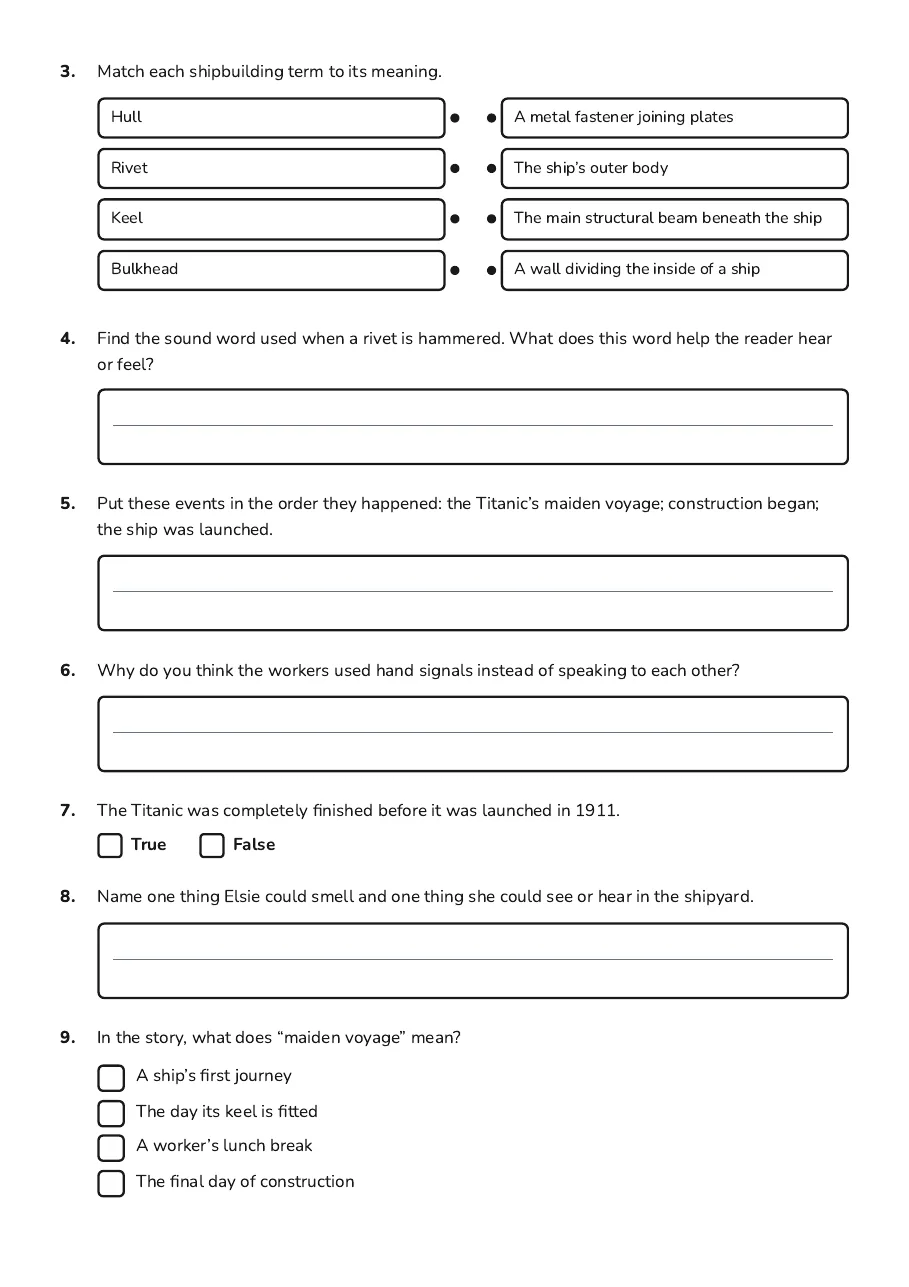
- Hull
- Rivet
- Keel
- Bulkhead
- A metal fastener joining plates
- The ship’s outer body
- The main structural beam beneath the ship
- A wall dividing the inside of a ship
- A ship’s first journey
- The day its keel is fitted
- A worker’s lunch break
- The final day of construction
4 printable pages
Page 1
Page 2
Page 3
Page 4
About This Worksheet
Free in Kuraplan
Sign up free, grab the PDF, and customize it for your class.
Print-Ready
Formatted for standard paper. Clean layout, easy to read.
AI-Generated
Created with Kuraplan's AI, designed for real classroom use.
For Teachers & Parents
Use in classrooms, for homework, tutoring, or homeschool.
Need a custom version of this worksheet?
Kuraplan's AI generates custom worksheets in seconds — differentiated for every learner, aligned to your curriculum.
Generate Custom Worksheets — Free