Te Reo MāoriFreePrintable

Toku Marae Writing

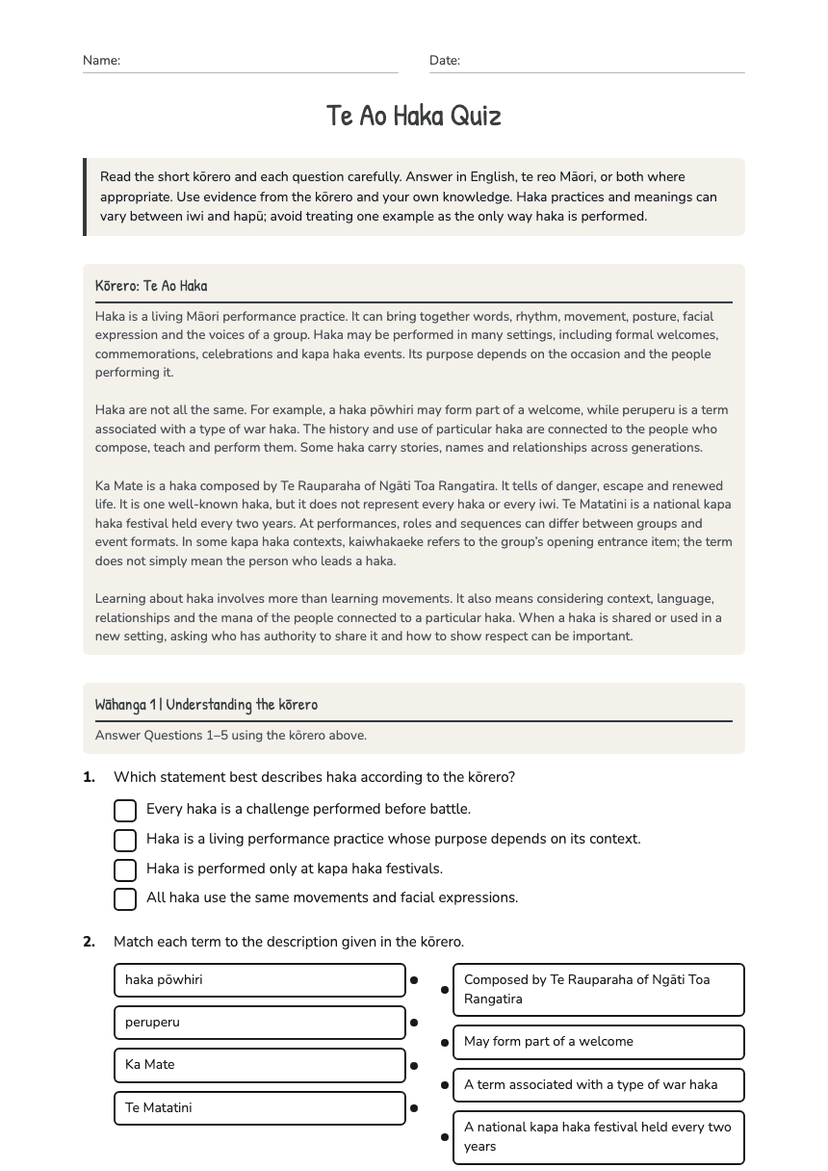
A free te reo māori worksheet ready for your classroom. Open in Kuraplan to grab the print-ready PDF, customize it for your students, or generate a fresh version in seconds.
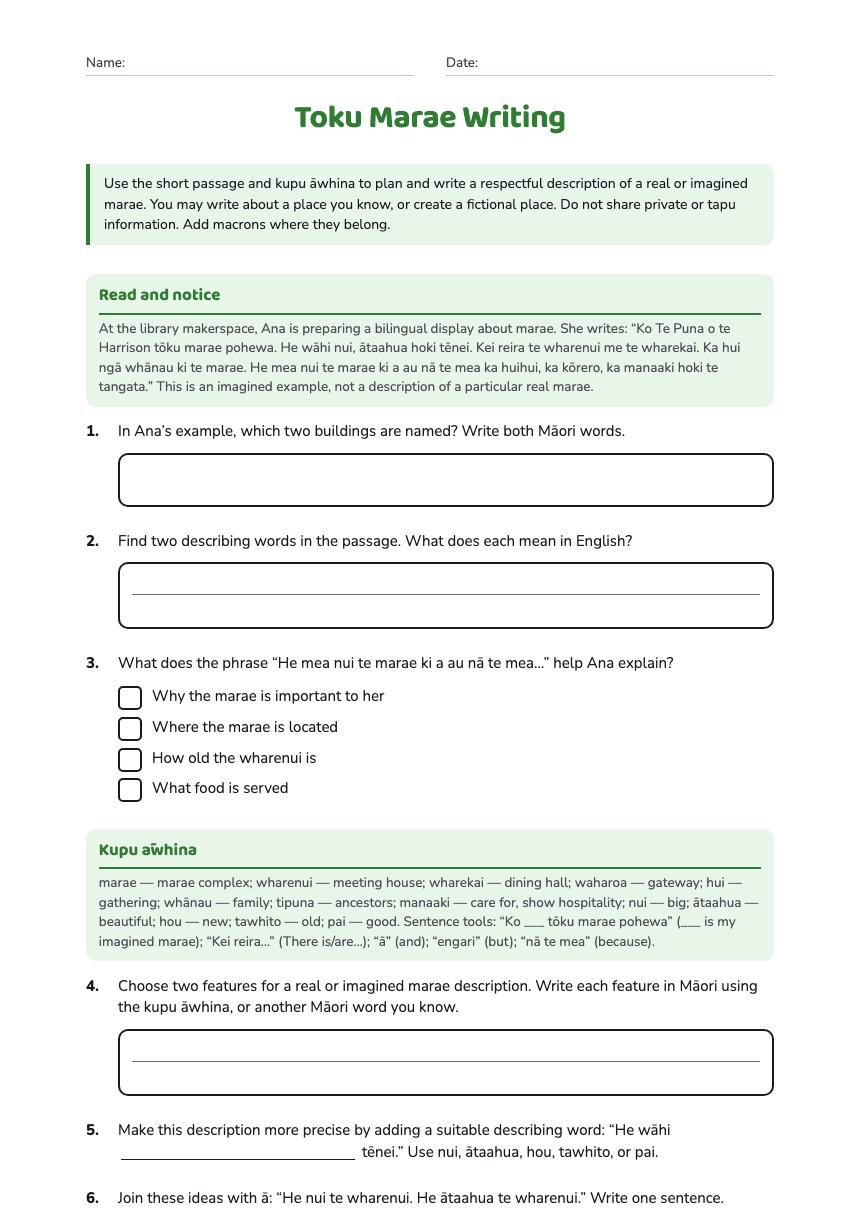
Toku Marae Writing worksheet preview
Name:Date:

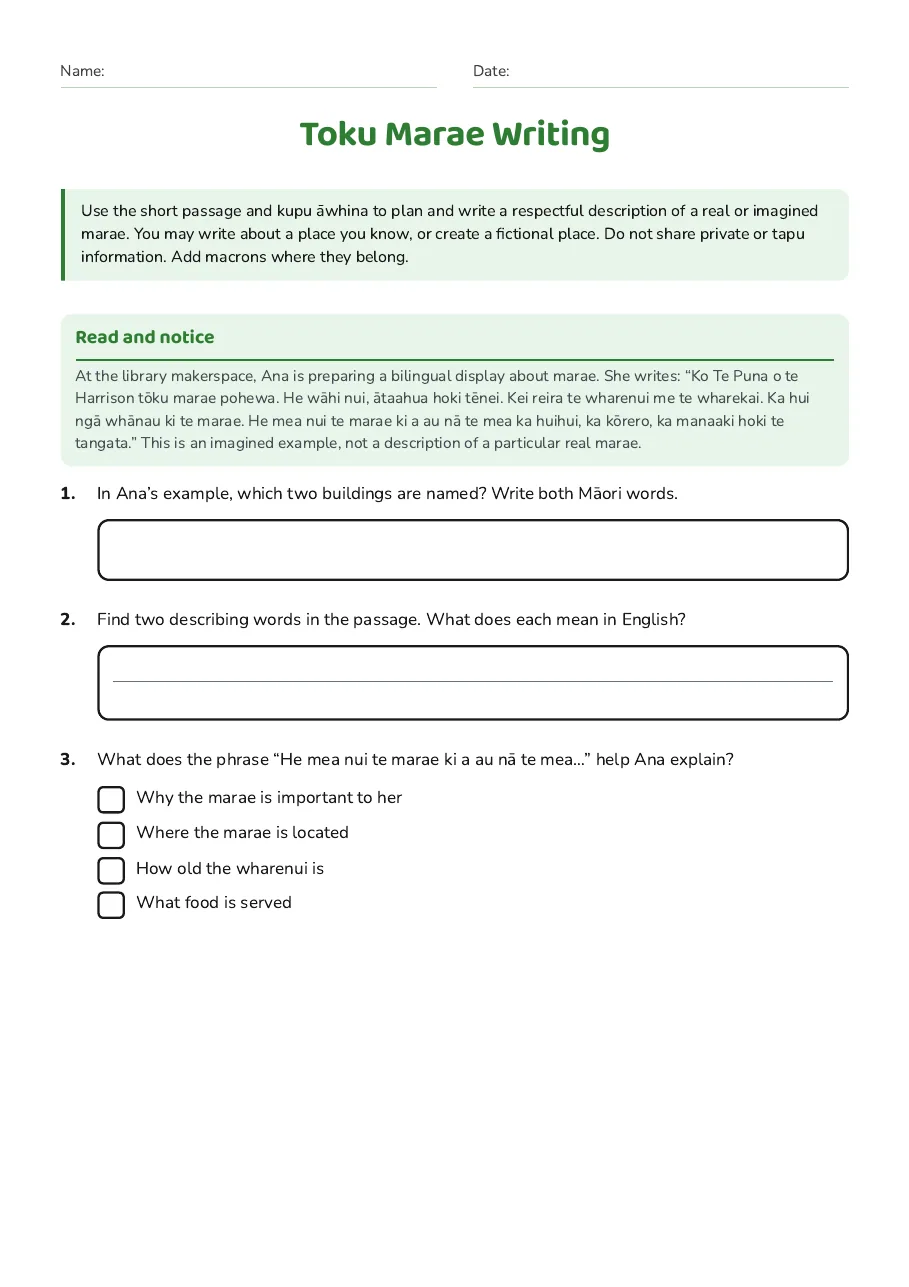
Toku Marae Writing

Use the short passage and kupu āwhina to plan and write a respectful description of a real or imagined marae. You may write about a place you know, or create a fictional place. Do not share private or tapu information. Add macrons where they belong.

Read and notice

At the library makerspace, Ana is preparing a bilingual display about marae. She writes: “Ko Te Puna o te Harrison tōku marae pohewa. He wāhi nui, ātaahua hoki tēnei. Kei reira te wharenui me te wharekai. Ka hui ngā whānau ki te marae. He mea nui te marae ki a au nā te mea ka huihui, ka kōrero, ka manaaki hoki te tangata.” This is an imagined example, not a description of a particular real marae.

1.In Ana’s example, which two buildings are named? Write both Māori words.
2.Find two describing words in the passage. What does each mean in English?
3.What does the phrase “He mea nui te marae ki a au nā te mea…” help Ana explain?
  • Why the marae is important to her
  • Where the marae is located
  • How old the wharenui is
  • What food is served

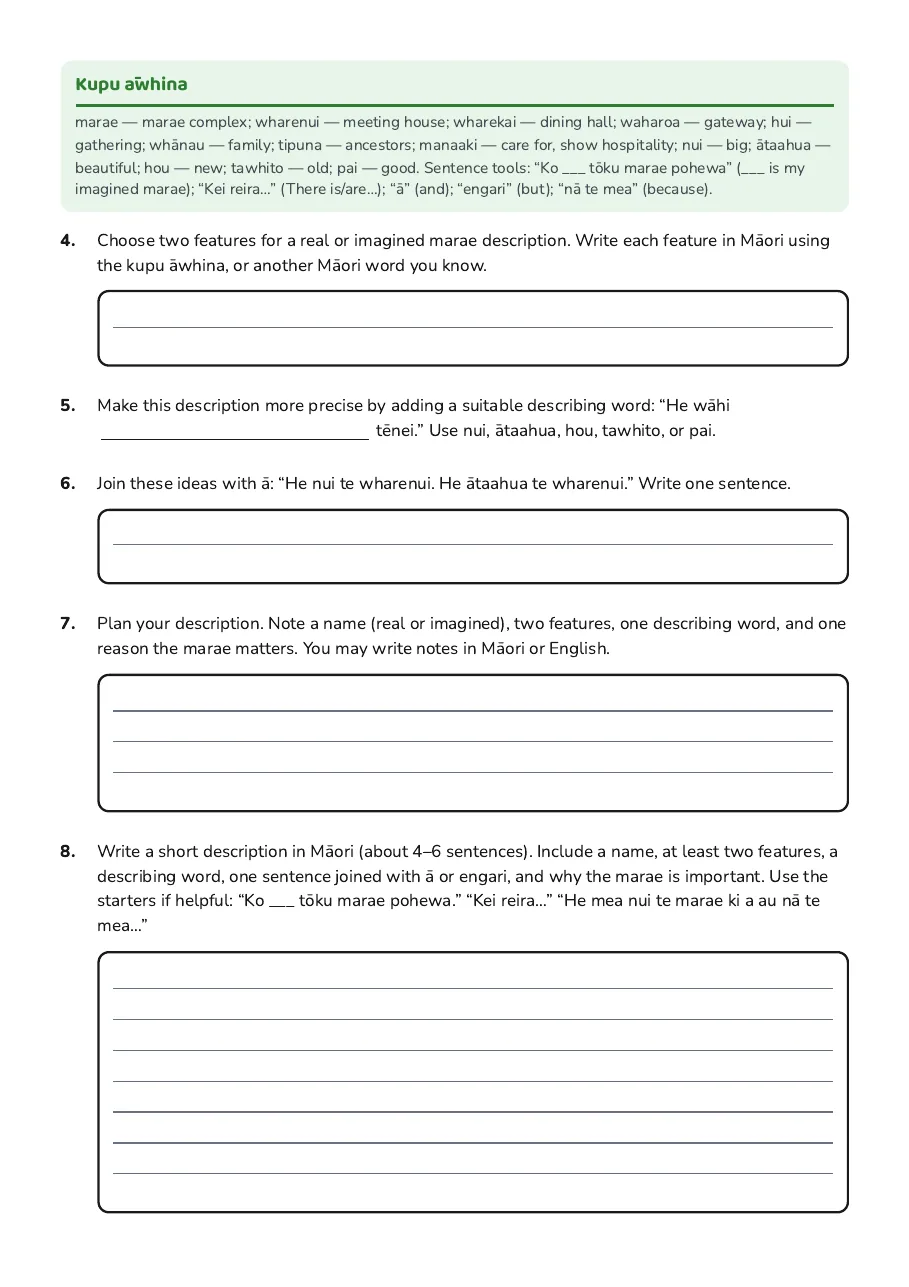
Kupu āwhina

marae — marae complex; wharenui — meeting house; wharekai — dining hall; waharoa — gateway; hui — gathering; whānau — family; tipuna — ancestors; manaaki — care for, show hospitality; nui — big; ātaahua — beautiful; hou — new; tawhito — old; pai — good. Sentence tools: “Ko ___ tōku marae pohewa” (___ is my imagined marae); “Kei reira…” (There is/are…); “ā” (and); “engari” (but); “nā te mea” (because).

4.Choose two features for a real or imagined marae description. Write each feature in Māori using the kupu āwhina, or another Māori word you know.
5.Make this description more precise by adding a suitable describing word: “He wāhi tēnei.” Use nui, ātaahua, hou, tawhito, or pai.
6.Join these ideas with ā: “He nui te wharenui. He ātaahua te wharenui.” Write one sentence.
7.Plan your description. Note a name (real or imagined), two features, one describing word, and one reason the marae matters. You may write notes in Māori or English.
8.Write a short description in Māori (about 4–6 sentences). Include a name, at least two features, a describing word, one sentence joined with ā or engari, and why the marae is important. Use the starters if helpful: “Ko ___ tōku marae pohewa.” “Kei reira…” “He mea nui te marae ki a au nā te mea…”
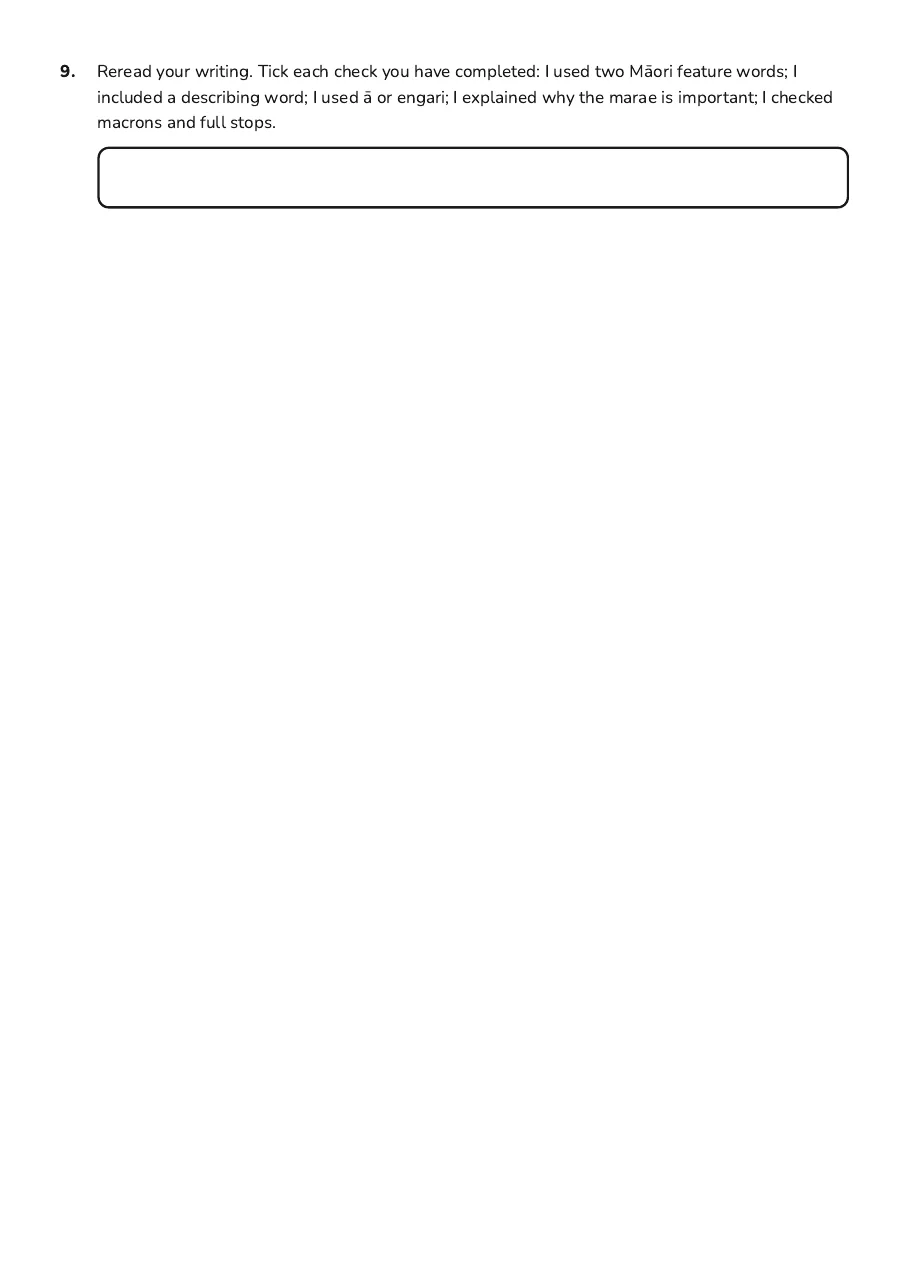
9.Reread your writing. Tick each check you have completed: I used two Māori feature words; I included a describing word; I used ā or engari; I explained why the marae is important; I checked macrons and full stops.

3 printable pages

  • Toku Marae Writing, page 1 of 3: Read and notice

    Page 1

  • Toku Marae Writing, page 2 of 3: Kupu āwhina

    Page 2

  • Toku Marae Writing, page 3 of 3: 9. Reread your writing. Tick each check you have completed: I used two Mā ori feature…

    Page 3

About This Worksheet

Free in Kuraplan

Sign up free, grab the PDF, and customize it for your class.

Print-Ready

Formatted for standard paper. Clean layout, easy to read.

AI-Generated

Created with Kuraplan's AI, designed for real classroom use.

For Teachers & Parents

Use in classrooms, for homework, tutoring, or homeschool.

Need a custom version of this worksheet?

Kuraplan's AI generates custom worksheets in seconds — differentiated for every learner, aligned to your curriculum.

Generate Custom Worksheets — Free
No credit card Curriculum-aligned Under 60 seconds