ScienceFreePrintable

Touch and Blindness Exploration

A free science worksheet ready for your classroom. Open in Kuraplan to grab the print-ready PDF, customize it for your students, or generate a fresh version in seconds.
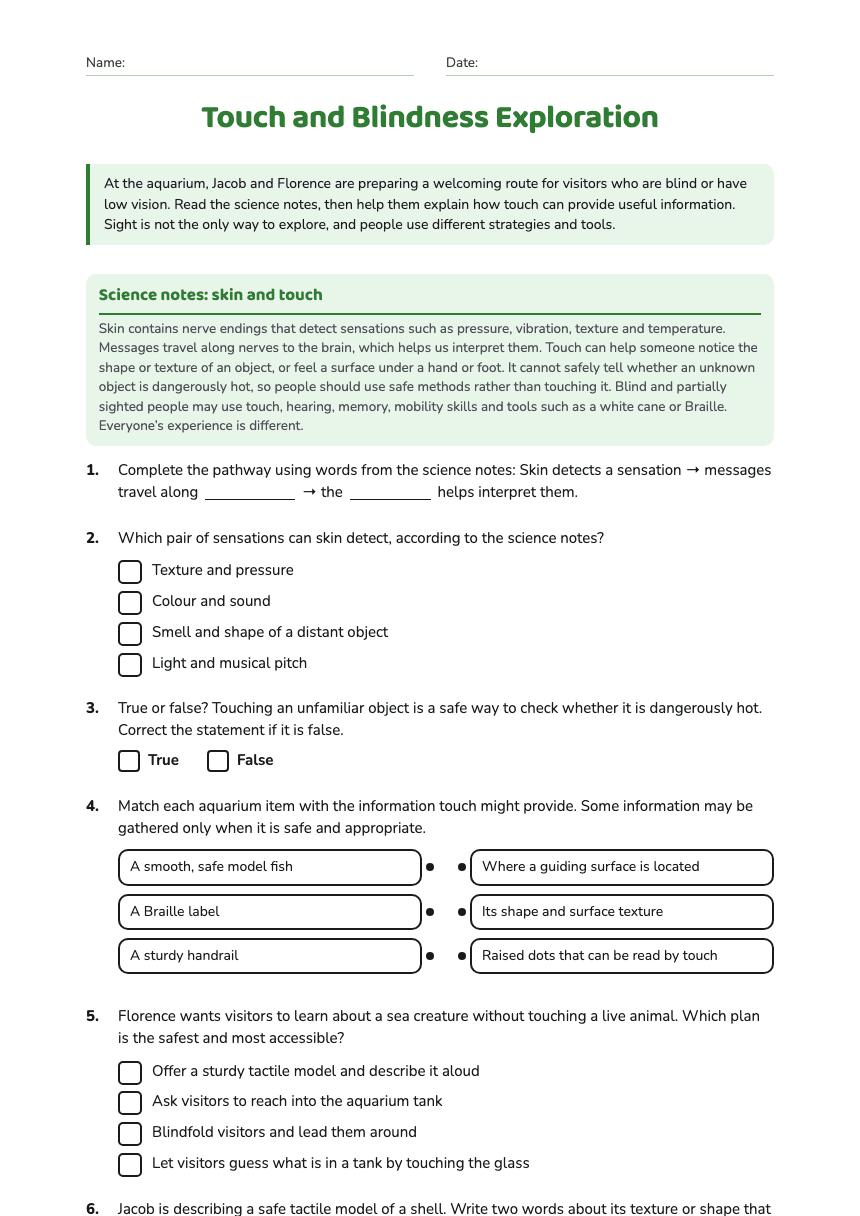
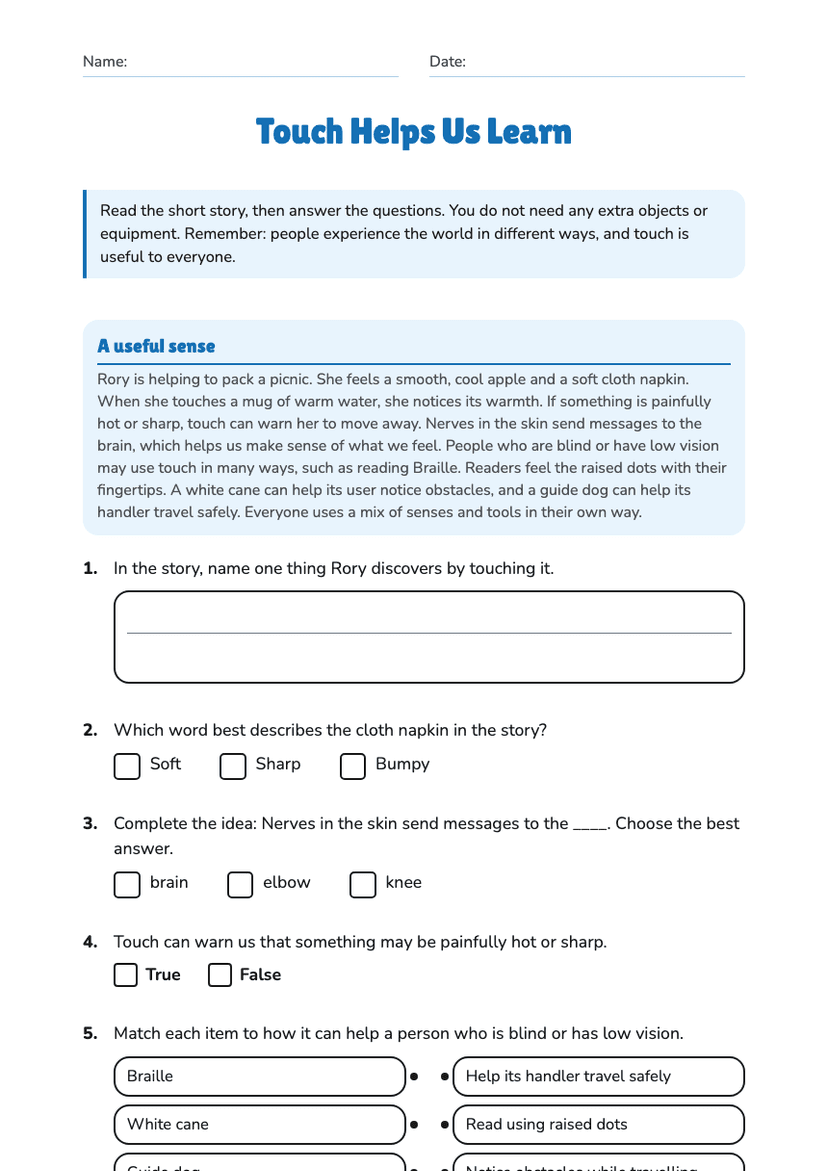
Touch and Blindness Exploration worksheet preview
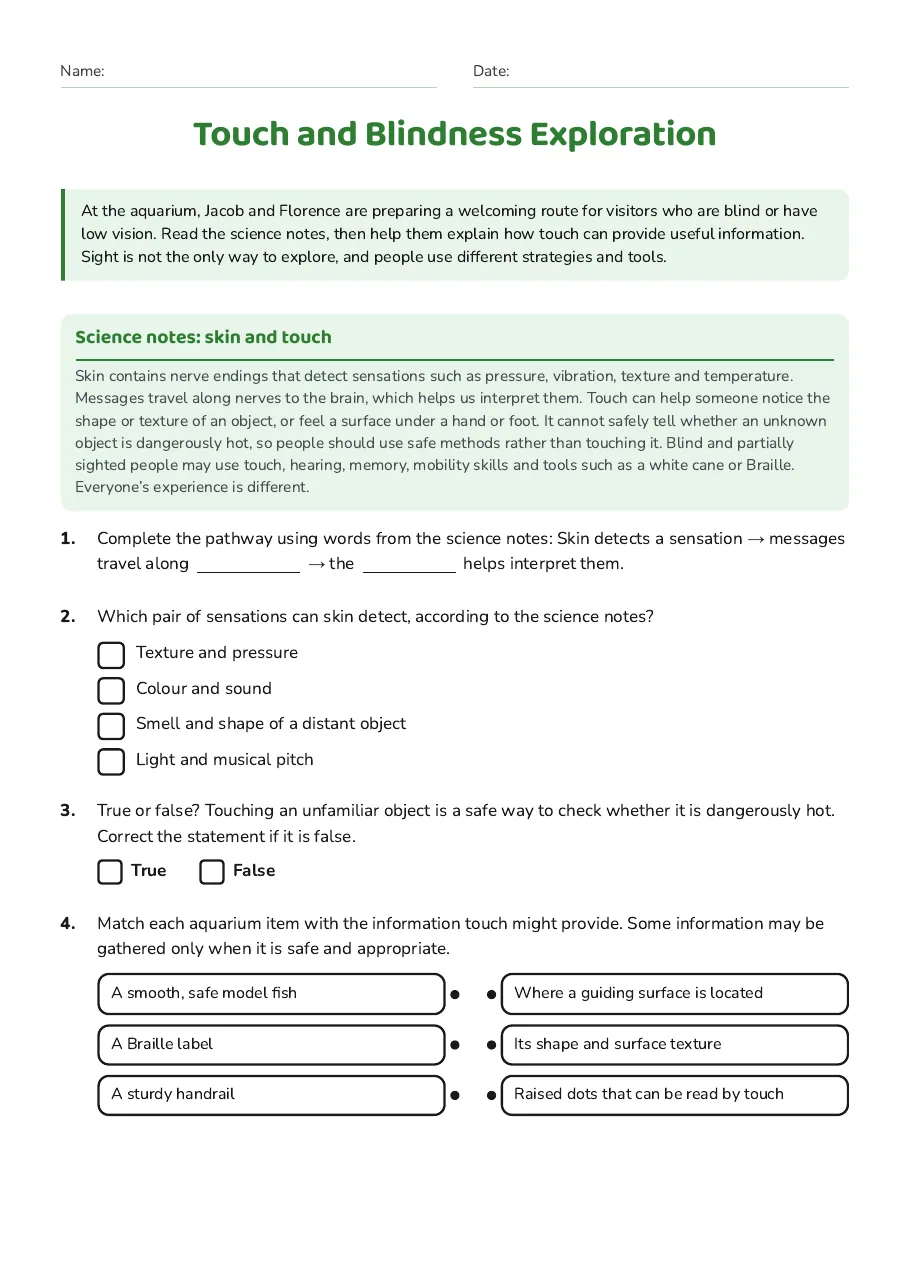
Name:Date:

Touch and Blindness Exploration

At the aquarium, Jacob and Florence are preparing a welcoming route for visitors who are blind or have low vision. Read the science notes, then help them explain how touch can provide useful information. Sight is not the only way to explore, and people use different strategies and tools.

Science notes: skin and touch

Skin contains nerve endings that detect sensations such as pressure, vibration, texture and temperature. Messages travel along nerves to the brain, which helps us interpret them. Touch can help someone notice the shape or texture of an object, or feel a surface under a hand or foot. It cannot safely tell whether an unknown object is dangerously hot, so people should use safe methods rather than touching it. Blind and partially sighted people may use touch, hearing, memory, mobility skills and tools such as a white cane or Braille. Everyone’s experience is different.

1.Complete the pathway using words from the science notes: Skin detects a sensation → messages travel along → the helps interpret them.
2.Which pair of sensations can skin detect, according to the science notes?
  • Texture and pressure
  • Colour and sound
  • Smell and shape of a distant object
  • Light and musical pitch
3.True or false? Touching an unfamiliar object is a safe way to check whether it is dangerously hot. Correct the statement if it is false.
TrueFalse
4.Match each aquarium item with the information touch might provide. Some information may be gathered only when it is safe and appropriate.
  • A smooth, safe model fish
  • A Braille label
  • A sturdy handrail
  • Where a guiding surface is located
  • Its shape and surface texture
  • Raised dots that can be read by touch
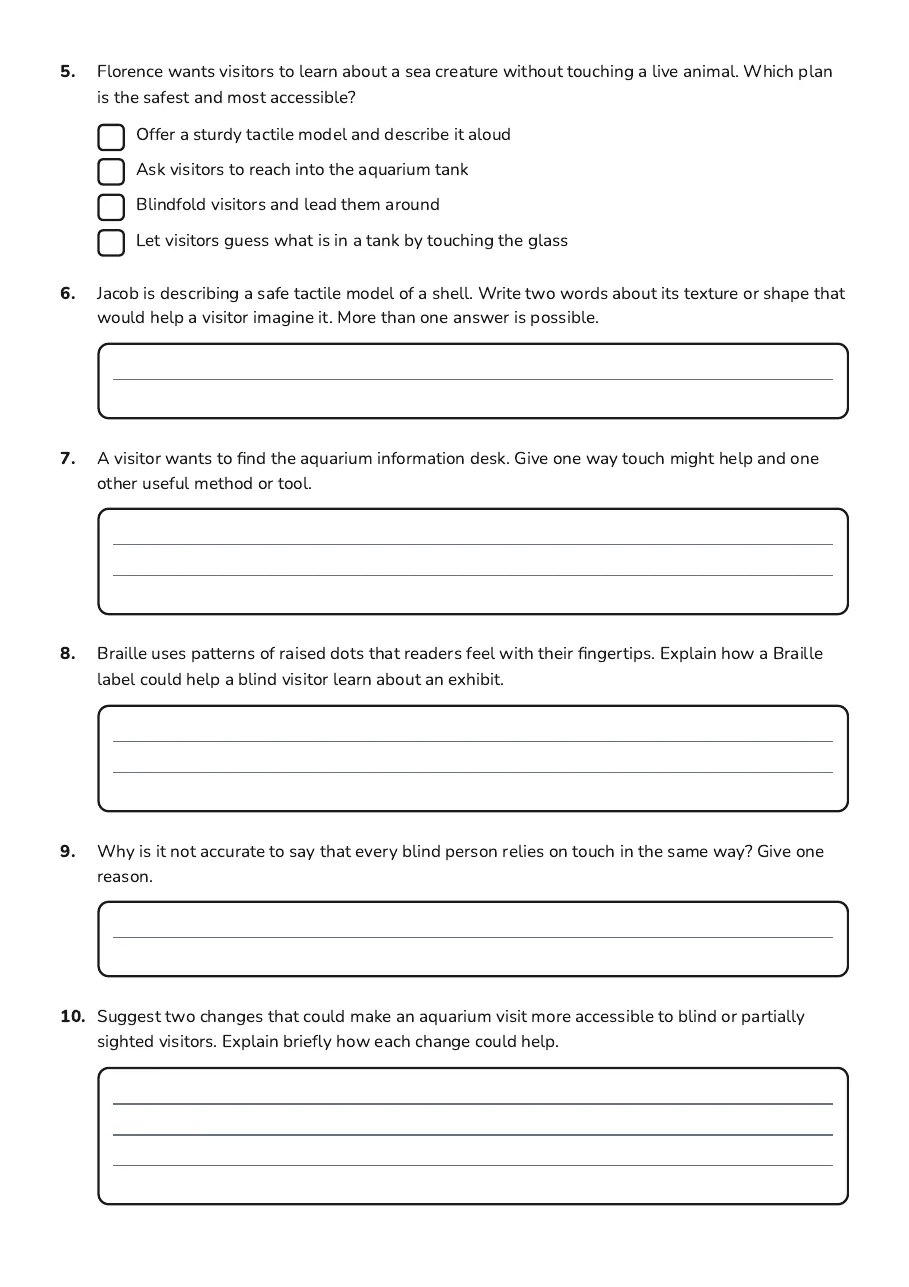
5.Florence wants visitors to learn about a sea creature without touching a live animal. Which plan is the safest and most accessible?
  • Offer a sturdy tactile model and describe it aloud
  • Ask visitors to reach into the aquarium tank
  • Blindfold visitors and lead them around
  • Let visitors guess what is in a tank by touching the glass
6.Jacob is describing a safe tactile model of a shell. Write two words about its texture or shape that would help a visitor imagine it. More than one answer is possible.
7.A visitor wants to find the aquarium information desk. Give one way touch might help and one other useful method or tool.
8.Braille uses patterns of raised dots that readers feel with their fingertips. Explain how a Braille label could help a blind visitor learn about an exhibit.
9.Why is it not accurate to say that every blind person relies on touch in the same way? Give one reason.
10.Suggest two changes that could make an aquarium visit more accessible to blind or partially sighted visitors. Explain briefly how each change could help.

2 printable pages

  • Touch and Blindness Exploration, page 1 of 2: Science notes: skin and touch

    Page 1

  • Touch and Blindness Exploration, page 2 of 2: 5. Florence wants visitors to learn about a sea creature without touching a live animal.…

    Page 2

About This Worksheet

Free in Kuraplan

Sign up free, grab the PDF, and customize it for your class.

Print-Ready

Formatted for standard paper. Clean layout, easy to read.

AI-Generated

Created with Kuraplan's AI, designed for real classroom use.

For Teachers & Parents

Use in classrooms, for homework, tutoring, or homeschool.

Need a custom version of this worksheet?

Kuraplan's AI generates custom worksheets in seconds — differentiated for every learner, aligned to your curriculum.

Generate Custom Worksheets — Free
No credit card Curriculum-aligned Under 60 seconds