Treaty Narrative Elements Worksheet
A free english worksheet ready for your classroom. Open in Kuraplan to grab the print-ready PDF, customize it for your students, or generate a fresh version in seconds.

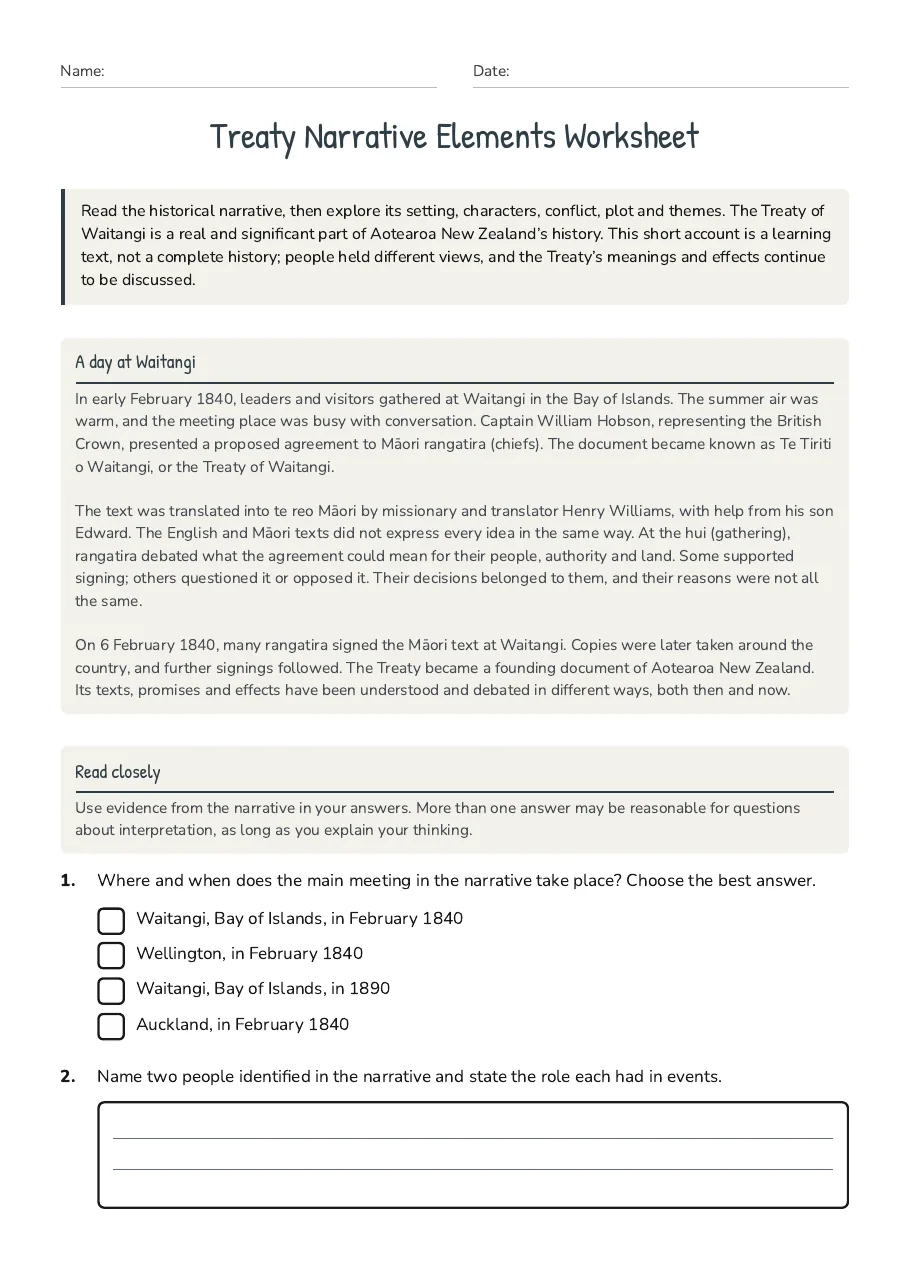
Treaty Narrative Elements Worksheet
A day at Waitangi
In early February 1840, leaders and visitors gathered at Waitangi in the Bay of Islands. The summer air was warm, and the meeting place was busy with conversation. Captain William Hobson, representing the British Crown, presented a proposed agreement to Māori rangatira (chiefs). The document became known as Te Tiriti o Waitangi, or the Treaty of Waitangi. The text was translated into te reo Māori by missionary and translator Henry Williams, with help from his son Edward. The English and Māori texts did not express every idea in the same way. At the hui (gathering), rangatira debated what the agreement could mean for their people, authority and land. Some supported signing; others questioned it or opposed it. Their decisions belonged to them, and their reasons were not all the same. On 6 February 1840, many rangatira signed the Māori text at Waitangi. Copies were later taken around the country, and further signings followed. The Treaty became a founding document of Aotearoa New Zealand. Its texts, promises and effects have been understood and debated in different ways, both then and now.
Read closely
Use evidence from the narrative in your answers. More than one answer may be reasonable for questions about interpretation, as long as you explain your thinking.
- Waitangi, Bay of Islands, in February 1840
- Wellington, in February 1840
- Waitangi, Bay of Islands, in 1890
- Auckland, in February 1840
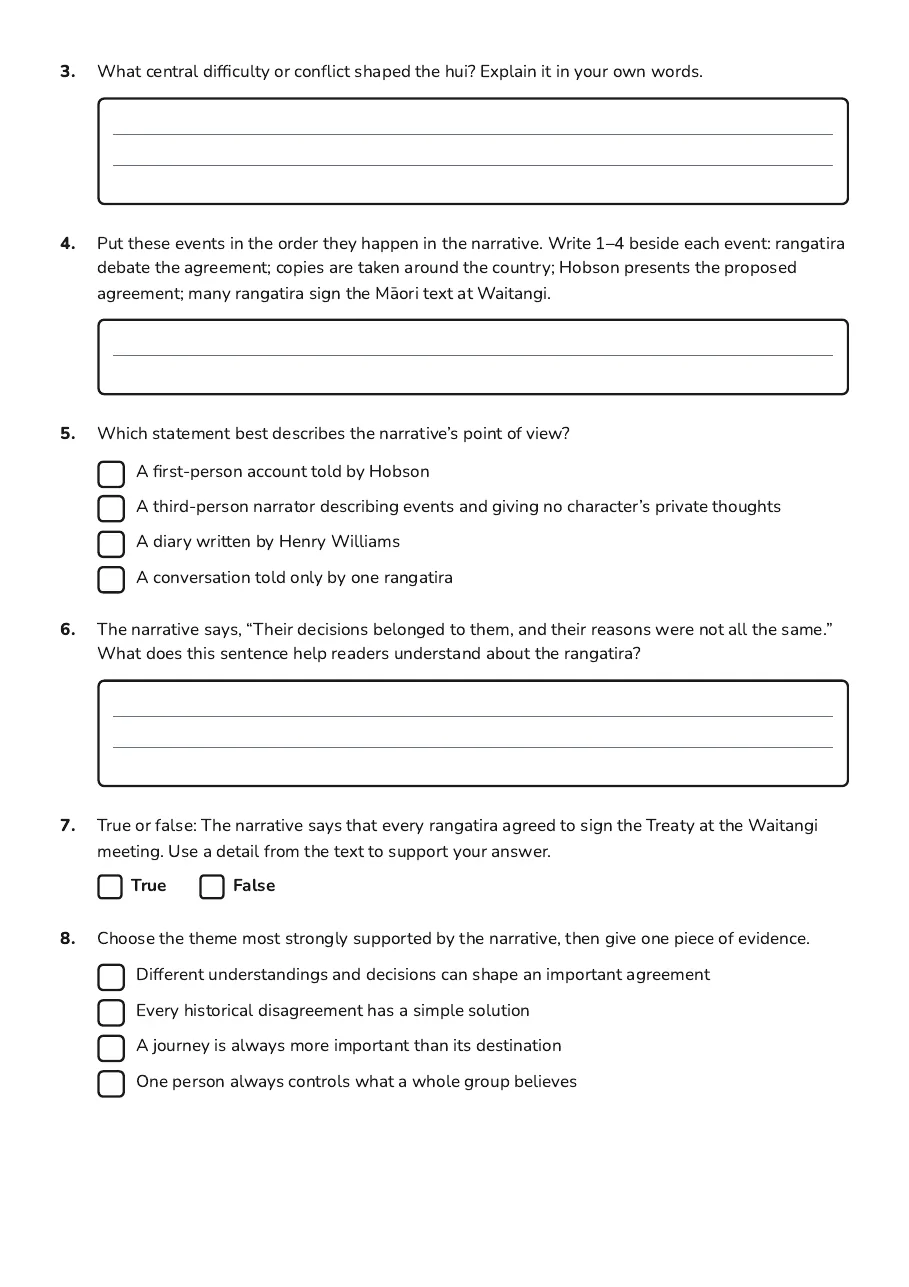
- A first-person account told by Hobson
- A third-person narrator describing events and giving no character’s private thoughts
- A diary written by Henry Williams
- A conversation told only by one rangatira
- Different understandings and decisions can shape an important agreement
- Every historical disagreement has a simple solution
- A journey is always more important than its destination
- One person always controls what a whole group believes
3 printable pages
Page 1
Page 2
Page 3
About This Worksheet
Free in Kuraplan
Sign up free, grab the PDF, and customize it for your class.
Print-Ready
Formatted for standard paper. Clean layout, easy to read.
AI-Generated
Created with Kuraplan's AI, designed for real classroom use.
For Teachers & Parents
Use in classrooms, for homework, tutoring, or homeschool.
Need a custom version of this worksheet?
Kuraplan's AI generates custom worksheets in seconds — differentiated for every learner, aligned to your curriculum.
Generate Custom Worksheets — Free