Understanding Gravity!
A free science worksheet ready for your classroom. Open in Kuraplan to grab the print-ready PDF, customize it for your students, or generate a fresh version in seconds.
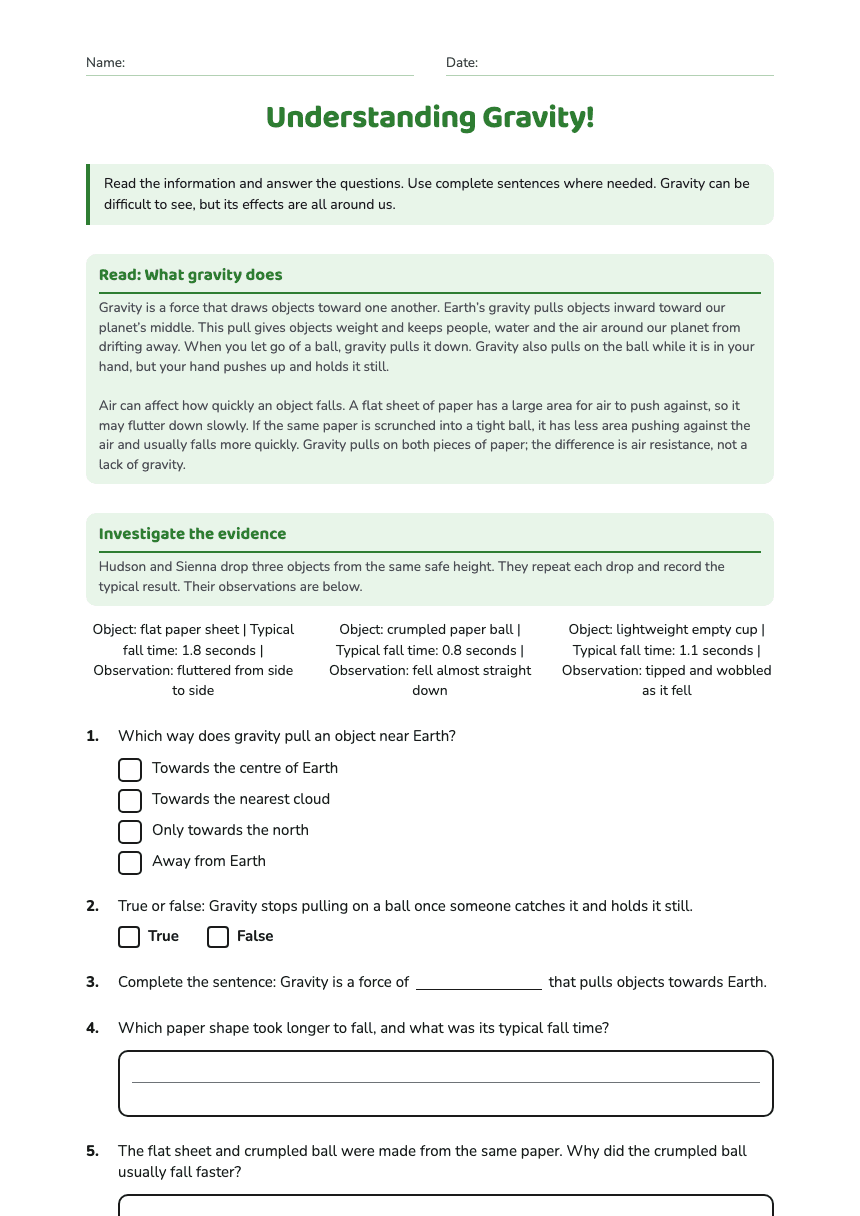
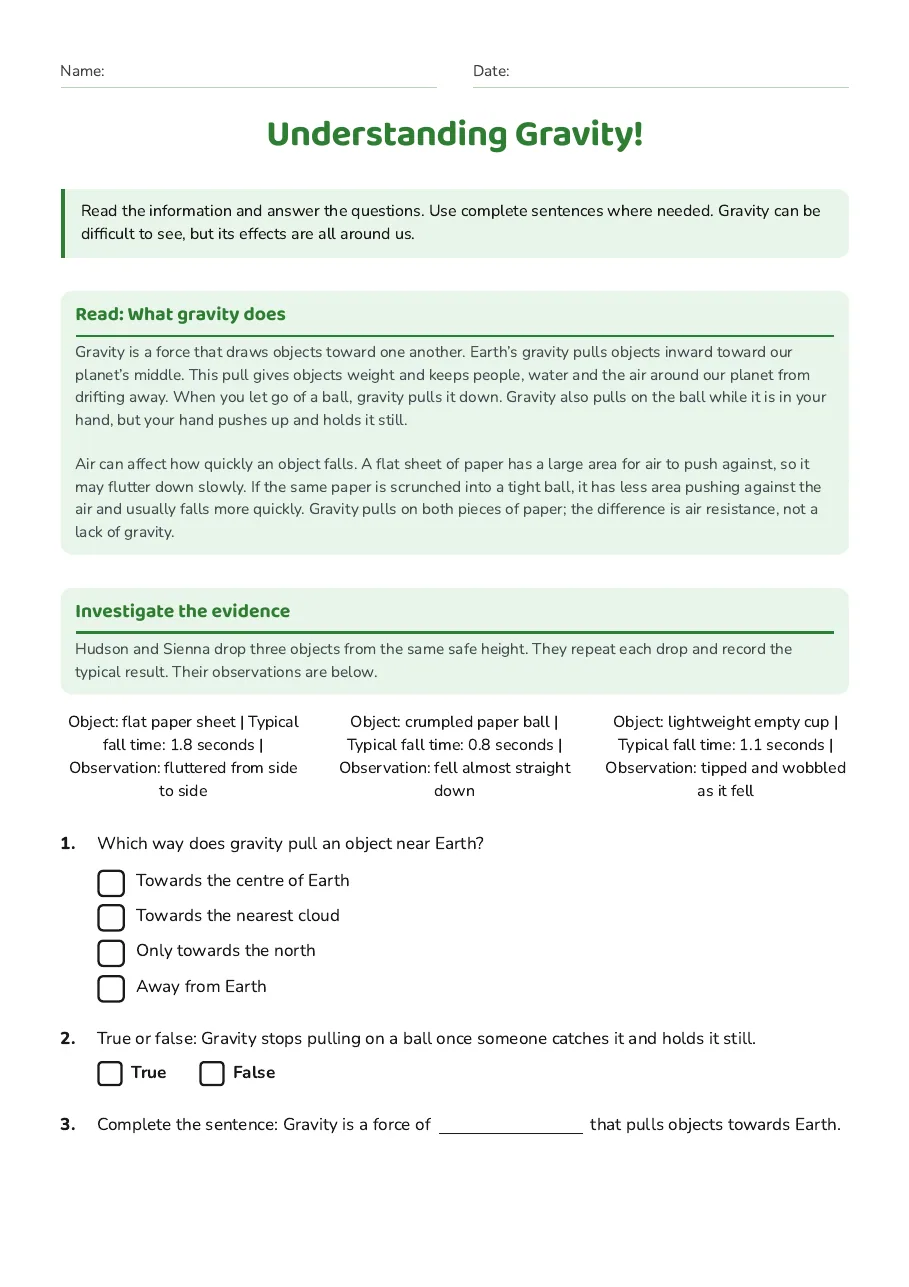
Understanding Gravity!
Read: What gravity does
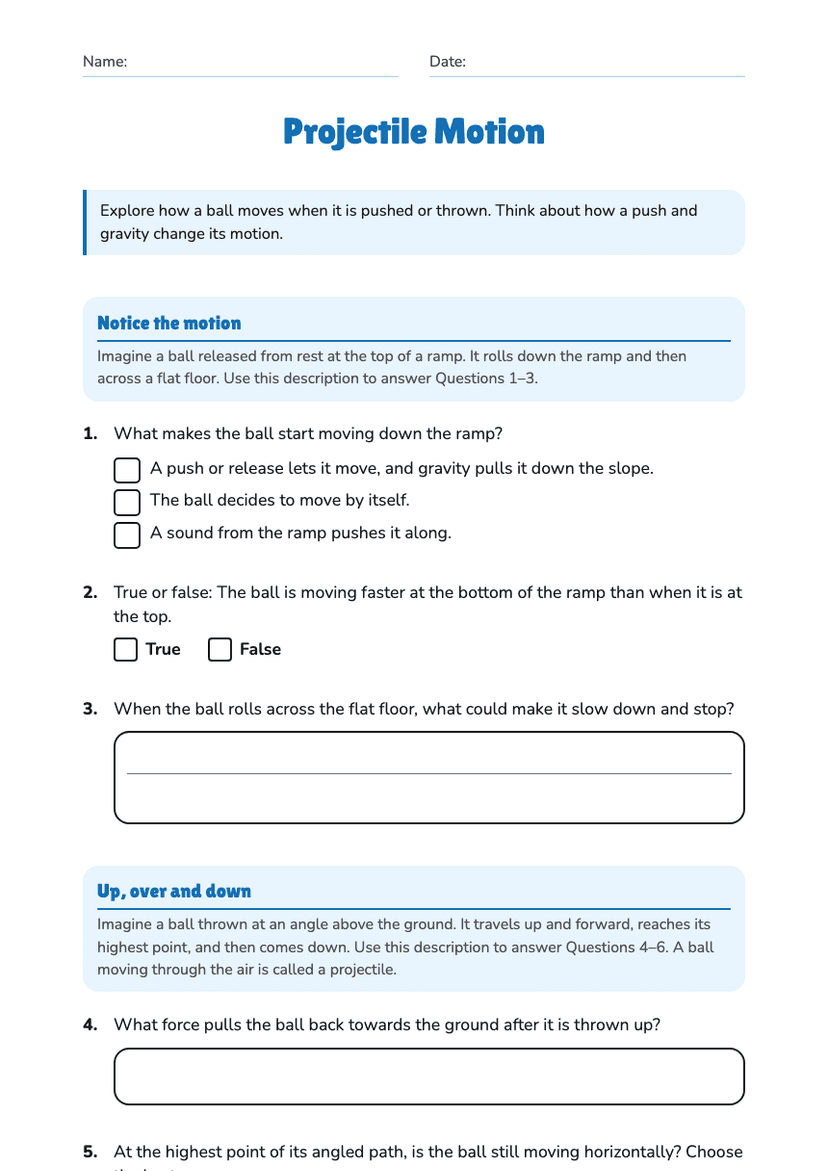
Gravity is a force that draws objects toward one another. Earth’s gravity pulls objects inward toward our planet’s middle. This pull gives objects weight and keeps people, water and the air around our planet from drifting away. When you let go of a ball, gravity pulls it down. Gravity also pulls on the ball while it is in your hand, but your hand pushes up and holds it still. Air can affect how quickly an object falls. A flat sheet of paper has a large area for air to push against, so it may flutter down slowly. If the same paper is scrunched into a tight ball, it has less area pushing against the air and usually falls more quickly. Gravity pulls on both pieces of paper; the difference is air resistance, not a lack of gravity.
Investigate the evidence
Hudson and Sienna drop three objects from the same safe height. They repeat each drop and record the typical result. Their observations are below.
Object: flat paper sheet | Typical fall time: 1.8 seconds | Observation: fluttered from side to side
Object: crumpled paper ball | Typical fall time: 0.8 seconds | Observation: fell almost straight down
Object: lightweight empty cup | Typical fall time: 1.1 seconds | Observation: tipped and wobbled as it fell
- Towards the centre of Earth
- Towards the nearest cloud
- Only towards the north
- Away from Earth
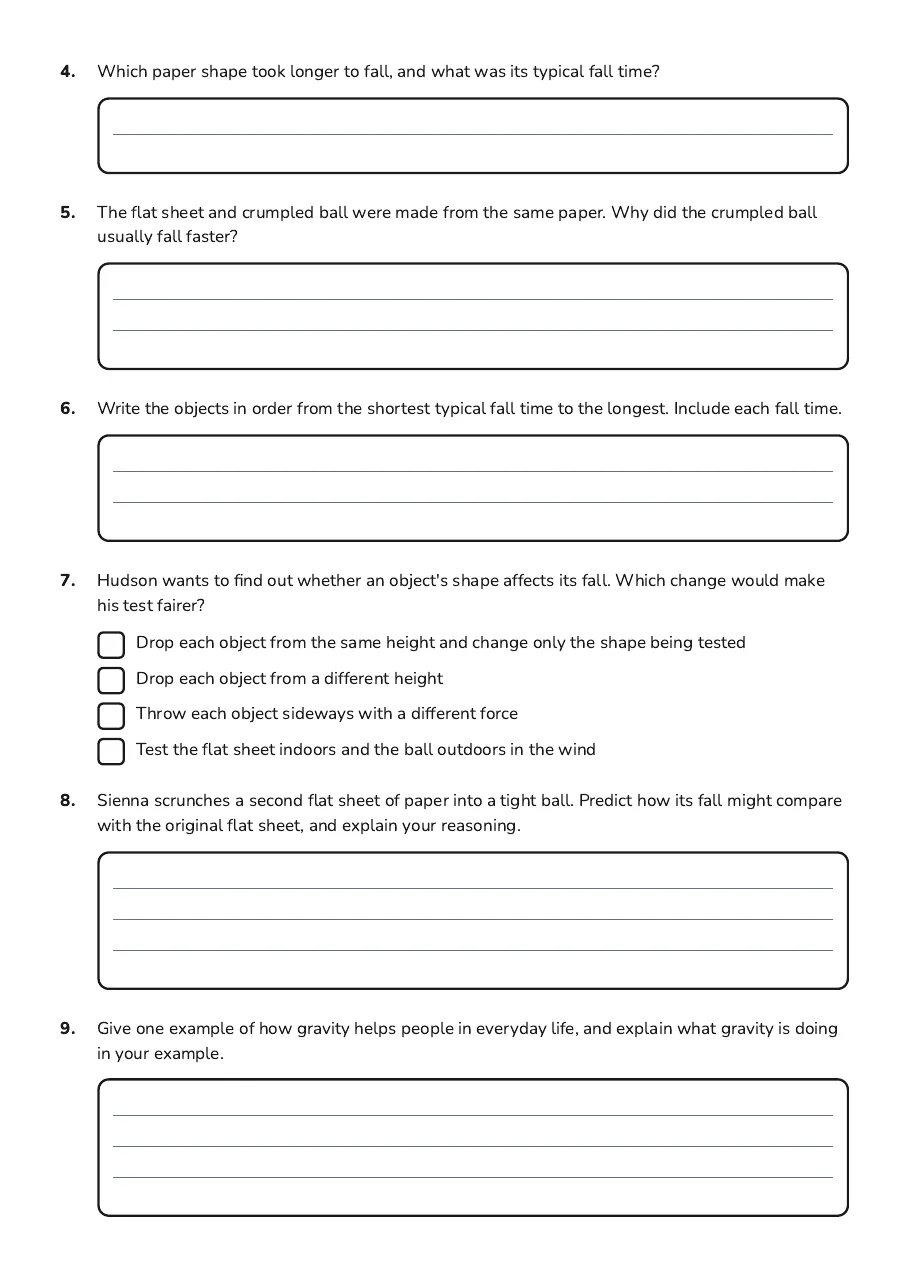
- Drop each object from the same height and change only the shape being tested
- Drop each object from a different height
- Throw each object sideways with a different force
- Test the flat sheet indoors and the ball outdoors in the wind
3 printable pages
Page 1
Page 2
Page 3
About This Worksheet
Free in Kuraplan
Sign up free, grab the PDF, and customize it for your class.
Print-Ready
Formatted for standard paper. Clean layout, easy to read.
AI-Generated
Created with Kuraplan's AI, designed for real classroom use.
For Teachers & Parents
Use in classrooms, for homework, tutoring, or homeschool.
Need a custom version of this worksheet?
Kuraplan's AI generates custom worksheets in seconds — differentiated for every learner, aligned to your curriculum.
Generate Custom Worksheets — Free