Animal cell diagram
An animal cell is the basic building block of every animal — including you. Unlike a plant cell, it has no cell wall, no chloroplasts and no large central vacuole, which is why animal cells look rounded and irregular. Below is a diagram with a color key, a plain-language table of every part and its job, and free printable worksheets for your class.
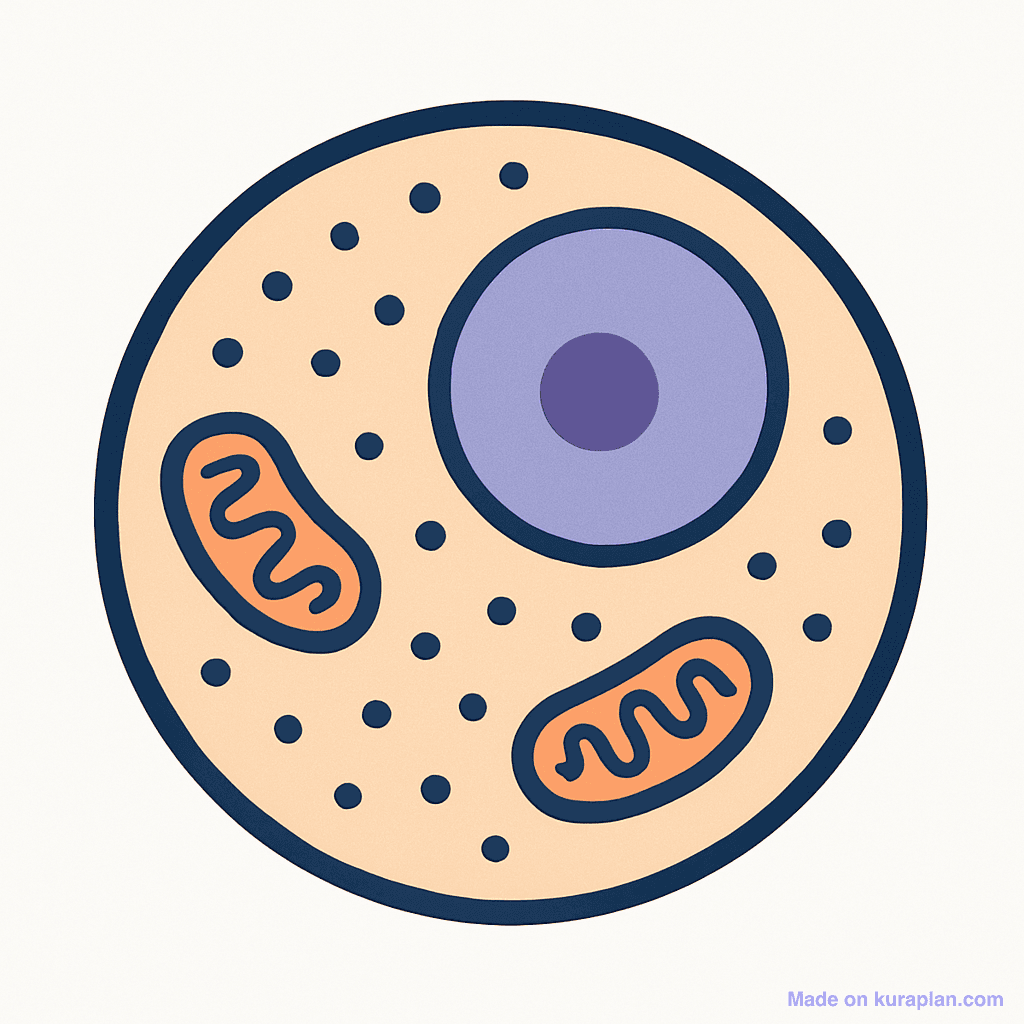
What you're looking at
- Cell membrane — The thin, flexible skin around the cell. It controls what comes in (like nutrients) and what goes out (like waste). Animal cells have no wall outside it — the membrane is the outer layer.
- Nucleus — The control centre. It holds the cell's DNA — the instructions for everything the cell does. The darker blob inside is the nucleolus.
- Cytoplasm — The jelly-like liquid that fills the cell. All the other organelles float in it.
- Mitochondria — The powerhouses. They release the energy stored in food through respiration — hard-working cells like muscle cells are packed with them.
- Ribosomes — Tiny factories that build proteins — they look like small dots scattered through the cytoplasm.
Parts of a animal cell and what they do
Kid-friendly descriptions of each organelle — the first seven are the ones most diagrams expect students to label.
| Part | Job |
|---|---|
| Cell membrane | The thin, flexible skin around the cell. It controls what comes in (like nutrients) and what goes out (like waste). Animal cells have no wall outside it — the membrane is the outer layer. |
| Nucleus | The control centre. It holds the cell's DNA — the instructions for everything the cell does. The darker blob inside is the nucleolus. |
| Cytoplasm | The jelly-like liquid that fills the cell. All the other organelles float in it. |
| Mitochondria | The powerhouses. They release the energy stored in food through respiration — hard-working cells like muscle cells are packed with them. |
| Ribosomes | Tiny factories that build proteins — they look like small dots scattered through the cytoplasm. |
| Small vacuoles | Small, temporary storage bubbles for water, food or waste. Unlike a plant cell, there's no single large central vacuole. |
| Lysosomes | The cleanup crew — small sacs of digestive enzymes that break down waste, food particles and worn-out cell parts. |
| Endoplasmic reticulumOlder students | A folded network of membranes that moves proteins and other materials around the cell. Rough ER is covered in ribosomes; smooth ER is not. |
| Golgi apparatusOlder students | The packing department. It sorts, packages and ships proteins to where they're needed. |
The first 7 parts are the ones most elementary and middle-school diagrams expect students to know. The endoplasmic reticulum and Golgi apparatus usually appear from middle school onwards.
Plant cell vs animal cell
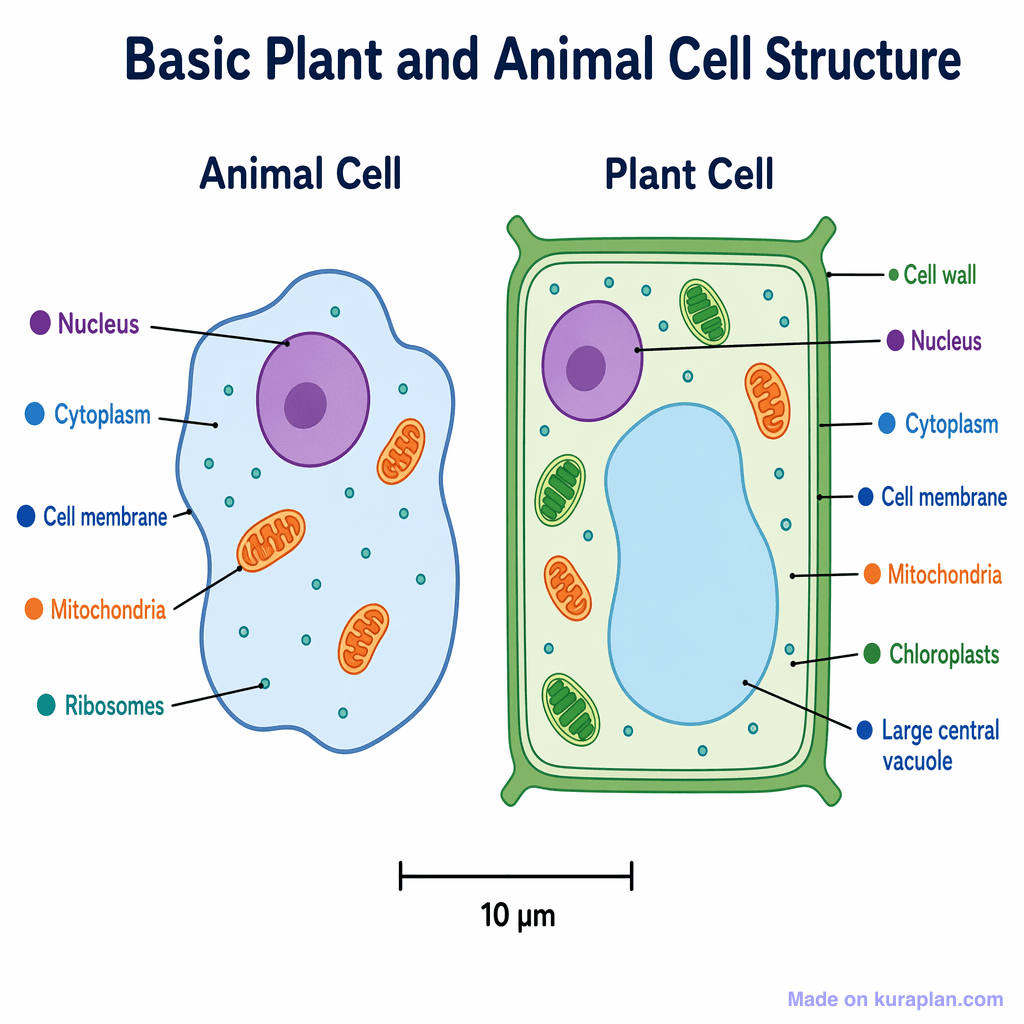
Plant and animal cells share the same basic machinery — cell membrane, nucleus, cytoplasm, mitochondria, ribosomes — but four differences come up on every test. See the full plant cell diagram for the other side of the comparison.
| Feature | Plant cell | Animal cell |
|---|---|---|
| Cell wall | Yes — a stiff outer wall made of cellulose | No cell wall — just the cell membrane |
| Chloroplasts | Yes — they make food using sunlight (photosynthesis) | None — animals get food by eating |
| Vacuole | One large central vacuole full of watery sap | Small vacuoles, and only sometimes |
| Shape | Regular and box-like — the wall holds its shape | Irregular and rounded — it can change shape |
| Lysosomes | Rare — the vacuole does much of the breaking down | Yes — they digest waste and worn-out parts |
Printable animal cell worksheets
Each button prints just that sheet (or saves it as a PDF) — clean black-and-white pages that photocopy perfectly.
Label the animal cell worksheet
Each row describes one part of a animal cell — students write the matching name from the word bank. Works with or without a diagram on the wall.
Label the animal cell
Each row describes one part of a animal cell. Write its name in the label column. Use the word bank to help you.
| # | What this part does | Label |
|---|---|---|
| 1. | The thin, flexible skin around the cell. It controls what comes in (like nutrients) and what goes out (like waste). Animal cells have no wall outside it — the membrane is the outer layer. | |
| 2. | The control centre. It holds the cell's DNA — the instructions for everything the cell does. The darker blob inside is the nucleolus. | |
| 3. | The jelly-like liquid that fills the cell. All the other organelles float in it. | |
| 4. | The powerhouses. They release the energy stored in food through respiration — hard-working cells like muscle cells are packed with them. | |
| 5. | Tiny factories that build proteins — they look like small dots scattered through the cytoplasm. | |
| 6. | Small, temporary storage bubbles for water, food or waste. Unlike a plant cell, there's no single large central vacuole. | |
| 7. | The cleanup crew — small sacs of digestive enzymes that break down waste, food particles and worn-out cell parts. |
Challenge: draw your own animal cell on the back of this sheet and label every part from the word bank.
Free from kuraplan.com/animal-cell-diagram — Name: ____________________ Date: ____________
Animal cell facts reference sheet
Every part and its job on one page — the wall chart and folder reference for a cells unit.
Animal cell facts
Every part of a animal cell and its job — the folder reference for a cells unit.
| Part | Job |
|---|---|
| Cell membrane | The thin, flexible skin around the cell. It controls what comes in (like nutrients) and what goes out (like waste). Animal cells have no wall outside it — the membrane is the outer layer. |
| Nucleus | The control centre. It holds the cell's DNA — the instructions for everything the cell does. The darker blob inside is the nucleolus. |
| Cytoplasm | The jelly-like liquid that fills the cell. All the other organelles float in it. |
| Mitochondria | The powerhouses. They release the energy stored in food through respiration — hard-working cells like muscle cells are packed with them. |
| Ribosomes | Tiny factories that build proteins — they look like small dots scattered through the cytoplasm. |
| Small vacuoles | Small, temporary storage bubbles for water, food or waste. Unlike a plant cell, there's no single large central vacuole. |
| Lysosomes | The cleanup crew — small sacs of digestive enzymes that break down waste, food particles and worn-out cell parts. |
| Endoplasmic reticulum* | A folded network of membranes that moves proteins and other materials around the cell. Rough ER is covered in ribosomes; smooth ER is not. |
| Golgi apparatus* | The packing department. It sorts, packages and ships proteins to where they're needed. |
*Usually introduced to older students (around middle school and up).
Free from kuraplan.com/animal-cell-diagram — Name: ____________________ Date: ____________
Plant vs animal cell comparison worksheet
Students sort ten parts into “plant only”, “both” and “animal only” columns — the classic end-of-unit check.
Plant cell vs animal cell
Sort each part from the word bank into the correct column. Some parts belong to both.
| Plant cell only | Both cells have | Animal cell only |
|---|---|---|
Think about it: why do plant cells need chloroplasts but animal cells don't?
Free from kuraplan.com/animal-cell-diagram — Name: ____________________ Date: ____________
Animal cell FAQs
What are the parts of an animal cell?
The main parts of an animal cell are the cell membrane, nucleus, cytoplasm, mitochondria, ribosomes, small vacuoles and lysosomes. Older students also learn the endoplasmic reticulum, which moves proteins and other materials around the cell, and the Golgi apparatus, which packages them for delivery.
Do animal cells have a cell wall?
No. Animal cells are surrounded only by a thin, flexible cell membrane. That's why they have rounded, irregular shapes — while plant cells get their rigidity from a stiff cellulose wall.
What do mitochondria do?
Mitochondria are the cell's powerhouses. Through respiration, they release the energy stored in food (glucose) so the cell can use it to move, grow and build things. Cells that work hard — like muscle cells — are packed with them.
What do lysosomes do?
Lysosomes are the cleanup crew. They are small sacs of digestive enzymes that break down waste, food particles and worn-out cell parts so the pieces can be reused or removed.
What is the difference between an animal cell and a plant cell?
Animal cells have no cell wall, no chloroplasts and no large central vacuole — the three features that define plant cells. Instead they have small vacuoles (if any) and lysosomes, and their shape is rounded and irregular. Both kinds share a cell membrane, nucleus, cytoplasm, mitochondria and ribosomes.
Why don't animal cells have chloroplasts?
Chloroplasts make food from sunlight — and animals don't make their own food, they eat it. Because animals get glucose from what they eat, their cells only need mitochondria to release the energy, not chloroplasts to capture it.
Are these animal cell worksheets free to print?
Yes. Every sheet on this page prints or saves as a PDF in one click — we just ask for an email on your first download. No accounts and no watermarks.
More free science resources
plant cell diagram
The other half of the comparison — every part of a plant cell, with printable worksheets.
Living things worksheets
Free printable worksheets on plants, animals, habitats and life cycles.
Free classroom images
Cell diagrams, labelled and unlabelled, plus thousands more free science images.
Planet facts
More science: a fact file for all eight planets, with printable fact-file sheets.
Create your own cells and living things worksheet in seconds
Kuraplan's AI builds curriculum-aligned lessons, worksheets and slides - free to try.