🎯 Success Criteria
By the end of this worksheet, you will be able to:
✅ Calculate theoretical and experimental probability as fractions, decimals, and percentages
✅ Distinguish between independent and dependent events
✅ Identify mutually exclusive events and calculate compound probabilities
✅ Use sample spaces and tree diagrams to solve multi-step probability problems
Probability Scale: 0 = Impossible 0.5 = Even chance 1 = Certain
Key Formula: P(event) = Number of favourable outcomes ÷ Total number of possible outcomes
📚 Part 1: Multiple Choice (Circle the best answer — 1 mark each)
1. A bag contains 4 red, 3 blue, and 5 green marbles. What is the probability of picking a blue marble?
A) 1/4
B) 3/12
C) 1/3
D) 5/12
2. A fair six-sided die is rolled. What is the probability of rolling a number greater than 4?
A) 1/6
B) 1/3
C) 1/2
D) 2/3
3. Two events are mutually exclusive if:
A) They always occur together
B) They cannot occur at the same time
C) One event affects the probability of the other
D) They have the same probability
4. A coin is flipped and a die is rolled. How many outcomes are in the sample space?
5. A card is drawn from a standard 52-card deck. What is the probability of drawing a King or a Queen?
A) 1/13
B) 2/52
C) 2/13
D) 4/13
6. A spinner has 8 equal sections numbered 1–8. What is the probability of landing on an even number or a number less than 3?
A) 5/8
B) 6/8
C) 3/4
D) 7/8
7. A bag has 5 red and 3 white balls. One ball is drawn and not replaced. What is the probability that the second ball drawn is also red?
A) 5/8
B) 4/7
C) 5/7
D) 4/8
8. In 60 trials, a thumbtack landed point-up 42 times. What is the experimental probability of it landing point-up?
A) 0.5
B) 0.6
C) 0.7
D) 0.75
9. Which of the following pairs of events are independent?
A) Drawing two cards from a deck without replacement
B) Rolling a die and flipping a coin
C) Picking two marbles from a bag without replacement
D) Drawing a card, keeping it, then drawing another
10. P(A) = 0.4 and P(B) = 0.3. If A and B are independent, what is P(A and B)?
A) 0.7
B) 0.12
C) 0.1
D) 0.58
✏️ Part 2: Short Answer (Show all working — 2 marks each)
11. A class has 12 boys and 18 girls. One student is chosen at random. Find the probability of choosing a girl. Express your answer as a fraction, decimal, and percentage.
12. A fair die is rolled once. List the sample space and find the probability of rolling a prime number.
13. Two coins are flipped simultaneously. Draw the sample space and find P(at least one Head).
14. A bag contains 6 yellow, 4 purple, and 2 orange balls. Find P(not yellow).
15. Events A and B are mutually exclusive. P(A) = 0.35 and P(B) = 0.25. Find P(A or B).
16. A card is drawn from a standard deck. Are the events "drawing a Heart" and "drawing a King" mutually exclusive? Explain your reasoning.
17. A jar has 3 red and 5 blue lollies. One is eaten, then another is chosen. Find the probability that both lollies are red (without replacement).
18. A spinner is spun 200 times. It lands on Blue 70 times, Red 80 times, and Green 50 times. Calculate the experimental probability of landing on each colour. Which colour has the highest experimental probability?
19. A survey of 50 students found that 20 play football, 15 play basketball, and 8 play both. Find the probability that a randomly chosen student plays football or basketball.
Hint for Q19: Use the Addition Rule: P(A or B) = P(A) + P(B) − P(A and B)
20. A weather forecast states there is a 60% chance of rain on Saturday and a 40% chance of rain on Sunday. Assuming the days are independent, what is the probability it rains on both days? What is the probability it rains on at least one day?
🔢 Part 3: Problem Solving (Show full working — 3 marks each)
21. Tree Diagram Problem: A bag contains 2 red (R) and 3 blue (B) balls. A ball is drawn, its colour noted, replaced, and a second ball is drawn. Draw a tree diagram showing all possible outcomes and their probabilities. Then find:
a) P(both red) b) P(one of each colour) c) P(at least one blue)
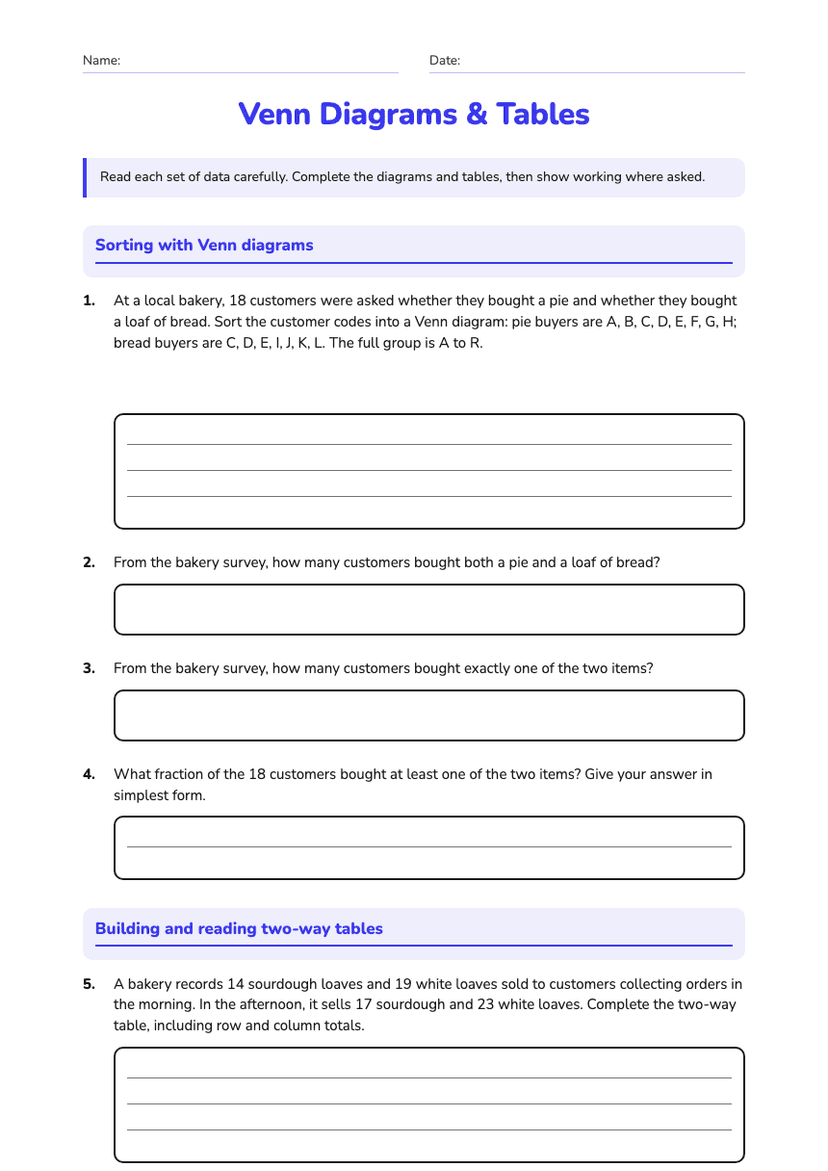
22. Two-Way Table: 80 students were surveyed about whether they have a pet and whether they have a sibling. Complete the table and answer the questions below.
Has a Pet No Pet Total
Has a Sibling 24 ____ 45
No Sibling ____ 18 ____
Total ____ ____ 80
a) Find P(has a pet and has a sibling)
b) Find P(no sibling | no pet) — probability of no sibling given no pet
c) Are having a pet and having a sibling independent events? Justify your answer.
23. Dependent Events: A box contains 4 green, 5 yellow, and 3 pink cards. Three cards are drawn one at a time without replacement. Find the probability that all three cards are yellow.
24. Real-World Application: A factory produces light bulbs. Quality control tests show that 2% of bulbs are defective. If a shop orders 3 bulbs, find the probability that:
a) None are defective b) At least one is defective
(Assume defective bulbs are independent events)
🌟 Extension: Challenge Questions (For Advanced Learners — 4 marks each)
These questions go beyond the standard curriculum. Give them a go!
25. Conditional Probability: In a group of 100 people, 60 drink coffee, 50 drink tea, and 30 drink both. A person is chosen at random and found to drink tea. What is the probability they also drink coffee? Use the formula: P(A|B) = P(A and B) ÷ P(B)
26. Olympiad Style: Three friends — Ava, Ben, and Cara — each independently solve a maths problem. The probability that Ava solves it is 2/3, Ben is 3/4, and Cara is 1/2. What is the probability that the problem is solved by at least one of them?
27. ICAS/Selective Style: A game involves rolling two fair dice. You win if the sum is 7 or 11. What is the probability of winning on a single roll? If you play 3 rounds, what is the probability of winning at least once?
28. Reflection — Explain Your Thinking: Describe the difference between theoretical probability and experimental probability. Why might they give different results? As the number of trials increases, what do you expect to happen to the experimental probability? Use an example to support your answer.
📋 Differentiation Guide (For Tutor Reference)
🟢 Foundation Support (Questions 1–15): Focus on Parts 1 and 2 only. Provide a probability scale number line. Allow use of fraction walls and calculators. Encourage drawing diagrams for every question.
🟡 Core Level (Questions 1–24): Complete Parts 1, 2, and 3. Encourage students to show full working and write probability answers in all three forms (fraction, decimal, percentage).
🔴 Extension / Advanced (All questions): Complete all sections including the Challenge Questions. Encourage students to verify answers using the complement rule and connect concepts to NAPLAN, ICAS, and Selective School exam formats.
📝 Vocabulary Support: Key terms to review — outcome, event, sample space, theoretical, experimental, independent, dependent, mutually exclusive, complementary, conditional probability.