You stop in the hallway to answer a colleague's question. By the time you reach your classroom, students are arriving, someone has a permission slip, and another student needs to explain yesterday's absence. Suddenly, you're mid-lesson with no warm-up posted, no attendance taken, and a substitute request you forgot to prepare for.
That isn't a willpower problem. You're trying to remember instructional decisions, administrative tasks, and individual student needs while people keep interrupting you. A useful checklist for teachers puts the repeatable steps somewhere other than your head.
The trick is not to build a giant master document that you'll abandon when things get busy. Keep separate routines where you'll use them: arrival prompts by the door, grading steps beside the stack, and planning checks inside your lesson template.
These eight focused checklists cover the school day and the work around it, from welcoming students to contacting families. Adopt them one at a time. Start with the routine that keeps breaking down, make it workable, and leave the others until you've got room for them.
1. Morning Arrival and Entry Routine Checklist
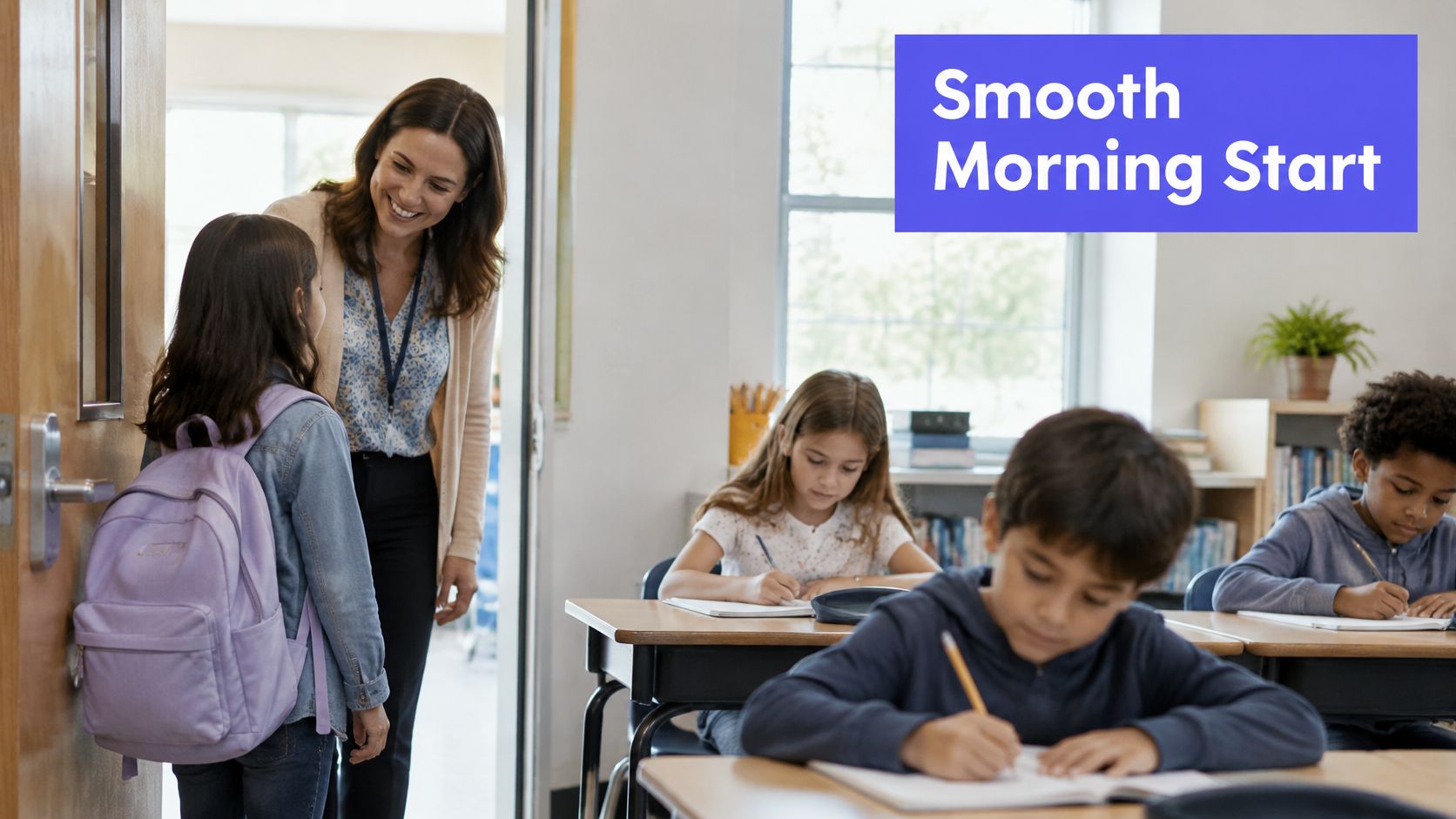
Prepare the entry task before you stand at the door. Otherwise, greeting students competes with finding your slides, answering questions, and sorting paperwork.
A middle school science warm-up might ask students to label a diagram, predict an outcome, and explain their reasoning. An elementary classroom might use a picture-labeled lunch-count bin beside the entrance, so students can register their choice without joining a queue at your desk.
- Before entry: Post a short, familiar task and place the materials where students can reach them.
- At the door: Greet students and direct notes or permission slips to a designated tray.
- Once students settle: Complete attendance through the school's required system, checking late arrivals separately.
- Before instruction: Scan responses and decide whether students need a brief clarification.
Teach the entry, not just the task
The Institute of Education Sciences' elementary behavior guidance recommends explicitly teaching, practicing, and monitoring classroom expectations rather than assuming posted rules are enough.
Walk students through what to do when they enter, forget a pencil, or finish early. Rehearse the awkward parts, not just the ideal version.
Keep a sub-ready copy beside the door. After a trial period, remove steps that don't serve a clear purpose, but retain required attendance and safeguarding checks.
2. Start-of-Year Classroom Setup and Readiness Checklist
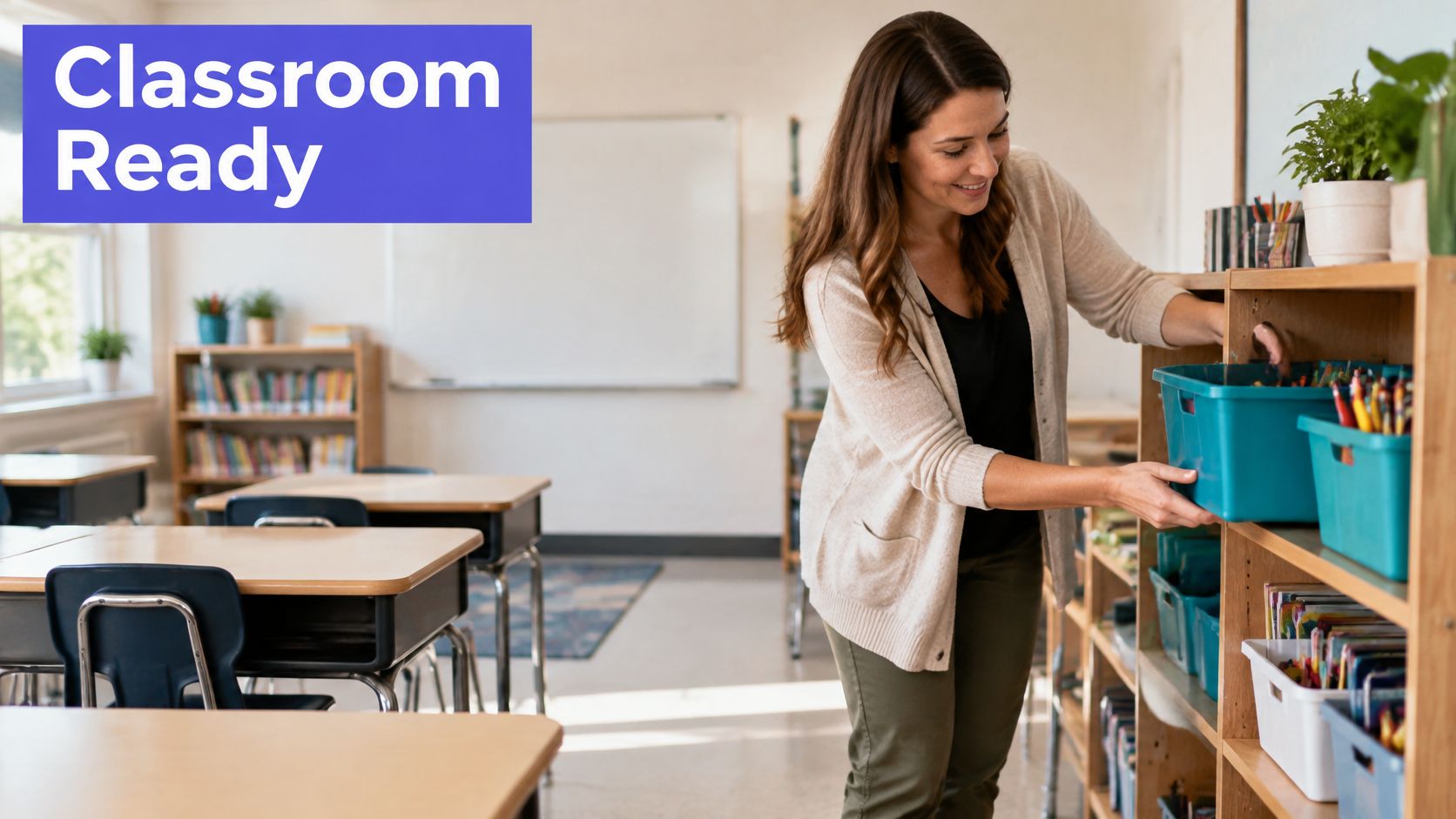
A beautifully labeled room can still be difficult to teach in. Before decorating another display, walk from the entrance to a student seat, then to the supplies, turn-in tray, and exit.
Can students move without squeezing past chairs? Can you see every seat from the doorway, and can students reach materials without interrupting a group?
Set up for independence
Harry Wong's procedures-first approach offers a useful priority: establish how the classroom works before expecting students to work independently within it.
- Movement and access: Check pathways, sightlines, accessible seating, and emergency routes.
- Everyday requests: Decide how students ask for the bathroom, water, supplies, and help.
- Materials: Label bins with words and pictures where helpful, and teach what belongs inside.
- Readiness: Test technology, prepare opening activities, and put emergency information in its approved location.
- First-week teaching: Schedule short blocks for explaining, modeling, and practicing procedures.
For a fourth-grade class, picture-and-word labels make cleanup expectations concrete. In high school history, discreet procedure cards on the back wall can prompt you to teach missing-work and discussion routines before students need them.
The CAST Universal Design for Learning framework emphasizes planning for engagement, representation, and action and expression. Apply that thinking to the room itself: instructions students can't read, hear, reach, or interpret aren't accessible procedures.
Practical rule: Finish the systems students need before the decorations you'd like.
3. Transition and Movement Routine Checklist
The station timer sounds. Students stand up, but some carry unfinished work, others leave materials behind, and the next group can't find its instructions. A timer tells students when to move; it doesn't tell them how.
Write the transition as a sequence students can perform.
- Signal: Use a consistent cue that students can perceive, with a visual alternative where needed.
- Stop: Teach what happens to voices, hands, equipment, and unfinished work.
- Reset: Assign responsibility for returning shared materials.
- Move: Identify the route and destination before anyone stands.
- Restart: Display the task students begin immediately on arrival.
A kindergarten teacher might pair a chime with a finger signal for stop, look, and listen. A middle school math teacher might assign a materials captain while everyone else carries only their recording sheet.
Fix the bottleneck before adding consequences
Observe several transitions and note where students hesitate. If everyone needs the same supply tub, rearranging materials is more useful than another reminder to hurry.
The Institute of Education Sciences behavior practice guide recommends identifying behavior triggers and modifying classroom conditions or instruction. Use that approach when movement repeatedly breaks down.
Practice the routine, then acknowledge the specific behavior you want: materials returned, pathway clear, next task started. Don't turn speed into a competition that disadvantages students who need more movement or processing time.
Use this video as a prompt for discussing transition routines:
4. Substitute Teacher Binder Checklist
Write for someone who hasn't met your class. “Students know what to do” isn't a substitute plan, especially when the projector won't connect and the usual classroom helper is absent.
Put the essential information at the front, not behind old worksheets and outdated seating charts.
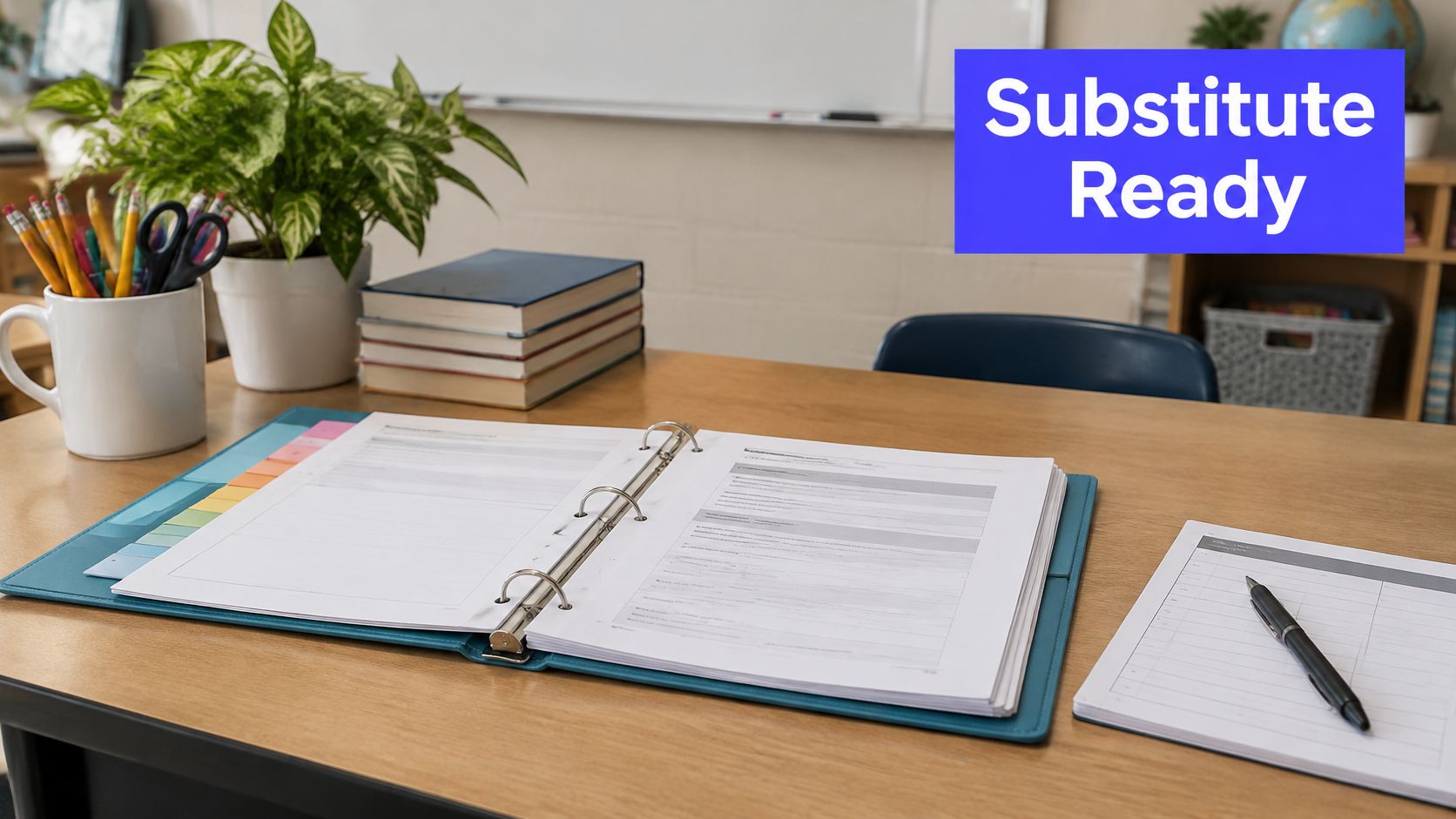
- Find the day: Include the current schedule, roster, seating chart, and attendance instructions.
- Run the room: Explain entry, transitions, bathroom requests, technology access, and dismissal.
- Get support: Identify neighboring staff and the approved route for urgent help.
- Teach the lesson: Supply accessible materials, clear directions, answer guidance, and backup activities.
- Report back: Leave space for completed work, difficulties, and students needing follow-up.
Keep backup work teachable
For high school biology, include a printable review task tied to the current unit, with a worked example and answer guidance. Don't leave an unfamiliar practical investigation that requires equipment or safety expertise the substitute may not have.
For elementary classes, list familiar review games and explain the rules. Name willing student helpers for locating supplies, but don't make students responsible for managing peers.
A substitute should be able to find the next action without searching your desk or asking the class to reconstruct your routine.
Keep paper and digital copies, and check access permissions. Store sensitive medical, accommodation, and safeguarding information through approved school procedures rather than in an openly accessible folder.
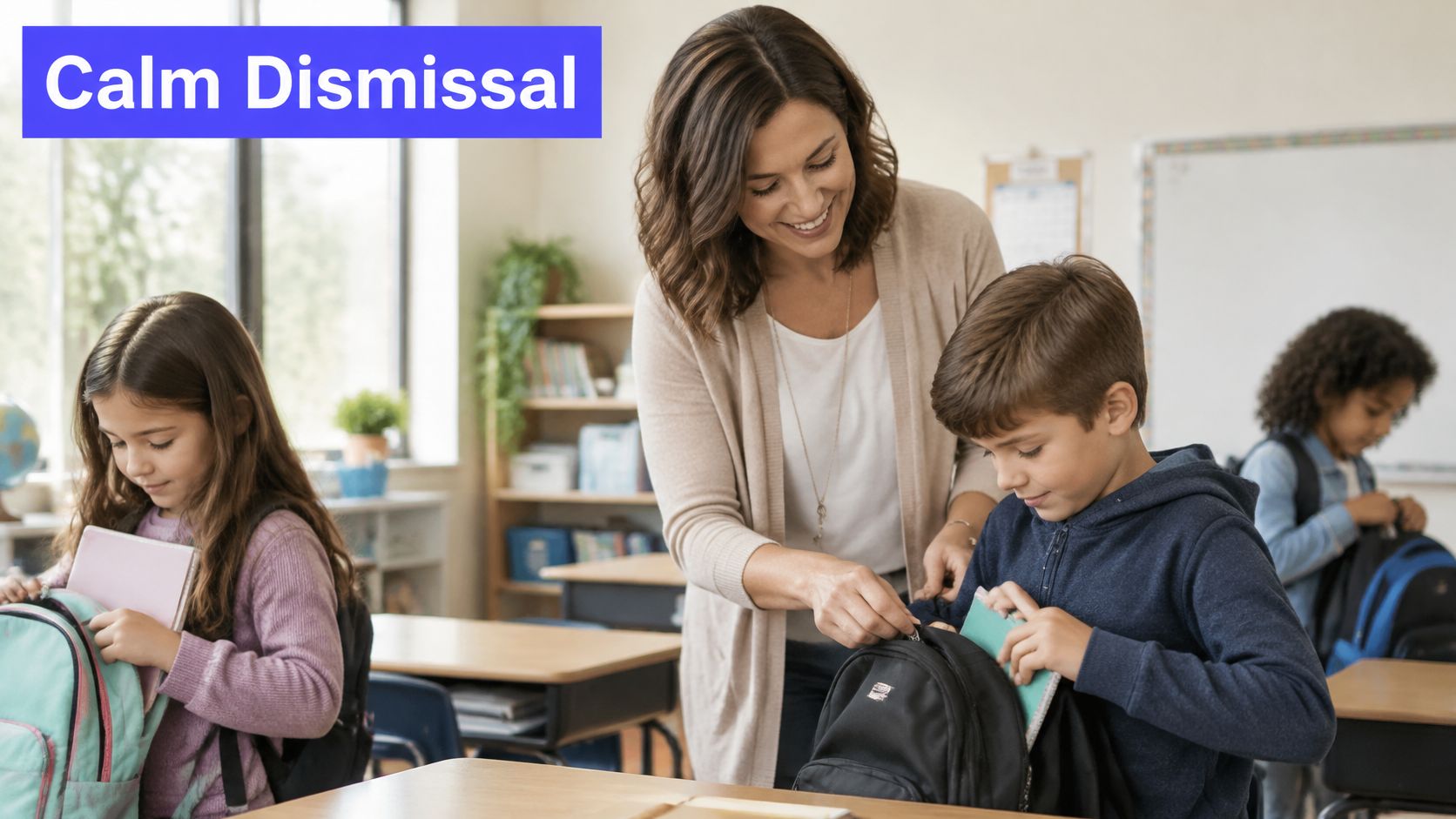
5. End-of-Day Dismissal and Closing Checklist
Dismissal isn't the moment to introduce a complicated reflection task. Use a familiar closing sequence that lets students finish thinking before they start hunting for coats.
A third-grade teacher might sort brief exit slips into ready, almost ready, and needs help piles. A middle school English teacher might display the next reading assignment and required materials, then read them aloud before packing begins.
Close learning before closing bags
- Capture learning: Ask a focused question tied to the lesson objective.
- Clarify next steps: Display homework, materials, and unfinished-work expectations.
- Reset the space: Assign cleanup responsibilities and check shared equipment.
- Pack deliberately: Prompt students to check belongings, messages, and required materials.
- Dismiss safely: Follow the school's verified dismissal arrangements and communicate changes through approved channels.
Build enough cleanup time into the lesson that you aren't collecting scissors as students leave. Post the dismissal order where students can see it, and keep your own prompts near the door.
Read exit slips before planning the next lesson. If students confuse evaporation with boiling, record the example you'll revisit rather than writing a vague reminder to review science.
Don't let the closing routine become another marking pile. Collect only evidence you'll use, and reserve a place in tomorrow's plan for the response.
6. Weekly Planning and Lesson Readiness Checklist
Start with last week's student work, not a blank slide deck. It tells you whether to move forward, reteach a prerequisite, or change the example that didn't land.
Lesson planning accounted for 14% of teachers' working time, on average across the education systems covered by TALIS 2024, according to the OECD's findings on teaching demands. Protect a recurring planning appointment rather than relying on leftover time.
- Confirm the target: Check standards, pacing, prerequisites, and the evidence that will demonstrate learning.
- Draft the sequence: Plan modeling, guided practice, independent application, and closure.
- Prepare access: Review accommodations, language supports, accessible formats, and extension tasks.
- Check readiness: Gather materials, test links, and prepare an offline alternative.
- Review generated content: Verify facts, reading level, representations, citations, and curriculum alignment.
Draft faster, review carefully
Kuraplan generates editable, standards-aligned lesson and unit plans, worksheets, and visuals, with differentiation and assessment rubrics. Use the guide to writing a lesson plan to organize the draft, then adapt it to the learners in front of you.
For example, a first-year teacher might draft the week, then revise response formats and scaffolds for students with IEPs. AI-generated text shouldn't replace required specialist collaboration or human review, concerns highlighted in Education Week's reporting on AI-assisted IEP writing.
For a music extension, AmaJova's guide to online music classes can provide a starting point for exploring options. Check suitability, access, and school approval before assigning any external resource.
7. Assessment and Grading Workflow Checklist
Decide what needs a grade before collecting it. A practice response can tell you what to reteach without becoming a fully marked assignment.
For a science lab report, a teacher might use a rubric and a comment bank organized around evidence, reasoning, and communication. For an elementary reading response, check conventions separately from comprehension so neat sentences don't disguise weak understanding.
Separate checking from grading
- Choose the purpose: Identify whether the work is practice, a formative check, or evidence for a reported grade.
- Set the criteria: Share the rubric or success criteria before students begin.
- Calibrate judgments: Read a sample across the class before committing to scores.
- Work in batches: Assess the same criterion across papers where that helps consistency.
- Record and return: Enter results securely, flag missing evidence, and schedule student response time.
The Education Endowment Foundation's feedback guidance emphasizes planning how pupils will receive and act on feedback. Returning a paper isn't the end of the workflow.
Keep this distinction: Feedback tells students what to change. The next classroom task gives them a chance to change it.
Replace “add detail” with an actionable prompt, such as explaining how a quoted sentence supports the claim. Build reusable comments, but personalize the next step rather than pasting everything that might apply.
Use these formative assessment examples to choose quick checks that inform instruction without requiring another evening of grading.
8. Parent Communication Checklist
A missing-assignment message shouldn't be the only time a family hears from you. Establish a manageable rhythm of useful updates and specific positive contact, then keep a record so follow-up doesn't depend on memory.
For example, an elementary teacher might send a short Friday update with upcoming dates and a classroom learning highlight. A middle school teacher might use a shared, access-controlled contact log to coordinate messages with colleagues.
- Confirm access: Record each family's preferred contact method and language.
- Share useful information: Explain upcoming learning, deadlines, and what students need to bring.
- Notice something specific: Send positive observations about effort, progress, contribution, or growing independence.
- Prepare difficult conversations: Gather examples, describe the concern neutrally, and identify a possible next step.
- Close the loop: Record the agreed action, responsible person, and follow-up date.
Keep messages factual and readable
For a missing assignment, name the task, explain what's incomplete, and state how the student can get help. Avoid turning an observation into a character judgment: an unsubmitted paragraph doesn't establish that a student is lazy.
Use school translation resources when needed. Share classroom photos only through approved channels and in line with permissions.
A parent-email drafting workflow can help organize a message, but verify names, dates, tone, and commitments before sending. Don't enter identifiable student information into an unapproved tool, and keep confidential discussions out of group messages.
The 8 Teacher Checklists at a Glance
| Checklist | Best For | When to Use | Time to Set Up |
|---|---|---|---|
| Morning Arrival and Entry Routine Checklist | Creating a calm, predictable start to class | Each school morning | Brief; requires practice with students |
| Start-of-Year Classroom Setup and Readiness Checklist | Preparing classroom space, procedures, and materials | Before the school year begins | Substantial advance preparation |
| Transition and Movement Routine Checklist | Keeping activity changes and group movements orderly | During transitions throughout the school day | Brief to plan; requires repeated practice |
| Substitute Teacher Binder Checklist | Helping a substitute run class smoothly | Before planned or unexpected absences | Takes an afternoon to prepare well |
| End-of-Day Dismissal and Closing Checklist | Organizing cleanup, reflection, and dismissal | During the final minutes of each school day | Brief to prepare |
| Weekly Planning and Lesson Readiness Checklist | Preparing standards-aligned lessons and materials | Before each teaching week | Recurring planning time required |
| Assessment and Grading Workflow Checklist | Managing grading and providing timely feedback | When collecting and reviewing student work | Some initial rubric and workflow preparation |
| Parent Communication Checklist | Keeping families informed and building trust | Weekly or biweekly, and when student concerns arise | Brief to establish; ongoing time required |
Put One Checklist to Work This Week
Pick the routine that matches your biggest daily friction point. If arrival feels chaotic, don't start by reorganizing your grading system; put the entry task, attendance prompt, and paperwork tray in place first.
If Sunday-night planning keeps stretching into bedtime, start with lesson readiness. If the paper stack keeps growing, decide which assignments need grades and which only need a quick instructional response.
Make the trial small enough to finish
Run your chosen checklist for two weeks before adding another. Treat that as a practical trial, not a deadline for making the routine perfect.
- Put it at the point of use: Arrival checks belong by the door, not inside a planning document you rarely open.
- Use visible actions: Write “post the warm-up” rather than “prepare for a successful morning.”
- Notice the snag: Record where you still repeat directions, search for materials, or postpone decisions.
- Revise the routine: Remove duplication, clarify confusing steps, and preserve essential safety and access checks.
A missed checkbox doesn't automatically mean you need more discipline. Perhaps the attendance prompt is in the wrong place, the cleanup task starts too late, or the worksheet requires materials students can't collect independently.
For team leaders, that distinction matters. Use checklists to support shared preparation and coaching, not to turn every classroom decision into a compliance exercise.
Keep the steps that protect learning, access, and safety. Question the steps that only prove you completed paperwork.
Routines, not willpower, protect teaching time. You'll still need professional judgment when a student is distressed, an explanation falls flat, or a lesson takes an unexpected turn; the checklist keeps ordinary tasks from competing with those decisions.
As your planning needs change, review the routine rather than preserving it out of habit. Kuraplan's weekly updates are based on teacher feedback, and that same principle belongs in your classroom systems: adjust what you use when teachers and students identify a better way.
Kuraplan offers editable, standards-aligned lesson plans, differentiated activities, worksheets, and assessment rubrics to support your weekly readiness routine. Visit Kuraplan to try it for free, draft an upcoming lesson in minutes, and use your checklist to review it before teaching.