You have 20 minutes before the lesson starts. Your class includes 27 pupils, three languages spoken at home, two students with IEPs, and one advanced reader who finished yesterday's extension before lunch. The worksheet on your desk assumes everyone reads, writes, processes instructions, and responds in the same way.
That's the moment when differentiated instruction for diverse learners can sound like one more demand. In practice, it doesn't mean preparing 27 separate lessons. It means designing one strong learning goal with flexible ways to access it, practise it, and show understanding. The workable version respects teacher time, uses evidence from pupils' responses, and changes what needs changing without lowering expectations.
What Differentiation Really Looks Like on a Monday Morning
At 8:35, you might begin a Grade 4 science lesson on food chains. The objective is simple: pupils will explain how energy moves from one living thing to another. You have one short reading, a labelled diagram, vocabulary cards, and a task asking pupils to explain a food chain.
The lesson isn't identical for everyone, but it isn't 27 different lessons either. Some pupils read the text independently. Others listen while following the diagram. A small group works with you on the words producer, consumer, and predator. One pupil uses a sentence frame, another records an oral explanation, and a confident reader adds a second example from a different habitat.
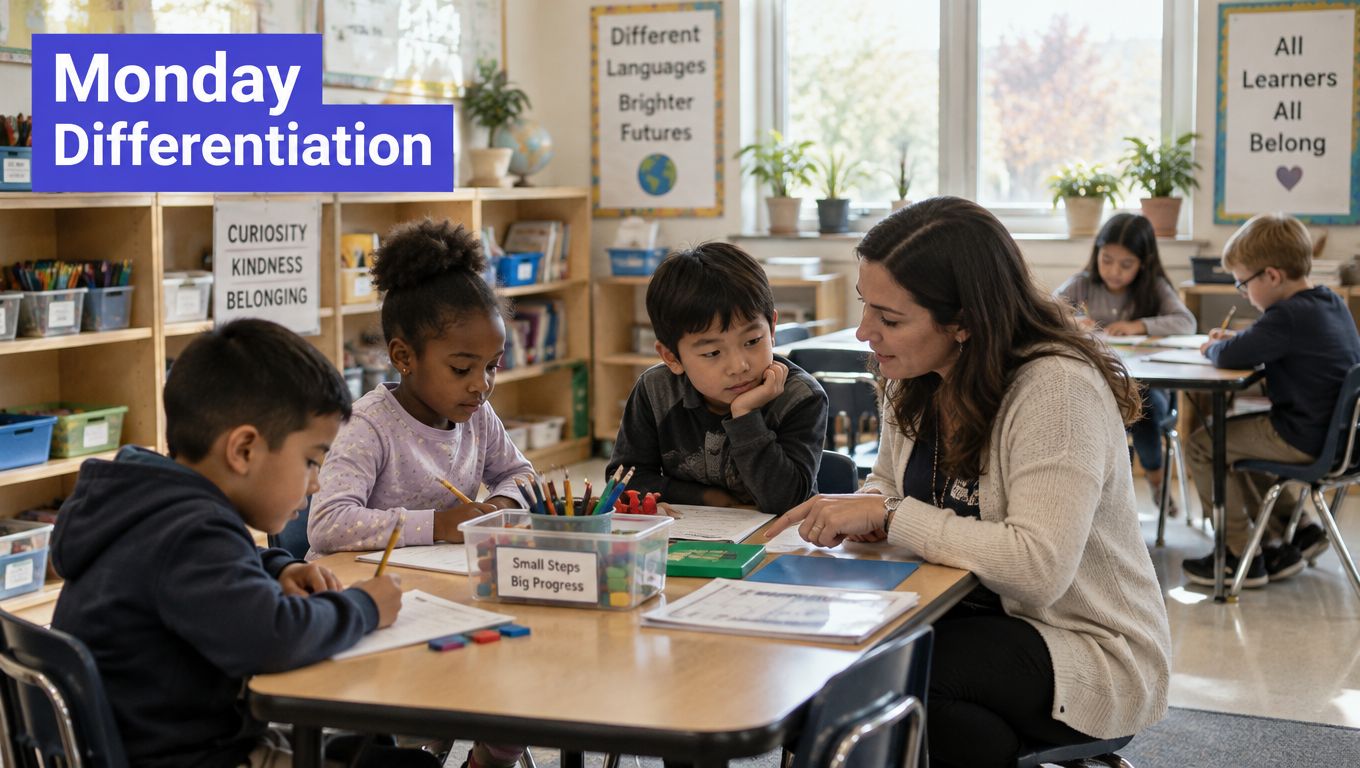
The learning target stays stable. The route changes because pupils differ in readiness, language background, attention, confidence, sensory access, and previous experience. A support is useful when it removes a barrier to the concept. It becomes unhelpful when it replaces the concept with an easier one.
Start with the lesson, not the labels
Before planning groups, ask three practical questions:
- What must every pupil understand? Write the concept in one clear sentence.
- Where might access break down? Check vocabulary, reading load, instructions, motor demands, and the response format.
- What evidence will I collect? Decide how pupils will show progress before choosing the activity.
A group generator such as Kuraplan's classroom grouping tool can support temporary, need-based groups, but the teacher still decides why pupils are together and when the grouping should change. A child shouldn't remain in a “low” group because of an old reading score when today's task requires a different kind of support.
Practical rule: Plan the smallest useful set of variations. One alternative way into the content and one alternative way to respond can be more valuable than a pile of separate worksheets.
This approach treats planning time as a real design constraint. The question isn't whether you can imagine more adaptations. It's which adaptations make the lesson more accessible without making the planning load impossible.
The Core Idea and the Three UDL Pillars
Think about a public building entrance. If it has only stairs, someone using a wheelchair must wait for a ramp to be added later. A more thoughtful design includes stairs, a ramp, and automatic doors from the beginning, so people don't have to announce themselves as the reason access is needed.
Differentiation works in a similar way. Instead of creating one narrow lesson and adding individual fixes after pupils struggle, you anticipate predictable barriers while planning. Universal Design for Learning, or UDL, gives that approach a clear structure through engagement, representation, and action and expression, as outlined by CAST's UDL framework.
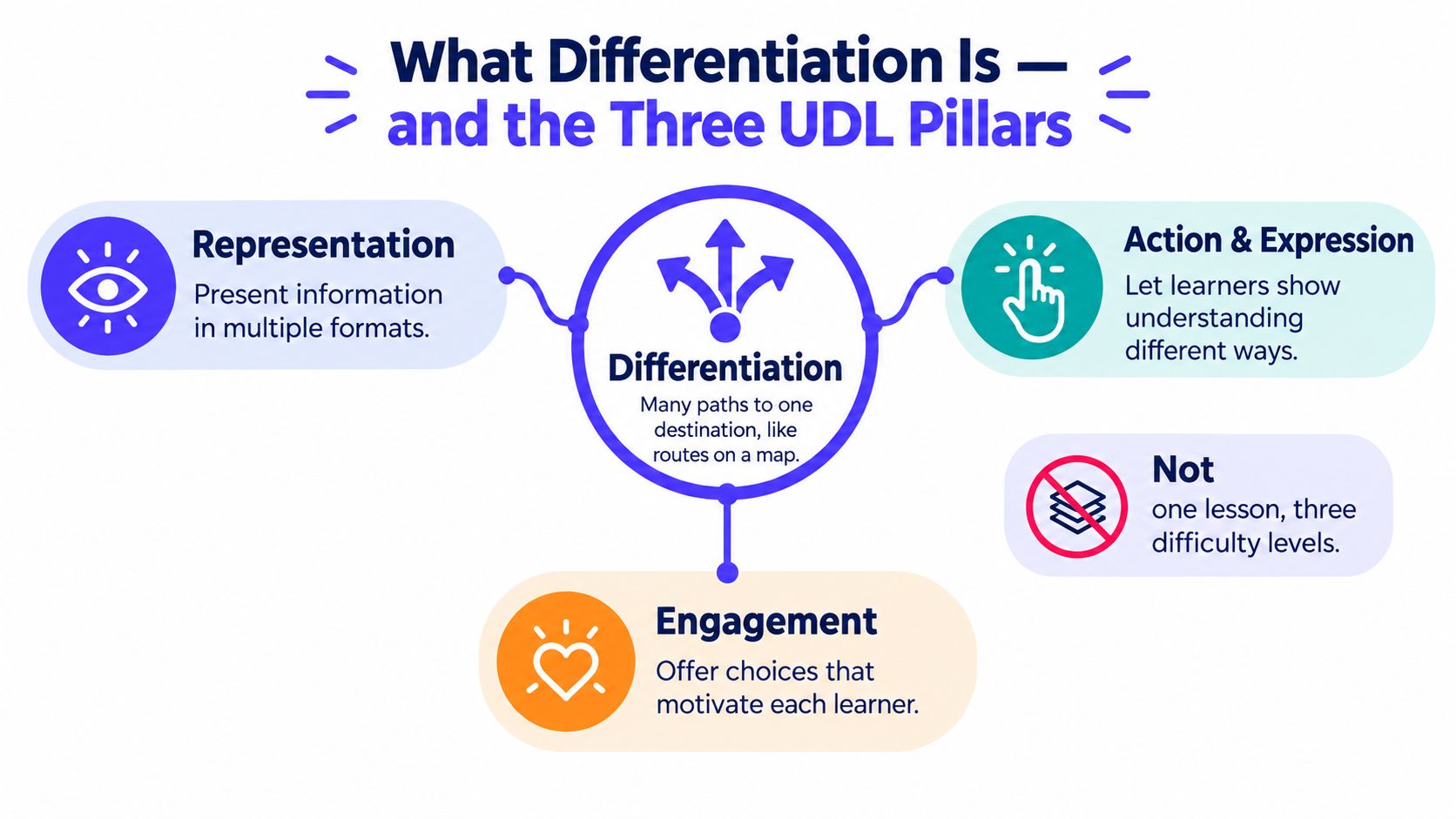
Engagement answers why
Engagement concerns interest, persistence, and self-regulation. You might offer a choice of examples, connect a task to pupils' interests, provide a predictable sequence, or let learners choose whether to work alone or rehearse with a partner.
Choice doesn't mean removing structure. A pupil can choose between animals for a food-chain investigation while still meeting the same science objective.
Representation answers what
Representation concerns how pupils perceive and understand information. A teacher might pair text with a labelled diagram, explain unfamiliar vocabulary, caption a video, provide an audio version, or highlight the key relationship in a dense paragraph.
These options aren't “easier work.” They're different access routes to the same idea. The MEDIAL inclusive training guide offers a useful, accessible explanation of how inclusive design can anticipate barriers rather than waiting for individual failure.
Action and expression answers how
Action and expression concern how learners participate and demonstrate understanding. A pupil might write, speak, draw, build a model, or annotate an image, depending on the task and the evidence you need.
The response mode must still measure the objective. If the goal is explaining a food chain, an oral recording can measure the explanation just as a paragraph can. A scaffold such as this guide to scaffolding in education should help pupils reach independence, not become a permanent substitute for thinking.
What the Research Actually Says and Where It Gets Messy
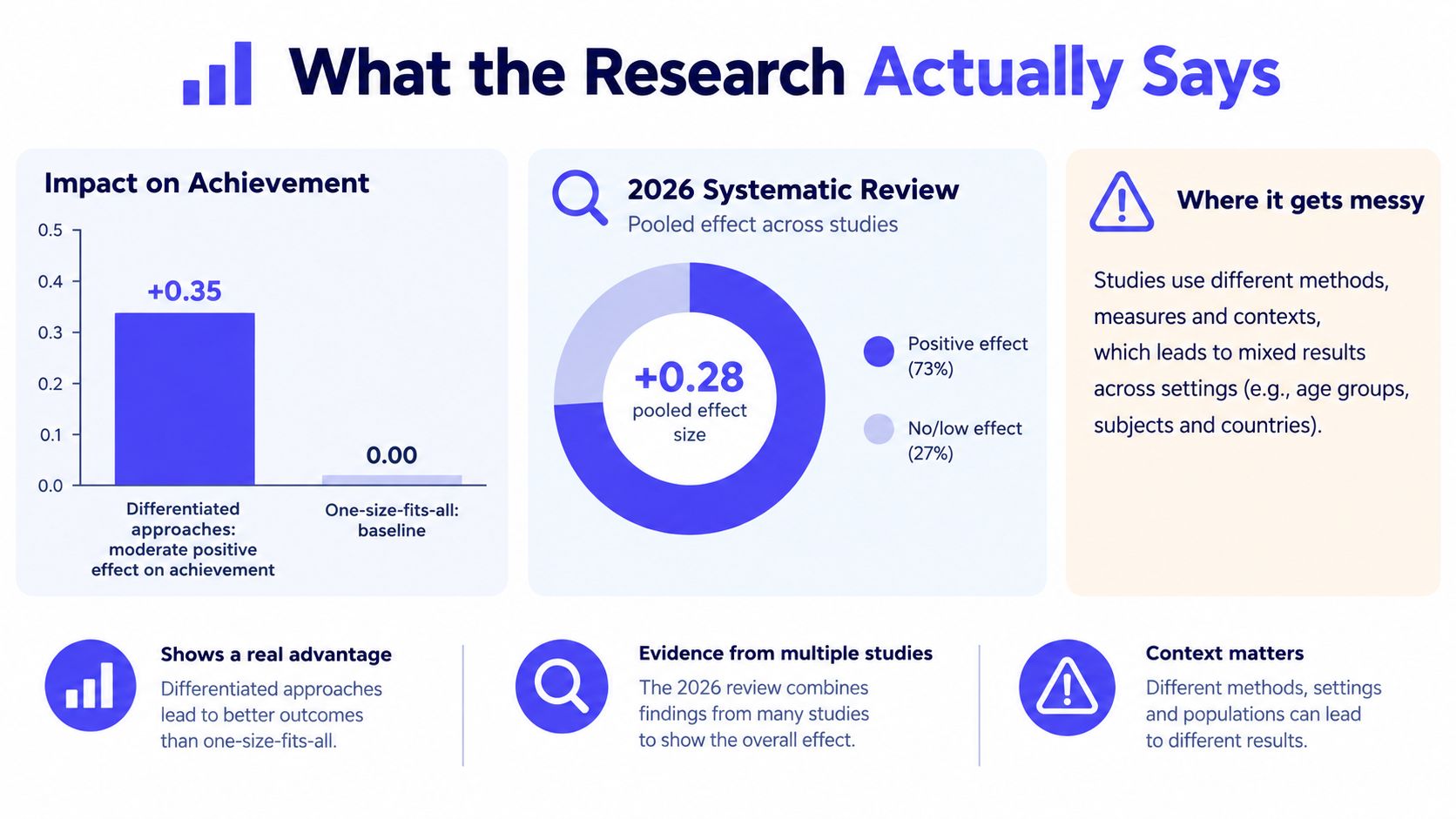
The evidence supports differentiation, but it doesn't support a recipe book. A 2026 systematic review synthesised 45 controlled studies conducted between 2011 and 2024 across 18 countries, representing 56 effect sizes and 16,773 learners. Across those studies, differentiated instruction produced a statistically significant medium-to-large improvement in cognitive academic language outcomes, with a random-effects Hedges' g of 0.78, a 95% confidence interval of 0.557–1.003, and p < .001 (Frontiers in Education systematic review).
That pooled effect exceeded the commonly cited education-research benchmark of g ≈ 0.40, suggesting a meaningful average advantage over less-adaptive instruction. The average matters, especially for multilingual learners whose academic-language development may vary considerably across a class.
The average doesn't predict every classroom
The same review found effects ranging from −0.47 to 3.12. 11 of 56 effect sizes were negative, and heterogeneity was extremely high, with I² = 97.75%. In plain language, some implementations worked much better than others, and the difference likely relates to learner characteristics, instructional design, context, and implementation quality.
UNESCO's 2020 Global Education Monitoring Report shows why access matters beyond attainment. Across 14 countries participating in 2017–2019 Multiple Indicator Cluster Surveys, children with disabilities represented approximately 15% of the out-of-school population, while people with sensory, physical, or intellectual disabilities were 2.5 times more likely never to have attended school than peers without disabilities (UNESCO's 2020 inclusion report).
These figures don't tell a teacher which grouping strategy to use tomorrow. They do establish that flexible access is connected to participation and equity, not only enrichment for high attainers.
Differentiation is a hypothesis about what will help a learner access the target. The pupil's response tells you whether the hypothesis was useful.
Watch for evidence. If a diagram helps pupils explain the relationship, keep it. If a sentence frame produces copied fragments without understanding, revise it. If one group needs a vocabulary rehearsal while another needs a more complex comparison, adjust the next lesson rather than defending the original plan.
Strategies That Travel Together, Not a Menu of Random Moves
Differentiation works best as a short cycle:
- Check readiness.
- Adjust access or practice.
- Group pupils around the current need.
- Collect evidence.
- Remove, change, or extend the support.
The strategies below belong together because each one answers a different part of that cycle.
Flexible grouping follows the task
Start with the barrier, not a permanent label. In a food-chain lesson, you might bring together pupils who need vocabulary rehearsal for five minutes, then regroup pupils by the kind of explanation they're developing. Later, mixed pairs can compare habitats.
Groups should change when the evidence changes. A pupil who needs language support in a science discussion may be ready for independent work during a diagram task.
Tiered tasks preserve one objective
Tiering doesn't mean writing unrelated assignments. Keep the same goal and vary complexity, scaffolding, or independence.
For the food-chain objective:
- Supported route: Pupils arrange picture cards and use the frame, “The ___ is eaten by the ___ because…”
- Core route: Pupils write or record an explanation using the labelled diagram.
- Extension route: Pupils compare two food chains and explain what might happen if one organism disappeared.
The cognitive demand can remain meaningful across all three routes. The difference lies in how much language, organisation, or background knowledge each pupil must manage alone.
Graduated scaffolding should fade
Provide a model, vocabulary bank, worked example, or sentence starter when it removes a barrier. Then reduce the support as pupils gain control.
A useful sequence might be a completed example, a partly completed example, and an independent response. If every worksheet always includes every prompt, pupils may learn to wait for the scaffold instead of using the underlying strategy.
Formative checks decide the next move
Use a quick diagram label, a hinge question, a mini whiteboard response, an observation during partner talk, or an exit ticket. Don't collect evidence just because assessment is expected. Collect it because you need to decide whether to reteach, regroup, extend, or remove a support.
One standards-aligned planning platform can help you prepare alternative explanations, visuals, practice routes, and assessment formats for the same lesson. Kuraplan is one such option, with lesson planning, differentiated materials, worksheets, visuals, and assessment rubrics in one workflow.
The minimum-viable version is often enough: one shared representation, one scaffolded practice route, one independent route, and one check that tells you what to change next.
The Honest Part, Teacher Time, Confidence, and Capacity
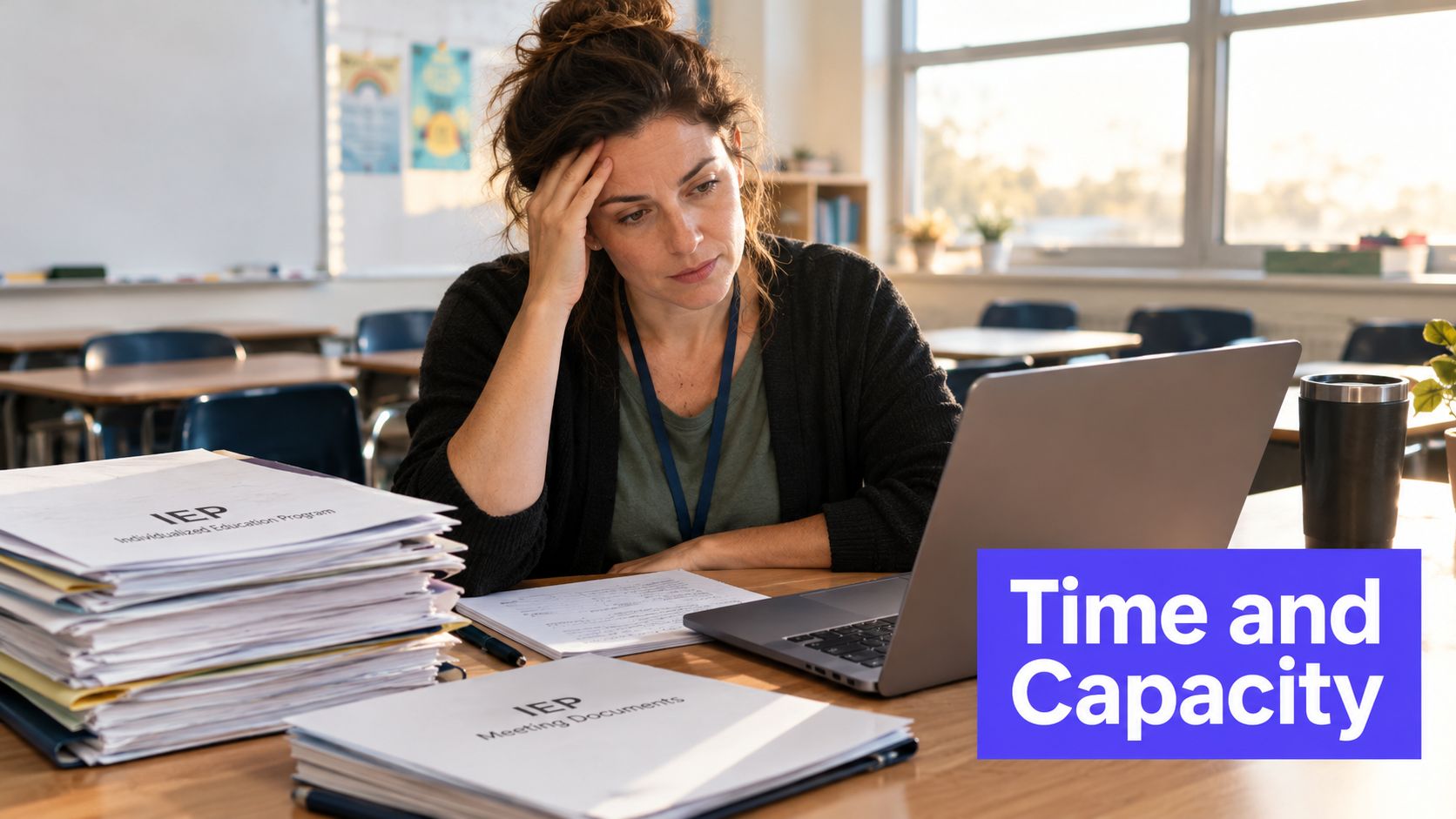
Teachers often know what differentiation should look like. The harder question is whether they can prepare it after meetings, marking, family communication, behaviour support, and paperwork.
A 2025 survey of 234 primary teachers across Ireland found that confidence in differentiation scored 3.17 on a five-point scale, the highest domain score, yet teachers reported strong pressure around planning, collaboration, and managing inclusive workloads (Irish National Teachers' Organisation report). Confidence and feasibility aren't the same thing.
Reduce the number of decisions
Don't begin by redesigning every lesson component. Choose one objective and reuse a small planning template:
- Access: What visual, audio, concrete example, or vocabulary support will make the content clearer?
- Practice: Which pupils need a model, guided rehearsal, or a smaller first step?
- Expression: Can pupils write, speak, draw, build, or annotate while demonstrating the same understanding?
- Evidence: What will you look for before deciding the next step?
Reuse the same structure across subjects. A predictable template saves mental energy because you're changing the content, not reinventing the planning process.
The planning bottleneck is also a sensible place to use a digital aid. A tool that produces editable lesson variations, worksheets, visuals, and rubrics can reduce formatting and preparation decisions, provided the teacher checks the content and keeps professional judgement in charge.
Work with the capacity you actually have
Batch similar tasks. Prepare vocabulary cards for several lessons at once. Ask a colleague to share a diagram while you create the exit ticket. Use the same response formats repeatedly so pupils learn the routine.
A sustainable classroom doesn't display every possible adaptation. It uses a few well-chosen supports consistently, watches the evidence, and changes them when they stop helping. The pressure isn't proof that you lack commitment. Often, it shows that the recommended practice needs to fit within ordinary staffing and planning conditions.
Designing for Overlapping Identities and Needs
A multilingual learner with a disability can be misunderstood in two directions. Teachers may mistake limited proficiency in the instructional language for a learning difficulty, or a disability may remain hidden because the pupil's language needs explain away every struggle.
The safest response is to separate the questions. What can the pupil understand when language demands are reduced? Which difficulty appears across languages or response modes? What does the family observe at home? What do specialists and previous teachers know?
Keep the academic target ambitious
Consider a Grade 6 social studies lesson on ancient civilizations. The target is for pupils to explain how a civilization's geography influenced its development. A multilingual pupil with a reading disability might use a bilingual glossary, an audio version of the source, and a labelled timeline. The pupil can then give an oral explanation supported by the timeline rather than producing a written paragraph.
The target hasn't been lowered. The teacher has reduced barriers in reading, vocabulary, sequencing, and written output while preserving the historical reasoning.
Useful design moves include:
- Preteach essential language: Introduce the few terms pupils need to reason about the concept, not every word in the chapter.
- Keep grade-level ideas visible: Use diagrams, maps, audio, models, and chunked text without replacing complex content with age-inappropriate work.
- Compare evidence across settings: Consider whether the difficulty appears during discussion, practical tasks, the home language, and independent work.
- Invite collaboration: Families, language specialists, special educators, and classroom teachers each hold different evidence.
For practical ideas that combine sound, movement, visual cues, and repetition, ReadLab's multisensory reading activities for children can provide useful inspiration. The activity still needs to serve the lesson objective rather than become an isolated exercise.
Gifted pupils can also have overlapping needs. A pupil may reason well but need language support, or read fluently while requiring challenge in analysis. Differentiation should respond to the actual task and evidence, not assume that one identity cancels out another.
Assessment and Progress Tracking That Closes the Loop
Assessment is the steering mechanism for differentiation. Without it, teachers can mistake a busy classroom for an effective one, or keep a support in place because it feels helpful even when pupils have outgrown it.
Use small checks that fit the lesson. An exit ticket can reveal whether pupils identified the key relationship. A quick write can show vocabulary use. A cold-call question, used carefully, can expose misconceptions, while observation during partner talk may show that a pupil understands more than a written response suggests.
Look for patterns, not isolated answers
One incorrect answer doesn't tell you that a whole group needs reteaching. Look for repeated patterns:
- Several pupils use a term incorrectly.
- Pupils can identify facts but can't explain the relationship.
- A pupil succeeds orally but not in writing.
- A group completes the task only when the model remains visible.
- One subgroup receives less opportunity to practise or respond.
Track progress against the same success criteria while recording the route each pupil used. A rubric can describe the quality of the explanation without penalising a pupil for choosing speech instead of writing when written output isn't the target. Standards mapping and rubric features in a planning tool can help keep those criteria stable across differentiated materials.
The formative assessment examples guide can help teachers build a bank of quick checks rather than inventing a new one for every lesson.
A simple progress snapshot
| Subgroup | What to track | How often | Adjust if... |
|---|---|---|---|
| Multilingual learners | Use of target vocabulary and understanding shown through different response modes | During key lessons and after each unit check | Language support helps access but the concept remains unclear |
| Pupils with IEPs | Progress toward the shared objective with agreed accommodations | At planned review points and through lesson evidence | The accommodation removes access barriers but independence isn't developing |
| Advanced learners | Depth, transfer, justification, and increasingly independent application | During core tasks and extension work | Extension adds volume without adding reasoning |
| Whole class | Common success criteria and recurring misconceptions | During each lesson sequence | The same misconception appears across groups |
The table isn't a demand for another tracking system. A few useful notes in an existing planning book can be enough. The purpose is to close the loop: identify a barrier, make a change, check the result, and decide what happens next.
What to Do This Week and a Quick FAQ
Choose one lesson, not an entire scheme. Write the shared objective, identify where pupils may meet a barrier, add one alternative representation, add one alternative response mode, and plan one quick formative check. After the lesson, record what worked and what you'll change next.
A few staff-room answers
What if I have no time? Start with the lesson you already teach. Add a diagram, vocabulary support, or oral response option instead of rebuilding the whole sequence.
What if a parent thinks their child is receiving easier work? Show the shared objective and success criteria. Explain that the access route has changed, while the intended understanding remains appropriately challenging.
Can I differentiate without a co-teacher? Yes. Use whole-class design first, then one temporary group or conference based on the evidence. You don't need simultaneous individual instruction for every pupil.
Should I group pupils by ability? Group by the need of the task, and change groups when the evidence changes. A permanent label rarely captures what a pupil can do today.
Differentiated instruction becomes manageable when you treat it as a cycle, not a performance. Plan one strong target, open more than one route to it, check the evidence, and make the next adjustment small.
Kuraplan helps teachers create standards-aligned lesson plans, differentiated worksheets, visuals, and assessment rubrics from one planning workflow. If preparing multiple access and response routes is your current bottleneck, visit Kuraplan and use it to build the next lesson around the learners in front of you.