
It's Tuesday morning. You're explaining the task while someone searches for a pencil, someone else has already finished, and several children are waiting because they couldn't read the directions. You've planned a sensible lesson, but getting everyone started is taking more teaching than the lesson itself.
Differentiated instruction for elementary students should make that situation more manageable, not give you another evening of preparation. Start with a shared learning goal, prepare a small amount of targeted support, and decide beforehand what evidence would make you change it.
What Stays Fixed and What Flexes in a Differentiated Lesson
Say thirty Grade 3 children are learning to explain equivalent fractions. Think of the class crossing the same river to the same far bank, with different boats: some children use fraction strips, some draw matching bars, and others explain why different fraction names represent the same amount.
Differentiated instruction changes how students reach a shared grade-level goal, rather than lowering or replacing that goal. The destination matters more than whether everyone uses identical materials.
The four levers you can adjust
| Lever | What changes | Classroom example |
|---|---|---|
| Content | How students access the essential information | Versions of the same informational text at two reading levels carry the same key idea. |
| Process | How students work through the learning | A guided group studies a worked example while classmates work independently from the same success criteria. |
| Product | How students demonstrate understanding | A labelled diagram or a three-sentence paragraph explains the same scientific relationship. |
| Environment | Conditions that help students participate | A quiet corner, manipulatives on the table, or an extra five minutes removes a barrier. |
Those choices need boundaries. Different reading levels make sense when the target is understanding scientific content, but not when the assessment is specifically testing independent decoding. Likewise, a diagram can demonstrate scientific understanding, but it can't replace a paragraph when paragraph construction is the skill being taught.
CAST's Universal Design for Learning guidelines identify inflexible, one-size-fits-all curricula as a source of barriers and recommend multiple means of engagement, representation, and action or expression. Build legitimate access choices into the lesson from the beginning, rather than waiting until a child gets stuck.
Support without a separate destination
Differentiation isn't a separate worksheet for the low group. It isn't permanent ability grouping, and it isn't permission to expect less from children who need more help.
Practical rule: Change the barrier before you change the intellectual demand.
A prompt that helps a child begin an explanation is different from giving them an answer to copy. Our guide to scaffolding in education explains how to make that support temporary.
Before teaching, ask:
- Same goal? Is everyone working toward the intended learning?
- Clear path? Can each group access the task and demonstrate success?
- Evidence-based change? Does the adaptation address something students need?
Strategies That Work in Elementary Classrooms
Writing is a useful place to begin. A systematic review and meta-analysis of classroom differentiated literacy instruction found a small but statistically significant overall effect across 18 studies, with a weighted mean effect of g = +0.13, while the writing effect was g = +0.96.
That stronger writing result suggests looking beyond easier and harder texts. Children may need different amounts of modelling, sentence support, planning structure, or revision guidance. It doesn't establish that every writing scaffold works equally well, or that the same result will appear in your classroom.
Six differentiation strategies compared
The setup efforts below are planning judgments, not research estimates. Choose by the instructional problem, not by how impressive the activity looks.
| Strategy | Best for | Setup effort | Common failure |
|---|---|---|---|
| Tiered tasks | Mixed readiness in one skill | Medium: two or three versions | Labels stick to the lower tier |
| Flexible small groups | Skills that shift week to week | Low once routines exist | Groups never change |
| Scaffolds, including sentence frames and word banks | Writing and reading responses | Low: adapt an existing prompt | Support is never faded |
| Choice menus | Engagement and product choice | Medium: check each option against the objective | Choice changes the learning goal |
| Learning stations | Practice across several skills | High in the first term | Transitions and noise take over |
| Teacher-led small group | Targeted reteaching | Low: prepare a model and practice task | Only the group you see most gets help |
For a tiered maths task, try three versions of the same addition problem: one with a place-value drawing, one without a representation, and one asking students to identify and correct a plausible error. The stretch comes from reasoning, not a longer page.
A flexible writing group might meet for ten minutes on Tuesdays and Thursdays to practise linking evidence to a topic sentence. Use a sentence frame while it helps, then ask children to construct the relationship themselves.
For stations, keep familiar activities running for three weeks before adding another. Change the practice content without changing where materials live, how children move, or what they do when finished.
Keep the strategy smaller than the learning
- Keep the skill constant. Tiers should offer different entry points into the intended learning.
- Change groups when evidence changes. A child needing help with inference may not need help with vocabulary.
- Drop fixed ability labels. Name groups by their current task or teaching focus.
Choice menus need particular care in creative subjects. For older pupils or a home-school extension, The Online College of Art & Design (OCAD) offers art project guidance for home educators; adapt the project demands to your pupils rather than importing secondary-level expectations into an elementary lesson.
Start with the one or two strategies that match this week's skill gap, not the full menu.
How to Plan One Lesson for Several Readiness Levels
Prepare a single lesson with a supported route and a stretch route, not separate curricula for every table. The shared teaching, vocabulary, and assessment should still fit together.
The Education Endowment Foundation's guidance on special educational needs in mainstream schools recommends explicit instruction, cognitive and metacognitive strategies, scaffolding, flexible grouping, and technology-assisted approaches as a responsive teaching repertoire. The practical implication is to plan what support does and when students should work without it.
Use this visual as a planning reminder, then make the assessment decisions explicit.
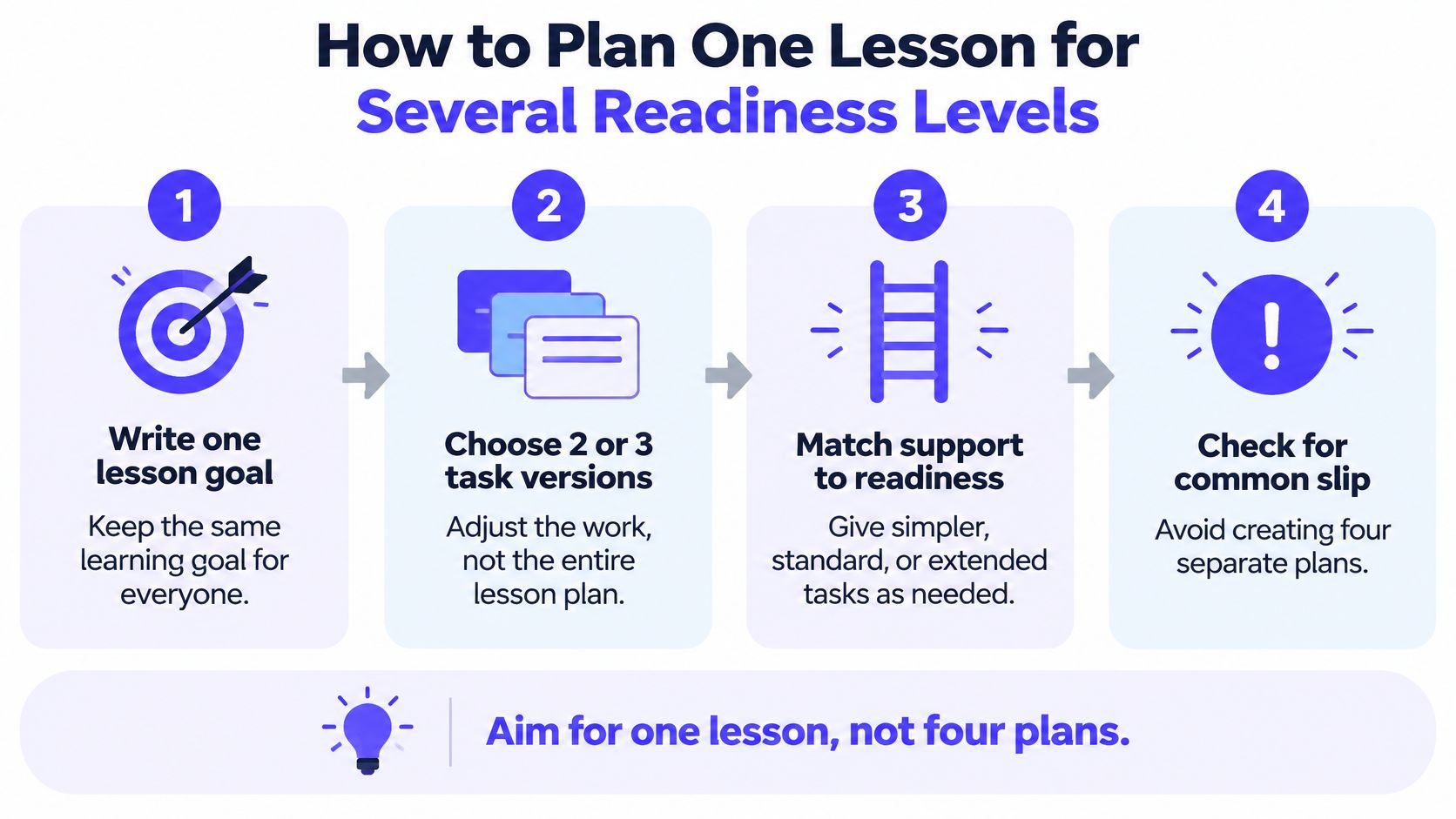
Six decisions before you teach
For example, plan a Grade 4 water cycle lesson like this:
Write one shared objective in student language. Use: explain how the water cycle moves water between ground, air, and sky, and leave it visible throughout the lesson. Avoid an activity-only objective such as completing a water cycle poster, because completion doesn't tell you what students understand.
Run a three-question prerequisite check. Ask what evaporation means, what condensation means, and which process explains droplets forming on a cold surface, using whiteboard hold-ups or yesterday's exit slips. Don't mix in unrelated vocabulary or handwriting demands, which make the results harder to interpret.
Build two task versions, not four. The supported task uses a labelled diagram and word bank to explain water movement; the stretch task asks why puddles disappear on a sunny day using the same terms and connecting the explanation to the wider cycle. Don't mistake extra questions for greater complexity.
Assign a purposeful scaffold to each group. Give the supported group the diagram and vocabulary bank, and give the stretch group a prediction prompt that asks where the water might move next. Avoid handing every child every support sheet, which adds clutter without clarifying the next step.
Write the removal criterion. In this example, remove the word bank after two correct explanations without vocabulary prompts. Don't remove access arrangements a child still needs because a temporary instructional scaffold is ready to fade.
Plan a five-minute exit check. Ask where rainwater goes after it reaches the ground, and assess whether children explain a plausible route using accurate processes. Use common criteria, rather than giving the supported group a recall question and the stretch group an explanation.
Keep the finished plan on one page
Kuraplan can draft the objective and task versions from your grade level and learning goal. Treat that as a first draft: compare its vocabulary, demands, and proposed support with the prerequisite responses before teaching.
The finished sheet needs six parts: objective, prerequisite check, task versions, assigned scaffolds, removal criterion, and exit question. Put the two tasks and their supports alongside each other so you can see whether they still assess the same learning.
If your existing template buries those decisions under administrative detail, use this approach to writing a lesson plan. You should be able to glance down during teaching and know what to do next.
Minimum Viable Differentiation for Large, Busy Classes
Being told to differentiate more doesn't create planning time or another adult in the room. A review of differentiated-instruction implementation barriers identifies limited training, insufficient planning time, weak institutional support, and resource constraints as persistent obstacles.
Keep the organisation simple enough that you can teach a group while classmates work independently.
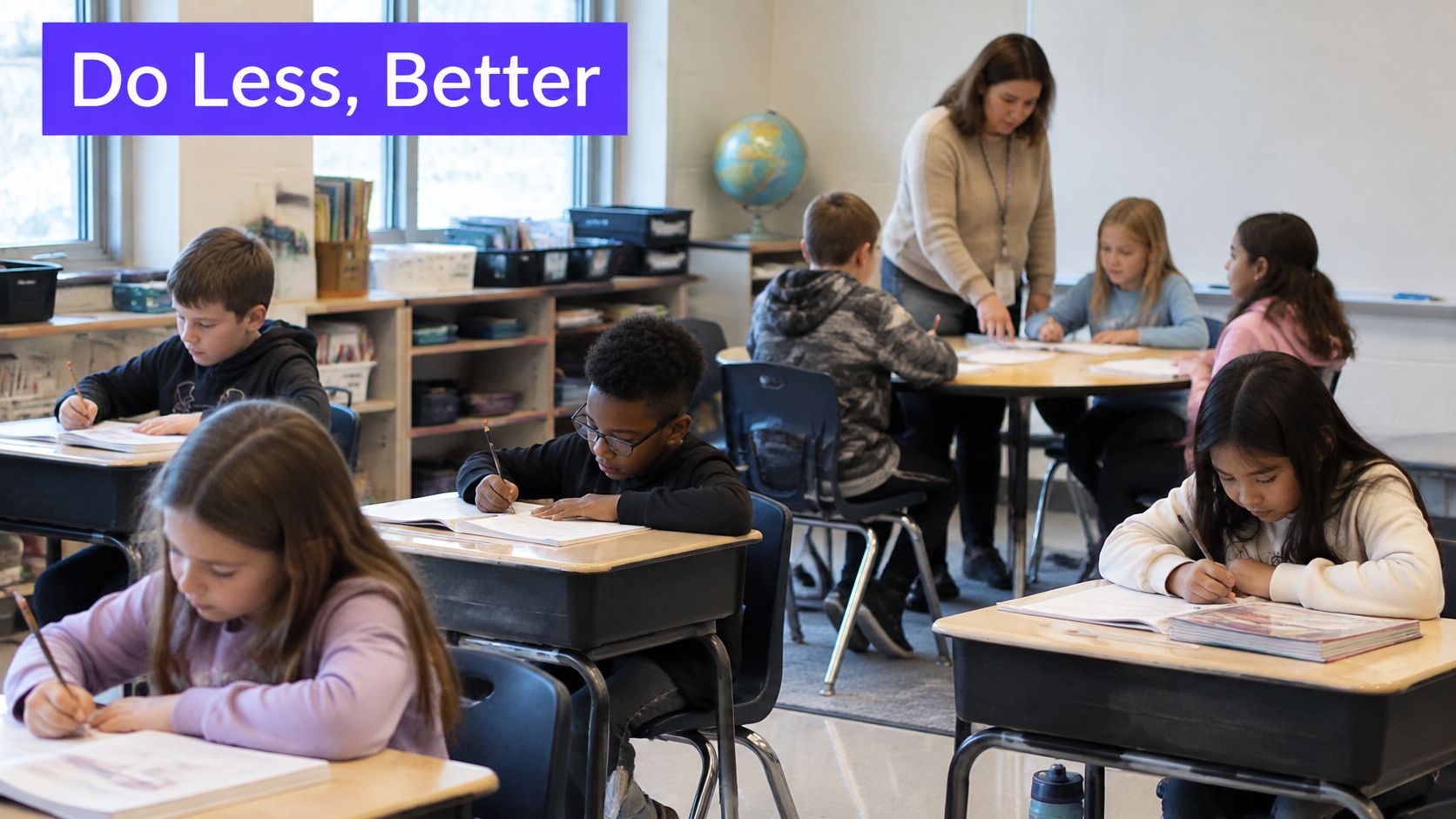
Try a deliberately reduced routine: one prepared task, one support sheet, and a five-minute check near the end, with the same format reused across the week. Put materials in table trays and teach what to do when stuck before starting a teacher-led group.
Decision rules for adjusting and regrouping
These are suggested classroom starting rules, not validated cutoffs. The review dates tell you when to inspect the evidence, not when a child must change groups.
| Signal | Adjustment | Regroup or review |
|---|---|---|
| Two or more misses on the exit check | Add a worked example and one more guided practice | After the next lesson |
| Correct answers but no working shown | Add a think-aloud prompt or an explain-it step | After two lessons |
| Finishes early every time | Raise task complexity, keep the same skill | After one week |
| Stuck at the start, correct later | Add a sentence frame or manipulative | Fade support after three successful checks |
| Group keeps changing without evidence | Check the pre-assessment, not the group name | Weekly review |
Correct answers without working aren't automatically a problem. First establish whether showing a method is part of the objective, or whether a brief oral explanation would give you the evidence you need.
For a low-resource routine, laminate a card with three prompts: What are you trying to explain? What have you tried? What will you do next? Use it consistently so children learn how to ask for useful help instead of waiting for you to restart the whole task.
Keep the same decision questions in mind when considering classroom demonstrations.
A group is a teaching arrangement, not a description of a child.
Don't wait to help a struggling student, but avoid reorganising the class after every isolated mistake. As a starting rule, move a child when two or more checks point in the same direction, and keep the move provisional.
Tracking Progress So Differentiation Actually Works
A busy room can hide weak learning. Children may enjoy the stations, complete the diagrams, and talk enthusiastically while still misunderstanding the concept you intended to teach.
A U.S. Institute of Education Sciences review of elementary formative assessment examined 22 studies and found a positive overall effect on achievement, generally larger in mathematics than reading and writing, with average effects of 0.29 standard deviations for other-directed assessment and 0.20 for student-directed assessment. That supports teacher interpretation and instructional follow-through, not just collecting more slips of paper.
Five checks to track differentiation
Choose checks that answer a decision you need to make. The frequencies below are suggested routines, not compulsory assessment schedules.
| Check | When | What it tells you | Action |
|---|---|---|---|
| Exit ticket, two or three questions | End of every lesson | Who reached the objective | Regroup next session when corroborating evidence supports it |
| Whiteboard or thumbs check | Mid-lesson | Who needs a second model now | Adjust the scaffold during the lesson |
| Running record or reading check | Weekly or fortnightly | Decoding and comprehension level | Change practice text level or group |
| Writing sample against criteria | Every two weeks | Planning, sentence control, revision | Target the next modelling step |
| Baseline and follow-up test | Start and end of a 6–12 week unit | Whether the approach moved learning | Keep, adjust, or drop the approach |
Whiteboards reveal more than thumbs. A written answer shows the misconception; a thumbs-up mostly shows a child's reported confidence. Follow confidence checks with a question that requires an actual response.
Likewise, a running record shouldn't become a permanent reading label. Record the particular decoding or comprehension difficulty so the next teaching move addresses a skill rather than a broad category.
Record the action, not just the score
Say a Year 4 teacher notices that three students miss the same decoding pattern on two exit tickets. She brings them together for ten minutes the next day, models the pattern, and checks it again in unfamiliar words.
The useful record isn't just an incorrect mark. It's the pattern missed, the teaching response, and whether students can subsequently apply it without prompting.
Assessment test: If the result won't change what you teach or how you teach it, reconsider whether you need to collect it.
Keep a tracking sheet with names, objective, check result, and action taken, and review it every Friday. Add a brief note about independence, because a correct response with substantial prompting means something different from an independent explanation.
Use these formative assessment examples to select a manageable check. You don't need every assessment format for every objective.
Differentiated Examples from Early Years to Upper Primary
Every tier needs common success criteria. Different materials don't automatically produce equitable learning: a supported task can remove the very thinking children need to practise.
Use the examples below as lesson designs to adapt, not prescribed grade-level curriculum statements. Check them against your local standards and the content you've taught in practice.
Grade and subject examples with support and stretch tiers
| Grade and subject | Shared goal | Support tier | Stretch tier | Check |
|---|---|---|---|---|
| Grade 1 reading | Decode CVC words and retell a story | Picture cues and a shorter decodable text | Longer text with the same phonics pattern | Running record every two weeks |
| Grade 2 maths | Add within 100 using place value | Base-ten blocks and a number line | Mental strategies and word problems | Exit ticket with one explain-it question |
| Grade 3 writing | Write a paragraph with a topic sentence | Sentence frames and a planning graphic | Add evidence and a revision prompt | Writing sample against criteria |
| Grade 4 science | Explain how a food chain moves energy | Labelled diagram | Predict what happens if one species disappears | Diagram plus one explanatory sentence |
| Grade 5 history | Explain cause and effect in one event | Timeline with key facts | Compare two causes using sources | Short written claim with evidence |
In Grade 1 reading, keep the consonant-vowel-consonant pattern constant while adjusting text length and illustration support. Use pictures to support story meaning, not to encourage guessing words instead of decoding them; listen to the child read and ask for a retelling.
For Grade 2 maths, base-ten blocks make place-value reasoning visible. Students using mental strategies should still explain how they handled tens and ones, rather than produce an answer faster.
In Grade 3 writing, a planning frame might separate the topic sentence, supporting details, and closing sentence. The stretch prompt asks for stronger evidence and purposeful revision, but both versions must produce a paragraph with a clear topic sentence.
Check the thinking beneath the format
In Grade 4 science, a labelled food-chain diagram is a starting support, not sufficient evidence by itself. Ask the child to explain how energy moves between organisms; the species-removal prediction should also depend on that relationship, rather than on unsupported guesses about animals.
For Grade 5 history, a timeline helps students locate relevant events before explaining cause and effect. Comparing causes using sources adds complexity, but both tiers need a defensible causal claim supported by a fact or source detail.
Watch for a supported version that asks children only to colour, match, or copy while classmates explain. Those actions may help students prepare, but they don't demonstrate the shared objective.
If the easier version drops the skill rather than adjusting the support, the tier is wrong. Revise it before making another worksheet.
Start with One Lesson and One Measure This Week
Choose one lesson in the next two weeks where you already see a clear spread of readiness. Write one objective, prepare two task versions and two scaffolds, and finish with an exit check that lets you judge the intended learning.
Set realistic expectations. A synthesis of elementary differentiated-instruction studies reported comprehension gains ranging from 10% to 34% for tiered reading instruction over implementation periods of roughly six to twelve weeks, but the studies differed in design, duration, and support.
Treat those figures as a reason to measure, not a promise. Keep a baseline and a comparable follow-up, and record whether children needed prompts when they answered.
Start with the next teachable decision: who needs a model, who needs guided practice, and who needs a more demanding application? Write the one-page plan for your next lesson now, while the grade-level goal is still in view.
Kuraplan creates lesson plans with objectives, activities, differentiated instruction, and assessment rubrics. Visit Kuraplan to draft your next elementary lesson, then check the proposed tasks and supports against what your students can already do.