
On Monday morning, a reading block can feel less like a lesson and more like air-traffic control. One student needs help blending simple patterns, another is ready to debate an author's argument, and a multilingual learner is working hard to connect English sounds, words, and meaning. You have one core text, a crowded schedule, and the responsibility to make challenging reading available to everyone.
Differentiated reading instruction isn't a matter of giving every child a different book. It's the disciplined work of keeping worthwhile text and ambitious thinking at the center while changing the support, grouping, task, or response so more students can participate. The practical question is simple: How can we widen access without lowering the intellectual demand?
The Monday Morning Reading Puzzle
At 8:35, Ms. Alvarez places a fourth-grade article about river habitats under the document camera. Eight students are still working through short-vowel patterns and basic decoding. Twelve can read chapter books fluently and are eager to race ahead. Four newcomers are matching letters to sounds while following the discussion in English.
The lesson plan says “read, annotate, discuss.” The clock gives her forty-five minutes. The state assessment is approaching. She has one grade-level text, several distinct instructional needs, and the familiar question every teacher asks before the first group forms: Who needs me first?
That puzzle appears throughout K–12 classrooms. Readers may share a grade, a classroom, and a standard while differing widely in decoding, fluency, vocabulary, background knowledge, language development, and confidence. A teacher who teaches only to the middle leaves some students behind. A teacher who assigns easier material too quickly may make the curriculum easier to enter but harder to climb.
The problem isn't that students need different things. The problem is deciding which support will help each student reach the same important text.
The strongest starting point is not “Which level should this child receive?” It's “What barrier is blocking this child today?” One reader may need vocabulary before reading. Another may need an oral rehearsal, a partner routine, or a graphic organizer. A third may need a focused decoding lesson before returning to the shared passage.
This guide follows that logic from definition to classroom practice. You'll see how flexible groups, assessment data, scaffolds, accommodations, and purposeful stations can work together without turning reading instruction into permanent tracks or a collection of disconnected activities.
What Differentiated Reading Instruction Actually Means
Start with the classroom decision, not the terminology. You choose an important reading outcome, select a worthwhile text, and then adjust the conditions that help students reach that outcome. Those adjustments might include scaffolding, grouping, task design, pacing, response options, or teacher time.
The text and standard can remain common even when the route changes. A student who needs vocabulary support might use a bilingual glossary and sentence frame. A student with a decoding gap might listen to a passage while tracking the print, then read a selected paragraph with the teacher. A fluent reader might work with a more demanding question about evidence and author's purpose.
That makes differentiated reading instruction different from several practices that look similar on the surface:
- It isn't handing every student a different book. Text choice has a place in independent reading, but it shouldn't automatically replace the shared grade-level anchor.
- It isn't fixed ability grouping. A group formed for vowel patterns today may dissolve when the instructional need changes.
- It isn't reduced thinking. Students can receive more support while still explaining, inferring, comparing, and citing evidence.
- It isn't permanent help. Effective scaffolds should fade as students gain control.
Think of a building surrounded by adjustable scaffolding. The building is the grade-level text and standard. The scaffolding includes vocabulary previews, partner routines, modeled annotation, audio support, sentence frames, and carefully chosen prompts. Some students need more platforms and handrails; others need only a brief lift. The structure stays standing while the support changes.
The four levers are practical:
- Content, such as the amount of background knowledge or vocabulary introduced.
- Process, such as choral reading, partner reading, teacher modeling, or guided annotation.
- Product, such as an oral explanation, written response, diagram, or recorded answer.
- Environment, including seating, timing, group size, and access to tools.
Recent guidance argues for keeping grade-level text central and differentiating the support around it, rather than lowering text complexity for students who struggle. Savvas' discussion of rethinking guided reading also highlights the practical implementation challenge: teachers may understand the principle but still need concrete rules for daily lessons.
Core Models and Principles Teachers Rely On
Three models give teachers different ways to adjust instruction. They work best as tools, not as labels for students.
Tiered assignments keep the standard common while changing complexity, scaffolding, or response demands. For a vocabulary lesson, every student might determine word meaning from context, while some students receive highlighted clues and others explain how the word changes across contexts. Tiering is useful for constructed responses, but it becomes harmful when the same students always receive the least demanding version.
Flexible grouping gathers students around a specific, temporary need. A group might study multisyllabic decoding, distinguish main idea from supporting detail, or track an argument across paragraphs. The Florida Center for Reading Research notes that there's no single correct grouping method. Its guidance suggests 1–4 students for struggling readers and 5–8 for on-grade-level readers, with meeting frequency and lesson length adjusted by need (Florida Center for Reading Research guidance).
Gradual release gives the lesson a rhythm: I do, we do, you do, and you do together. The teacher models the thinking, rehearses it with students, watches students try it, and then creates a supported opportunity for collaboration. It works particularly well in a minilesson that flows into small-group instruction. It fails when teachers rush from modeling straight to independent work and assume students can perform a new process without guided practice.
| Model | Best Used For | Common Misuse | Success Signal |
|---|---|---|---|
| Tiered assignments | Vocabulary, analysis, and constructed response | Permanent “low,” “middle,” and “high” tasks | Students work toward the same standard through varied support |
| Flexible grouping | Short-term skill instruction and targeted practice | Groups become labels that survive after the need changes | Students move groups as evidence changes |
| Gradual release | Modeling comprehension and building independence | Skipping guided practice or the collaborative phase | Students take over the thinking and explain their choices |
The shared principle is match task complexity and support to the reader's current need. Don't make the reader permanently fit the task. For additional classroom-ready ideas, see Kuraplan's guide to differentiation teaching strategies.
Using Assessment Data to Shape Groups
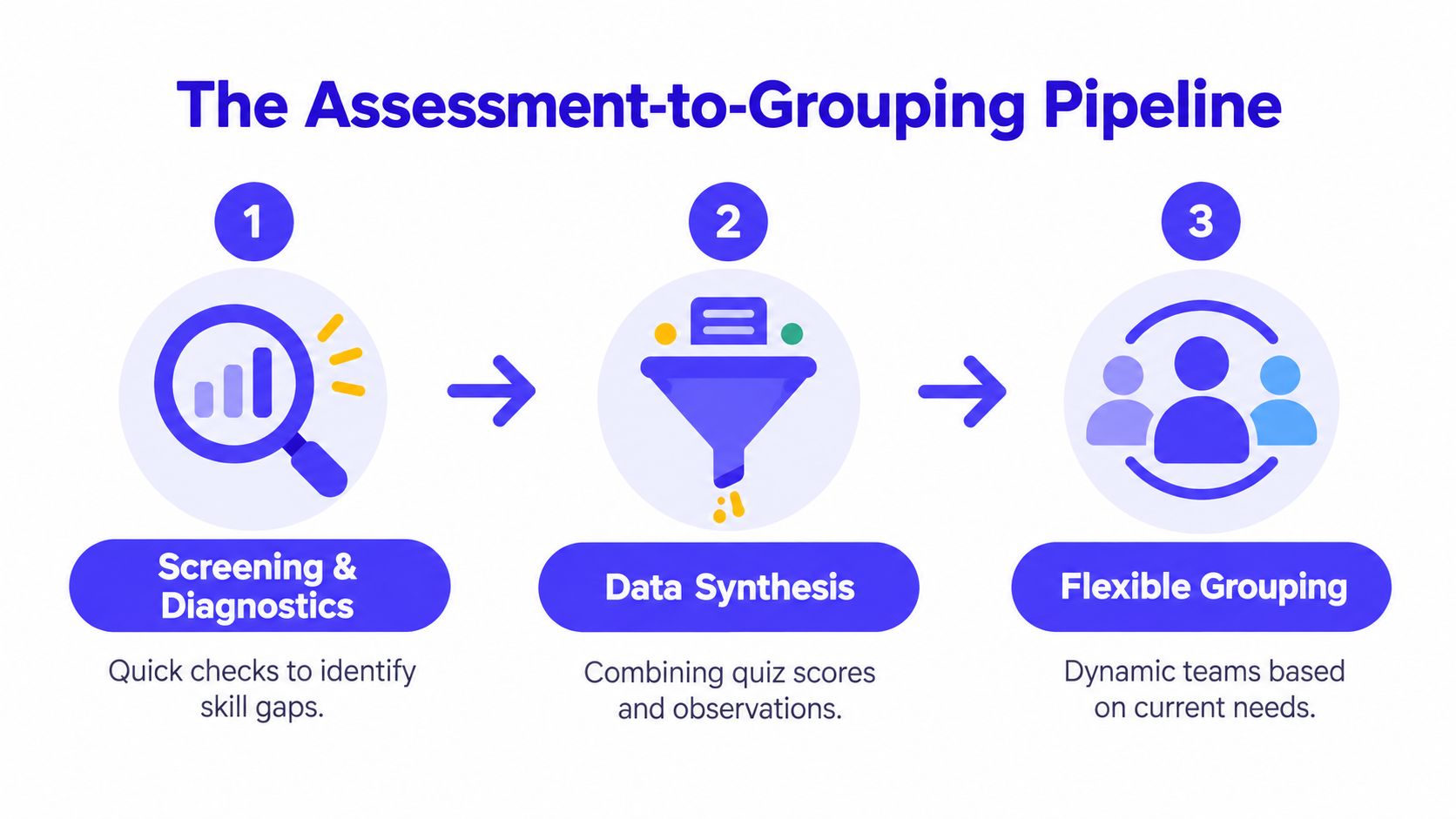
Differentiation without evidence is often just station rotation with a hopeful name. Teachers need enough information to identify the barrier, choose a response, and notice whether that response is working.
Gather three kinds of evidence
A universal screener, such as DIBELS or MAP, can help identify broad patterns when administered according to the school's assessment calendar. It isn't a complete lesson plan. It tells you who may need closer diagnostic attention.
A curriculum-based measure collected regularly can show whether students are responding to current instruction. Use it to examine a narrow skill, such as decoding, fluency, vocabulary, or comprehension, rather than treating one overall score as a full description of a reader.
Your conference notes add what a test rarely captures. Record what the student does when a word breaks down, whether the student rereads, how the student uses context, and whether the student can explain an answer orally. These observations turn a score into an instructional decision. These formative assessment examples can help teachers build a broader evidence routine.
Turn evidence into a temporary purpose
Suppose a fourth-grade team notices that several students can identify a topic but struggle to connect evidence to a claim. The teacher spreadsheet doesn't need a permanent “low group” column. It can include the current skill, evidence, planned response, meeting date, and next check.
One group might meet for a teacher-led lesson on tracing a claim through an informational passage. Another might practice decoding multisyllabic words found in the same text. A third might work independently on a response that requires selecting evidence and explaining its relevance. The groups are different because the purposes are different, not because the children have been assigned fixed identities.
Tell students why groups change. “This group is working on evidence today because your recent responses show that's our next step. When the evidence changes, the group changes too.” That language protects dignity and makes regrouping feel like normal learning rather than public ranking.
The Institute of Education Sciences recommends keeping grades 2–3 groups small, generally no more than 5–7 students, and making membership fluid when progress-monitoring data indicates a different level of support is needed (IES guidance for differentiating reading in grades K–3). The same principle is useful across grades: groups should breathe.
A Sample Differentiated Reading Lesson in Action
Ms. Alvarez's forty-five-minute lesson uses an informational text about river ecosystems. Every student receives the same article. The differentiation appears in what students do with it and how much support they receive.
She begins with a brief purpose: How do changes in a river affect the organisms that depend on it? She introduces a few essential terms with quick visuals, models one annotation, and names the evidence students will need in their final response.
The teacher-led table
At the first station, Ms. Alvarez works with students who need support connecting ideas across paragraphs. She reads the opening paragraph aloud while students track the print, then asks two cold-read questions:
- “What does the river provide for living things in this paragraph?”
- “Which phrase helps you know that?”
Students mark one phrase, turn to a partner, and explain their choice before writing. She doesn't simplify the passage. She makes the thinking visible and gives students a manageable entry point.
The partner station
At the second station, partners use a structured jigsaw. Each student reads an assigned chunk, identifies one important idea, and teaches it to the partner. A cue card says:
- “The section is mostly about…”
- “The evidence I found is…”
- “This matters to the river ecosystem because…”
The card supports oral language and accountability without doing the interpretation for students.
The independent station
At the third station, students answer a constructed-response prompt: Explain one way a change in the river can affect an organism. Use evidence from the article. They self-check against a short rubric: clear claim, accurate evidence, explanation connecting evidence to claim, and complete response.
Transitions are visible and predictable. Each group has a task card, a finished product, and a way to request help. Students still touch the grade-level text, discuss its ideas, and produce evidence-based thinking.
Rhode Island literacy guidance describes a common daily literacy block as 45–65 minutes, with small-group instruction taking about 15–20 minutes per group. It also describes Tier 2 intervention as typically 15–25 minutes, 3–5 times per week, delivered individually or in a small group (Rhode Island's MTSS reading paper). The exact schedule will vary, but the lesson principle holds: change the support layer, not the intellectual destination.
Accommodations for Multilingual Learners and Students with Hidden Gaps
A generic “make it easier” approach misses the reason a student is struggling. A multilingual learner may understand the concept but lack the English vocabulary to show it. A student with dyslexia may understand a passage when it's read aloud but lose meaning while laboring over individual words. An advanced reader may need deeper analysis, not extra pages.
Multilingual learners
Keep the grade-level English text available. Preview essential vocabulary with images, cognate connections where appropriate, gestures, and student-friendly explanations. A bilingual glossary, sentence frame, or brief partner rehearsal can help students express complex thinking without replacing the text.
Avoid translating every sentence or giving a watered-down passage as the default. Those moves can reduce opportunities to build academic English and content knowledge.
Students with dyslexia or hidden decoding gaps
Use explicit, structured phonics instruction for the specific pattern students need. During grade-level reading, text-to-speech or a teacher read-aloud can release some decoding pressure so students can participate in meaning-making, while targeted instruction continues to address the underlying skill. Typed responses can also remove handwriting friction when the objective is comprehension rather than handwriting.
Avoid treating audio support as a substitute for reading instruction. It's an access tool, not the intervention itself.
Advanced readers
Offer extension questions that deepen interpretation. Ask students to compare how two sections develop an idea, evaluate the strength of evidence, or explain an author's choice. Peer mentoring can be useful when it is structured and brief, but advanced readers still need direct teaching and challenging work of their own.
Avoid turning strong readers into unpaid assistants. Helping a partner should never replace their opportunity to analyze, write, and receive feedback.
| Learner Profile | Try This | Avoid This |
|---|---|---|
| Multilingual learners | Cognate anchors, bilingual glossaries, visuals, and sentence frames | Replacing the grade-level text with a simplified text |
| Students with dyslexia or hidden gaps | Structured phonics, audio access, repeated supported reading, and typed responses | Using audio as the only response to a decoding need |
| Advanced readers | Evidence-based extension prompts and purposeful peer discussion | Extra worksheets or constant peer tutoring |
For teachers preparing multiple versions of questions, organizers, or response supports around one shared passage, Kuraplan's differentiate text tool can support that planning work. The teacher still decides which scaffold fits the learner and when to remove it.
Common Mistakes and How to Fix Them
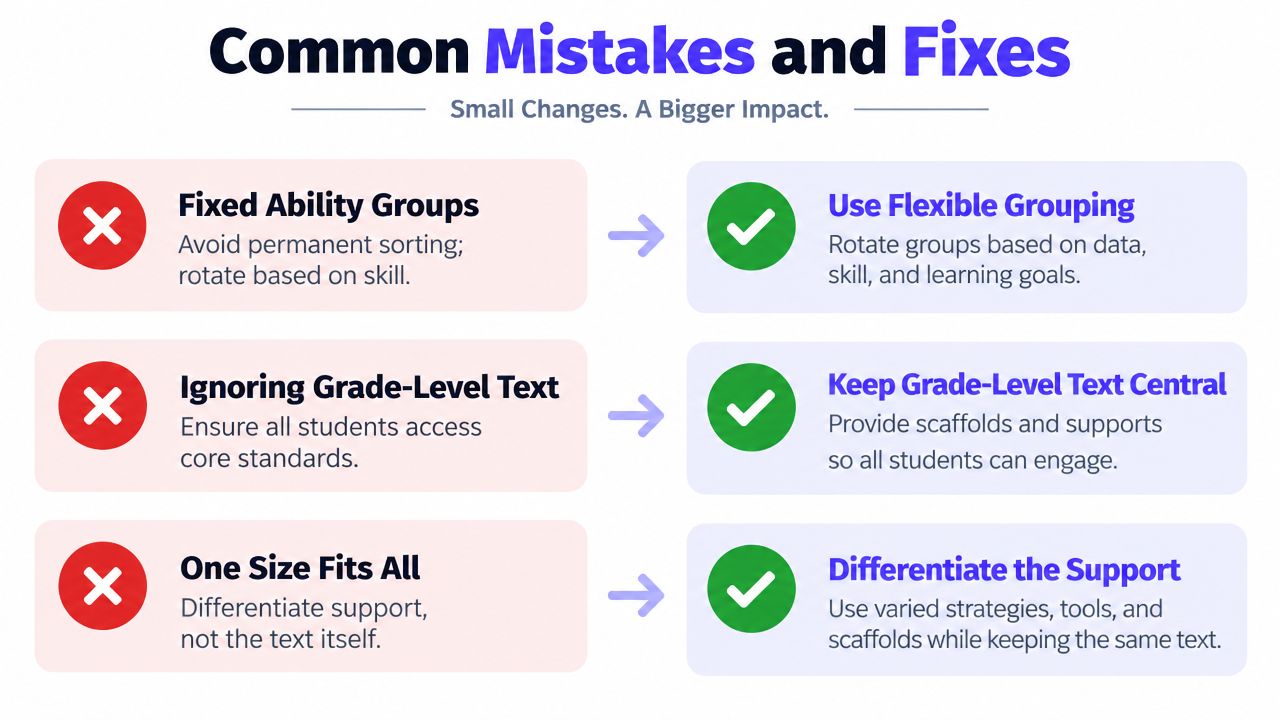
Some differentiation problems begin with good intentions. A teacher wants to be efficient, so groups are set in September. A student struggles, so the text is lowered immediately. Stations appear on the schedule, so every student rotates whether or not the activity has a clear instructional purpose.
Fixed groups
A September group can become a quiet label by October. Students notice who receives which materials, and teachers may stop looking for evidence that needs have changed.
Fix: Put regrouping dates on the calendar and use fresh classroom evidence to reconsider membership. Some schools may review groups every four to six weeks, while a sharper skill need may require an earlier change.
A coach might say, “Let's name the skill this group needs today, then decide what evidence will tell us the group has done its job.”
Lowering the text too quickly
Easier text can feel compassionate, especially when a student is visibly frustrated. But it can also remove the vocabulary, syntax, ideas, and evidence work students need to encounter.
Fix: Keep the grade-level anchor and adjust the supports. Frontload essential vocabulary, use a partner read, model one paragraph, provide a graphic organizer, or let students listen while tracking print.
Coach's language: “Before we change the text, let's identify the barrier and change the support that addresses it.”
Colorado guidance distinguishes targeted and intensive tiers, listing Tier II instruction at 30 minutes for 3–5 days per week with groups of 5–8 students, and Tier III instruction at 45–120 minutes five days per week with groups of 1–3 students (Colorado reading support guidance). Those distinctions reinforce an important point: more intensive support doesn't automatically mean less rigorous classroom text.
Stations without purpose
A station isn't differentiated because students move around the room. Each group needs a learning target, a product, and a reason that particular students need that particular support.
Ask, “What does this group need today that only I can teach them?” If the answer is unclear, redesign the station before adding another rotation.
The following video offers another visual way to think about differentiated instruction and classroom support.
Your Differentiated Reading Toolkit
Keep this checklist beside your reading-block plan:
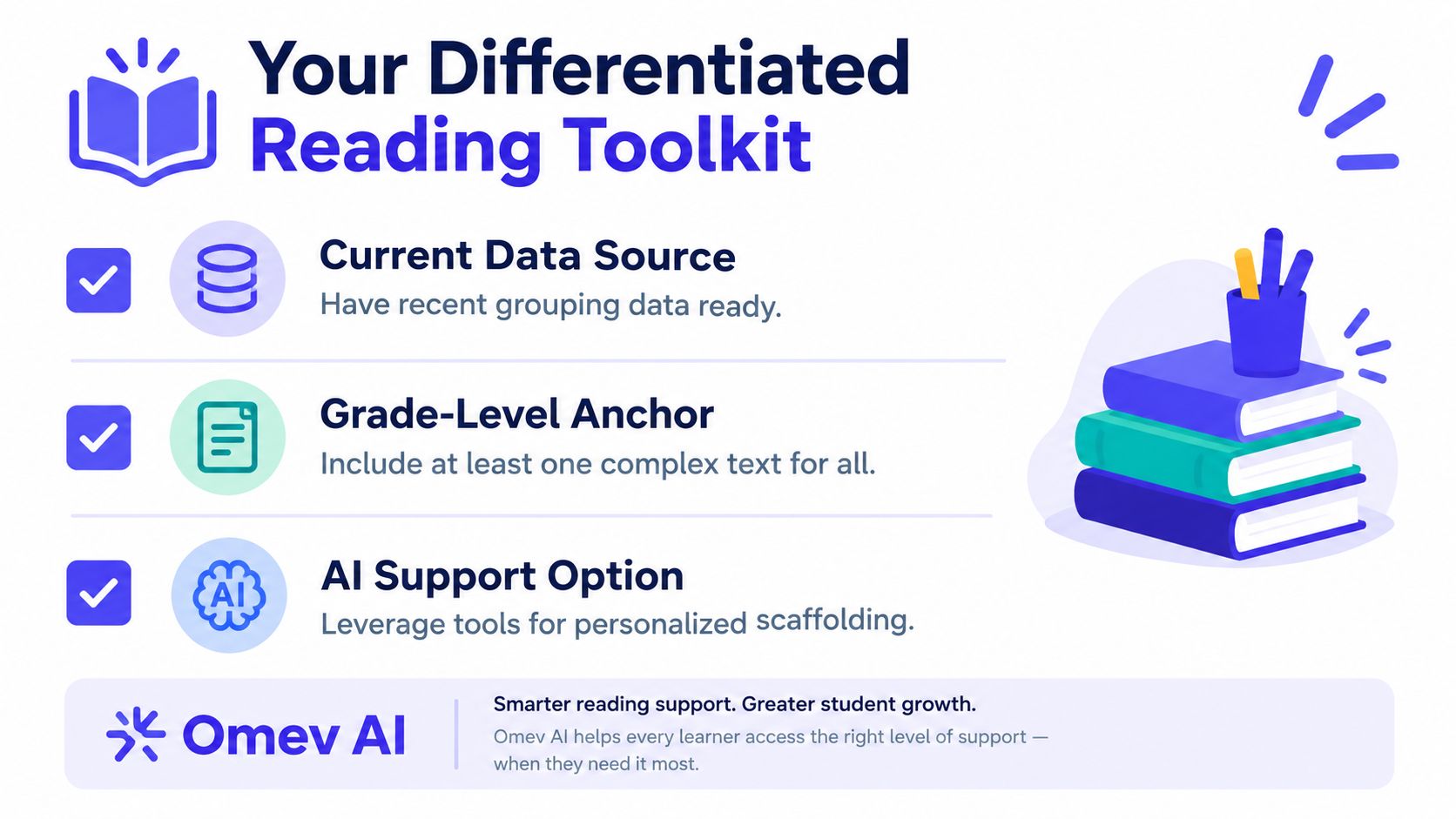
- Current data source: Know which recent observation, measure, or student work sample shaped today's groups.
- Grade-level anchor: Make sure every student engages with meaningful grade-level text.
- Station purpose: Write what each group will learn, practice, or produce.
- Regrouping date: Decide when you'll review the evidence and reconsider membership.
- Documented accommodation: Record the support each subgroup needs and how you'll know when to reduce it.
Planning tools can handle some of the preparation that otherwise consumes teacher time. Kuraplan, for example, can generate standards-aligned lesson materials, differentiated questions, graphic organizers, worksheets, and assessment rubrics, giving teachers a starting point for varied support around a shared reading objective. The professional judgment remains yours, especially in the small moves at the small-group table, where you notice a hesitation, choose the next prompt, or remove a scaffold at the right moment.
If you want to spend less planning time building differentiated reading materials and more time coaching readers through the text, visit Kuraplan. You can use it to create standards-aligned passages, questions, organizers, worksheets, and rubrics that vary the support while keeping the reading purpose clear.