You're sitting with a marked quiz, maybe yours, maybe one you just handed back to a class, and one thing doesn't add up. The student clearly understood the topic in discussion yesterday, answered fine when you asked it a different way, and still picked the wrong option on paper. That gap is rarely about effort. It's about what happens in the thirty seconds between reading a question and circling an answer, and whether anyone taught a better routine for those thirty seconds, plus a better use for the miss afterward.
Why Smart Students Still Lose Points on Multiple Choice
A Year 9 student can tell you plants make food from light. Put that in a quiz, add an option about respiration full of familiar science words, and she picks respiration instead. She didn't forget photosynthesis. She recognized vocabulary and let recognition do the work that recall should've done.
That's a process failure, not a knowledge failure, and it's where most lost marks live. Students skim the stem and answer a slightly different question. They read the options before pulling an answer from memory, so the options lead. They change a right answer because doubt feels like evidence, or they guess with no plan at all.
Wrong options aren't random filler. Test writers build distractors from common misunderstandings, so each wrong choice points to a specific gap. Picking respiration tells you exactly what to reteach. Picking a random letter tells you nothing.
Sort Before You Reteach
Every item asks for three decisions. How will you answer it, whether a guess is worth taking, and what you'll do with a miss afterward.
Take one recent quiz and sort each miss into process error or knowledge gap. Teachers, run the same sort on a class set. If process errors dominate, you don't need more revision. You need a routine, practiced until it's automatic.
How to Work Through Each Question in Four Passes
Learning how to answer multiple choice questions well comes down to slowing the first few seconds down, on purpose. This four-pass routine works on a Year 6 fractions check and a Year 12 exam alike, because the traps are the same even when the content isn't.
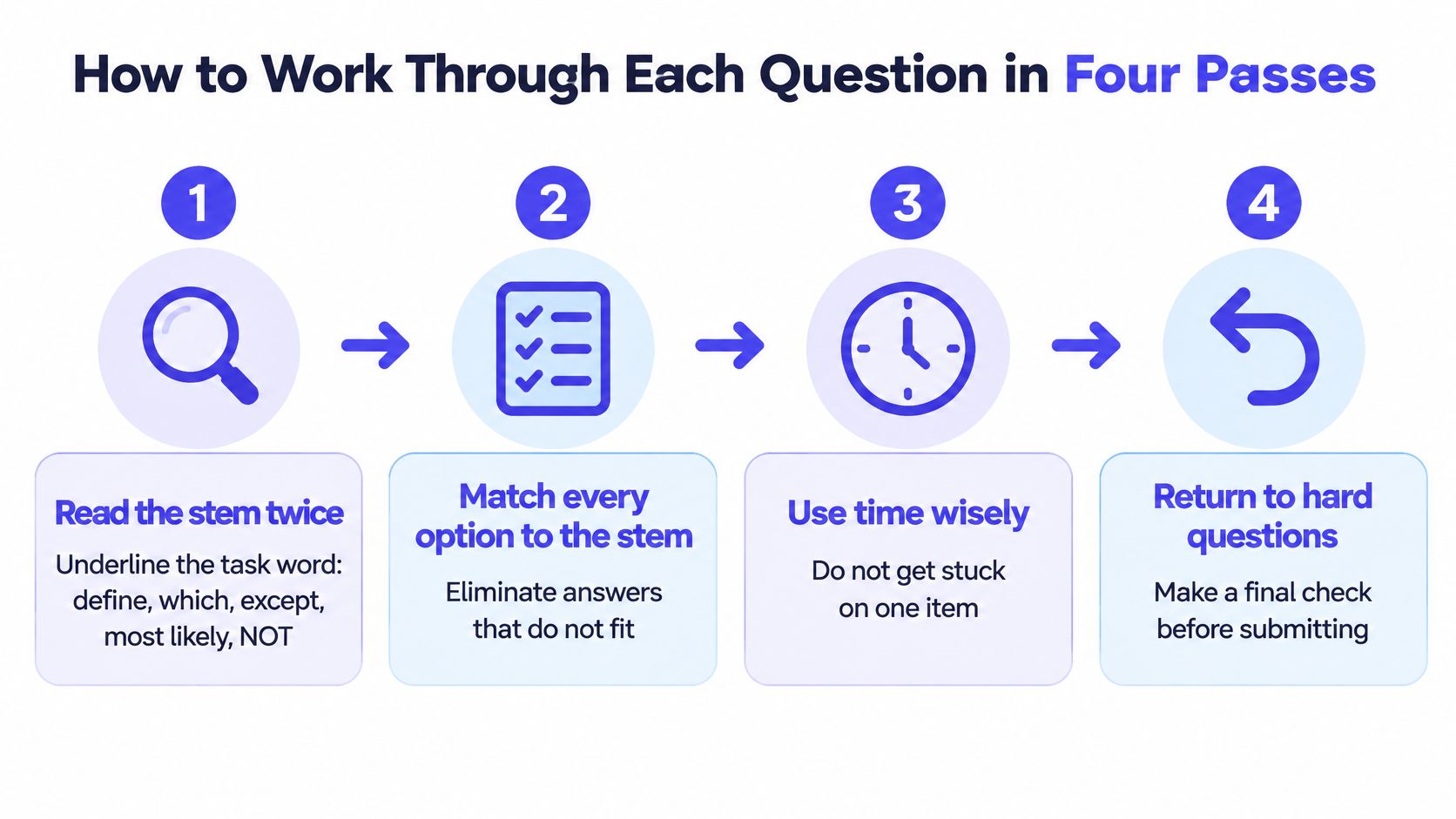
The Four Passes
- Read the stem twice, underline the task word. Look for define, which, except, most likely, or NOT. Many misses happen because a student answers a sensible question that wasn't asked. The second read costs five seconds and catches the word that flips the whole item.
- Cover the options and predict your answer. Say it in your own words before you look. Dickinson College guidance on strategies for different test types recommends covering the options, predicting the likely answer, and then finding the choice that most closely matches that prediction. Your prediction gives you something to match against, instead of four options competing to sound convincing.
- Read all four options in full and cross out what's wrong. Eliminate statements that are clearly false, irrelevant, or outside the question's scope. Cross them out physically on paper or use the strikethrough tool on screen, so your eyes stop returning to options you've already rejected.
- Choose the closest match to your prediction. Check it once against the task word you underlined. If two options remain, compare their exact wording with the stem, word by word. The difference between them is usually one qualifier, one direction, or one unit, and that difference is the question.
Practical rule: If you can't say why the three wrong options are wrong, you haven't finished the question yet, even if you've circled something.
Flagging and Changing Answers
Don't let one hard item eat the time meant for five easy ones. Mark uncertain questions, finish everything you know, then return with fresh eyes and use elimination between what's left. Coming back later also helps because a later question sometimes jogs the memory or clarifies a term you were stuck on.
Changing an answer deserves its own rule. It's defensible when you misread the stem or find new evidence somewhere else on the test. It isn't defensible just because your first answer feels uncomfortable while you're reviewing. Discomfort during a review sweep is normal, especially near the end when you're tired, and it isn't information.
Adult learners preparing for licensing exams use the same flag and return habit, which is why resources like the 24hourEDU MLO exam tips from 24hourEDU translate well to school settings even though the subject matter differs completely.
Expect the routine to feel slow at first. On the first two or three practice sets, predicting before looking will feel like extra work. After that, predictions start arriving on their own and the whole sequence speeds up, because you've stopped rereading options you eliminated mentally but never marked.
Distractor Traps That Catch Strong Students
Absolute wording catches strong students first, which surprises people. A confident student reads always or never and thinks, well, that sounds definite, that must be the taught answer. But science and history rarely hold without exceptions, so a definite sounding option is often the false one. Before choosing it, search for one exception. If you can find a single case where it breaks, the option breaks too.
| Trap | What it looks like | Why it fools students | How to check |
|---|---|---|---|
| Absolute wording | Uses always, never, only or all | Real science and history rarely hold without exceptions | Search for one exception before choosing |
| Partly true option | First clause is correct, second clause is false | Students stop reading once the familiar part matches | Read the whole option against the stem |
| Reversed relationship | Swaps cause and effect or increase and decrease | Topic words match, so the option feels right | Ask which way the relationship runs |
| Near-miss term | Uses a real term from a neighbouring idea | Recognition feels like understanding | Name the process the question asks about first |
| Longest option | Contains the most qualifiers | Test writers often add detail to the correct answer | Check whether length alone is driving your choice |
| All of the above | Lists options that might each be correct | Students pick it after confirming only two | Choose it only after checking every option |
Reading to the End of the Option
The partly true option is built for students who read quickly. The first clause matches something from the lesson, the student relaxes, and the false second clause slides past unread. Read every option to its final word, then test the whole statement against the stem, not just the part that felt familiar.
Reversed relationships work the same way. All the topic words are present, so the option feels right, but cause and effect have swapped places. Ask which way the relationship runs. Does heat cause evaporation, or does evaporation cause heat? Naming the direction out loud, even in your head, exposes the swap.
On a water cycle quiz, one option says evaporation always happens at night. That's absolute, and one sunny afternoon puddle disproves it. The correct option mentions heat from the sun, which matches the direction, heat first, evaporation second. Two traps, checked in about ten seconds.
The longest option and all of the above need care rather than rules. Correct answers often carry qualifiers that make them longer, so length is a weak clue, never a reason. Choose all of the above only after you've confirmed every listed option individually, not two out of three. Medical students get taught the same discipline at a higher stakes level, and the distractor analysis for USMLE prep from Ace Med Boards shows how deliberately professional exam writers construct these traps.
A distractor is a diagnostic clue. If you can name the misconception a wrong option represents, the question has already taught you something.
That's the shift worth making with students. Wrong options aren't decorations around the right answer. They're a map of the four or five ways this idea is commonly misunderstood, printed right there on the page.
When a Guess Is Worth Taking
A penalty for guessing changes the math, so it helps to see the formula once. Corrected score = number correct − number incorrect ÷ (number of answer choices − 1). Say a student gets 26 correct and 6 incorrect on a four-option test. The corrected score is 26 − (6 ÷ 3) = 24.
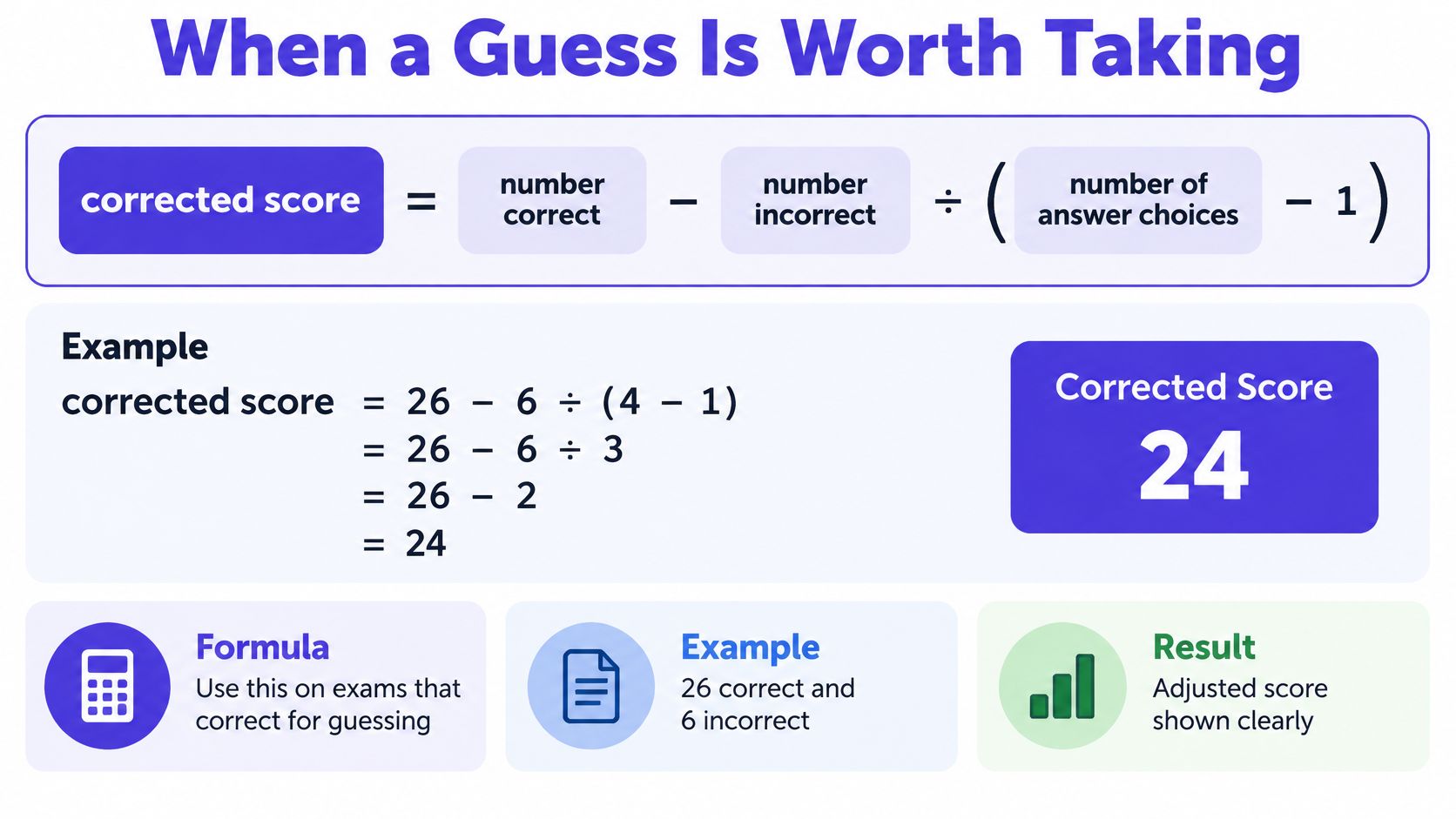
That correction makes blind guessing roughly neutral across four options. Guess on every item you do not know, and the points gained by luck are pulled back at about the same rate. Always guess cannot work as a universal rule under that system.
Think of each elimination like crossing names off a short list. Fewer names left means a better chance the one you pick is right.
How Elimination Changes the Odds
| Options left | Chance of a correct blind guess | Advice |
|---|---|---|
| 4 (nothing eliminated) | 25% | Guess only if there is no penalty; with a penalty, leave it blank |
| 3 | About 33% | Guess; with a penalty the expected gain is still positive |
| 2 | 50% | Guess, even with a penalty |
With four answer choices and no penalty for incorrect answers, a blind guess has a 25% chance of being correct, eliminating one option raises the chance to about 33%, and eliminating two raises it to 50%, according to the university test-taking guidance in Blueprint for Success. The same guidance recommends answering when a student can narrow the field, while warning that leaving an item blank may be preferable when wrong answers lose points and no option can be eliminated.
Here is where the diagnostic habit pays off again. When you narrow four options to two, pause and ask what each rejected option was testing. Perhaps one confused a definition with an example, and the other reversed cause and effect. If you can name those two traps, your guess between the last two is no longer blind. It is an informed choice between ideas you have already checked.
Check the Rule Before You Start
Read the instructions for a guessing penalty before the test begins, not halfway through. If the instructions are unclear, ask the teacher. It changes your plan on every uncertain item.
For the digital SAT as a specific case, unanswered questions earn no points, so students should answer every question if time remains, even with an educated guess. Scoring rules can change, so check the current test directions before you rely on that plan. Never carry one test rule into another exam without checking.
Build one final habit either way. In the last two minutes, scan for blanks. Count them on your fingers as you go down the answer sheet, one finger per blank, so none hides in a skipped row. Then use any crosses you made during elimination to make the strongest final choice the time allows.
Turn Wrong Answers Into Practice With Kuraplan
A missed multiple choice item is a diagnosis, not just a lost point. Research on AI-generated multiple choice practice, described in a 2025 arXiv paper on AI-generated multiple choice practice, points to the same routine teachers have used for years. Repeated low-stakes attempts plus an immediate explanation of why each distractor is wrong builds stronger recall than rereading notes. The learning lives in the review.
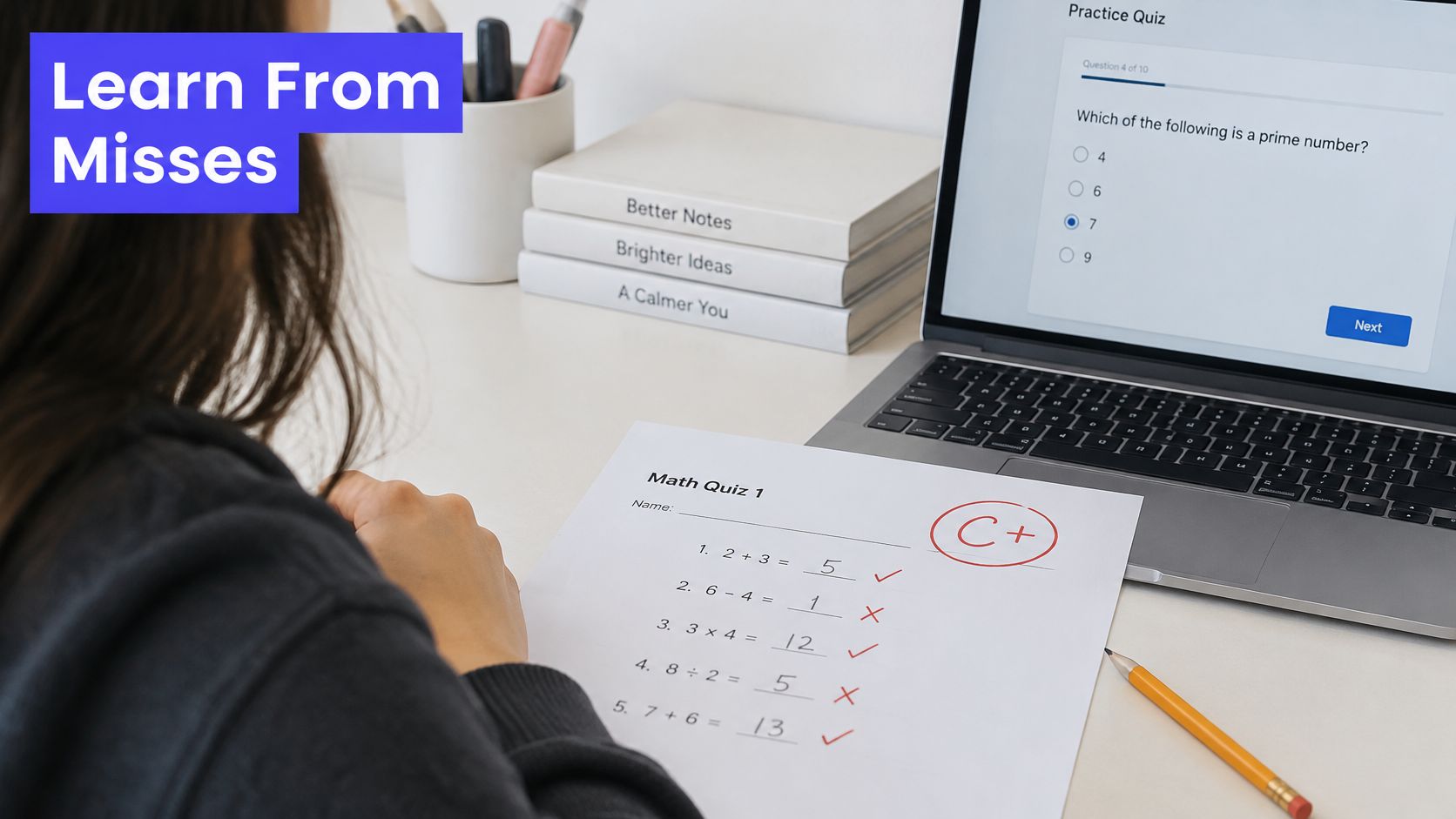
The Post-Question Routine
Run this on every miss, while the thinking is still fresh. Students often want to glance at the correct letter and move on. Slow that moment down.
- Name the misconception. Which distractor did you choose, and what misunderstanding does it represent? Write it in a phrase, such as confused evaporation with boiling.
- Explain the correct option in your own words. One or two sentences, no copying from the answer key. If you can't explain it, you don't have it yet.
- Answer a parallel item without looking. Same concept, different surface details. This checks whether you fixed the idea or just memorized one answer.
Then reattempt the concept after a few days, not just the next morning. Spacing the reattempt is what tells you the fix stuck. Add confidence tracking as you go, marking each answer sure, unsure, or guessed. A correct guess still signals a gap.
This short video walks through how reviewing a quiz item by item turns a grade into a study plan.
Where Kuraplan Fits for Teachers
Generating parallel items and fresh practice sets takes time teachers don't have. Kuraplan fills that practical gap because it can generate a draft quiz from a prompt or from an existing lesson plan, complete with multiple choice items and explanations. The teacher then does the part only a teacher can do. Review every distractor and ask whether it maps to a plausible misconception students hold. Check the explanation for each wrong option, not just the correct one, before anyone sees the quiz.
That review step is required, not optional polish. AI-generated distractors can be implausible or accidentally correct, and explanations can sound confident while being wrong, so they need the same scrutiny you would give a question from any source. Treat the draft as a starting point you approve, item by item.
Used this way, quick low-stakes quizzes become genuine formative assessment examples rather than mini exams, because the point is the feedback loop, not the score.
Making Multiple Choice Fair for Every Learner
Extra time is the accommodation everyone reaches for first, and it doesn't fix an unfair question. If a fractions item is wrapped in a dense paragraph, a slow reader fails fractions on paper while understanding fractions perfectly well. The problem is construct-irrelevant difficulty, obstacles that have nothing to do with the skill being assessed, and more minutes with a badly built item just means more minutes struggling with the wrong thing.
Checks That Actually Change the Item
- Plain-language stems. Shorten and clarify the wording without lowering the thinking required. The concept stays hard, the sentence gets easier.
- Fewer negatives. Stems like which is not false force students to untangle logic before they can show knowledge. Ask the question directly.
- Readable, compatible formatting. Write options as real text so screen readers can read them, keep layouts uncluttered, and add image descriptions for diagrams.
- Vocabulary support. Gloss key terms that aren't the thing being tested, so language doesn't block the concept.
- Alternate response modes. Let a student answer orally or by pointing when the format itself is the barrier.
These choices matter most for multilingual learners, students with dyslexia or ADHD, and students with visual impairments, but in truth they help everyone. A 2025 ERIC research report on AI-supported assessment notes that AI systems can struggle with interpreting images and making nuanced decisions, and warns that generated questions may oversimplify or misrepresent understanding. Check any image-based item by hand before it reaches a student.
For every distractor ask one question. Does this option test the intended misconception, or does it penalize reading speed, cultural knowledge, or visual processing?
If it's the second one, rewrite it. That single review question catches most unfair items before they do damage, and it pairs naturally with broader differentiation teaching strategies you're already using in lessons.
Students can advocate from their side too. Ask for stems to be read aloud if that's an agreed support. Track lines with a card to reduce visual crowding. Lean on the four-pass routine, because predicting an answer before reading the options cuts down how often you need to reread dense text, which conserves energy for the actual thinking.
Build a Practice Set Before Your Next Test
Put the routine on one page and practice with it visible. Build a 10-item template with five columns, question number, chosen option, confidence marked sure, unsure, or guessed, the misconception named, and a one-line fix. It takes two minutes to draw in a notebook and it turns a practice set into usable information instead of just a score out of ten.
Run the set under a timer. Use all four passes, flag uncertain items, and return to them last, the way you would on test day. Professionals train for high-stakes multiple choice the same way, which is why timed practice sets like the ACLS certification test prep from ProMed Certifications are structured around repeated attempts rather than reading alone.
Score It, Then Sort It
Score the set, then sort every miss into process error or knowledge gap. Process errors get routine practice. Knowledge gaps get the post-question routine, name the misconception, explain the correct option yourself, and answer a parallel item. Don't mix the fixes, because rereading notes won't cure skimming and drilling the routine won't teach missing content.
For the next set, generate ten fresh items on a topic such as Photosynthesis for Year 9 using a quiz maker, or build them from an existing lesson plan, then review each distractor before anyone sits the set. Before the test, read its scoring rule so you already know whether guessing pays.
The answer you choose matters less than the reason you chose it.
Do one concrete thing this week. Run one 10-item set, log it in the template, sort the misses carefully, and repeat with fresh items after three or four days. Two short sets done this way will teach you more about how a student, or you, thinks than a single long test taken cold.
Turn your next lesson plan into a reviewed, ready to use multiple choice practice set with distractors you approve and explanations your students can learn from. Kuraplan helps K to 12 teachers build standards-aligned lessons, quizzes, and worksheets in minutes, so the feedback loop above fits into a normal week. Visit Kuraplan and build your first 10-item set today.