The most common grammar advice in schools still sounds sensible and still fails in practice. Teach the rule, assign the worksheet, quiz on Friday, move on. Then students turn in a paragraph on Monday and the same errors are back.
That disconnect is the key problem. If you're trying to figure out how to teach grammar in a way that makes a difference in student writing, the answer usually isn't more drills. It's a different model. Grammar has to live inside reading, discussion, imitation, drafting, and revision, or it stays trapped in the lesson where it was taught.
Why Your Grammar Lessons Aren't Working
If your students can circle the predicate on a worksheet but can't write a clean sentence in their own essay, the issue probably isn't effort. It's the design of the instruction.
Research synthesized by Columbia University's Center for Professional Education of Teachers confirms that traditional methods like grammar worksheets and sentence diagramming do not usually help children learn grammar skills or transfer that knowledge to their own writing, and that effective instruction must be contextualized within students' reading and writing in this Columbia CPET overview.
That finding matches what a lot of teachers have seen for years. Students can perform grammar in a narrow format. They can't always use it when they're trying to tell a story, explain an idea, or support an argument.
The transfer problem
Grammar taught in isolation asks students to do something abstract first and meaningful later. That sounds orderly, but it creates a transfer gap.
When students fix ten disconnected sentences, they're mostly learning how to complete that task. They aren't necessarily learning when a sentence needs revision in their own draft, or why a writer would choose one structure over another for emphasis, rhythm, or clarity.
Practical rule: If grammar instruction never touches real student writing, don't expect it to show up there.
A better sequence is to model a concept briefly, study it in a real text, and then move students toward using it themselves. That mirrors the gradual release of responsibility approach teachers already use in reading and writing instruction.
What works better than isolated drills
The shift is smaller than it sounds. You don't have to throw out explicit instruction. You do have to give grammar a job.
- Teach grammar inside writing work. Connect the concept to a draft students are already shaping.
- Use short mini-lessons. One or two ideas at a time is enough.
- Lean on examples more than labels. Students usually learn faster from noticing patterns in sentences than from memorizing technical terms.
- Give corrective feedback where it matters. Respond to errors in context, not only on stand-alone exercises.
When grammar becomes a tool for making meaning, students stop seeing it as a separate subject and start using it as part of writing.
Flip Your Approach with Inductive Teaching
A lot of grammar instruction starts with the rule. Inductive teaching starts with the sentence.
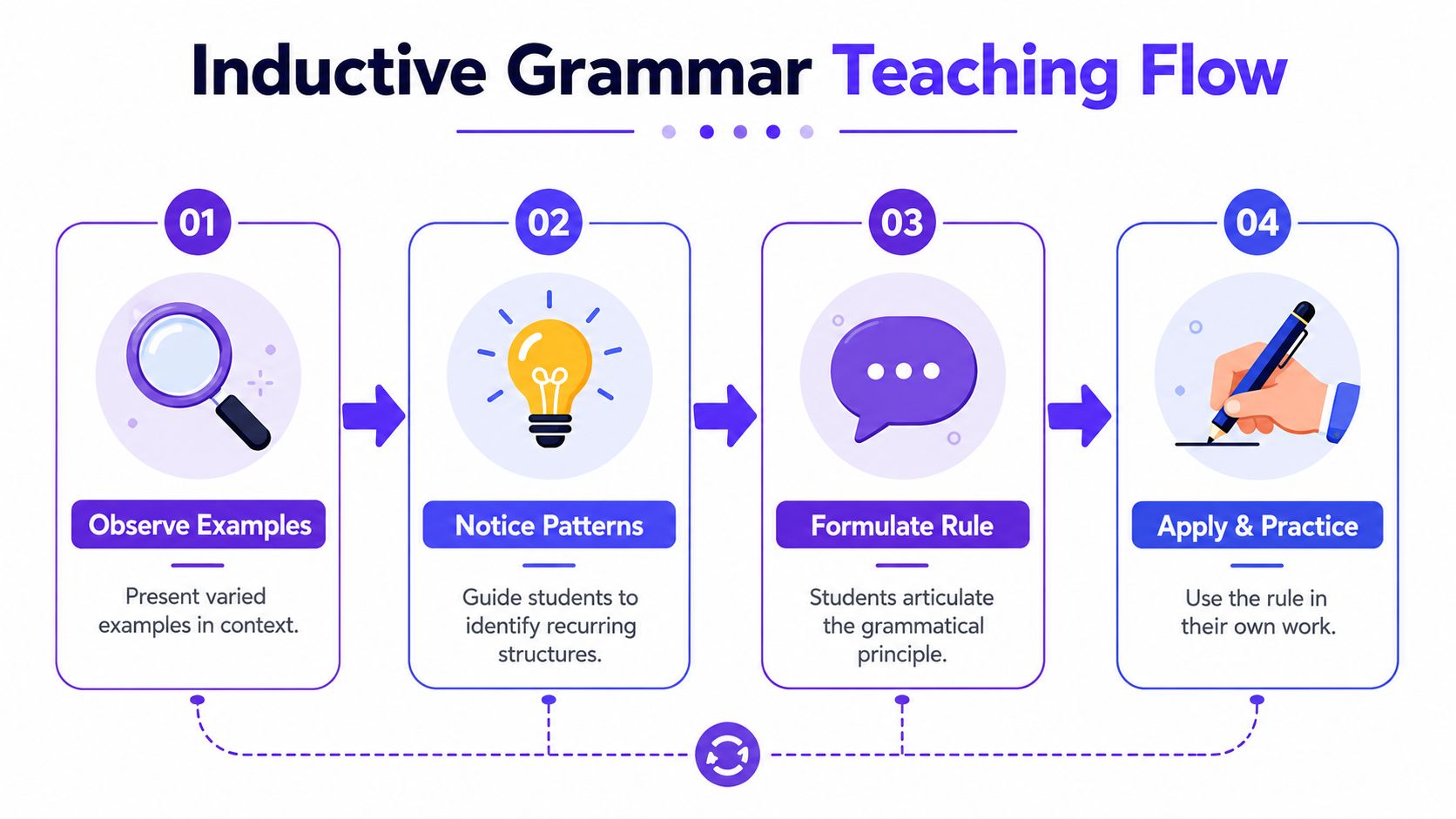
That one shift changes the role of the student. Instead of receiving a definition and hunting for places to apply it, students look at examples, notice what repeats, and build the principle from what they see. It feels more like solving a puzzle than obeying a lecture, which is one reason it tends to hold attention better.
Studies show the inductive approach, where students discover rules through pattern analysis, yields significantly higher effectiveness in grammatical improvement than deductive methods. The same research also notes that a key to success is introducing new structures in 100% familiar linguistic contexts with known vocabulary to reduce cognitive load in this grammar teaching study.
What deductive teaching looks like
A deductive mini-lesson usually sounds like this:
- The teacher defines the grammar rule.
- The class copies notes.
- Students complete controlled practice.
- A few try to use the skill later in writing.
That model isn't automatically bad. It just tends to make students passive too early. They can repeat a rule without really seeing how it functions in living language.
What inductive teaching looks like
An inductive lesson reverses the order.
| Approach | First move | Student role | Typical result |
|---|---|---|---|
| Deductive | Start with the rule | Receive and apply | Short-term compliance |
| Inductive | Start with examples | Notice and infer | Deeper understanding |
Here's a simple example with compound sentences.
Instead of saying, “A compound sentence joins two independent clauses with a comma and conjunction,” put three strong examples on the board from a text students know. Ask: What do you notice? Where does the sentence turn? What job is the comma doing? Why didn't the author split this into two short sentences?
After students talk, label what they've already observed. The rule lands better because it explains something they've already seen.
Students remember what they helped discover.
Why this lowers friction in the lesson
Inductive teaching works especially well when the examples are familiar in content and vocabulary. Students aren't burning attention on decoding the sentence itself. They can focus on pattern.
That matters in every grade band, but especially with multilingual learners and students who freeze when grammar feels overly technical. The less mental energy they spend on unfamiliar wording, the more they can spend on structure.
If you want a broader classroom lens on why this kind of discovery work matters, the Playz active learning guide is a useful read because it frames student noticing and discussion as active learning rather than passive note-taking.
A clean sequence to try tomorrow
Use this in a mini-lesson and keep it tight.
- Show examples first. Pull several sentences that contain the target structure.
- Ask noticing questions. Have students mark what repeats, shifts, or connects.
- Name the pattern second. Introduce the rule after students have language for what they saw.
- Move to guided use. Give one highly structured attempt before asking for independent writing.
That sequence feels slower at first. It usually sticks better because students are building meaning before memorizing terminology.
Implement the Mentor Sentence Routine
If you want one routine that consistently improves grammar instruction, use mentor sentences. They turn abstract rules into visible craft choices.
A mentor sentence is a sentence from a real text your students have already read, or can read easily, chosen because it highlights one useful move. Maybe the sentence shows a vivid appositive, a strong opening dependent clause, or purposeful punctuation. The point isn't to admire the sentence and move on. The point is to study how it works and then use that move in student writing.
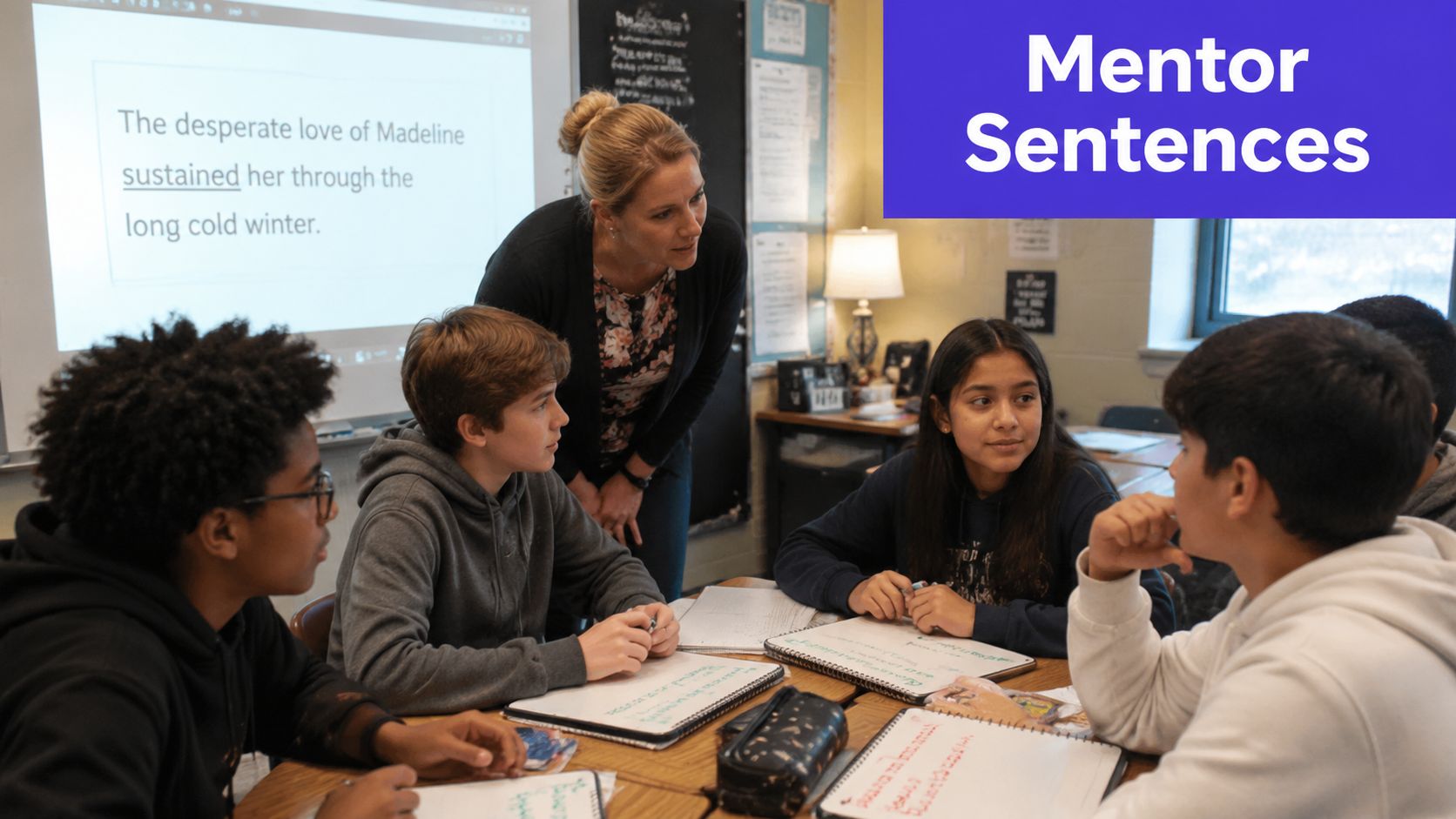
Researcher Debra Myhill's evidence-based LEAD approach requires teachers to explicitly link a grammar rule to a specific writing assignment and use authentic published texts as models, replacing technical terminology with a maximum use of examples, as described in Edutopia's explanation of the LEAD approach.
What a weekly routine can look like
A mentor sentence cycle doesn't need to eat the whole block. Ten to fifteen minutes is enough if you stay focused.
For an upper elementary class working on sentence variety, you might use a sentence like this from a read-aloud:
After the storm passed, the children ran outside and searched the yard for fallen branches.
That sentence gives you timing, clause structure, and coordination without becoming too dense.
Monday: Notice
Read the sentence aloud twice. Then ask students what they notice and what they like.
Keep the questions concrete:
- What comes first?
- Where does the sentence pause?
- Why didn't the author begin with “The children ran outside”?
- What effect does “After the storm passed” create?
The goal on day one isn't terminology. It's attention.
Tuesday: Label
This is the day to attach just enough language to the pattern. You might identify the opening dependent clause and the independent clause that follows. If students need sentence-part refreshers, Verse's sentence guide is a handy teacher reference because it lays out parts of the sentence in a straightforward way.
Use labels lightly. Students don't need a full grammar taxonomy every time they meet a useful sentence.
Wednesday: Revise
Now change the sentence and study the effect.
Try questions like:
- What happens if we remove the opening phrase?
- What changes if we split this into two short sentences?
- What if we move the time phrase to the end?
At this point, grammar starts to feel like writer's craft instead of sentence correction.
Thursday and Friday move students into ownership
Thursday is imitation day. Students borrow the structure, not the content.
They might write:
- After the bell rang, we grabbed our notebooks and headed to science.
- After the rain stopped, the dog sprinted across the muddy field and barked at the fence.
That imitation step matters because it closes the gap between noticing and producing.
For quick printable follow-up, especially if you want sentence-order support for students who need more structure, a sentence sequencing activity can reinforce how parts fit together before students draft independently.
A simple model in action helps. This classroom video shows the kind of sentence-level discussion that makes the routine work.
Friday should stay brief. Don't turn it into a long quiz. Ask students to write one original sentence using the week's pattern, then underline the part they were trying to control. You can scan those in minutes and sort students into three groups: secure, almost there, and needs another round.
Why mentor sentences hold up over time
The routine works because it blends several strong moves into one short practice block.
- Authentic text keeps grammar grounded. Students study what real authors do.
- Repetition builds familiarity. The same sentence supports multiple kinds of thinking across the week.
- Imitation reduces blank-page stress. Students don't have to invent structure from scratch.
- Application ties directly to writing. The lesson has somewhere to go.
Coach's reminder: If students can talk about what a sentence is doing, they're much closer to using that move in their own writing.
The routine is also flexible. In primary grades, you can simplify the talk and focus on oral language. In middle school, you can increase the complexity of the sentence and the revision work. The core idea stays the same.
Engaging Activities Beyond the Worksheet
Once grammar is anchored in mentor sentences and writing, practice can get a lot more lively. It should. Silent drills rarely build the kind of flexible sentence control students need when they're composing under pressure.
Research consistently demonstrates a positive correlation between teaching embedded grammar skills within writing and overall writing improvement, whereas memorizing rules and skill-and-drill approaches are proven ineffective for helping students master the English language in Sadlier's discussion of embedded grammar instruction.
Sentence scramble with a purpose
A strong sentence scramble isn't just “put the words in order.” The teacher chooses a target structure and builds discussion into the task.
In one class, students got strips for this sentence pattern: opening phrase, subject, action, added detail. Teams had to build the strongest version, then explain why one order sounded more natural or more dramatic.
The learning payoff is bigger than accuracy alone. Students start hearing syntax.
Grammar gallery walk
This works well when you want movement and quick analysis. Post sentences around the room from class read-alouds, shared writing, or student drafts. Give each pair one job only.
For example:
- Group one highlights how the writer combines ideas.
- Group two marks punctuation choices.
- Group three rewrites one sentence for a different effect.
Students move, discuss, and leave a short comment at each station. The room gets noisier than a worksheet lesson, but the thinking gets sharper.
Good grammar practice usually includes talking, not just circling.
Author emulation in paragraph form
This activity pushes beyond the sentence level. Choose a short paragraph from a text students admire and ask them to imitate the structure, cadence, or punctuation pattern while changing the topic completely.
A teacher might say, “Write about recess using the same kind of sentence openings this author used to describe the forest.” Suddenly grammar is connected to style. Students aren't just avoiding mistakes. They're making choices.
Error hunt with real writing
This one works best when the examples are authentic but safe. Pull a few anonymous sentences from drafts, or write your own “teacher draft” with deliberate issues related to the current focus.
Then ask:
- Which sentence is hardest to read?
- What exactly is causing the confusion?
- What small revision would make the meaning clearer?
That last question matters. It keeps the class centered on clarity instead of correction for its own sake.
These activities all beat the worksheet for the same reason. They ask students to manipulate language, discuss effect, and make meaning. That's where grammar starts to stick.
Assess and Differentiate with Confidence
Traditional grammar tests often make teachers feel organized and informed, but they can give a false sense of mastery. A student who aces a quiz on fragments may still write three of them in a personal narrative. If the goal is usable grammar, then assessment has to look at usable writing.
That means checking for grammar where grammar lives. In notebook entries. In science explanations. In literary analysis. In revision conferences. The cleanest evidence is not whether students can identify the rule on demand. It's whether they can use the structure with some control when they write for a real purpose.

A common but ineffective strategy for differentiating grammar for multilingual learners is a rigid “50% grammar and 50% vocabulary” split, which ignores the interconnected nature of language acquisition. Practical guidance on differentiating the grammar point itself within a standards-aligned unit is still limited, as discussed in this piece on grammar instruction for upper elementary multilingual settings.
What to assess instead of isolated quizzes
Keep the lens narrow. If you assess everything at once, you won't learn much.
A simple writing-based grammar rubric might look like this:
| Focus area | Look for |
|---|---|
| Control | Does the student use the target pattern correctly most of the time? |
| Purpose | Does the grammar choice help clarity, emphasis, or flow? |
| Independence | Can the student use it without heavy prompting? |
You don't need a giant rubric for every assignment. One target is often enough. If the class is studying sentence combining, score sentence combining. If the class is studying dialogue punctuation, score that.
Assessment check: Score the grammar move you taught, not every error on the page.
For practical formative approaches, this collection of formative assessment examples gives a useful range of quick checks that can be adapted to grammar within writing.
How to differentiate the grammar point, not just the task
Many grammar lessons often fail at this stage. Teachers often differentiate by changing workload, adding visuals, or offering extra time. Those supports matter, but they don't solve the central issue if every student is still tackling the exact same grammatical demand.
Differentiate the structure itself.
- For students who need stronger scaffolds, shorten the mentor sentence and keep vocabulary highly familiar.
- For multilingual learners, pair the grammar move with oral rehearsal before writing. Let students say the pattern several times in meaningful context.
- For students ready for more complexity, ask for two versions of the same sentence and have them explain which one creates the stronger effect.
- For students with writing fatigue, provide sentence frames that preserve the grammar target without reducing thinking.
One practical option for planning those variations is Kuraplan, which can generate standards-aligned lesson materials, worksheets, and rubrics from a single lesson idea so teachers can adjust sentence complexity or support level without rebuilding the whole task by hand.
Keep the evidence authentic
The best time to check retention isn't always right after the mini-lesson. Watch what shows up later in a new writing task, a quick conference, or a notebook response when the grammar point is no longer the star of the show.
That's the moment when you see whether instruction transferred.
Your Grammar Instruction Game Plan
A workable grammar plan is less complicated than most programs make it sound. Teach one useful pattern at a time. Start with examples. Study it in a real sentence. Connect it to current writing. Revisit it later when students have to use it again without being cued every step of the way.
That last part matters more than many teachers realize. The dominant PPP model for grammar often fails because the practice stage is too controlled, and valid assessment requires impromptu checks weeks later to measure true retention, not just immediate recall after a lesson, according to this analysis of grammar teaching and assessment.
The short version
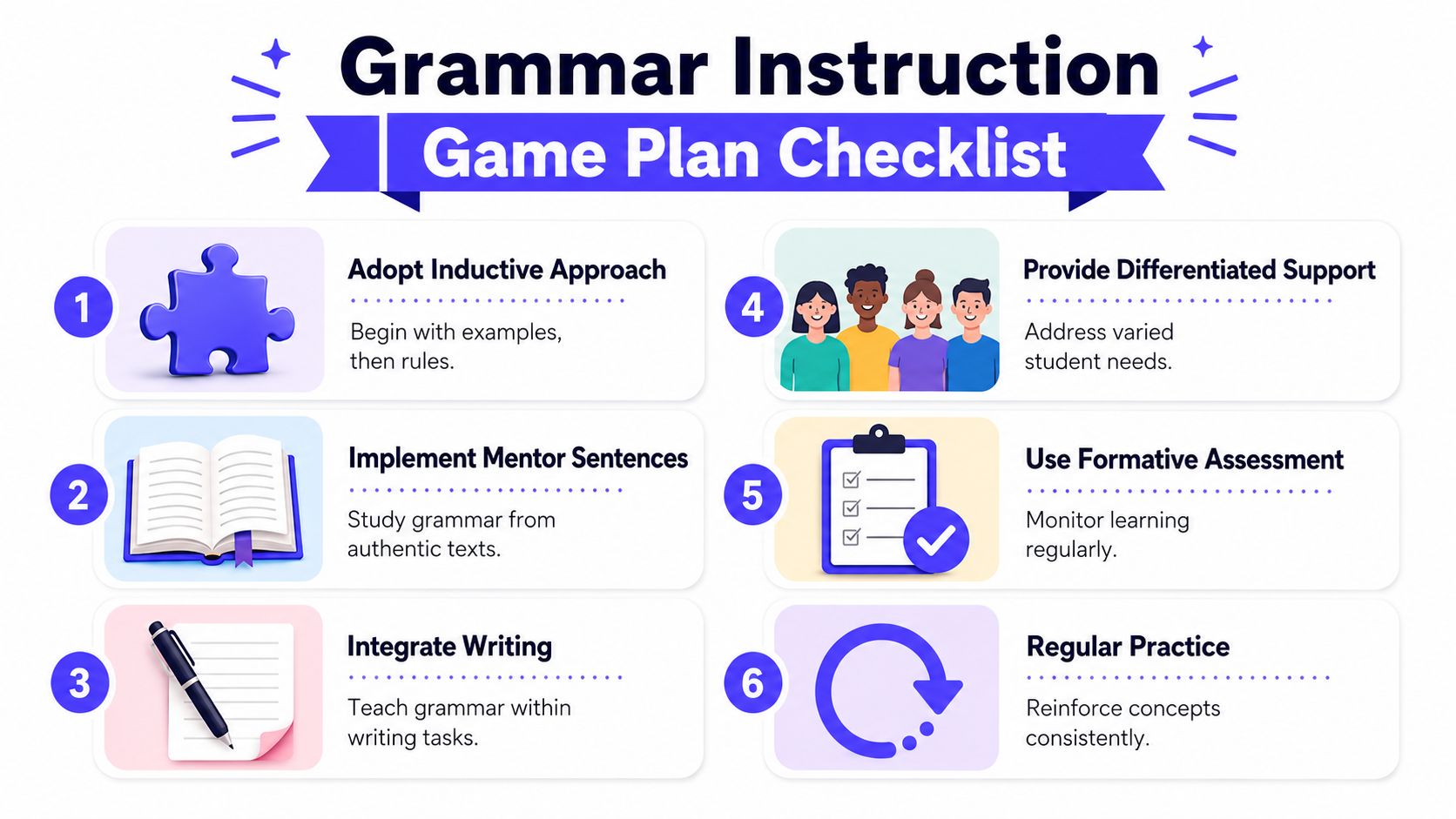
If you want a clean decision filter for how to teach grammar, use this checklist:
- Begin with examples. Let students notice before you define.
- Teach from real texts. Strong sentences from books, articles, and class read-alouds do more than invented drills.
- Tie grammar to current writing. Every lesson should improve something students are already drafting or revising.
- Give guided practice, then loosen support. Students need a bridge from imitation to independence.
- Check later, not only now. Look for the skill in future writing, not just today's exit slip.
- Adjust the demand. Change sentence complexity and support level for different learners.
Common hurdles and how to clear them
Teachers usually hit the same roadblocks.
My students say grammar is boring.
They're often reacting to the format, not the content. Grammar gets more interesting when students compare real sentences, imitate authors, and revise their own writing for effect.
My curriculum requires worksheets.
Use them as brief support, not the center of instruction. A worksheet can reinforce a pattern after students have already seen it in text and used it in writing.
I don't have enough time.
Fold grammar into reading and writing instead of creating a separate block. A strong mentor sentence routine can do more in a short burst than a long disconnected lesson.
Students do fine right away, then forget later.
That's common. Build in return points. Ask students to use the same structure again in a different unit, or in speaking and quick writes, not only in the original lesson.
If you want students and families to see grammar as a long-term writing skill rather than a quiz topic, resources like this guide on how to improve English grammar can also help frame grammar as practice, reading, revision, and repeated use rather than rule memorization alone.
The core shift is philosophical. Stop treating grammar as a set of facts to cover. Start treating it as a set of writing moves students can notice, try, discuss, and reuse. That's when grammar stops disappearing after the test.
If you want a faster way to build standards-aligned grammar mini-lessons, differentiated practice, and simple assessment tools, Kuraplan can help you turn one grammar target into usable classroom materials without spending your prep time formatting everything by hand.