You've got the standards document open, next week's lessons half planned, and a blank space beside learning objective. The standard sounds clear until you try to decide what students should hand in. That's where learning how to unpack standards becomes useful: not as another planning form, but as a way to make the expected learning visible.
Why Standards Need Unpacking Before Lesson Planning
Say a grade 6 teacher reads a standard asking students to analyze how an author develops a central idea. The teacher writes a lesson objective about learning central ideas, finds an interesting text, and plans a discussion. By Thursday, students are completing a summary worksheet because nothing in the plan specifies what an analysis should contain.
The worksheet might be useful. It just doesn't establish whether students can explain how the author develops an idea.
Standards describe learning goals, not ready-made classroom tasks. Teachers can read the same sentence and choose very different activities, texts, and expectations for student work. Unpacking means separating a broad expectation into the knowledge students need, the skills they must use, the observable actions they'll perform, and the evidence that demonstrates mastery.
Separate the goal from the activity
An activity tells students what to do during a lesson. A target tells them what learning they must demonstrate through that activity. Reading a passage, highlighting details, and discussing ideas are activities; explaining how selected details develop a central idea is the intended performance.
The OCALI guidance on deconstructing standards emphasizes identifying content and performance requirements, checking the grade level, and making sure all components needed for mastery are represented. That prevents familiar mistakes: copying the standard into the activity box, teaching a neighboring standard, choosing work below the intended grade, or accepting a simpler performance.
A usable planning routine needs more than student-friendly wording. It needs a procedure for separating the parts, a guide to the verbs, measurable objectives, and a unit coverage check.
If you can't describe what a student would produce, the standard isn't unpacked yet.
Sorting Verbs by Cognitive Demand
Nouns identify the content; verbs identify the performance. The Regional Educational Laboratory resource on creating performance outcomes recommends analyzing both to decide what students must be taught, practice, and demonstrate. Replacing a demanding verb with an easier one doesn't clarify the standard. It changes the expectation.
Use this comparison to check whether your target preserves the thinking required.
| Standard verb | Cognitive demand | Weak version to avoid | Target wording |
|---|---|---|---|
| Analyze | Break a whole into parts and explain how they relate | Identify the parts | Analyze how one event causes another, citing two details |
| Evaluate | Judge against stated criteria | Describe or list features | Evaluate two solutions using cost and fairness criteria |
| Compare | Identify similarities and differences and weigh them | List features of each | Compare two fractions with a visual model and explain which is larger |
| Explain | Make causes or reasons clear in own words | Repeat a definition | Explain why water boils at a lower temperature at altitude |
| Model | Represent a situation with a diagram, equation, or table | Draw a picture | Model a real situation with an equation and interpret the result |
| Understand | No observable performance | Read or summarize | Replace with the verb that shows the understanding, such as explain or apply |
What changes in the student's work
Analyze requires relationships, not just parts. A student might correctly identify events in a story without explaining how an event changes a character's choices. The missing relationship is precisely what the teacher needs to assess.
Evaluate requires a judgment supported by criteria. Listing the advantages of proposed solutions isn't enough if students never decide which solution better meets the stated requirements.
With compare, the common mistake is accepting separate descriptions. Students need to connect the objects being compared through relevant similarities, differences, or relative size. The standard's content determines which comparison matters.
Explain asks students to make reasoning clear. Repeating the definition of boiling doesn't explain why altitude affects boiling temperature. Look for a connected account of the cause, not merely correct vocabulary.
For model, a neat drawing can distract from missing mathematics or science. Students should show what the representation stands for and interpret its result in the original situation.
Understand needs an observable partner. Don't automatically replace it with summarize; choose the performance that would demonstrate the intended understanding.
Use the verb without treating it as a ranking shortcut
Find the standard's verb, check whether your draft resembles the weak version, and adapt the stronger wording to your actual content. The guide to Bloom's taxonomy verbs can help you choose precise language.
A verb alone doesn't settle difficulty. Explaining a familiar procedure and explaining a surprising experimental result can require very different reasoning. Read the verb together with the content, context, and expected independence.
How to Unpack a Standard Step by Step
Start with the official standard, not a worksheet title or a remembered paraphrase. The guide to the structure of mathematics standards explains how domains, conceptual categories, and clusters organize related expectations. Those surrounding headings help establish scope and progression before you write daily targets.
The opening preparation is worth keeping visible beside your planning document.
Work from the wording to the evidence
Use this illustrative standard throughout the process: analyze how an author develops a central idea over the course of a text.
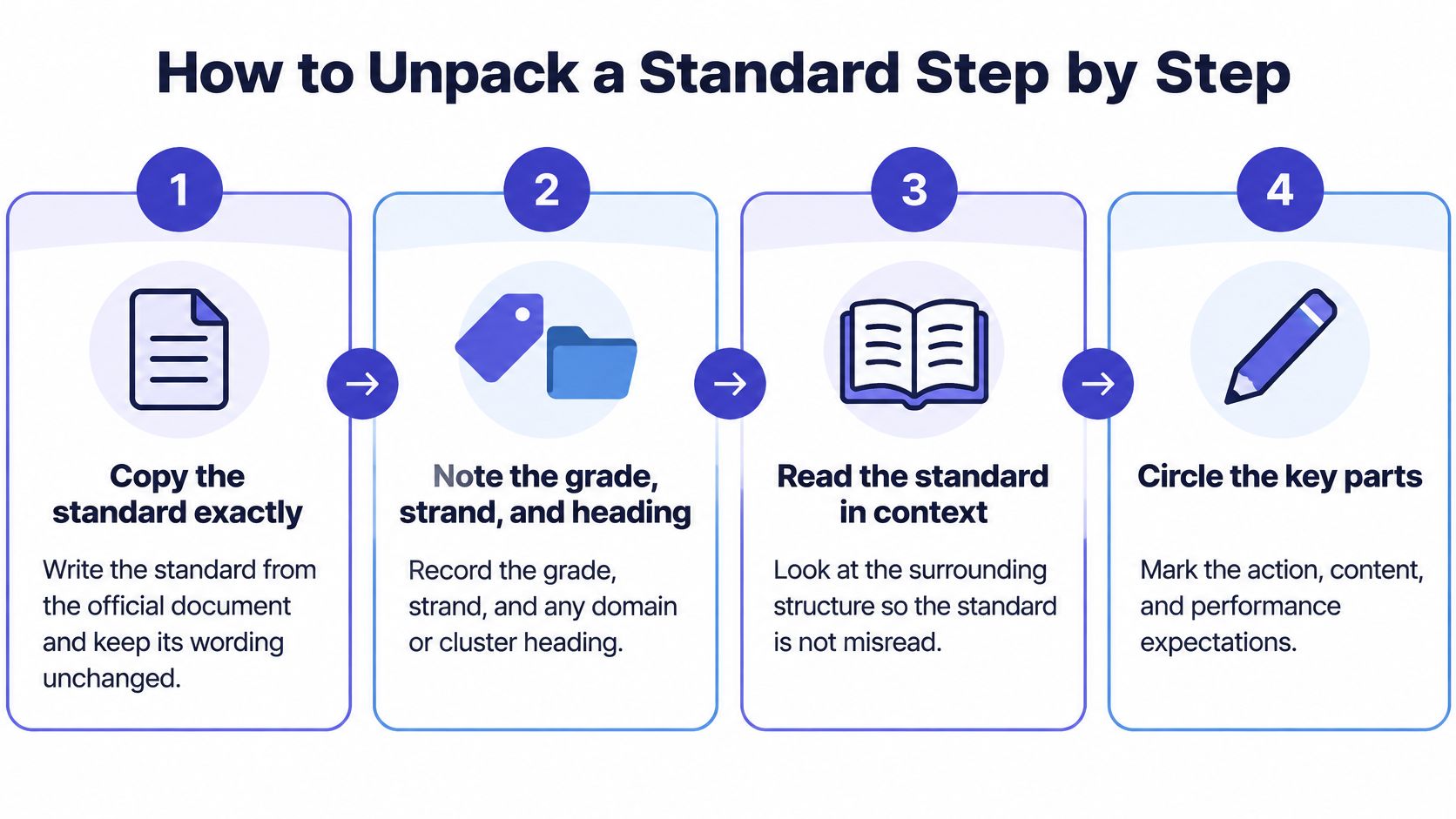
Copy the standard exactly and record its context. Note the grade, strand, and relevant heading from the official document, then check neighboring expectations and prerequisite learning. Don't assign this illustrative sentence a grade or code without checking your own curriculum.
Circle the verb and underline the content phrases. In this example, mark analyze, then identify author, central idea, and course of a text as important content or scope markers. The easy mistake is keeping central idea while overlooking development across the text.
Sort the requirements into knowledge, reasoning, skills, and products. Students need knowledge of central ideas and relevant details, reasoning about how those details contribute to development, and skills in selecting and connecting evidence. An analytical paragraph is a possible product you choose, not necessarily a product mandated by the standard.
Pair content with the relevant action to form candidate targets. For example, ask students to analyze how details introduced early in the text establish an idea and how later details extend or qualify it. Don't turn every noun into an isolated vocabulary objective.
Rewrite the candidates in student-facing language. A useful version is: I can analyze how details from different parts of a text develop its central idea. Replacing analyze with find during rewording would make the sentence easier to read but change what students must demonstrate.
Check completeness, grade fit, and assessability against the original. Beside each target, name the student work that would demonstrate it and check that the work addresses the whole text rather than a convenient excerpt. Remove targets that add unrelated demands, and restore any required content you've lost.
Keep the finished list usable
For this example, a manageable draft might contain these three connected targets:
- Identify the central idea, supported by a concise statement and relevant text details.
- Trace its development across the text, demonstrated through an annotated sequence of details.
- Analyze the author's development of that idea, demonstrated through a response connecting the selected details to the idea.
The first targets support the final performance; they don't replace it. Keep each target focused on an action, a content element, and a recognizable kind of evidence.
If a standard contains lettered parts or several verbs, unpack those demands separately. A hypothetical standard requiring students to compare texts and explain differences in author purpose needs evidence for both comparison and explanation, even if students produce them in the same assignment.
For teams documenting this routine, Trupeer Inc.’s how to guides offer a resource for thinking about clear procedural instructions. Keep the curriculum interpretation itself anchored to your official standards.
Writing Measurable Objectives With a Success Threshold
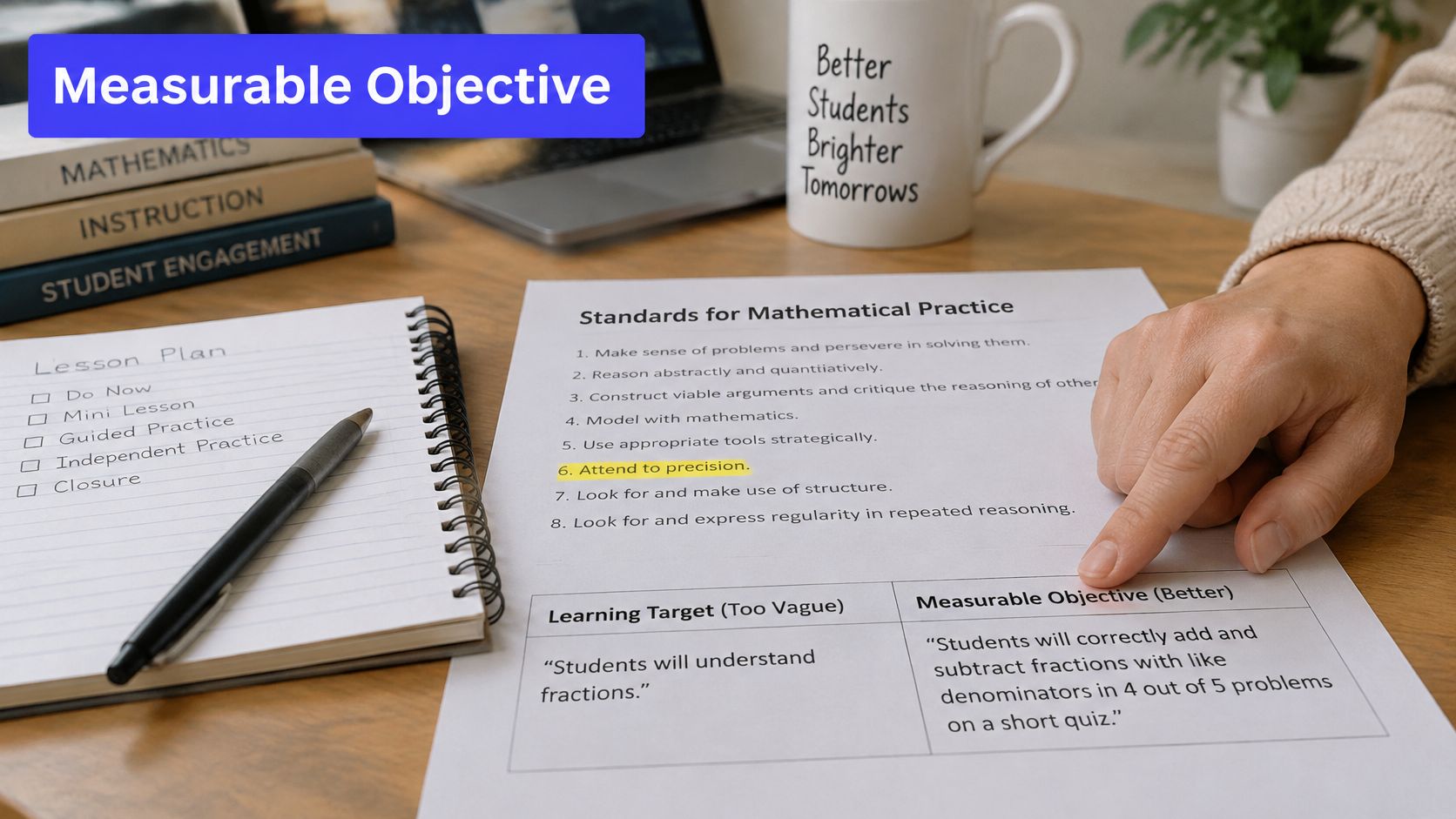
A target identifies the learning. A lesson objective makes the expected performance specific enough to teach and judge within the time available. An objective about understanding fractions leaves too much undecided: which fraction relationships, what action, and what would count as success?
Use the contrast below as a reminder to check the wording before selecting activities.
The federal toolkit for implementing Student Learning Objectives calls for specific, measurable objectives aligned to standards, informed where possible by prior learning, and ambitious yet attainable within a defined instructional period. The practical question is whether your wording tells you what evidence to collect and how to judge it.
Move from a topic to a defensible threshold
An objective about understanding fractions fails the action test and leaves the content too broad. It also gives no performance threshold. A stronger draft asks students to compare fractions using a visual model and justify which is larger: now the action and content are visible.
For a hypothetical class, you might specify 3 out of 4 comparisons correct across two representations within one week, with valid models and reasoning supporting each credited answer. Those are example planning choices, not a recommended universal benchmark. Accuracy alone shouldn't earn full credit when the objective also requires justification.
The distinction between a learning intention and the evidence of success matters here. The guide to learning intentions and success criteria can help you keep the intended learning separate from the features you'll look for in student work.
This video provides another format for considering the planning process.
Choose mastery or growth deliberately
A mastery target sets an expected level of achievement by the end of the instructional period. A growth target specifies improvement from a student's starting point, which can be useful when students enter with markedly different knowledge.
Check either choice against actual baseline work. If students can't yet represent equivalent fractions, plan that prerequisite instruction before expecting independent comparisons. A demanding number isn't evidence of a well-designed objective.
Before committing, check for:
- Action verb: What will students do?
- Content: What knowledge will they use?
- Performance level: What counts as successful?
- Evidence: What work will you examine?
- Time frame: When should students demonstrate it?
If an element is missing, you still have a planning decision to make.
Matching Assessments to the Verb
A recall quiz can cover the right topic and still measure the wrong learning. Students might recognize the definition of evaluation without being able to judge a solution. Correct answers don't automatically demonstrate the performance named in the target.
The U.S. Department of Education guidance on standards and assessments identifies alignment dimensions that matter here: coverage of the standard's full range, measurement of both knowledge and performance, appropriate content emphasis, and preservation of cognitive depth. That means you need to closely inspect what students must do to answer, not just whether the item mentions the right topic.
Choose evidence that makes the thinking visible
For evaluate, ask for a written judgment against stated criteria, such as cost and fairness. A response that names a preferred solution without applying those criteria is incomplete, even if the choice is sensible.
For explain, a labeled diagram with a short account of the mechanism can reveal more than labels alone. For model, give students real measurements or observations, ask them to build a representation, and require an interpretation of the result. For compare, use a constructed response that connects the objects through the relevant relationship.
Evidence check: A correct conclusion with missing reasoning may show partial success, not full mastery.
Attach evidence to each unpacked skill rather than assigning a general quiz to the standard as a whole. A single task may assess several targets, but your scoring needs to distinguish them. Otherwise, you won't know whether a student struggled with content, representation, or reasoning.
Make quick checks useful for tomorrow's teaching
Formative checks should elicit the same kind of thinking as the intended final performance, using shorter or more supported tasks when appropriate. An exit response can ask students to explain a relationship without requiring a full essay.
For practical formats, consult these formative assessment examples. David T.C. Tutoring Services' 2026 guide to formative assessment is another resource to consider when planning checks within instruction.
Apply the same scrutiny to questions drafted by a planning tool. Review every item with these questions:
- Required action: Does answering successfully require the target's verb?
- Required content: Does the item use the knowledge named in the target?
- Evidence beyond guessing: Would a student who guessed the conclusion still fail to demonstrate mastery without the required reasoning?
Checking Coverage Across the Whole Unit
Make a coverage map before you finalize the lesson sequence. List each target in a column, then record where students learn it and where they demonstrate it. Include the task or item reference, not just an assessment title.
A blank teaching entry reveals a target students are expected to achieve without planned instruction. A blank assessment entry reveals learning you won't be able to judge. A crowded row deserves attention too: you may be spending repeated lessons on an accessible supporting skill while leaving the demanding performance until the final assignment.
Look for gaps and misplaced emphasis
The study of alignment among standards, instruction, and assessment treats these as separate relationships to examine, not an alignment educators can assume from shared subject matter. Use your map to inspect the connection between the student's practice and the eventual evidence.
Check for these problems:
- Vocabulary without performance: Students define terms but never use them in the required reasoning.
- Reduced demand: Practice stops at identification when the target requires analysis.
- Unrelated content: An engaging lesson consumes time without contributing to the intended learning.
- Unclear access: Wording or task design makes it difficult to tell whether a student lacks the learning or can't access the prompt.
Ask a colleague to review target language and assessment directions with multilingual learners and students with disabilities in mind. Clarifying instructions, providing accessible materials, or allowing an appropriate response format shouldn't remove the reasoning students must demonstrate.
Keep enough targets, not the most targets
A hypothetical unit with twelve tiny targets may produce more scoring than useful information. Combine closely related fragments when the combined result still tells you what to teach next. Keep distinct demands separate when merging them would hide a meaningful learning gap.
For a different perspective on checking planned coverage against intended coverage, Taja AI's content gap analysis guide offers a content-planning analogy. Your classroom map still needs curriculum-specific judgments about learning, access, and evidence.
Use this checklist to inspect the finished map.
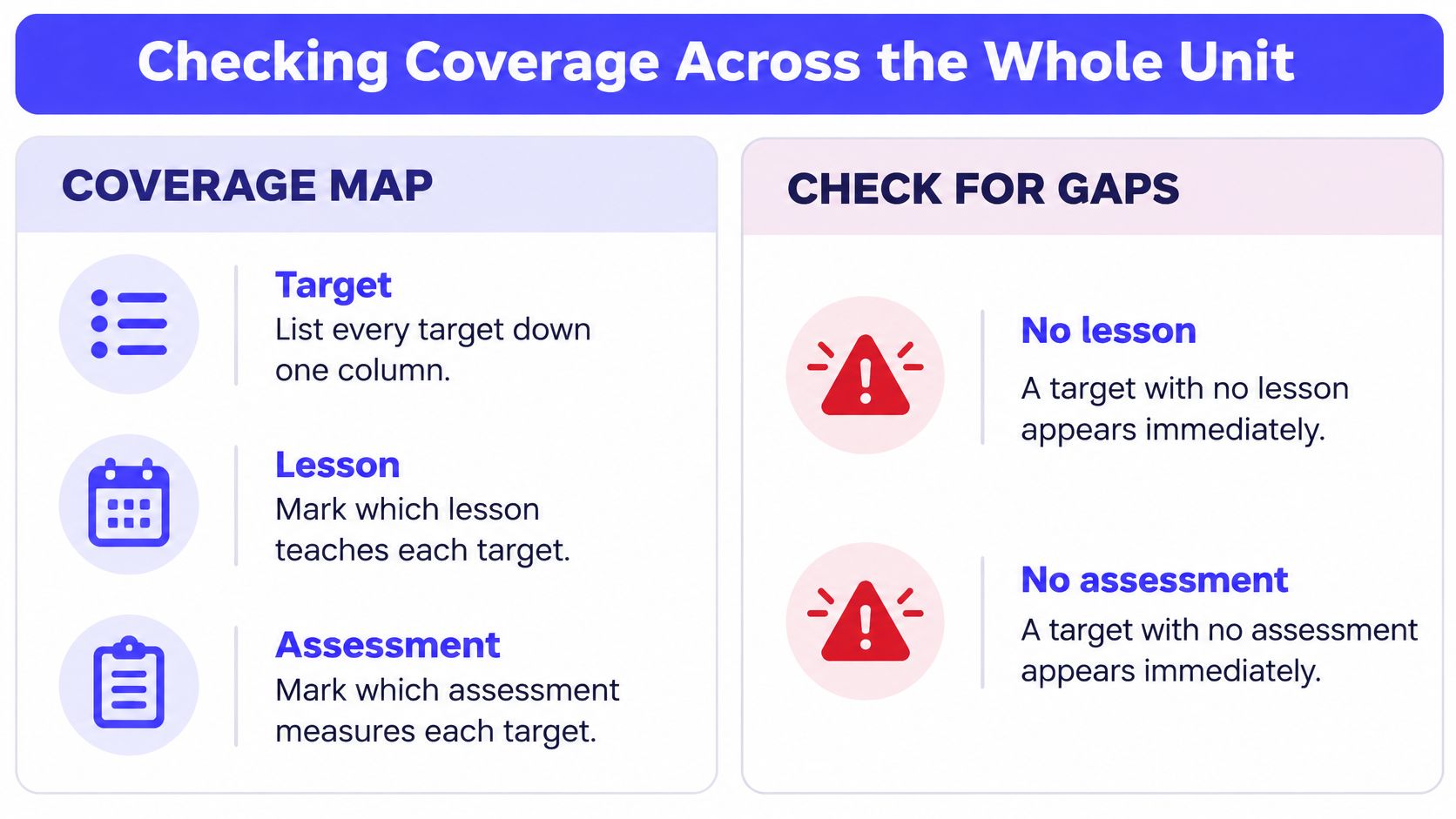
Run the assessment questions against each row. If no item requires the action, uses the intended content, and demands evidence beyond a lucky answer, that row isn't finished.
Test One Standard This Week Before Planning the Unit
Choose a standard from your next unit and give it a focused planning session. Don't start by finding activities. Start by deciding what a successful student response would let you conclude.
Use a small trial:
- Preserve the wording: Copy the official standard and note its context.
- Mark the requirements: Circle verbs, underline content, and sort the demands.
- Draft the targets: Write a manageable set of student-facing statements.
- Specify success: Give a target a measurable objective and an appropriate threshold.
- Test the strongest verb: Draft an assessment item and sketch an acceptable response.
For this trial, you might set aside about an hour. If the work expands, inspect whether the standard contains several demands that need separate treatment rather than forcing everything into a single target.
Compare interpretations before building lessons
Bring the draft and sample response to a colleague teaching the same year. Ask what they would accept as full mastery and what they'd mark as partial. Disagreement about the evidence often exposes an ambiguity that polished objective wording can hide.
Once that interpretation is sound, Kuraplan is an AI lesson planner for K–12 teachers that creates standards-aligned lesson plans in minutes, with all plans including curriculum alignment with Common Core State Standards; its unit plans include interconnected lessons, assessments, and learning progressions. Use the drafting support after you've established the intended performance.
Take a standard to your next planning meeting with a target, an assessment item, and an example response. Before approving the lesson, make your own final check that the student's work demonstrates the official verb.
Visit Kuraplan to turn your checked targets into lesson and unit drafts with aligned assessments and rubrics. Bring the standard, your success criteria, and the evidence you expect, then review the draft against what students must demonstrate.