A useful unit plan is more than a topic list, and the workload behind one is larger than many templates suggest. In TALIS 2024, lesson planning accounted for 14% of teachers' working time on average, while 35% of teachers reported too much lesson preparation as a source of stress. A ready-to-teach plan earns its place by connecting standards to measurable objectives, sequencing learning experiences, checking understanding, and anticipating learner differences.
The eight sample unit lesson plans below move from elementary through high school and across mathematics, science, social studies, and English language arts. You can borrow the architecture without copying the subject matter. The strongest examples make the learning progression visible, identify the evidence students will produce, and give teachers practical choices when time, reading level, or prior knowledge varies. Tools such as Kuraplan can help turn a sound instructional idea into standards-aligned plans, worksheets, visuals, and rubrics, but teacher judgment still determines what belongs in the room. For related school operations, see this resource on school volunteer background screening.
1. Grade 3 Fractions Unit Parts of a Whole
Fractions become easier to teach when students see and handle the mathematics before they meet a page of symbols. Begin with halves, thirds, and fourths using fraction strips, paper folding, pattern blocks, measuring cups, and food models. Pizza slices and candy bars can make the idea familiar, but circles alone create a narrow picture of what a fraction means.
A strong sequence moves from naming equal parts to building unit fractions, then combining those units into fractions with larger numerators. Students should explain what the denominator tells them, represent a fraction in more than one way, and connect a visual model to written notation. The relevant Grade 3 standard can sit beside each objective, rather than appearing only in a planning header. A plan such as Eureka Math or EngageNY Grade 3 Module 5, Illustrative Mathematics Grade 3 fractions, or the Singapore Math sequence can provide useful structure, but the teacher still needs to select representations that fit the class.

Make the evidence visible
Use quick checks that ask students to draw, build, compare, and explain. A student who can shade three-fourths may still misunderstand why the parts must be equal, so include prompts that expose that misconception. In a mixed-ability class, keep the goal stable while varying the model, numbers, language support, and level of independence.
Practical rule: Start with the meaning of the unit fraction. Symbolic procedures should describe a model students already understand.
Create an anchor chart with vocabulary and several representations. Kuraplan can help produce differentiated fraction worksheets with visual models and age-appropriate assessment questions, while third-grade fraction worksheets can support additional practice without requiring the teacher to format every version. The replicable tactic is simple: ask every student to solve one fraction problem with a model, one with words, and one with symbols before moving to the next representation.
2. Grade 2 Life Cycles Unit From Tiny to Grown
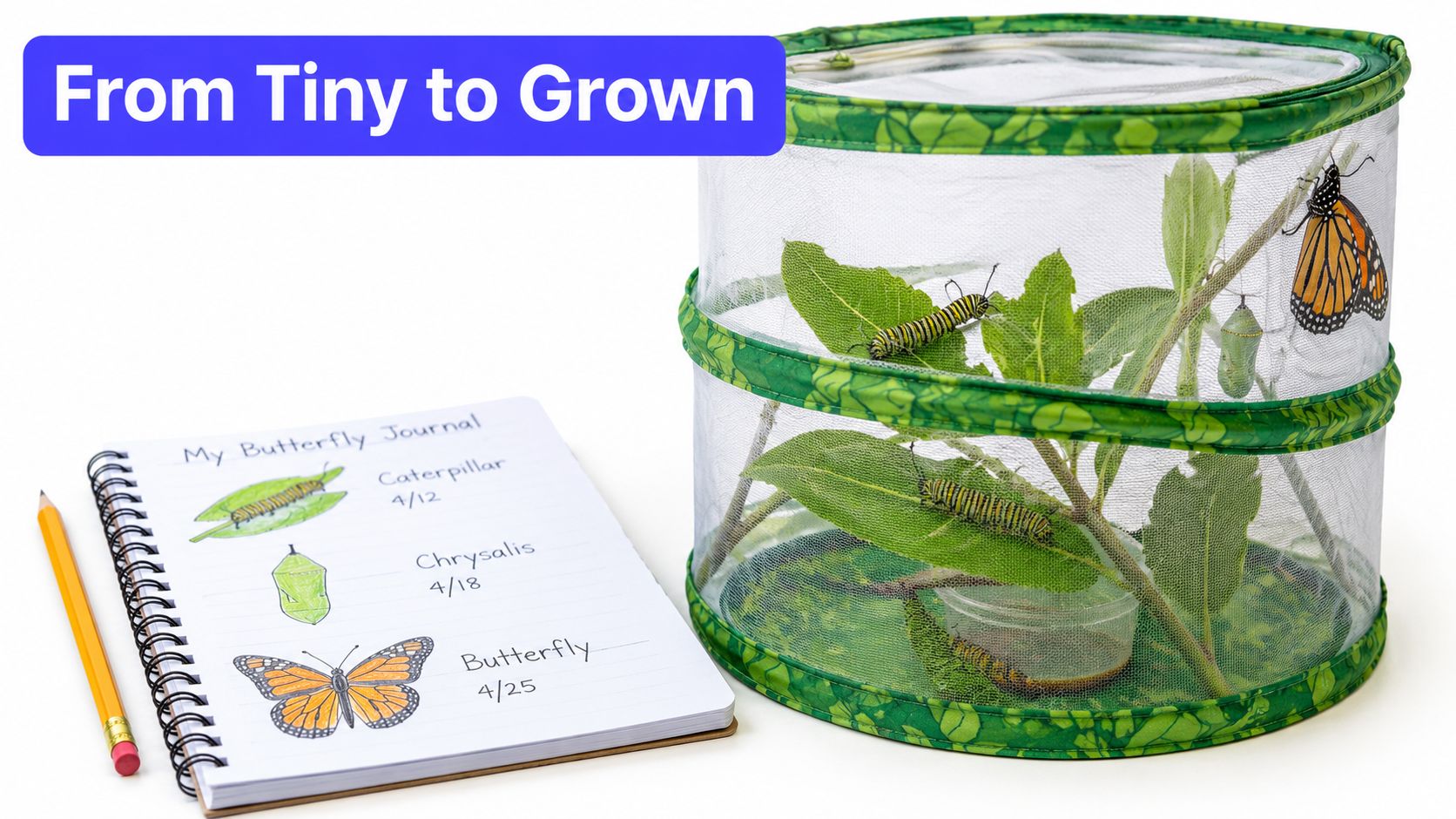
Young students understand life cycles best when the sequence begins with organisms they recognize. A butterfly, frog, bean plant, or human child gives students something concrete to observe before they encounter scientific vocabulary. Use real photographs first, then invite students to draw, label, and arrange stages in order.
The unit should build from noticing change to describing a repeating pattern. Students can maintain observation journals, compare a caterpillar with a tadpole, and create a large cycle poster that remains on display as new organisms enter the discussion. The daily lesson plan needs more than a craft. It should name the observation students will make, the vocabulary they'll use, and the evidence that shows they understand that a life cycle includes predictable stages.
Sequence observation into explanation
Begin with a shared image sort. Students work in pairs to arrange mixed-up photographs, explain their choices, and revise the sequence when new evidence appears. Later, they can create their own diagram and use words such as egg, young, adult, grow, change, and reproduce in an oral explanation. Drawing is an important access point, but it shouldn't replace scientific reasoning. Ask students what changed, what stayed similar, and why the stages belong together.
A short observation journal gives you formative evidence without turning every lesson into a quiz. For students who need support, provide partially labeled diagrams, oral rehearsal, picture vocabulary, and partner talk. Students ready for more challenge can compare two organisms and identify similarities in their patterns of growth.
Kuraplan can generate illustrated life-cycle worksheets with labeled diagrams and sequencing questions, including butterfly life cycle stages practice. The practical tactic is to revisit the same classroom cycle poster at the start and end of each lesson, adding one student-generated observation each time.
3. Grade 4 Water Cycle Unit Water's Journey
The water cycle makes more sense when students investigate water moving through a system rather than memorize three vocabulary words. Start with a sealed-bag or covered-container demonstration, a puddle outside, or condensation on a cold surface. Students can record what they observe, predict what will happen next, and connect the classroom event to weather in their own environment.
A coherent sequence introduces evaporation, condensation, and precipitation through observation before students construct a full model. Track local rainfall and temperature, discuss where water goes after a storm, and return repeatedly to the idea that the cycle continues even when one stage isn't visible. PBS LearningMedia, National Geographic Kids, and Scholastic science resources can supply illustrations and activity ideas, but your plan should identify the misconception each activity is meant to address.
Treat the diagram as an argument
Have students draw arrows and explain why each arrow points in that direction. A finished poster isn't enough if students can't explain how water changes state or moves between parts of the system. Use a shared model first, then ask students to create individual diagrams with blank spaces for labels, arrows, and short explanations.
Differentiation can happen through the reading, not the scientific idea. Provide a shorter illustrated passage for emerging readers, a vocabulary bank for multilingual learners, and a more complex account of groundwater or collection for students ready to extend the model. The raindrop journey summary practice can reinforce sequencing, while Kuraplan can help create differentiated reading passages, labeling pages, and assessment rubrics.
The classroom tactic is to end each lesson with a “Where is the water now?” question. Students answer with a sketch and one sentence, giving you immediate evidence of whether they see a continuous cycle or a disconnected list of terms.
4. Grade 5 Civil War Unit A Nation Divided
A Civil War unit should ask students to examine causes, choices, consequences, and human experiences, not just memorize battles and dates. Begin by establishing discussion agreements for difficult topics, then introduce a small set of accessible primary sources. Photographs, speeches, letters, maps, and newspaper excerpts can help students see that historical events affect people differently.
The sequence might move from background and competing interests to document analysis, major events, multiple perspectives, and a final research or persuasive task. Students need a clear question to investigate, such as how political, economic, and moral conflicts contributed to division. Graphic organizers can help them track who created a source, what the source says, what it leaves out, and how it supports or complicates a claim.
Keep the source work manageable
Document-based questions from the Stanford History Education Group and DBQ Project can model rigorous inquiry. iCivics resources, including Battle of the Ballot Box, may offer useful civic connections, but no published activity removes the need to check reading demands and historical framing for your class.
Use structured questions before asking students to interpret independently. Read difficult passages aloud, define terms in context, and allow students to discuss an initial interpretation before writing. A student who struggles with archaic language may still produce advanced historical reasoning when the access barrier is reduced.
Kuraplan can help generate differentiated comprehension questions for selected primary sources and rubrics for a research project or persuasive essay. The replicable tactic is a three-column source note: claim, evidence, and perspective. Require students to complete it for every source, then use their notes as the foundation for the final argument.
5. Grade 6 Early Civilizations How Societies Grow
Students often remember the names of rivers and rulers but miss the larger relationship between geography and social organization. An effective early civilizations unit makes that relationship the organizing question. Students investigate how the Nile, Tigris-Euphrates, Indus, and Yellow River supported settlement, while also asking how governments, economies, technologies, and cultural practices developed in response to local conditions.
Start with maps and satellite views through Google Earth or another interactive mapping tool. Students can identify water access, fertile land, flood risks, and transportation routes before reading about a civilization. From there, build comparison work gradually. A matrix should not become a copying exercise, so require students to use evidence to explain both a similarity and a difference.
Compare systems, not trivia
Use a backward-design structure: identify the understanding students should retain, determine what evidence would demonstrate it, and then select readings, maps, and activities. The Alberta unit-planning example describes this movement from desired results to acceptable evidence and then to learning experiences. It also emphasizes planning resources, anticipated pupil responses, board work, and timings, which keeps a unit grounded in actual classroom decisions.
Give students diverse voices and avoid presenting any civilization as a simple collection of achievements. A primary source excerpt, artifact image, or translated inscription should lead to questions about authorship and context. Kuraplan can create comparison matrices, visual organizers, and comprehension questions at different levels for the sources you select.
The tactic worth borrowing is a “geography claim” at the end of each lesson. Students complete the sentence, “This feature of the environment influenced society by…” and support it with one map detail and one reading detail.
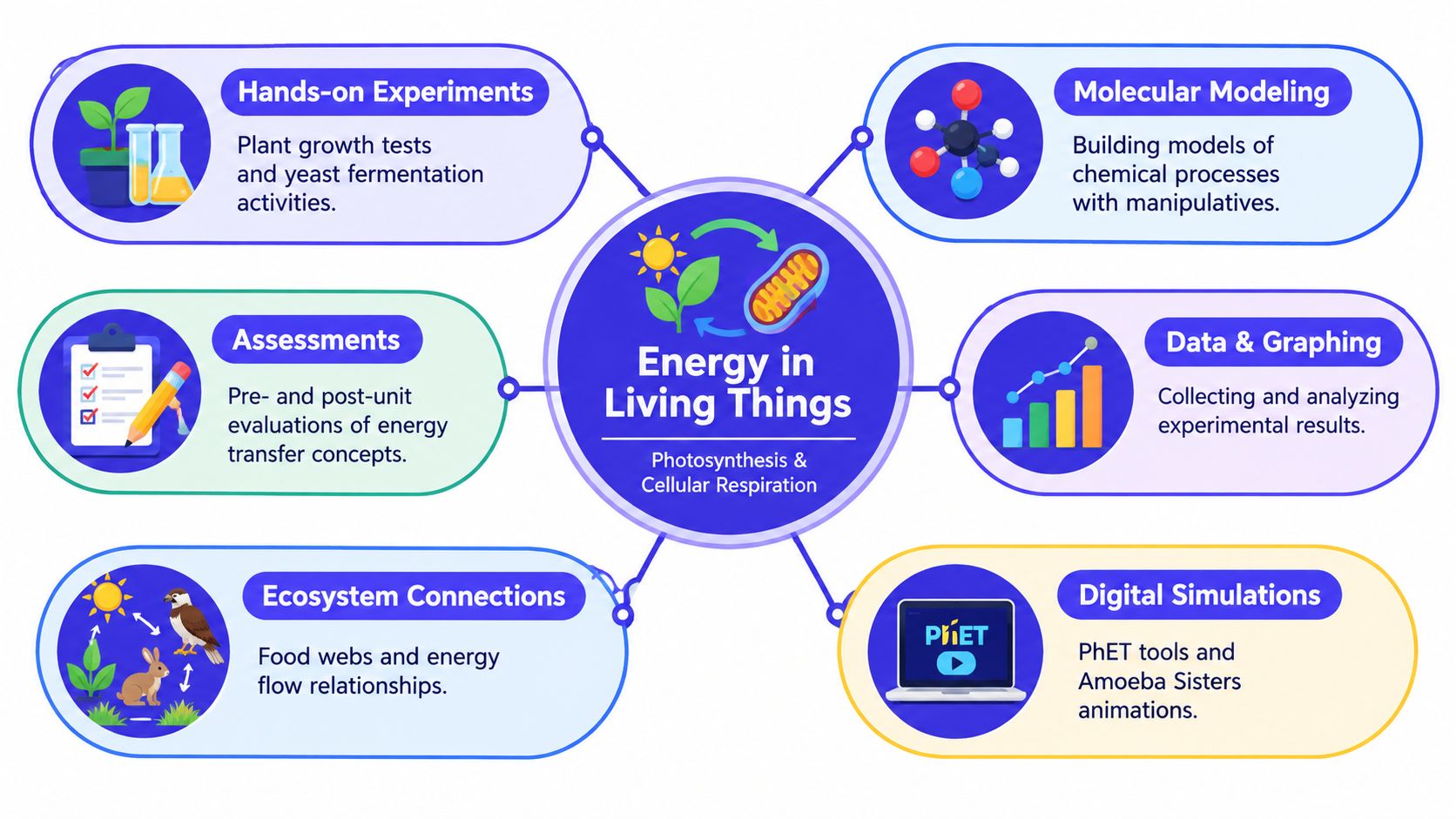
6. Grade 7 Photosynthesis and Cellular Respiration Energy in Living Things
Students can recite that plants need sunlight and still fail to explain how energy moves through living systems. Start with an observable phenomenon, such as a plant growing toward light, leaves changing over time, or organisms moving and using energy. Ask students to generate an initial explanation before introducing molecular diagrams or chemical equations.
The sequence should connect visible events to increasingly abstract models. Students investigate, record observations, analyze data, and revise an explanation of how photosynthesis stores energy and cellular respiration makes energy available for life processes. BOZEMAN Science, University of Colorado investigations, and Exploratorium Teacher Institute activities can provide useful starting points, but students need time to construct and critique their own models.
Make the two processes interact
Avoid teaching photosynthesis and cellular respiration as isolated vocabulary units. Use consistent colors for inputs, outputs, matter, and energy, then ask students to trace how the products of one process relate to the needs of another. A model should show relationships, not just include every term from a word wall.
Formative checks can include an annotated diagram, a claim-evidence-reasoning response, a lab reflection, and an exit ticket that asks students to correct a flawed model. Provide sentence frames and partially completed diagrams for students who need language or organization support. Students ready for extension can explain how the processes connect at the ecosystem level.
Kuraplan can produce lab-based assessments, exit tickets, and custom visual diagrams that present the process in smaller steps. The classroom tactic is to keep one shared model on the wall and revise it after every investigation. Students see scientific understanding as something they improve with evidence, rather than a diagram they copy once.
7. Grade 9 Algebra I Unit Linear Relationships
Linear relationships become more useful when students see them in a situation before they manipulate equations. A phone plan, taxi fare, sports statistic, or local business scenario can introduce a starting value and a rate of change. Students should move among tables, graphs, equations, and verbal descriptions, because fluency in only one representation often hides misunderstanding.
Begin with a concrete pattern, ask students to represent it in a table, and then connect the table to a graph. Introduce slope and y-intercept as features with meaning, not just numbers to identify. Illustrative Mathematics Algebra I, Desmos activities, and Khan Academy sequences can support practice, but the teacher must decide when technology clarifies a relationship and when it distracts from the reasoning.
Use mistakes as assessment evidence
Give students incorrect graphs and equations to analyze. One student may reverse the coordinates, another may confuse slope with the intercept, and another may calculate correctly without understanding what the values mean in context. Error analysis lets you distinguish these problems and respond with a targeted mini-lesson.
Open-ended tasks create multiple entry points. Students can compare two plans, explain which is better under different conditions, or design a scenario that produces a specified graph. Coordinate grids, sentence frames, and worked examples support students who need structure, while extension prompts ask students to defend a generalization.
Kuraplan can generate contextualized word problems, coordinate-grid worksheets, and visual practice pages adapted to familiar settings. The replicable tactic is a daily representation switch: show a graph and request an equation, show an equation and request a story, or give a story and request a table. That small change reveals whether students understand the relationship or are following a memorized procedure.
8. Grade 10 Shakespeare Unit Romeo and Juliet
A Shakespeare unit works best when students encounter the play as drama, language, history, and argument at the same time. Begin with context and a small amount of essential vocabulary, then read manageable sections aloud. Audio recordings, performance, film clips, and modern-language paraphrase can open the text, but students should return to the original language for evidence.
The sequence can move through character development, conflict, imagery, historical context, and theme. Break scenes into purposeful sections with reflection between them. Students might annotate a speech, compare two performances, rewrite a short exchange in modern language, and then explain what was preserved or lost in the adaptation. TeachingShakespeare.com, No Fear Shakespeare, and Royal Shakespeare Company resources can offer useful materials, but no resource should replace close reading.
Balance access with rigor
Pre-teach only the vocabulary students need to enter the scene. Too much front-loading turns the play into a glossary exercise. Give multilingual learners and struggling readers audio, visual context, vocabulary notes, and structured discussion roles while keeping the analytical question shared with the class.
A strong final task could be an analytical essay, performance, adaptation, or presentation supported by textual evidence. Formative checks might include a character decision log, a short passage annotation, and a claim about how a theme develops across scenes. Kuraplan can generate discussion questions at varied Bloom's levels and rubrics for creative projects, helping you scaffold the text without lowering the demand for interpretation.
The tactic is to ask students to perform one short passage twice, first according to an initial interpretation and later after studying the surrounding scenes. Their changed choices become evidence of deeper reading, and the discussion naturally connects language, character, and theme.
8-Unit Lesson Plan Comparison
| Unit | 🔄 Implementation complexity | ⚡ Resource requirements | ⭐ Expected outcomes | 📊 Ideal use cases | 💡 Key advantages & tips |
|---|---|---|---|---|---|
| Grade 3 Fractions, "Parts of a Whole" (Mathematics) | Moderate, CRA progression, hands-on lessons, pacing matters | Manipulatives (fraction strips, pie pieces), visuals, 2–3 weeks | ⭐⭐⭐⭐ Conceptual fraction understanding; smoother transition to notation | Mixed‑ability elementary classrooms; foundational math units | 💡 Use varied manipulatives; start with unit fractions; anchor charts; Kuraplan for differentiated worksheets |
| Grade 2 Life Cycles, "From Tiny to Grown" (Science) | Low–Moderate, observation-heavy, live‑care protocols add complexity | Live kits (butterflies/tadpoles), journals, classroom space, 2–3 weeks | ⭐⭐⭐⭐ Strong observation skills, sequencing, vocabulary growth | K–2 hands‑on science; vocabulary and inquiry starters | 💡 Begin with familiar organisms; use photos then drawings; maintain observation journals; Kuraplan for labeled diagrams |
| Grade 4 Water Cycle, "Water's Journey" (Science) | Moderate, experiments and repeated demos; safety for heated demos | Simple lab materials, weather tracking tools, 2 weeks | ⭐⭐⭐⭐ Improved process understanding and data recording skills | Upper‑elementary Earth science; weather and climate links | 💡 Use local weather data; large labeled diagrams; repeated demos; Kuraplan for differentiated reading & labeling worksheets |
| Grade 5 Civil War, "A Nation Divided" (Social Studies) | High, primary source analysis, sensitive facilitation required | Primary sources, research time, 3–4 weeks | ⭐⭐⭐⭐ Critical thinking, multiple‑perspective analysis, historical writing | Upper elementary/middle social studies inquiry and DBQ practice | 💡 Set norms for discussion; scaffold source analysis; use graphic organizers; Kuraplan for rubrics and leveled comprehension |
| Grade 6 Early Civilizations, "How Societies Grow" (Social Studies) | Moderate–High, interdisciplinary mapping, comparative analysis | Maps/tech (Google Earth), artifact images, projects, 3–4 weeks | ⭐⭐⭐⭐ Geographic literacy; comparative reasoning; synthesis skills | Grade 6 interdisciplinary units; world history intro | 💡 Use interactive maps; structured comparison charts; connect ancient innovations to today; Kuraplan for comparison matrices |
| Grade 7 Photosynthesis & Respiration, "Energy in Living Things" (Science) | Moderate–High, experiments + molecular modeling, scaffold needed | Lab materials, simulations (PhET), data tools, 2–3 weeks | ⭐⭐⭐⭐ Scientific reasoning, data interpretation, model construction | Middle school life science labs and inquiry units | 💡 Begin with observable phenomena; color‑code models; student‑created diagrams; Kuraplan for lab assessments and visuals |
| Grade 9 Algebra I, "Linear Relationships" (Mathematics) | High, abstract reasoning; tech integration recommended | Graphing tech (Desmos), manipulatives, 3 weeks | ⭐⭐⭐⭐ Conceptual & procedural fluency with multiple representations | High school algebra foundations; real‑world modeling lessons | 💡 Use real contexts (phone plans); error analysis tasks; tech to visualize parameter changes; Kuraplan for contextualized problems |
| Grade 10 Shakespeare, "Romeo and Juliet" (ELA) | High, complex text, needs heavy scaffolding and facilitation | Annotated texts, film clips, research resources, 3–4 weeks | ⭐⭐⭐⭐ Analytical writing, close reading, performance skills | High school ELA close reading, thematic study, performance projects | 💡 Pre‑teach vocabulary; use audio/film; chunk the play; Kuraplan for leveled discussion prompts and assessment rubrics |
Turn Strong Examples Into Your Own Unit
Start with the learning outcome, not the activity. Write what students should be able to explain, create, solve, compare, model, or perform by the end of the unit. Then map that outcome to the relevant standard and decide what evidence would convince you that students have achieved it. The U.S. Department of Education Curriculum Development Toolkit distinguishes unit planning from day-to-day instruction and highlights activities, materials, and formative assessment as part of the instructional design. Those details matter because a unit needs to show how students move toward the outcome, not merely list what the teacher intends to cover.
Order the lessons from access to application. In the fractions example, students handle and draw before working symbolically. In the water cycle and photosynthesis examples, they observe a phenomenon before building an abstract model. In the Civil War and early civilizations units, they examine evidence before making a historical claim. In algebra, they move between representations. In Shakespeare, they hear and perform language before making a sustained interpretation. These are different subjects, but the planning logic transfers.
Decide where you'll collect evidence before instruction begins. Include pre-assessment, formative checks, and a final task that asks students to use the intended knowledge in a meaningful way. The Montana State University unit-plan outline includes standards, instructional goals, pre-assessment, formative assessment, summative assessment, and daily lesson plans, which reflects a useful expectation for complete planning. The Montclair State University unit-plan guide likewise organizes an effective unit around learning goals, assessment evidence, and a learning plan, with daily objectives and assessment points made visible across the sequence.
Prepare differentiation before the first lesson, not after students struggle. Identify the vocabulary, reading, motor, language, and pacing supports that will let students access the same essential idea. Plan alternatives for emerging readers, multilingual learners, students with IEPs, and fast finishers. Also decide what you'll do if an investigation takes longer than expected, students misunderstand a model, or the class reaches mastery earlier than planned. Detailed planning isn't useful when it creates paperwork without improving those decisions.
A practical unit plan should contain a sequence, materials, learning activities, formative checks, a final assessment, and a rationale for the order. The British Council planning guidance identifies operational fields such as aims or outcomes, resources, anticipated problems and solutions, stages, timing, and interaction patterns. Education Northwest's lesson-study guide allocates 3 to 6 hours to planning the lesson within a broader professional cycle, a reminder that careful design involves more than filling in boxes. You can use this lesson-study planning guide to think about collaboration and review, even when you're planning independently.
Borrow one planning pattern from each example rather than copying an entire unit unchanged. Use concrete-to-abstract progression from fractions, visible modeling from the water cycle, observation journals from life cycles, multiple perspectives from social studies, error analysis from algebra, and performance-based interpretation from Shakespeare. Then adapt the materials, examples, language, pacing, and final task to the students in front of you.
Kuraplan can speed up the production of standards-aligned objectives, sequential lesson outlines, worksheets, visuals, and rubrics while you retain control over content and classroom decisions. Use it to generate a first draft, compare supports for different learners, or turn one strong activity into printable practice and assessment materials. Review every output against your standard, your students' prior knowledge, and the evidence you need.
If you're planning a new unit this week, choose one essential outcome, draft one final piece of evidence, and build the first three learning experiences backward from it. Then test the sequence with a colleague or student teacher and revise any step that doesn't clearly prepare learners for the next decision.
Kuraplan offers AI-supported unit planning with sequenced lessons, standards-aligned objectives, worksheets, educational visuals, and assessment rubrics for K–12 classrooms. Visit Kuraplan to turn one of these sample unit structures into an editable plan and classroom-ready resources, then adapt the materials to your students.