You've got four students at the kidney table, the rest of the class is rotating through stations, and the clock says you have about 20 minutes to fix a skill that didn't stick during whole-group instruction. Your literacy text is open, the whiteboard is ready, and one student has already asked what they're supposed to do next. A full-period unit plan won't help much in that moment.
A useful small group lesson plan template gives you something faster and more practical. It keeps the objective narrow, the lesson timed, the prompts visible, and the next instructional move easy to record. Research-based guidance recommends clear aims, outcomes, content, structure, timing, assessment tasks, prepared materials, and a short closing summary, often organized around 3 to 6 learning outcomes. The research summary on small-group teaching also emphasizes planning around learners' background knowledge and needs.
Why Small Group Lessons Need a Different Template
The difference becomes obvious when the lesson starts. In a whole-class lesson, you may have room for a long launch, several examples, discussion, independent work, and a closing reflection. At the kidney table, you need to know exactly what to say first, what students will try next, and how you'll decide whether tomorrow's group should be the same.
A small group usually begins with uneven understanding. One student may identify the character's problem, another may retell events but miss the lesson, and a third may repeat a phrase from the text without explaining it. That makes constant observation and adjustment part of the lesson itself, not an activity reserved for the end.
Practical rule: If you can't glance at the plan while teaching, the plan is too long.
The strongest template fits the realities of a short instructional block. It records the students, target skill, materials, sequence, checks for understanding, and next steps without turning every prompt into a script. Guidance from Notre Dame's small-group instruction resource stresses a clear purpose, multiple opportunities to interact with the concept, and formative checks throughout the lesson.
A reusable structure beats a beautiful document
A decorative plan might look polished in a shared drive, but a reusable structure does more instructional work. You can duplicate it for a new group, change the text or task, and still keep the same rhythm. That matters when groups shift after new assessment information.
For intervention planning, one practitioner brief recommends groups of 2 to 6 students, lessons of 20 to 40 minutes within a 40 to 60 minute intervention block, and instruction occurring 3 to 5 times per week. The small-group instruction brief from ER Strategies presents these as operating parameters, not rigid rules. Your template should help you work within the time and staffing you have.
The Core Sections of a Small Group Lesson Plan Template
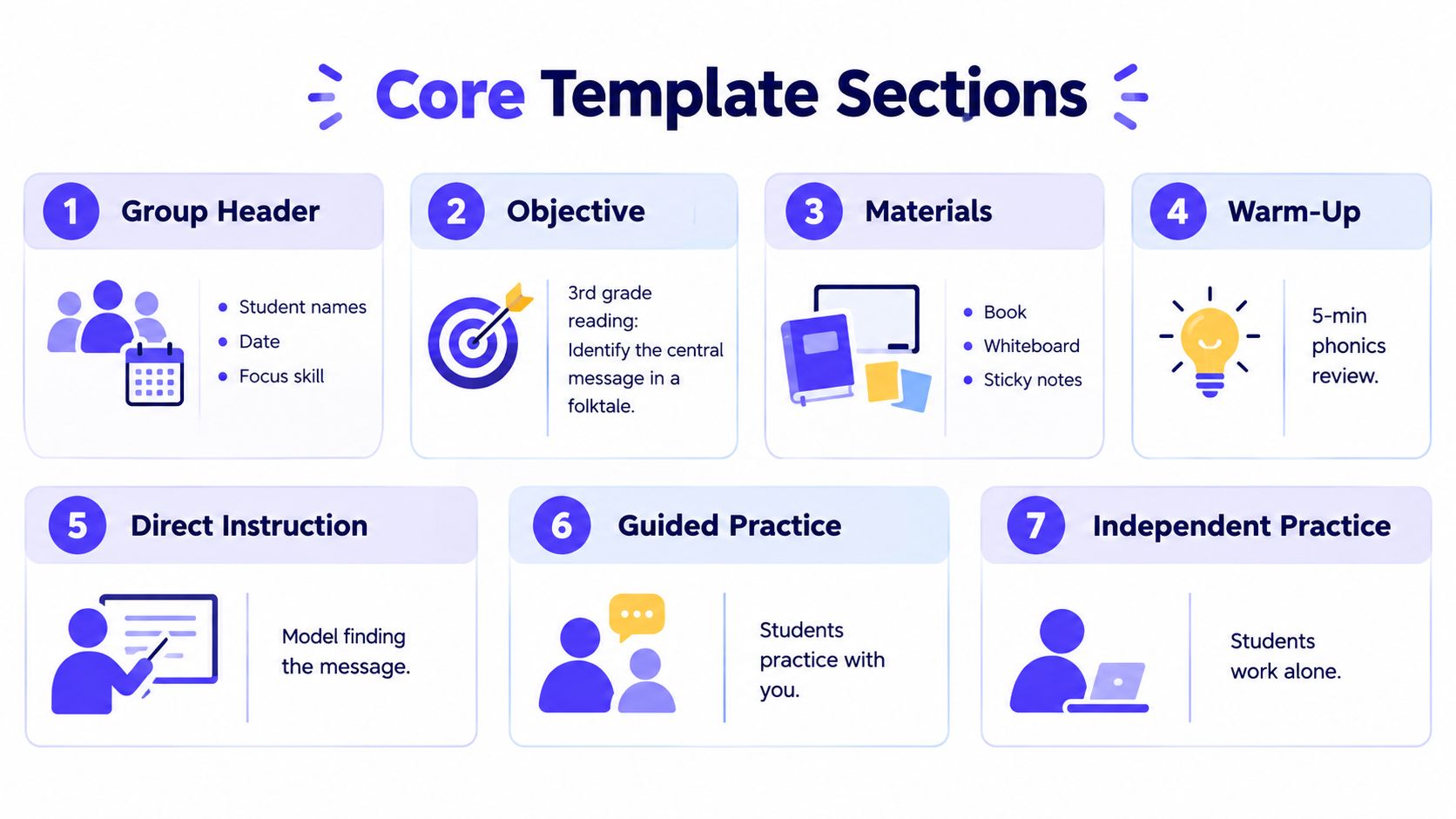
Fill the template in the order you'll use it at the table. A third-grade reading group working on the central message of a short folktale makes the structure concrete.
Start with the group and the outcome
The group header should include student names, the date, and the target skill. “Reading group” isn't enough. Write something you can recognize later, such as “Mia, Jordan, Luis, central message, Tuesday.”
The objective belongs directly underneath: Students will state the central message of a folktale in their own words. It uses an observable verb and tells you what successful work sounds like. Avoid “students will understand the story,” because you won't know what evidence to collect.
Materials should be specific. List the folktale, sentence strips, whiteboard, markers, and any pre-cut cards. Small groups lose momentum quickly when you discover that the sorting cards are still in the copier room.
Build a short instructional sequence
Use a sequence that matches the available time:
- Opening, 2 minutes: Connect to prior learning by asking students what a lesson or moral teaches us.
- Modeling and guided practice, 10 minutes: Think aloud while identifying what the character learns, then let partners practice with prompts.
- Independent practice, 5 minutes: Each student writes the central message in their own words and cites a related event.
- Check for understanding, 3 minutes: Use an exit prompt or call on students to explain their answer.
- Notes: Record who identified the message, who retold events without explaining the lesson, and what you'll change next time.
Each box has a job. The opening activates relevant knowledge, modeling makes the thinking visible, guided practice gives students support, and independent work shows what they can do without immediate prompting. For teachers creating supplemental activities or course materials, these prompt ideas for course creators can also help generate starting points for student-facing examples, though the final task still needs teacher review.
Aligning the Template to Standards and Formative Checks
A small-group plan is easier to evaluate when it names one standard instead of a long list. For the folktale group, place this code at the top:
RL.3.2, Recount stories and determine the central message, lesson, or moral.
Use the standard to test every activity. Students may sort character traits, but the task only serves the objective if they connect those traits to the lesson. Keep an activity when you can state that connection clearly. Cut it when it is merely interesting.
Write the objective with this stem: Students will [verb] [what] as shown by [evidence]. For example, “Students will explain the central message of a folktale as shown by an oral response and a written sentence” names a clear endpoint. Verbs such as identify, retell, sort, and explain describe observable performance. “Understand” and “learn” do not tell you what to watch for.
Put evidence inside the last few minutes
Plan the check for understanding before the group begins. Record the result in the notes box, so the next session starts with evidence rather than guesswork. For more ideas, review these formative check examples and choose one that matches the objective verb.
| Objective Verb | Example Objective | 3-Minute Formative Check |
|---|---|---|
| Identify | Students will identify the central message of a folktale as shown by a written response. | Students write the message on a whiteboard and hold it up. |
| Retell | Students will retell the key events in order as shown by an oral summary. | Students use three event cards to retell the story. |
| Explain | Students will explain how a character's actions support the lesson as shown by a partner response. | Students explain their reasoning while you listen for the connection. |
| Sort | Students will sort details that support the central message as shown by a completed card sort. | Students select the two details that best support the lesson. |
Let the next grouping decision come from what students show during core instruction and the small-group check. Louisiana's state literacy guidance describes grouping students around similar struggles and aligning small-group instruction with core instruction. The table lesson then stays connected to the week's learning instead of becoming an unrelated worksheet.
For targeted reading intervention, choose the skill before adding more minutes. A meta-analysis of 26 studies reported a weighted effect size of g=0.54, with stronger effects for instruction targeting a specific skill, g=0.65, than for broader multiskill programs, g=0.35. It found only weak relationships between outcomes and group size, r=0.21, or duration, r=0.11. That supports a precise target and aligned practice. The PubMed review of small-group reading interventions provides the evidence behind that planning choice.
Differentiation Tricks Using One Template
You shouldn't write three unrelated plans just because three groups need different levels of support. Start with one completed base plan, duplicate it, and change only the pieces that affect access and rigor: objective complexity, text level, guided prompts, and exit check.
Take a fourth-grade fractions lesson. The shared target and standards code remain visible on all versions, and the vocabulary stays consistent. What changes is the route students take toward the target.
| Template Section | Intervention Group | On-Level Group | Enrichment Group |
|---|---|---|---|
| Objective | Represent and compare fractions with visual support. | Compare fractions and justify the comparison. | Solve a multistep fraction problem and explain the reasoning. |
| Materials | Fraction tiles, number line, sentence stem. | Standard problem set, pencils, partner prompt card. | Multistep word problem, workspace, explanation frame. |
| Guided prompts | “The numerator tells me ___.” “What does the denominator show?” | “How do you know which fraction is greater?” | “What information matters first, and why?” |
| Independent practice | Build and record fraction comparisons with tiles. | Complete focused comparison problems and partner-share one answer. | Solve the multistep problem and write a justification. |
| Exit check | Point to the larger fraction and complete the sentence stem. | Compare a new pair and explain the strategy. | Defend the solution using words, numbers, or a model. |
Use the adjustment row intelligently
The adjustment row is where this approach saves planning time. Fill it in only when you prepare the second group. For intervention, note the sentence stem and concrete model. For enrichment, note the extension question and the expectation for written reasoning.
This preserves the shared learning target while acknowledging that students may need different pathways. Kuraplan's differentiation teaching strategies guide is useful when you need ideas for varying prompts, supports, or task complexity without losing the central objective.
Georgia DECAL guidance describes three workable approaches: the same lesson taught the same way, the same lesson taught different ways, or different lessons for different groups. The Georgia planning guidance also emphasizes that teachers may need different small-group templates as student abilities and needs change. A single flexible template gives you room to make those changes without letting documentation drift apart by Friday.
Turning the Lesson into a Printable Worksheet Fast
The manual method still works. Copy the independent practice and exit check from the completed plan into Word or Google Docs, add a clear title, leave a 1-inch margin, and keep the page uncluttered. Put only 2 to 3 problems per page when students need space to draw models, annotate text, or explain their reasoning.
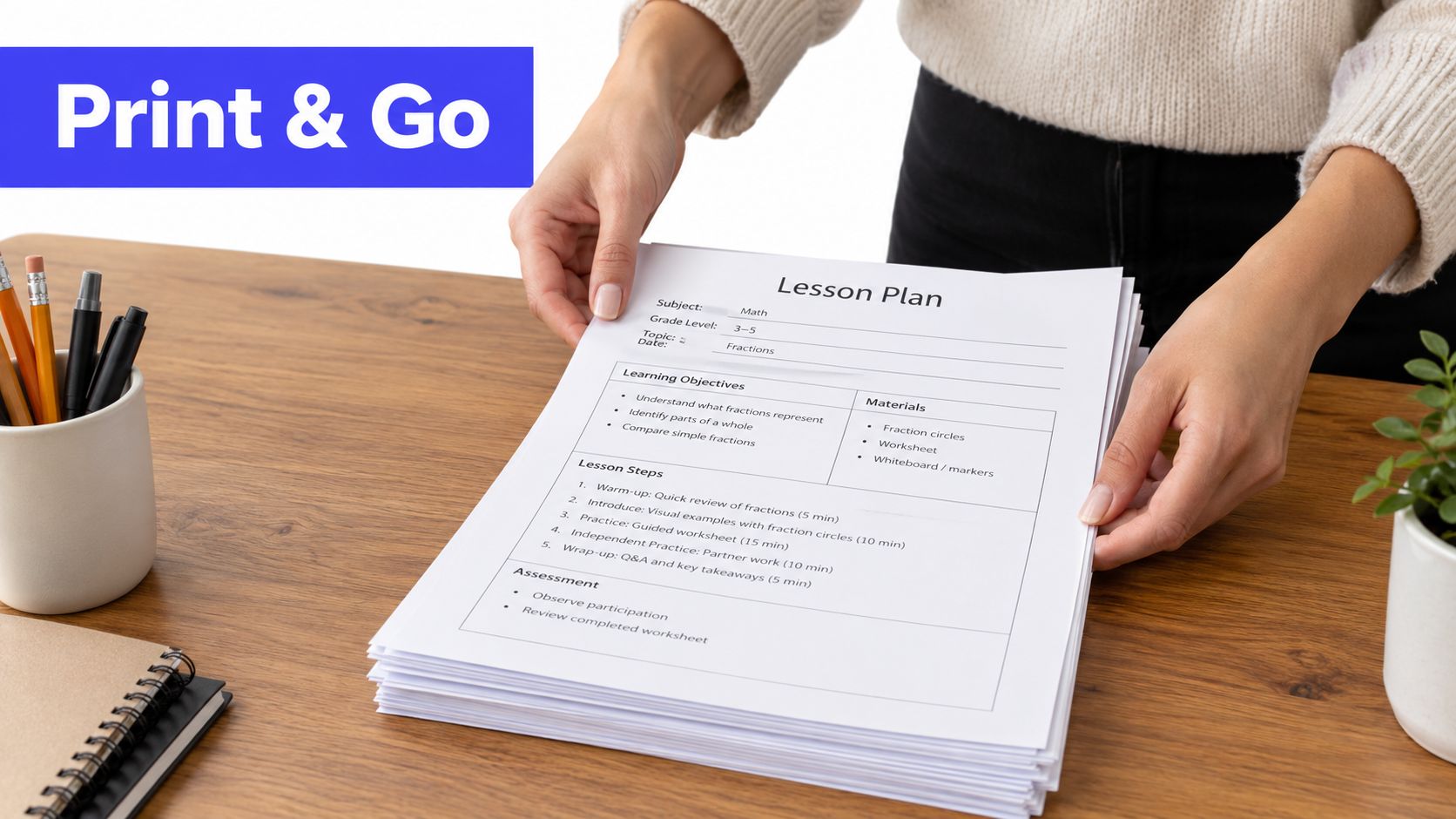
Use the same language from the template. If the objective says students will compare fractions using a visual model, the worksheet should ask for a comparison and include room for that model. Rewriting the target in different language can create a mismatch between what you taught and what the page asks students to do.
For teachers who want a faster production route, Kuraplan can turn lesson details into a printable worksheet matched to the small-group objective, using the target and vocabulary already entered in the plan. Its worksheet generation feature is one option alongside manual document creation, especially when the main barrier is formatting rather than instructional decision-making.
Teachers who need visual support for handouts can also browse printable resources for teachers from Bulk Image Generation. Any generated visual still needs to serve the lesson, not decorate the page.
A worksheet should support the table conversation, not replace it. Print one extra copy for the student who arrives late, then save the digital version in the template folder so you can reuse it for reteaching next quarter.
Mistakes That Break Small Group Planning
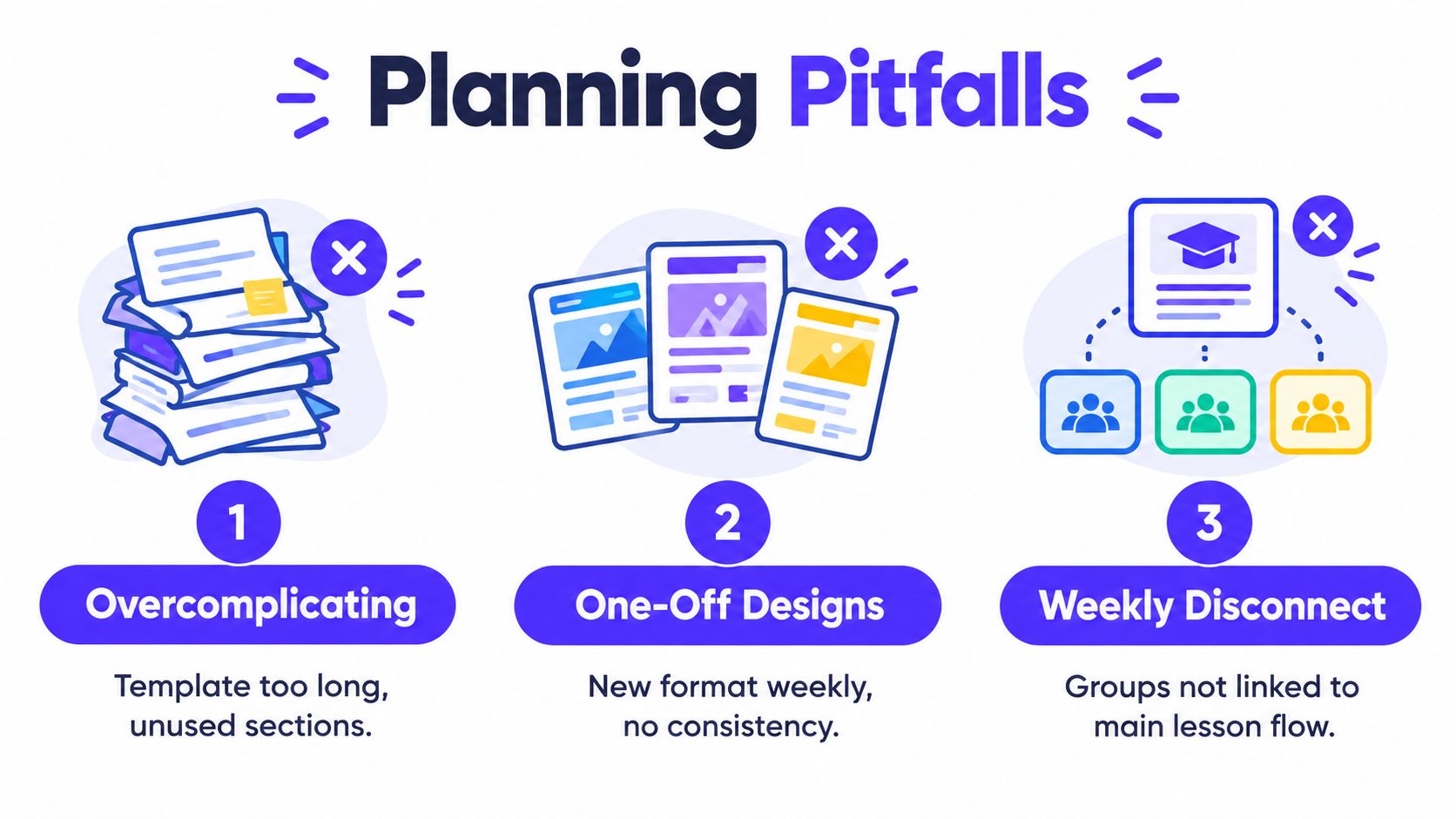
Small-group planning collapses when the template becomes too long, too unique, or disconnected from the rest of the week. A plan may contain every possible field, but if you can't complete it during a free period, it won't guide instruction when the group meets.
The first mistake is writing a brand-new objective for every group. Unpack one shared standard, then adjust the complexity, support, or evidence. The second is copying a full 45-minute lesson structure into a 20-minute group slot. A short group needs a tight launch, direct teaching, supported practice, independent evidence, and a closing check.
What usually goes wrong
- Overplanning the task: Five independent problems can crowd out feedback. Two focused problems may tell you more when students must explain their thinking.
- Skipping the formative check: The final box isn't redundant. It tells you whether to reteach, regroup, or move forward.
- Separating the group from core instruction: Students need targeted support connected to the grade-level learning, not a worksheet that leads somewhere else.
- Changing the format constantly: A new template every week forces you to relearn your own planning system.
- Decorating instead of deciding: Colorful borders, emoji rubrics, and unused rating scales consume space without clarifying the objective or next move.
A template earns its place when a teacher opens it next Tuesday morning and knows exactly what to do.
The practical test is reuse. If the document requires an hour of writing for a short group, it dies in a Google Drive folder. Keep the wording plain, preserve the same sequence, and leave enough room for notes about actual students. MIT's guidance on giving feedback recommends feedback that is targeted, timely, progress-oriented, based on observed behavior, and limited in amount. Your template should make that kind of feedback easier to record.
Putting the Template to Work This Week
Start with one group, not the entire roster. On Monday, use the template for a 20-minute intervention lesson. Spend the opening reviewing the prerequisite skill, model the target with one clear example, guide students through a second example, and reserve the final minutes for independent evidence and a check for understanding.
On Tuesday, use the notes box to decide what stays and what changes. If students confused the numerator and denominator, keep the same learning target and add fraction tiles. If they solved the comparison correctly but couldn't explain it, keep the model and change the exit prompt to require a sentence.
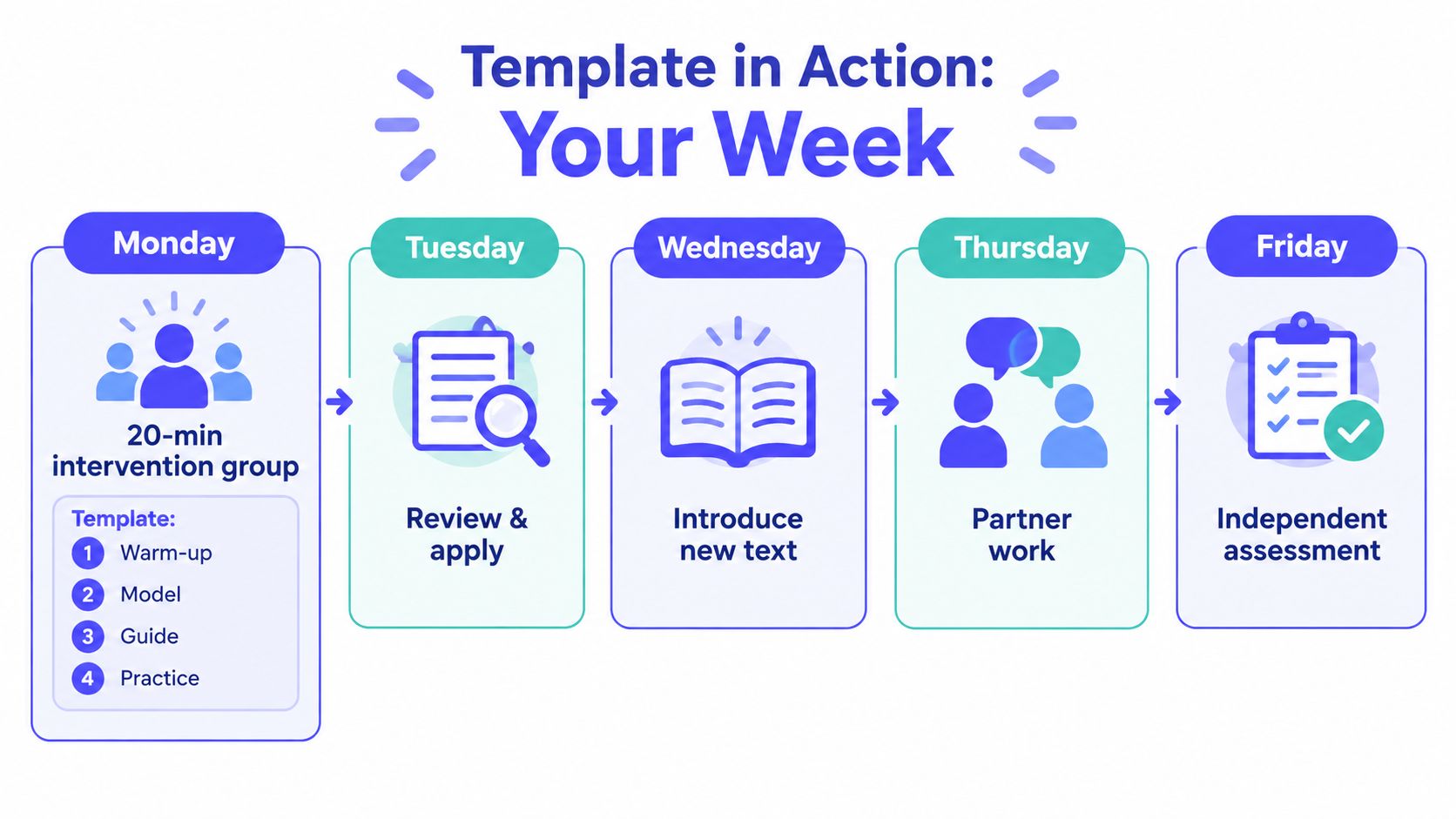
By Wednesday, duplicate the plan for the on-level group. Keep the standard, vocabulary, and core teaching sequence, then swap the text or problem set and adjust the guided prompts. Thursday can use partner work to apply the same target, while Friday's enrichment group tackles a more complex task and completes an independent assessment.
A workable weekly rhythm
- Monday: Intervention group, warm-up, model, guided practice, and a brief independent check.
- Tuesday: Review and apply the skill using the adjustment from Monday's notes.
- Wednesday: On-level group with a new text or task.
- Thursday: Partner practice with teacher observation.
- Friday: Enrichment application and independent assessment.
Print the worksheet as soon as it's ready and place it in the materials box of the template. Keep the plan open during instruction, then write one honest note afterward. Teachers looking for additional classroom technology and planning options can browse this education tools list from Wideo, but no tool will replace the quick judgment you make while listening to students explain their thinking.
A working template doesn't need to look impressive. It needs to help you teach the next group, capture what students showed you, and make tomorrow's decision easier than today's.
Kuraplan helps K–12 teachers build standards-aligned lesson plans, differentiate group tasks, and turn the same learning target into printable worksheets and educational visuals. Visit Kuraplan to create a small-group plan you can adapt across intervention, on-level, and enrichment groups this week.