You've got five strong lessons planned for next week. The activities work, the timing's realistic, and the worksheets are ready. Then you look at the end-of-unit test and realize none of those lessons build toward it. That's not a lesson-planning failure. It's what happens when you write lessons before the unit decides what counts as success.
Unit Plan vs Lesson Plan at a Glance
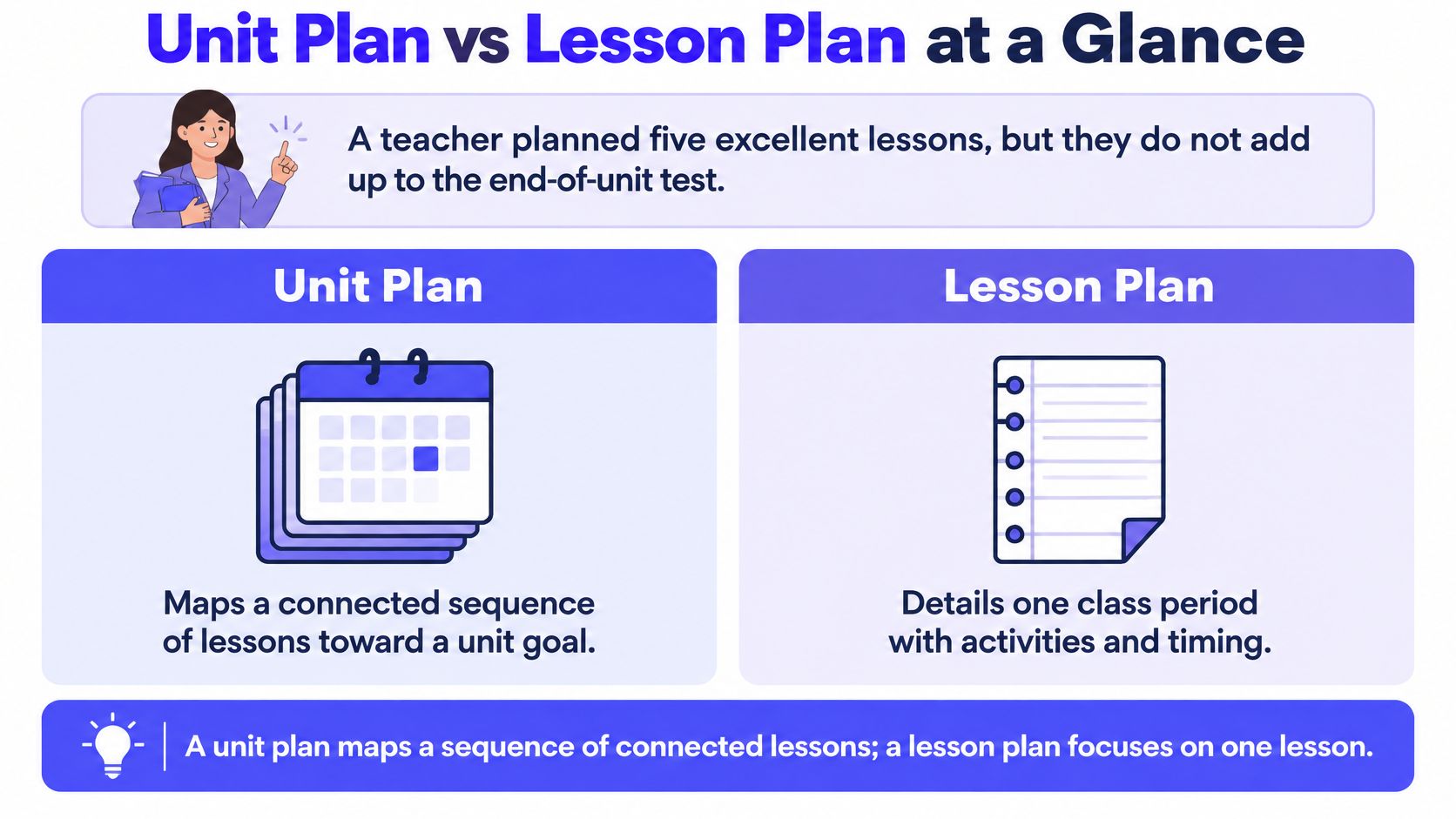
Say a teacher plans five excellent lessons on persuasive writing. Students debate, annotate, and draft every day. Then the final task asks for a counterclaim nobody practiced. Each lesson worked on its own. Together, they went nowhere.
That scene captures the unit plan vs lesson plan difference in one line. A unit plan maps a sequence of connected lessons over several weeks toward a set of outcomes and a final assessment, while a lesson plan specifies what happens in one class period. The EBSCO overview of Understanding by Design describes the framework introduced by Grant Wiggins and Jay McTighe in 1998, with three stages that start by identifying desired results before planning learning experiences.
| Criterion | Unit plan | Lesson plan |
|---|---|---|
| Core question | What should students understand and show by the end? | What happens in this class today, and what will I check? |
| Time span | Two to six weeks | One class period of 45 to 60 minutes |
| Owner of decisions | Teacher, grade team or department | Individual teacher |
| Revised when | Assessment evidence shows the sequence is off track | Daily formative checks show a gap in one objective |
| Main output | Sequence, pacing, assessments and materials across lessons | Objective, activities, timing and checks for one session |
These aren't rival formats. The unit sets direction and evidence. The lesson turns that direction into a class you can run, with explanations, tasks, timings, and checks for the students in front of you.
A lesson can be well made and still be wrong for the unit if it doesn't lead toward the assessment.
Read the table in that order. Check the unit first to see where the class is heading, what evidence will prove it, and where today sits in the sequence. Then check the lesson to see what happens today. If you reverse that order, you'll keep polishing activities that don't add up. I'd pin the unit destination above my desk and plan each day underneath it.
What Each Plan Is Built to Do
A unit plan isn't a longer lesson plan. It's a backward design framework that makes different decisions, in a different order.
The Three Stages at Unit Level
The Ohio State guidance on using backward design lays out Wiggins and McTighe's model in exactly three stages. First, identify the desired results, what students should know, understand, and be able to do by the end. Second, determine acceptable evidence by deciding how students will demonstrate that learning. Third, plan the learning experiences that prepare students for that evidence.
That order is the whole mechanic. You pick the assessment before you pick the activities. Most planning trouble starts when teachers do it the other way round and tack a test on after the lessons are written.
Say you're building a three week persuasive writing unit. At unit level you fix the final task first, for example a 500 word argument with a claim, two supported reasons, and a counterclaim. You write the rubric. You decide what a strong rebuttal looks like. Only then do you ask what Monday's lesson should do. Monday might only teach students to spot a claim in a model text. That's fine, because you know why it matters.
A platform like Kuraplan fits naturally here because it keeps standards, objectives, assessments, and sequential lessons inside one unit instead of scattering them across separate documents. The structure forces the right order even when you're drafting fast.
The Two Questions Each Plan Answers
The unit asks whether the sequence builds the intended understanding over time. Does lesson three depend on lesson two. Does the practice get harder in the right places. Does the final task measure what you claimed to teach.
The lesson asks a narrower question. Did students meet today's objective, and what happens tomorrow because of that evidence? If half the class can't write a claim today, tomorrow's counterclaim lesson won't work, and the lesson plan is where you catch that.
Teachers who want to sharpen this thinking can work through practice questions on teaching and education from MasteryMind alongside their planning, since testing your own reasoning about objectives and evidence exposes gaps before your students do.
The unit plan decides what counts as success, and the lesson plan decides how students get there.
That's why a unit plan holds fewer daily details but more consequential decisions. Sequence, pacing, and evidence live there. Scripts, timings, and grouping live in the lesson.
Components Each Plan Holds Side by Side
Both documents mention standards, objectives, and assessment. The difference is the grain. The same word means something bigger and slower at unit level, and something narrower and observable at lesson level.
| Element | Unit plan | Lesson plan |
|---|---|---|
| Standards | Full set the unit covers, mapped across the sequence | The one or two indicators this session addresses |
| Essential questions | Two to four big questions guiding the whole unit | One lesson question that links to a unit question |
| Learning objectives | Enduring outcomes for the unit | One measurable, observable objective for one period |
| Assessment | Culminating performance and checkpoints across weeks | Pre-check, formative check and exit evidence for the objective |
| Learning activities | Outline of tasks in sequence, without daily detail | Sequenced activities with teacher prompts and timings |
| Materials | Shared texts, resources and equipment for the whole unit | Specific handouts, slides and equipment for that day |
| Timing | Pacing across two to six weeks | Minutes allocated to each segment of one class period |
| Differentiation | Planned pathways for support and extension | Specific scaffolds for the group in front of you |
How the Grain Changes Row by Row
Standards at unit level are the full set mapped across the sequence, so you can see where each one gets taught, practiced, and assessed. In one lesson, that narrows to the one or two indicators today's session addresses. Copying a whole standard word for word into a lesson objective is the common slip here. You end up with a target nobody can observe in fifty minutes.
Objectives follow the same pattern. A unit outcome can be enduring, like constructing an evidence based argument. A lesson objective has to be one measurable behavior, like writing a claim with two reasons. If you can't watch a student do it before the bell, it's not a lesson objective yet.
Differentiation splits the same way. The unit plans pathways, the support route, the core route, and the extension route across weeks. The lesson names the specific scaffold for the group in front of you today, a sentence frame for these six students, a harder source text for those four. Our guide to formative assessment examples shows how those daily checks feed the pathway decisions.
The Backward Alignment Test
The Concordia course design chapter on planning a lesson describes the unit plan as the higher level architecture defining standards, sequence, and culminating assessment, with the lesson plan as the executable component inside it. Run this three part test on both documents.
- Assessment to standard: Does the unit assessment measure the stated standard, not just the topic?
- Lesson to assessment: Does each lesson produce evidence students will need for that final performance?
- Activity to objective: Does each activity directly support its lesson objective, or is it just engaging?
If any link fails, fix the higher document first. Rewriting an activity won't repair a broken assessment.
How to Turn One Unit Into Sequential Lessons
This is the procedure I'd use on a Sunday afternoon with a blank unit. Each step earns its place, and each one has a slip that costs teachers time later.
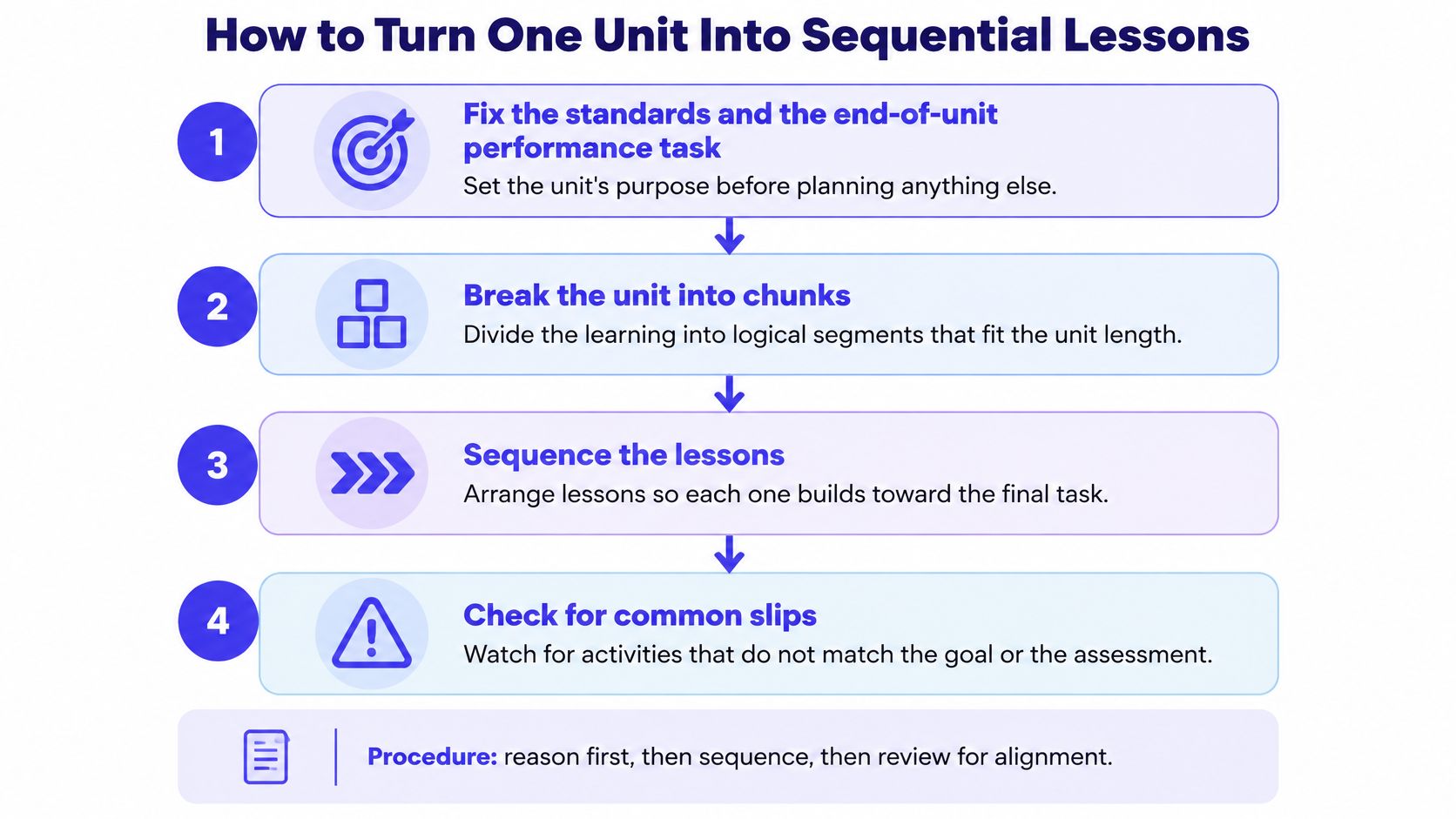
Fix the standards and the end of unit performance task first. Size the task to the unit's length, so a three week unit gets a performance students can realistically reach in three weeks. The usual slip is starting with favorite activities and hoping a destination appears. It won't.
Write two to four essential questions the lessons answer together. The Drexel guidance on how to write a lesson plan asks each lesson plan to state the standards addressed, explain how the lesson fits under the unit's essential questions, and describe formative assessments used to track progress. That link has to be explicit in writing, not assumed.
List the lessons in prerequisite order and label each one's job. Use four labels, introduce, practise, apply, or check. Order by skill dependency, not by topic headings from the textbook. Students can't rebut a counterclaim before they can state one, whatever chapter order suggests.
Write one measurable objective per lesson. Each objective narrows a unit outcome and names what students will do, in language you could tick off while circulating. One objective per lesson keeps the evidence clean. Three objectives usually means none of them gets checked properly.
Plan the evidence for each lesson before the activities. You need a pre-check, a formative check during the lesson, and an exit item tied to that day's objective. Decide the mastery bar now, while you're calm, not at 3pm with a pile of ambiguous exit tickets.
Draft each lesson in order. Kuraplan saves real time here, since it can generate a lesson draft and a matching worksheet from your unit outline. Check every draft against its objective before you print anything. A polished worksheet aimed at the wrong objective is still the wrong worksheet.
Review the evidence after lesson two or three and adjust the remaining lessons. Don't touch the end assessment. Change the route, add a practice lesson, regroup students, or reteach the shaky prerequisite. The destination stays stable so your adjustments have something to aim at.
A Worked Sequence
Here's how those steps land for the persuasive writing unit, moving from the final 500 word argument back to today's objective.
| Lesson | Job | Objective and evidence |
|---|---|---|
| 1 | Introduce | Identify claim, reasons and counterclaim in a model argument. Pre-check, label three claims in a sample text |
| 2 | Introduce | Write a claim with two supporting reasons. Formative check, one sentence claim scored against a rubric |
| 3 | Practise | Anticipate and answer one counterclaim. Formative check, paragraph with rebuttal and exit item |
| 4 | Practise | Use evidence from two sources in a body paragraph. Formative check, citation count in drafts |
| 5 | Apply | Draft the full argument combining claim, evidence and rebuttal. Formative check, teacher conferral checklist |
| 6 | Check | Revise and submit the final 500 word argument. Summative, final argument scored against the unit rubric |
Watch for one signal above all others. Several students missing the same check means the sequence has a hole, not that those students weren't listening. That's a unit level problem, and it gets a unit level fix, a reteaching branch or an extra practice lesson inserted before you move on. One student missing a check is a scaffold problem. A third of the class missing it is your sequence talking to you.
What a Lesson Plan Adds for Classroom Delivery
A well sequenced unit still won't teach Tuesday's class for you. The unit knows the order of concepts. It doesn't know that period three needs the vocabulary pre-taught or that your printer queue dies at 8am.
What the Unit Leaves Out
The Virginia Tech instructional planning guidance lists lesson components including background information, standards connections, enabling objectives, materials, key terms, accommodations, bell work, an interest approach, content, application, summary, and assessments, and recommends a formative check at the conclusion of each enabling objective. Read that list and notice how much of it never appears in a unit plan.
The items teachers most often discover too late are predictable. Exact timing for each segment. The bell work that settles the class in the first three minutes. The key terms that will block comprehension if you don't pre-teach them. Accommodations for named students, not a vague note about differentiation. The handouts that had to be printed yesterday.
A 50 Minute Lesson, Timed
For example, a 50 minute lesson might run like this. Five minutes of bell work that retrieves yesterday's objective. Ten minutes of interest approach and direct teaching of the new idea. Twenty minutes of content with guided practice, where you're checking as you go. Ten minutes of independent application. Five minutes for an exit check tied to the objective.
Those numbers aren't decoration. Timing decides whether the exit check happens at all. When a lesson overruns, the exit check is what gets cut, and then you're planning tomorrow blind. That's why time gets budgeted in the lesson plan, not the unit plan. The unit budgets weeks. Only the lesson can protect those last five minutes.
Kuraplan helps at this layer too, turning a lesson into worksheets and differentiated materials so the formatting work doesn't eat the time you need for checking objectives. If you want the full anatomy, our guide on how to write a lesson plan walks through each component in teaching order.
Before every lesson, verify three things.
- Materials ready: Handouts printed, slides loaded, equipment in the room.
- Timing set: Minutes assigned to each segment, with the exit check protected.
- Check written: The exit item exists and matches the objective word for word.
Ninety seconds of checking. It saves the improvisation that ruins good units.
When to Start With a Unit and When to Start With a Lesson
The default answer is unit first. But defaults have exceptions, and knowing them stops you over planning simple jobs and under planning hard ones.
| Situation | Start with | Why |
|---|---|---|
| New course or new standard | Unit plan | Outcomes and evidence must be settled before daily tasks |
| First time teaching a unit | Unit plan, then detailed plans for the first two lessons | The unit sets direction; early lessons need the most detail |
| Lesson taught before, only timing changes | Lesson plan | The sequence already works and only the session needs adjusting |
| Covering for an absent colleague | Lesson plan | One clear session with objective, materials and exit check is enough |
| Co-planning with a grade or department team | Unit plan | Shared assessments keep classes aligned while lessons vary |
| Class behind mid-unit | Unit plan | Pacing and order of remaining lessons must change together |
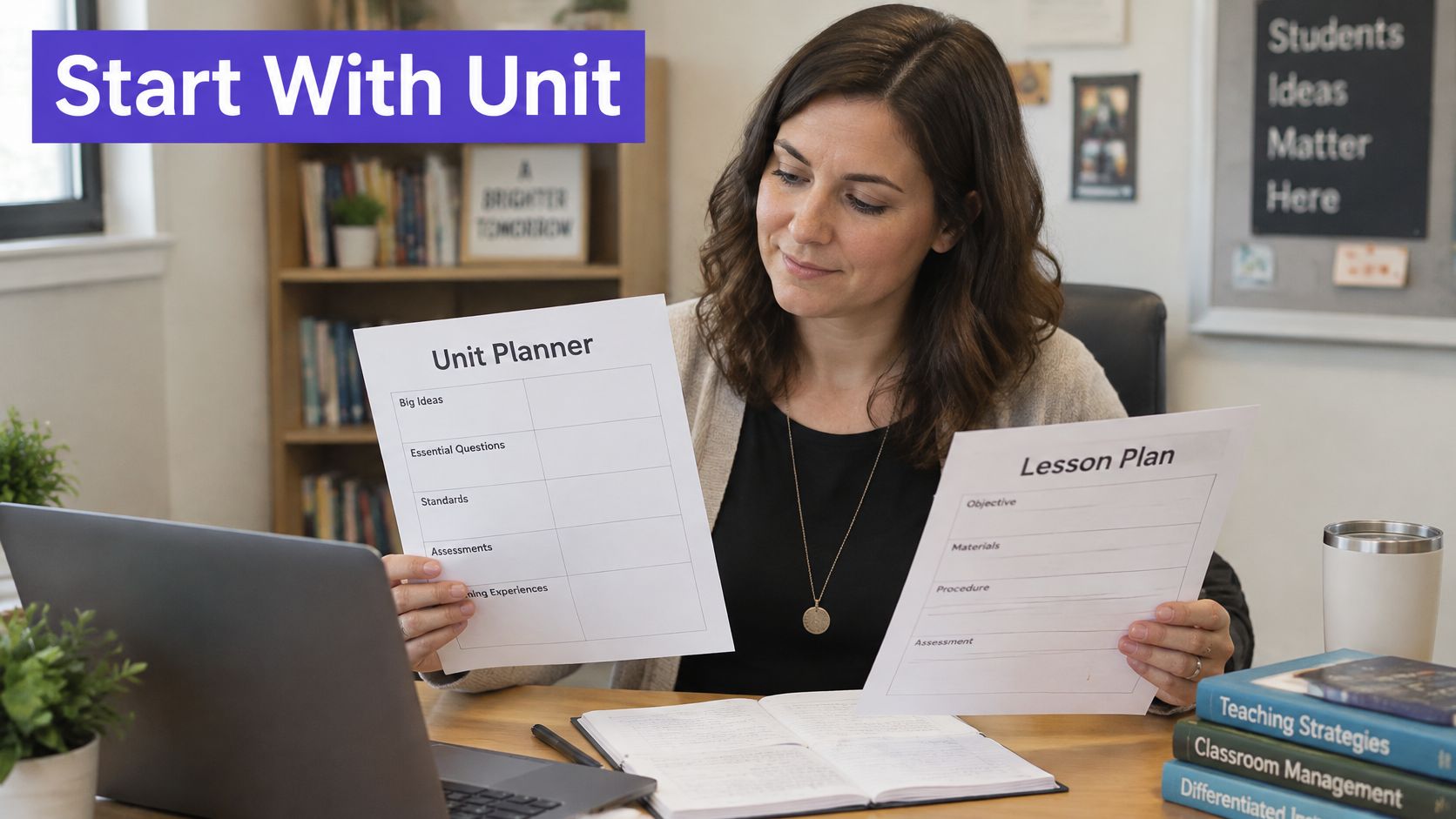
Read the table as a default plus a failure condition. The Start with column is your first move. The Why column tells you when that move stops working. If the reason no longer holds, switch documents.
Where the Default Breaks
Start with the unit when the course, standard, or assessment is new to you, because you can't sequence lessons toward evidence you haven't defined. Co-planning works the same way. A team that agrees the unit assessment and pacing can let individual teachers vary lesson order and activities freely, and classes still arrive at the same place. Teams that only share lesson plans usually drift apart within a fortnight.
Start with a lesson when you've taught it before and only the timing or objective shifts. Rebuilding the whole unit for a ten minute timetable change is wasted effort. A substitute teacher is the clearest case. They need one clear lesson with its objective, materials, and exit check, not your six week architecture. Tutors managing one off sessions face the same logic, which is why tools like lesson booking software from Tutorbase pair a single session plan with scheduling rather than full unit design.
Mid-unit trouble deserves emphasis. If the class is behind, edit the remaining lesson order and pacing in the unit plan. Rewriting tomorrow's lesson in isolation hides a sequence problem and you'll be behind again next week, just with a nicer worksheet.
One edge case catches people out. A unit built for another class can absolutely be reused, but check its prerequisites against what your students have learned first. The sequence assumes entry knowledge your class may not have, and no amount of lesson level polish fixes a missing foundation.
Confirm Alignment Before You Teach the Unit
AI tools can draft a unit outline, ten sequential lessons, and matching worksheets before your coffee cools. That speed is real. It just isn't the same thing as usable teaching time.
Why Unit Level Errors Cost More
A flawed activity damages one class period. You notice, you adjust, you move on. A wrong prerequisite sequence or an invalid end of unit assessment misdirects several weeks before the damage becomes visible, usually in final results you can't redo. That's the asymmetry that should govern how carefully you review each document.
The 2025 evaluation of AI generated lesson plans in Islamabad public schools found experienced teachers viewed scripted plans as insufficiently flexible for shortening lessons, adding expert content, or adapting to classroom context. Treat that as the correct instinct. A generated plan is a draft written by something that has never met your students. Your review is where it becomes teachable.
The Checks to Run on Any Draft
Whether the draft came from AI, a colleague, or a shared drive, run the same checks in the same order.
- Standards alignment: Does each objective specifically narrow the standard it claims, or just mention the topic?
- Developmental fit: Can your actual students do this in the time given, with their reading levels and prior knowledge?
- Factual accuracy: Are the examples, dates, and source texts correct and appropriate for the class?
- Assessment validity: Does the final task measure the stated standard, at the stated level of demand?
- Pacing reality: Does the sequence fit the lessons you really have, after assemblies, trips, and the inevitable lost Friday?
Writing precise learning intentions and success criteria makes the first and fourth checks much faster, because vague intentions hide misalignment that specific criteria expose immediately.
Measure the win correctly: judge any planning tool by usable teaching time reclaimed, not by how many plans it generates.
That's the honest trade off with automation. It cuts drafting time and creates review work. If the review takes longer than writing it yourself, the tool isn't helping, whatever the output count says. Kuraplan is built for this workflow, drafting the unit structure, lesson sequence, and matching worksheets from your standards so your effort goes into checking alignment rather than formatting. The review still belongs to you, and it should.
So here's the concrete next step. Take your next unit, run the backward alignment test on it, then check lesson one against its objective. Print only after both pass. Fifteen minutes of checking at unit level will save you the Sunday night rewrite at lesson level, every single time.
Stop writing lessons that don't add up to an assessment. With Kuraplan you can build the unit first, fix the standards, outcomes, and final task, then generate sequential lesson plans and matching worksheets that each target a distinct step toward that goal. Draft your next unit there, run your alignment checks, and spend the time you get back on your students instead of your formatting.