
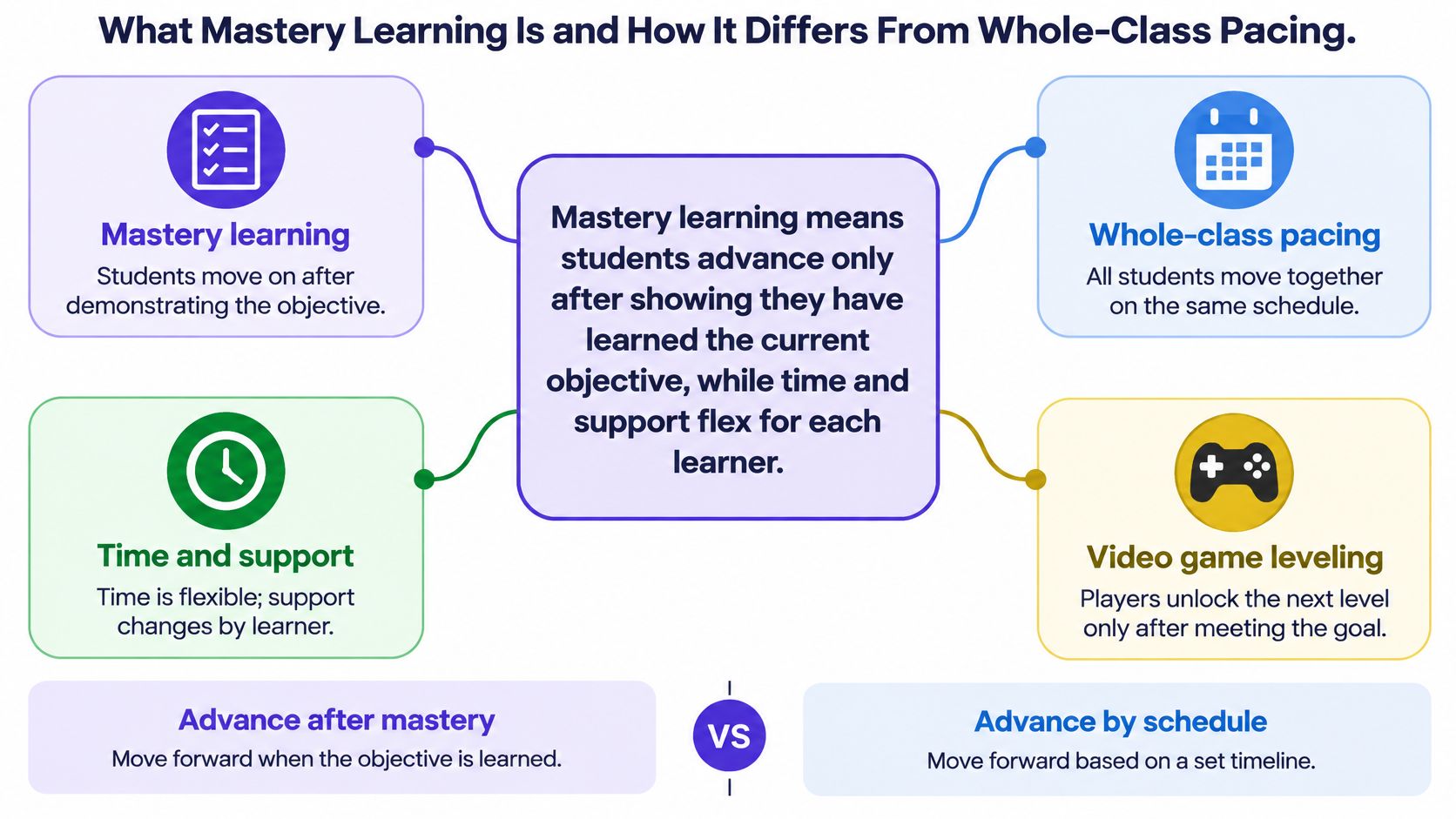
About five extra months of progress over a school year, and a shift from the 50th percentile to about the 70th on exams, is the scale of gain the largest reviews attach to mastery learning. Mastery learning means students move on only after showing they have learned the current objective, while the time and support they get is adjusted to fit each learner.
It's Thursday afternoon and the exit tickets are a mess in the useful way. Eight students nailed the skill. Twelve are close. Six still treat the minus sign as decoration. The scheme of work says the next topic starts Monday, and half the class isn't ready.
That calendar habit is the decision you're used to making. The date wins, the gap rides along, and next month's lesson pays for it.
What Mastery Learning Is and How It Differs From Whole-Class Pacing
Think of a video game. You don't reach level four by skimming level three and hoping the boss is kind. You meet the goal, then the next level opens. A classroom can run the same way. The objective is the level. The check is the boss fight. Support is the extra life, not a lower difficulty setting for the report.
Where the idea came from
The modern version sits with Benjamin S. Bloom's 1968 paper, Learning for Mastery. Bloom argued that ordinary classrooms often read student differences as differences in ultimate ability, when many of those gaps are differences in time and help. He wanted clear objectives, frequent formative assessments, corrective instruction, and extra chances to learn, so students could hit the same essential standards at different rates.
His headline claim was ambitious. He wrote that "perhaps over 90 percent" of students could master what teachers need to teach if instruction were adapted. That figure was a design principle, not a promise that every child would look identical or take the same path. The point was to improve teaching and allocate time before you decide a student can't learn it.
He named five variables that affect mastery: learner aptitude, instructional quality, ability to understand directions, perseverance, and time allowed for learning. You don't control aptitude. You do control how clear the teaching is, whether directions make sense, and how much time a student gets before you move the class on.
Fixed calendar or fixed target
| Criterion | Traditional pacing | Mastery learning |
|---|---|---|
| Pacing | Whole class moves on when the calendar says | Each student advances after reaching the threshold |
| Time | Fixed for everyone, so results vary | Outcome is fixed, time varies by student |
| Role of assessment | Mostly a final grade | Diagnosis and feedback during the unit, plus a retest |
| Students who miss content | Move on and the gap grows | Corrective work on the missed objective, then reassessment |
| Grading | One score on one test | A record of mastery per objective, updated after each retest |
Five working principles sit under that table.
- A defined objective. One observable skill, written before you teach.
- Frequent formative checks. Short, aimed at errors, not a surprise exam.
- Targeted corrective instruction. Only the missed piece, not a replay of the whole lesson.
- A parallel reassessment. Same goals, different questions.
- Flexible time or support. Same standard, different route to it.
Mastery doesn't mean the same mark or the same speed. It means the same essential standard.
Families sometimes meet a looser version of this in self-paced courses. The BDISchool self paced course guide is a useful contrast, because a fully individual timetable isn't what a Tuesday period 3 can offer. You still share a unit window. Inside it, the second chance is planned.
Before Monday, name three things for the next unit: the objective, the check, and the second chance. If you can't name them, you don't have a mastery unit yet. You have a hope.
How to Set a Mastery Threshold Students Can Reach
A mastery threshold is the score or performance level that says a student is ready to move on. There isn't one universal cutoff. A University of San Francisco dissertation notes that research commonly examines thresholds in the 80% range, high enough to show a student can proceed, and still attainable. One study in that literature treated mastery as 80% or more correct on a cumulative summative examination. In STEM meta-analyses, criteria between 80% and 89% produced the largest effect, g = 1.72.
Set the number before you teach, and tie it to the essential objective. A perfect score on trivia isn't mastery. An 80% built from the actual skill is.
A five-item check in Year 6 maths
Say the objective is finding the area of composite shapes. You write five items. Four correct, with no uncorrected misconception, counts as mastered. Three correct, with one repeated error, is approaching. Two or fewer means small-group reteaching. Those lower bands are classroom practice, not research cutoffs. The 80% line is the part with a research trail. The actions below are how you stop a percentage from sitting in a mark book.
| Result on check | Teacher action |
|---|---|
| Mastered | Move on; offer extension or enrichment |
| Approaching | Targeted corrective activities, then a parallel retest |
| Not yet | Small-group reteach; check for missing prerequisites |
Don't drop the bar on Friday because the class struggled. Swap in a parallel retest with new numbers. The standard stays. The questions change. Chasing a perfect paper has the same stall you see when why perfectionism stalls guitar progress shows up in practice rooms. 100% feels pure and teaches almost nothing new once the skill is already there.
Write the threshold on the lesson plan before the first example hits the board. If you want the wording of that target to match what students see, pair it with learning intentions and success criteria. Kuraplan can hold the link between the objective, the items, and the rubric. You still decide what "ready" looks like.
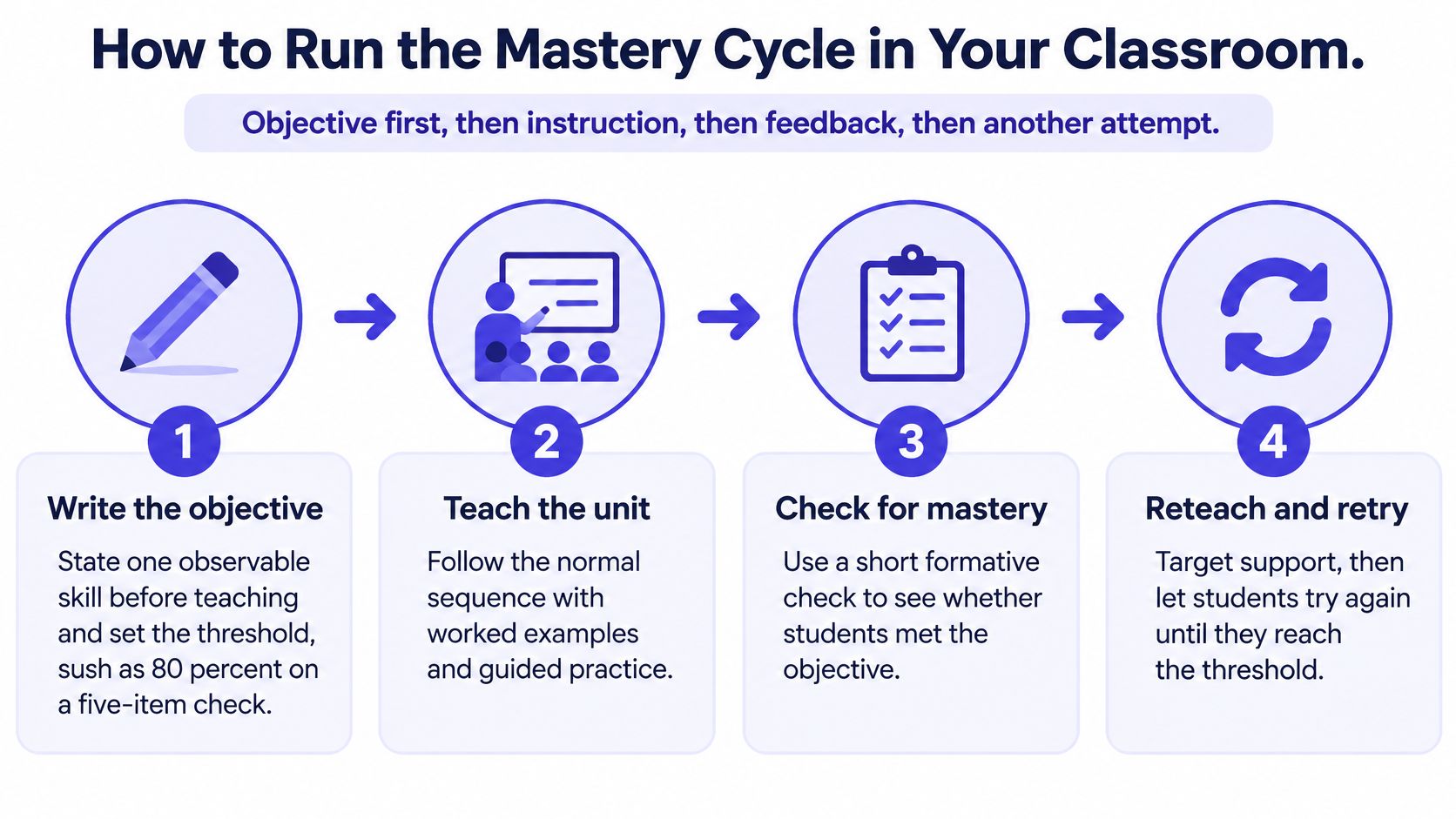
How to Run the Mastery Cycle in Your Classroom
The cycle is the teaching, not the theory. Error analysis and the parallel retest are the steps that change what students can do on Tuesday.
A short walkthrough of the same loop helps if you'd rather watch it once before you plan:
- Write the objective before you teach. One observable skill, threshold included, such as 80% on a five-item check. If you can't see the skill in a student's work, you can't judge it.
- Teach the unit in the normal sequence. Worked examples, then guided practice. Mastery isn't a substitute for a clear first lesson.
- Give a short formative check of four to six items. Build items that expose a specific misconception, not a vague right or wrong. A sign error and a reading error need different fixes.
- Sort errors by objective. Group students by the item they missed so a pattern shows up at once. In a pilot of 92 K–12 teachers, they rated formative-assessment error analyses as the most useful feedback for planning corrections, while mastery charts helped them see class progress, according to an ERIC report on that pilot.
- Assign a correction matched to each group. An alternate example, a visual model, or a short practice set for that one skill. This phase usually takes one or two class periods. Corrective guidance from the University of Kentucky puts the extra time at about 10% to 20% beyond the initial unit. Students who already passed use that window for extension.
- Give a parallel retest. Different numbers or wording, same goals. Students have to show the skill, not remember Monday's answers.
- Record the result against the objective. Pass means enrichment. Not yet means another round of the matched correction, not a new topic.
The percentage is a label. The error pattern is the lesson plan.
Kuraplan can turn the lesson into matched worksheets for those groups. You still choose which correction each learner needs. If you want starter formats for the check itself, look at formative assessment examples and keep yours to a handful of items.
A healthy end of unit looks ordinary. Most students have passed. The rest have a named gap and a next step. You know which objective to reteach harder next time, because the errors told you.
Mastery Learning Examples in Maths, Science and English
The same three pieces travel across subjects. An observable skill, a check that catches one mistake, and a correction that changes the representation instead of reprinting the worksheet.
| Subject | Objective | Quick check | Corrective route |
|---|---|---|---|
| Maths | Solve two-step linear equations | Four items, one testing a sign error | Balance-model worked example, then a parallel set |
| Science | Explain how friction changes motion | Predict-and-observe question | Ramp demonstration on a different surface, then short practice |
| English | Infer a character's motive from text evidence | Select the quote that best supports a motive | Sentence frames on a familiar text, then a new extract |
| History | Explain the causes of an event | Order three causes by importance | Timeline activity, then a causation paragraph |
Maths, in the room
The objective is solving two-step linear equations. Four items. One of them is built so a sign error fails it even if the arithmetic is fine. You sort the scripts in two minutes. The sign-error group gets a balance-model worked example, pans and weights, not another lecture on "inverse operations." Then they do a parallel set with new numbers. Students who were clean on all four move to a worded extension. Nobody sits through a full reteach of content they already own.
Science and English, same bones
In science, students must explain how friction changes motion. A predict-and-observe question shows whether they hold the idea or only the word. Corrective work is a ramp on a different surface, then two sentences of practice. The demonstration is new. The objective isn't.
In English, students infer a character's motive from text evidence. The check asks them to pick the quote that best supports a stated motive. Students who grab a vivid line that doesn't prove anything get sentence frames on a story they already know, then a fresh extract. The frame is a scaffold, not a lower standard.
History uses the same shape. Order three causes, then a timeline, then a causation paragraph. Each check diagnoses one misconception, so the correction stays narrow and fits inside the extra time you already set aside.
Design rule: objectives are skills you can see, checks target errors, and corrections change the representation rather than repeat the same task.
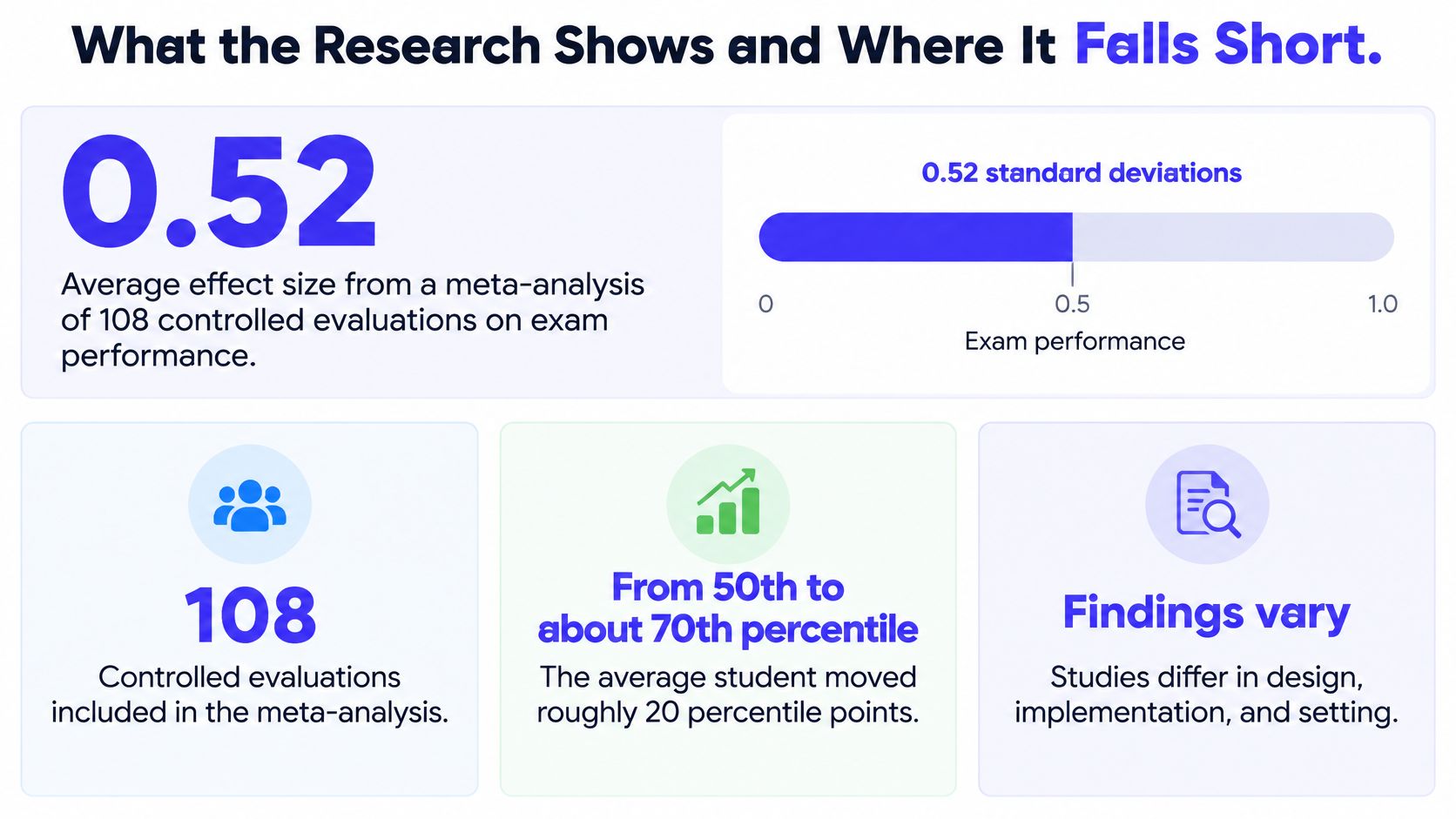
What the Research Shows and Where It Falls Short
The strongest widely cited number comes from a meta-analysis of 108 controlled evaluations of mastery programmes, covering Keller's Personalized System of Instruction and Bloom-style Learning for Mastery, across college, high school, and upper elementary. Across 103 studies of exam outcomes, the average effect was about 0.52 standard deviations. Read on a normal curve, the average student in a mastery class sat around the 70th percentile of the conventional class, against the 50th for the comparison average, as summarised in ASCD's review of that evidence. Bloom's early hope, an average student near the 84th percentile, was more ambitious than the evidence supports. Real gain, not a miracle.
The Education Endowment Foundation's mastery learning review pools 80 studies and estimates about five additional months of progress over a year. Effects are larger in primary (+8 months) than secondary (+3 months), and stronger in mathematics and science (+6 months) than reading (+3 months). The Foundation rates the security of that evidence as low. Use it to plan a trial, not to promise a result to your board.
| Source | Effect | Context |
|---|---|---|
| Meta-analysis of 108 controlled evaluations | About 0.52 SD on exam performance | Average student moves from the 50th to about the 70th percentile |
| Bloom's early prediction | Average student near the 84th percentile | More ambitious than the evidence supports |
| Education Endowment Foundation (80 studies) | About five additional months of progress | Evidence security rated low |
| EEF, primary education | +8 months | Larger than secondary |
| EEF, secondary education | +3 months | Smaller than primary |
| EEF, mathematics and science | +6 months | Stronger than reading |
| EEF, reading | +3 months | Weaker than maths and science |
Where schools stall
A review of 81 studies, discussed in Nature's mastery learning overview, found positive effects across maths, science, social studies, and English, in primary and secondary, with particularly strong benefits for lower-achieving students. Outcomes still vary by subject, assessment method, study design, and the exact procedures used. More time isn't the same thing as better support. A student who fails and gets the same worksheet again didn't get a new explanation, language support, or an accommodation. That hits multilingual learners, students with disabilities, and pupils dealing with attendance or technology barriers.
Wide prior-knowledge gaps also jam a fixed period. One student needs a ten-minute misconception check. Another needs several lessons. One whole-class sequence can't serve both, and mastery learning guidance from EdResearch is plain that these approaches add time on task and are hard to run well. Plan the corrective phase before the unit starts. Parents tracking progress will also need to see checks as information, not only as grades. Queens Online School's parent assessment guide is a clear way to explain that difference at home.
Track four things, not only the end-of-term average: objective-level mastery rates, reassessment gains, time to proficiency, and subgroup differences.
Frequently Asked Questions About Mastery Learning
Does mastery learning mean students work entirely at their own pace?
No, not for the whole class. The unit's objectives and the calendar window stay shared. What varies is how long a student takes to reach each objective inside that window. You're not running thirty private courses.
What if a student never reaches the threshold?
After one or two retests, stop the loop. Reteach in a small group, check for a missing prerequisite, and record the named gap. Don't lower the threshold to push the student over the line. A fake pass becomes next unit's failure.
How do I grade a mastery unit?
Record mastery against each objective, not one score for one test. Let the latest parallel retest replace the earlier result on that objective. The gradebook should show what the student can do now.
Does this add a lot of workload?
It adds work if you invent corrections on Thursday night. Plan the corrective phase with the unit, and reuse the same check design every time: a few items, one error each, a parallel form ready. The second chance should already be in the folder.
Does it work for multilingual learners and students with disabilities?
The evidence here is conditional, and reviews still call for more work centred on marginalised students. Give language support, scaffolds, and accommodations inside the corrective phase. A repeated worksheet isn't an equitable pathway, and it isn't a higher standard either.
Plan Your First Mastery Unit This Term
Pick one unit with a short list of essential objectives. Not the year. Not every subject. One unit you already know well enough to predict the mistakes.
Write those objectives as skills you can see, and put the threshold on the plan. Build a four-to-six item check and its parallel retest before you teach the first lesson. Sketch the corrective route for the two or three misconceptions you already expect, so the second chance is sitting there when the scripts come in.
Kuraplan is built for that prep. Unit plans bring interconnected lessons, assessments, and learning progressions together. Lesson plans include differentiated instruction and assessment rubrics, and any lesson can become a slideshow or a worksheet for the corrective groups. Olivia, a teacher using it, put the planning payoff this way: "I love that I can finally consolidate my ideas into a usable plan that is instantly connected to the curriuculum and outlines all the success criteria I am looking for." If you want the correction routes themselves to differ by learner, start from differentiation teaching strategies.
After the unit, look at three numbers only. How many students passed on the first check. Which objective caused the most retests. How long the corrective phase took next to the time you planned. Adjust the threshold or the route before the next unit, not after the report card.
Kuraplan helps you build the mastery unit before the teaching week starts, with standards-aligned objectives, checks, and corrective materials in one place. If you're ready to plan that first unit around a real threshold and a second chance, visit Kuraplan.