Animal cell (unlabeled) — free printable diagram
Free science resource for teachers · CC BY-NC 4.0
About this illustration
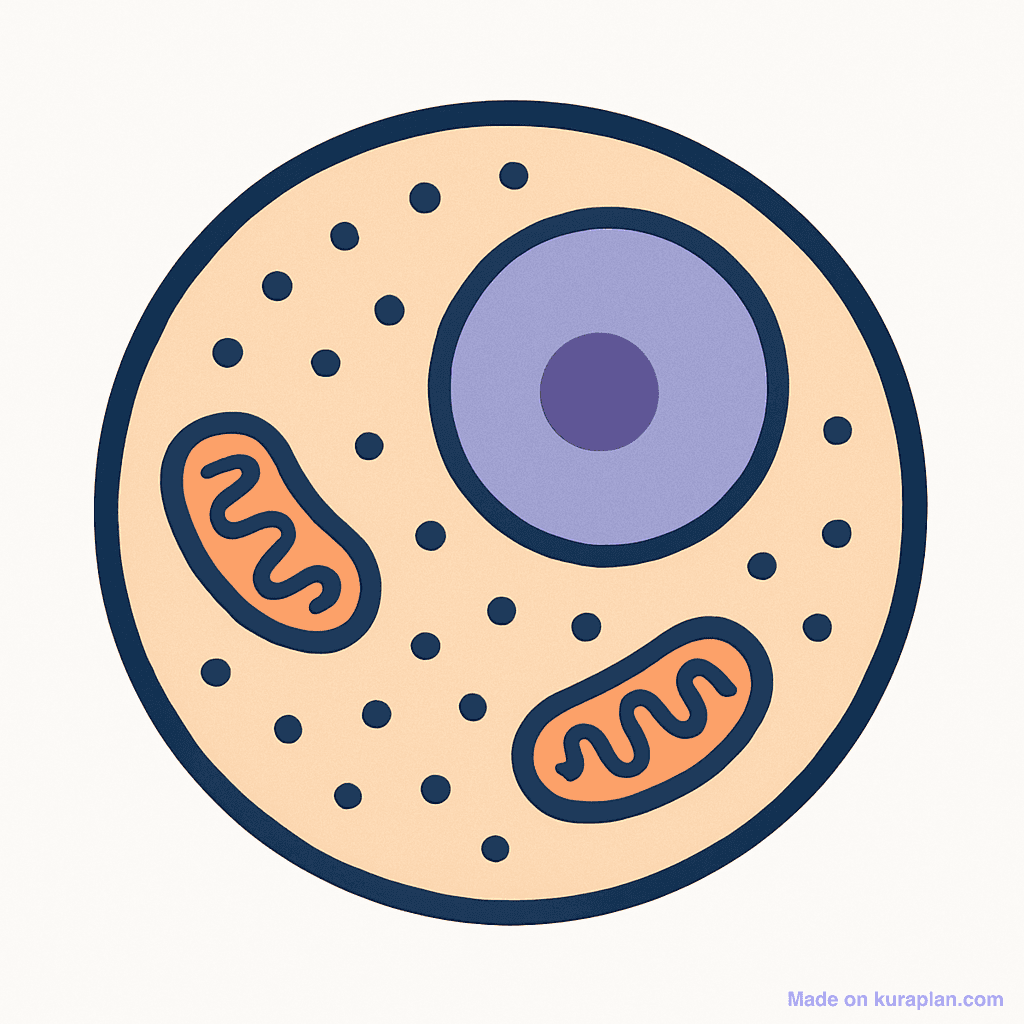
A simplified cross-section diagram of an animal cell showing nucleus, mitochondria, cytoplasm, cell membrane, ribosomes. Unlabelled.
What to label on an animal cell diagram
A blank animal cell diagram is normally used as a labelling exercise, so the parts below are the ones a student is usually expected to identify. An animal cell is defined as much by what it lacks as by what it has: no cell wall, no chloroplasts and no large permanent vacuole, which is why it is drawn with a soft, rounded outline rather than the boxy shape of a plant cell.
- Cell membrane
- Flexible outer boundary — controls what enters and leaves
- Cytoplasm
- Jelly-like fluid where most chemical reactions happen
- Nucleus
- Holds the DNA and controls the cell's activities
- Mitochondria
- Release energy through respiration
- Ribosomes
- Where proteins are made
- The outermost layer of an animal cell is the cell membrane, not a cell wall. Students who have just labelled a plant cell often carry the wall across by mistake, so it is worth marking for specifically.
- Because there is no rigid wall, an animal cell has no fixed shape and is usually drawn rounded or irregular. The shape itself is a labelling clue.
- Mitochondria are often drawn as small ovals with an inner folded line. Cells that use a lot of energy, such as muscle cells, contain far more of them than cells that do not.
- Ribosomes are the smallest structures on the diagram and are usually shown as dots. Students frequently miss them, so they make a good final check.
- An animal cell can have a vacuole, but it is small and temporary rather than the single large permanent one drawn in a plant cell.
- Labelling an animal cell and a plant cell side by side is the standard way to teach this: the shared parts are the membrane, cytoplasm, nucleus, mitochondria and ribosomes, and everything else belongs to the plant cell alone.
How to use
- 1Right-click the image and choose “Save image as”, or use the download button.
- 2Use it in your classroom worksheets, slides or printables — free under CC BY-NC 4.0.
- 3Attribute as “Image by Kuraplan” or link back to kuraplan.com. Not for commercial resale.
Turn this image into a worksheet
This illustration is already in Kuraplan's editor — describe the worksheet you need and the AI builds it around the image in seconds.
Related illustrations
More free science illustrations
Free worksheets on Animal cell (unlabeled)
All free worksheetsBrowse by subject
18 subjects · 4,850 free illustrations
Maths
1,894 free illustrations
Cross-Curricular
835 free illustrations
English
612 free illustrations
Geography
549 free illustrations
Health
200 free illustrations
Social Studies
177 free illustrations
Religious Education
139 free illustrations
Music
128 free illustrations
Art
66 free illustrations
Drama
56 free illustrations
Social Sciences
48 free illustrations
History
47 free illustrations
Arts
26 free illustrations
PE
25 free illustrations
Te Reo Māori
24 free illustrations
Technology
16 free illustrations
Culture
7 free illustrations
Languages
1 free illustrations