The Rock Cycle (simple) — free printable diagram
Free science resource for teachers · CC BY-NC 4.0
About this illustration
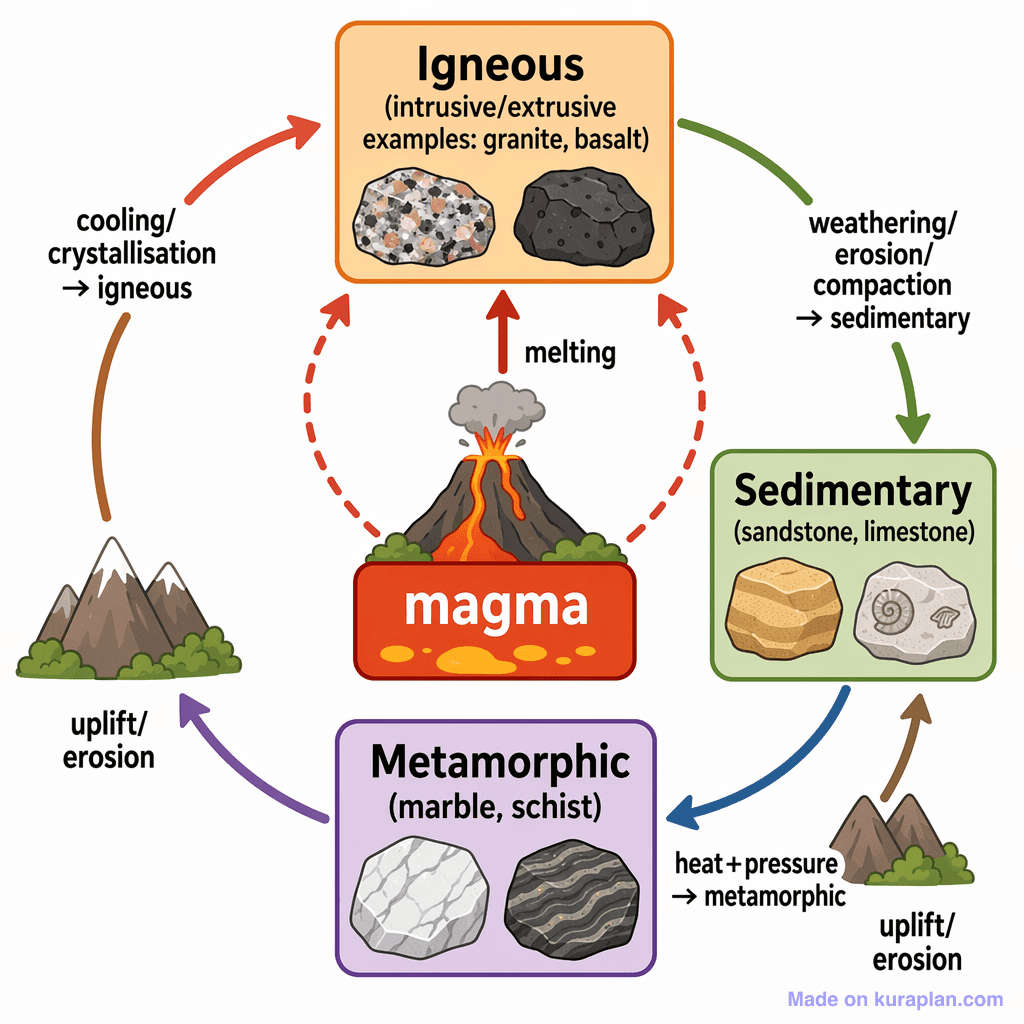
A circular rock cycle diagram showing the three main rock types — Igneous, Sedimentary, and Metamorphic — arranged around a central magma/volcano illustration. Arrows indicate the processes connecting each rock type, with process labels on each arrow. Rock examples are illustrated with small photographs inside each labelled box.
What the rock cycle diagram shows
The rock cycle is the set of processes that turn rock from one of the three types — igneous, sedimentary and metamorphic — into another, over and over. The diagram is drawn as a circle because the cycle has no start and no end: any rock type can become any other, given the right conditions and enough time.
- Rock types
- Igneous, sedimentary, metamorphic
- Molten rock
- Magma (underground), lava (at the surface)
- Makes igneous rock
- Cooling and crystallisation
- Makes sedimentary rock
- Weathering, erosion, compaction, cementation
- Makes metamorphic rock
- Heat and pressure
- Returns rock to magma
- Melting
- Igneous rock forms when magma or lava cools and crystallises — quickly at the surface, giving small crystals as in basalt, or slowly underground, giving large crystals as in granite.
- Weathering and erosion break exposed rock into sediment. The sediment is transported, deposited in layers, then compacted and cemented into sedimentary rock such as sandstone or limestone.
- Heat and pressure change an existing rock into metamorphic rock — limestone into marble, shale into slate — without it melting. That distinction is the one students most often lose: melting takes rock out of the solid part of the cycle altogether.
- If rock is buried deep enough and gets hot enough it melts back into magma, and the cycle begins again.
- There is no fixed order. A sedimentary rock can be uplifted and weathered straight back into sediment without ever becoming metamorphic, so tracing several different routes around the diagram makes a good classroom task.
- The processes run on geological timescales — typically thousands to many millions of years — which is why the cycle is modelled rather than observed.
How to use
- 1Right-click the image and choose “Save image as”, or use the download button.
- 2Use it in your classroom worksheets, slides or printables — free under CC BY-NC 4.0.
- 3Attribute as “Image by Kuraplan” or link back to kuraplan.com. Not for commercial resale.
Turn this image into a worksheet
This illustration is already in Kuraplan's editor — describe the worksheet you need and the AI builds it around the image in seconds.
Related illustrations
More free science illustrations



Free worksheets on The Rock Cycle (simple)
All free worksheetsBrowse by subject
18 subjects · 4,850 free illustrations
Maths
1,894 free illustrations
Cross-Curricular
835 free illustrations
English
612 free illustrations
Geography
549 free illustrations
Health
200 free illustrations
Social Studies
177 free illustrations
Religious Education
139 free illustrations
Music
128 free illustrations
Art
66 free illustrations
Drama
56 free illustrations
Social Sciences
48 free illustrations
History
47 free illustrations
Arts
26 free illustrations
PE
25 free illustrations
Te Reo Māori
24 free illustrations
Technology
16 free illustrations
Culture
7 free illustrations
Languages
1 free illustrations