Aquaponic System Optimization Guide
A free science worksheet ready for your classroom. Open in Kuraplan to grab the print-ready PDF, customize it for your students, or generate a fresh version in seconds.
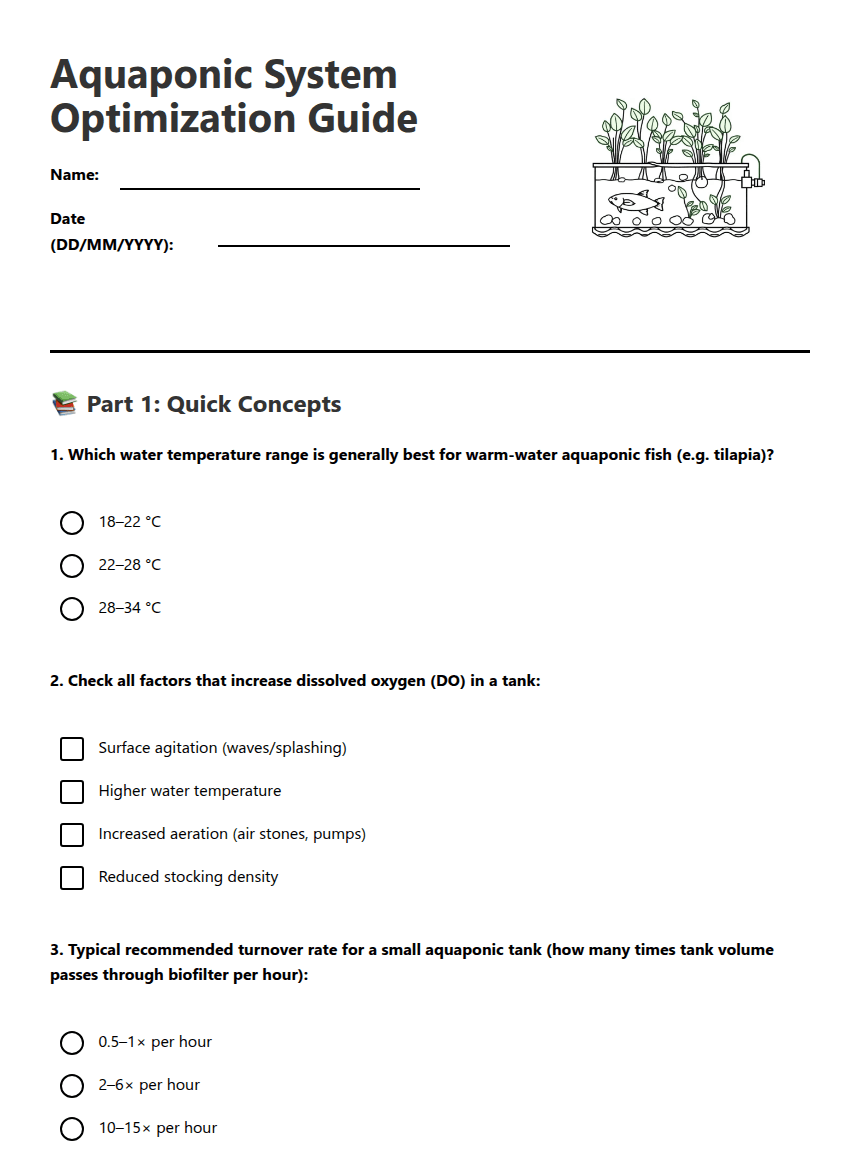
30L Aquaponic System
Part 1: Quick Concepts
Part 2: Formulas & Calculations (30 L system)
Formula: Biomass_max (kg) = Volume_L × C (kg/L). Recommended conservative C = 0.01–0.02 kg/L (10–20 kg/m³).
a) Using C = 0.01 kg/L, Work out the Biomass_max for a 30 L system:
b) If average fish mass = 6 g (0.006 kg), how many fish can you safely keep in a 30 L system? (Number = Biomass_max / avg_fish_mass_kg)
Formula: (Litres/min) = (turnovers_per_hour × Volume_L) / 60mins
Using a turnover of 3× per hour, work out the Litres/min for 30 L:
Formula: Surface agitation index SI = Q (L/min) ÷ surface_area_m². Aim for SI ≈ 10–50 L/min/m² depending on tank and fish load.
a) Measure or estimate your tank surface area (length × width in metres). Surface area = ______ m²
b) Using Q from Q6, calculate SI and state if it lies in the recommended range:
Formula: Growbed_area (m²) = Biomass_kg × G. Typical G for media beds ≈ 0.5–1.0 m² per kg fish (use 0.5 m²/kg for a conservative start).
Using Biomass_max from Q5, calculate growbed area (m²):
Formula (simplified): DO_new ≈ DO_standard(T) × (P_new_kPa ÷ 101.325)
If standard DO at your temperature is DO_standard and local pressure drops to 98 kPa, what fraction of DO_standard is available? (Compute 98 ÷ 101.325 and state percent.)
About This Worksheet
Free in Kuraplan
Sign up free, grab the PDF, and customize it for your class.
Print-Ready
Formatted for standard paper. Clean layout, easy to read.
AI-Generated
Created with Kuraplan's AI, designed for real classroom use.
For Teachers & Parents
Use in classrooms, for homework, tutoring, or homeschool.
Need a custom version of this worksheet?
Kuraplan's AI generates custom worksheets in seconds — differentiated for every learner, aligned to your curriculum.
Generate Custom Worksheets — FreeMore Science Worksheets

Ecosystem Observation Journal
Free
Energy Systems, Exercise Response, and Nutrition
Free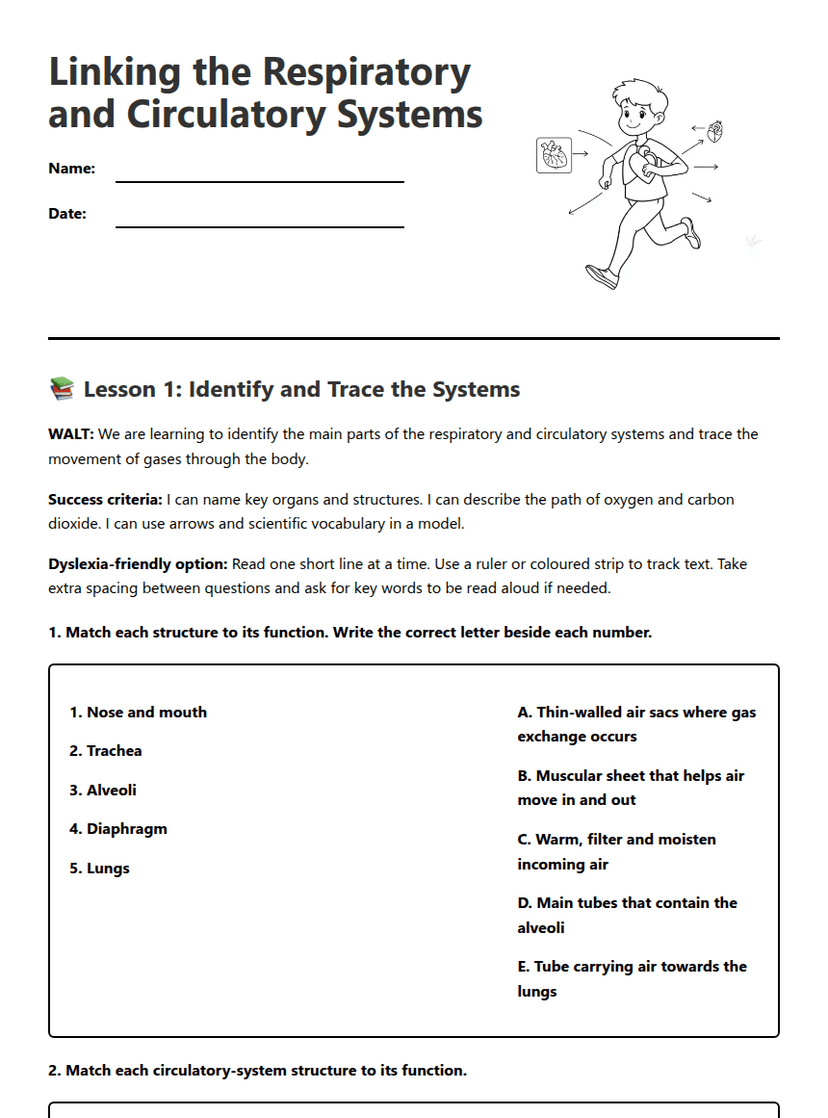
Respiratory and Circulatory Systems
Free
Space Systems Synthesis Worksheet
Free
Autonomic Nervous System Viewing Worksheet
Free
Autonomic Nervous System Worksheet
Free
Nervous System Responses
Free