ScienceFreePrintable
Digestive System Pathway
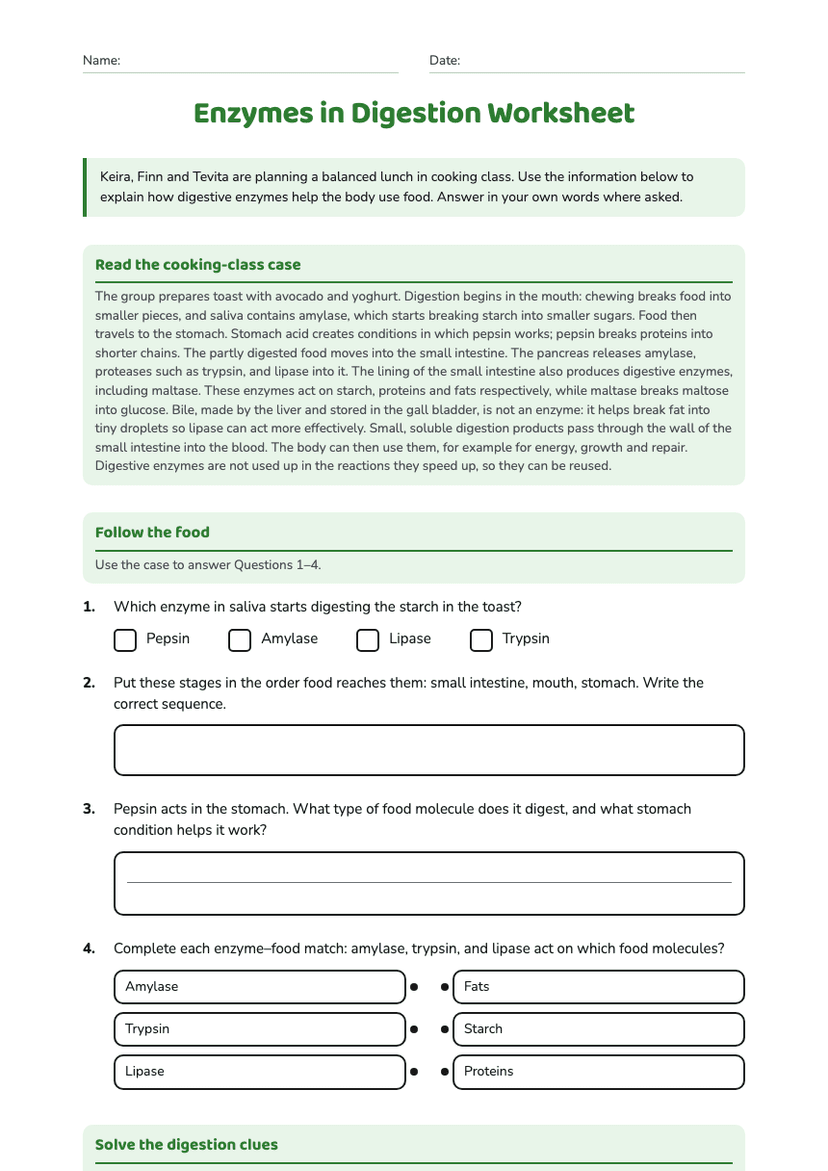
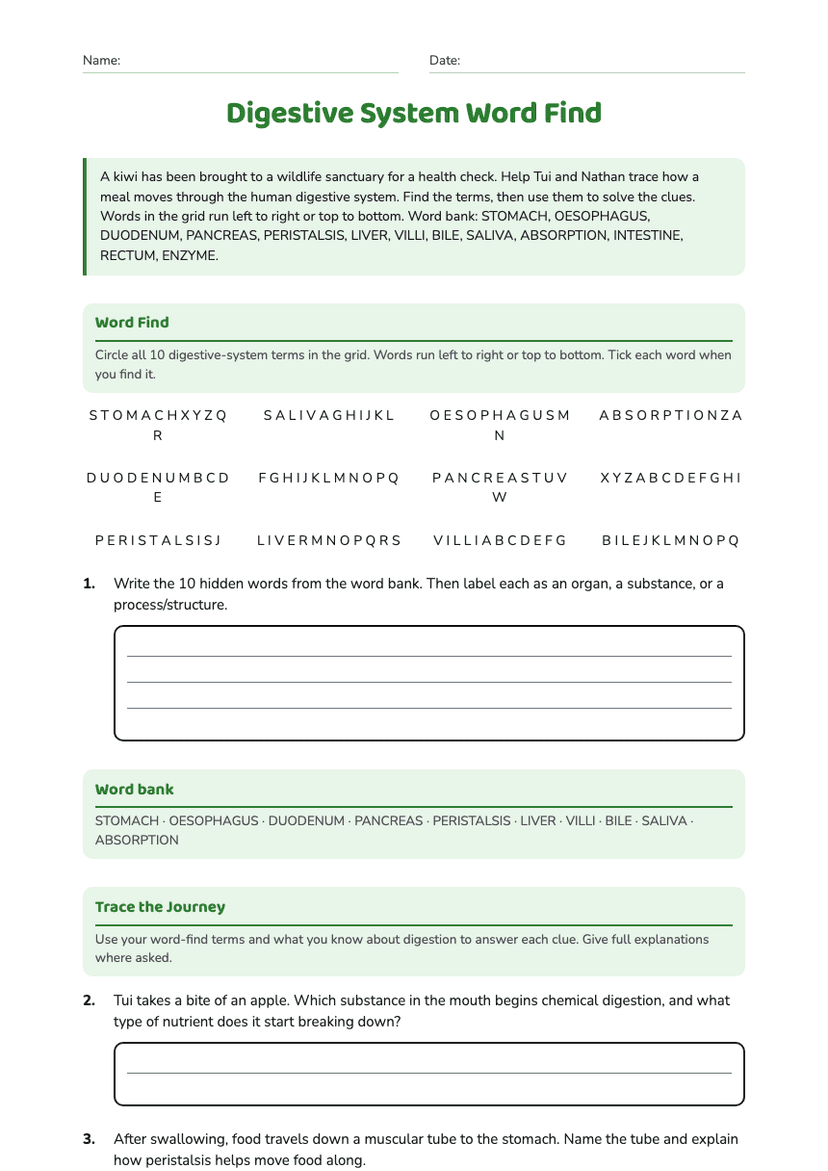
A free science worksheet ready for your classroom. Open in Kuraplan to grab the print-ready PDF, customize it for your students, or generate a fresh version in seconds.
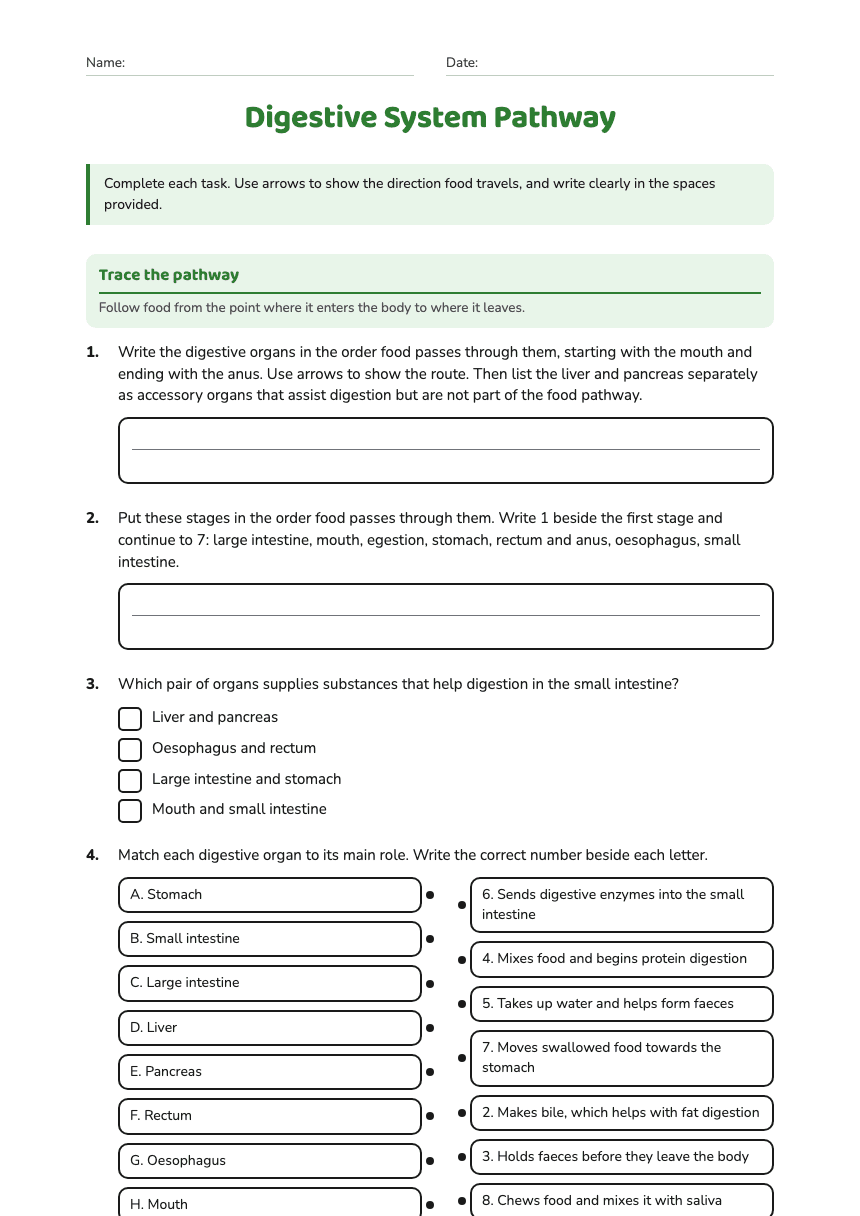
Name:Date:
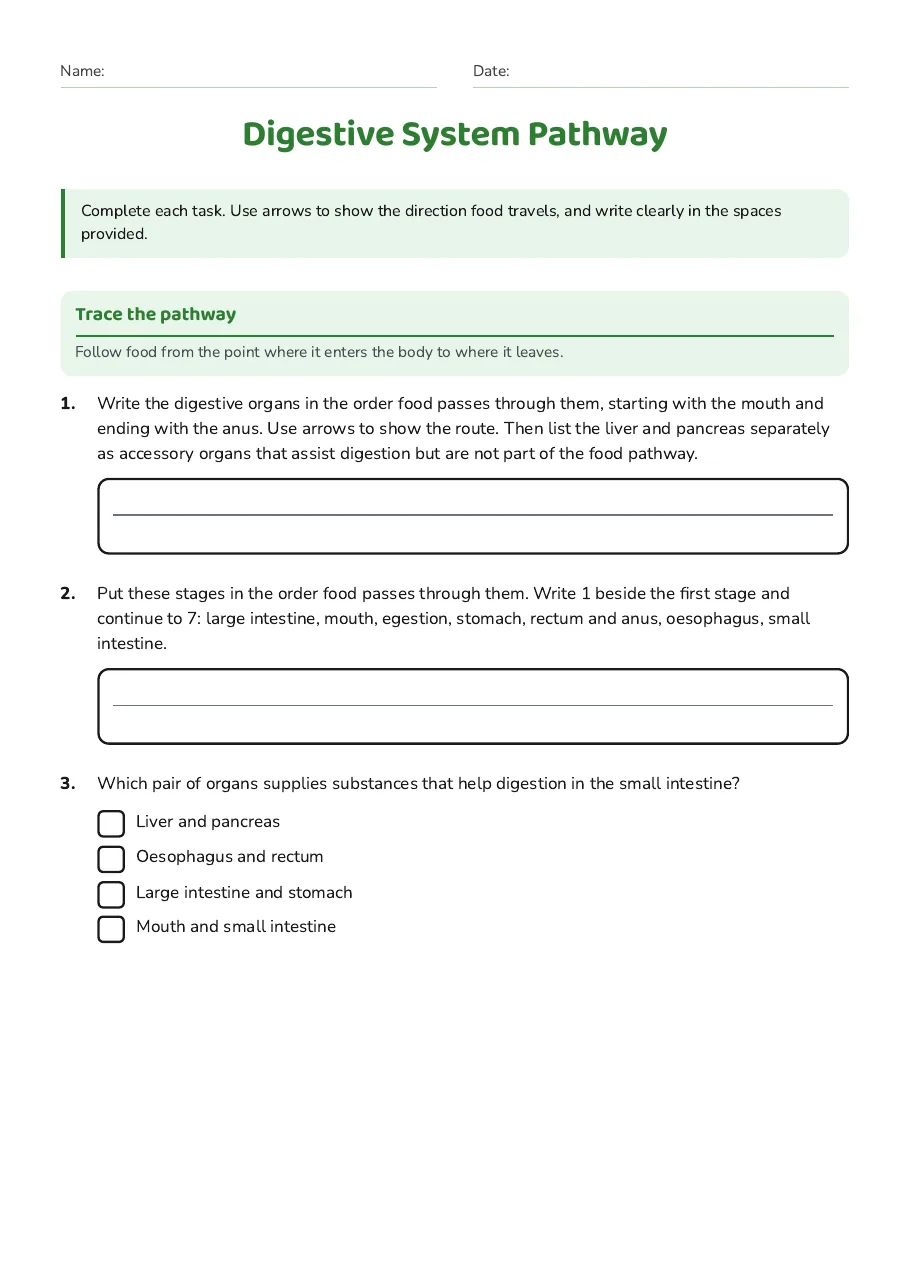
Digestive System Pathway
Complete each task. Use arrows to show the direction food travels, and write clearly in the spaces provided.
Trace the pathway
Follow food from the point where it enters the body to where it leaves.
1.Write the digestive organs in the order food passes through them, starting with the mouth and ending with the anus. Use arrows to show the route. Then list the liver and pancreas separately as accessory organs that assist digestion but are not part of the food pathway.
2.Put these stages in the order food passes through them. Write 1 beside the first stage and continue to 7: large intestine, mouth, egestion, stomach, rectum and anus, oesophagus, small intestine.
3.Which pair of organs supplies substances that help digestion in the small intestine?
- Liver and pancreas
- Oesophagus and rectum
- Large intestine and stomach
- Mouth and small intestine
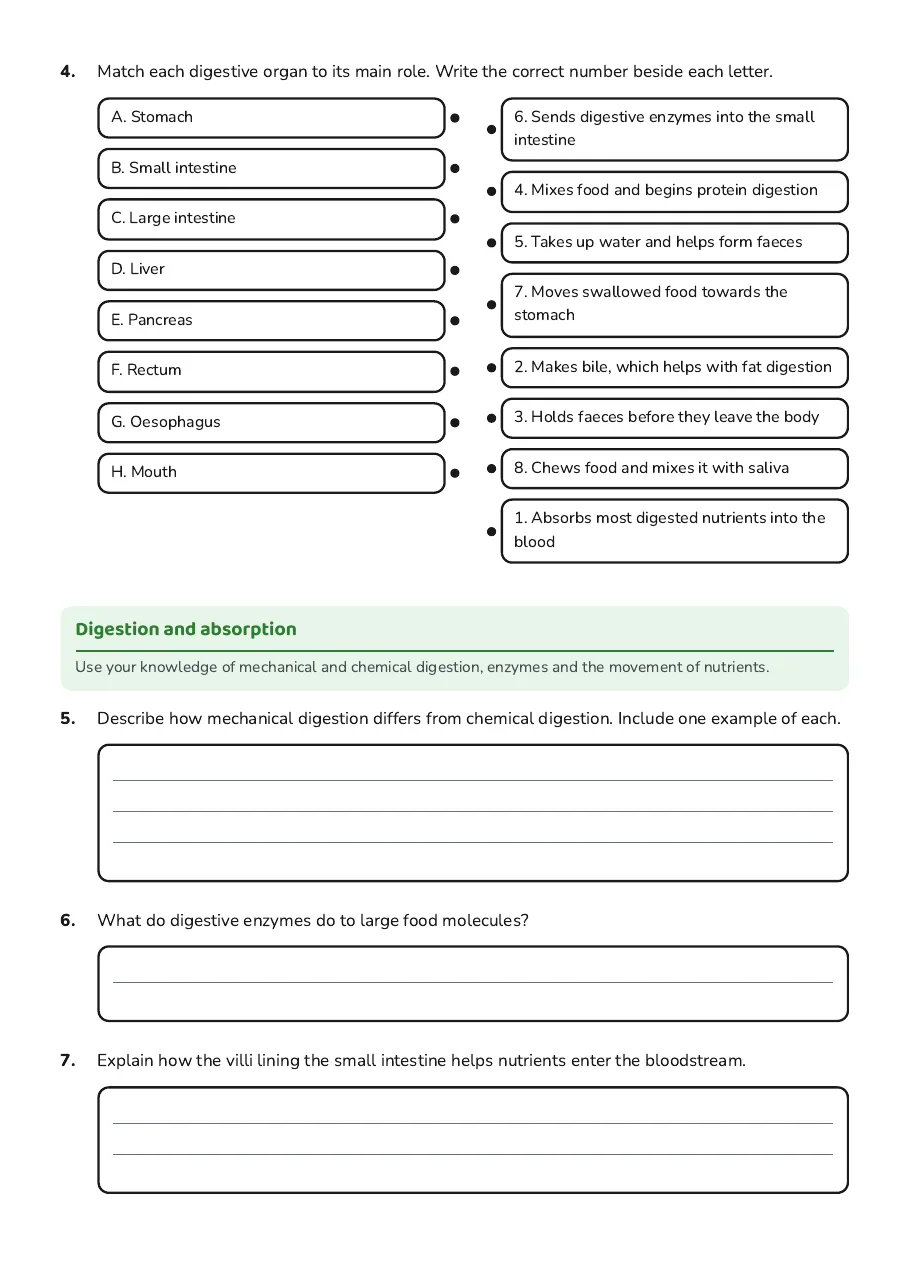
4.Match each digestive organ to its main role. Write the correct number beside each letter.
- A. Stomach
- B. Small intestine
- C. Large intestine
- D. Liver
- E. Pancreas
- F. Rectum
- G. Oesophagus
- H. Mouth
- 6. Sends digestive enzymes into the small intestine
- 4. Mixes food and begins protein digestion
- 5. Takes up water and helps form faeces
- 7. Moves swallowed food towards the stomach
- 2. Makes bile, which helps with fat digestion
- 3. Holds faeces before they leave the body
- 8. Chews food and mixes it with saliva
- 1. Absorbs most digested nutrients into the blood
Digestion and absorption
Use your knowledge of mechanical and chemical digestion, enzymes and the movement of nutrients.
5.Describe how mechanical digestion differs from chemical digestion. Include one example of each.
6.What do digestive enzymes do to large food molecules?
7.Explain how the villi lining the small intestine helps nutrients enter the bloodstream.
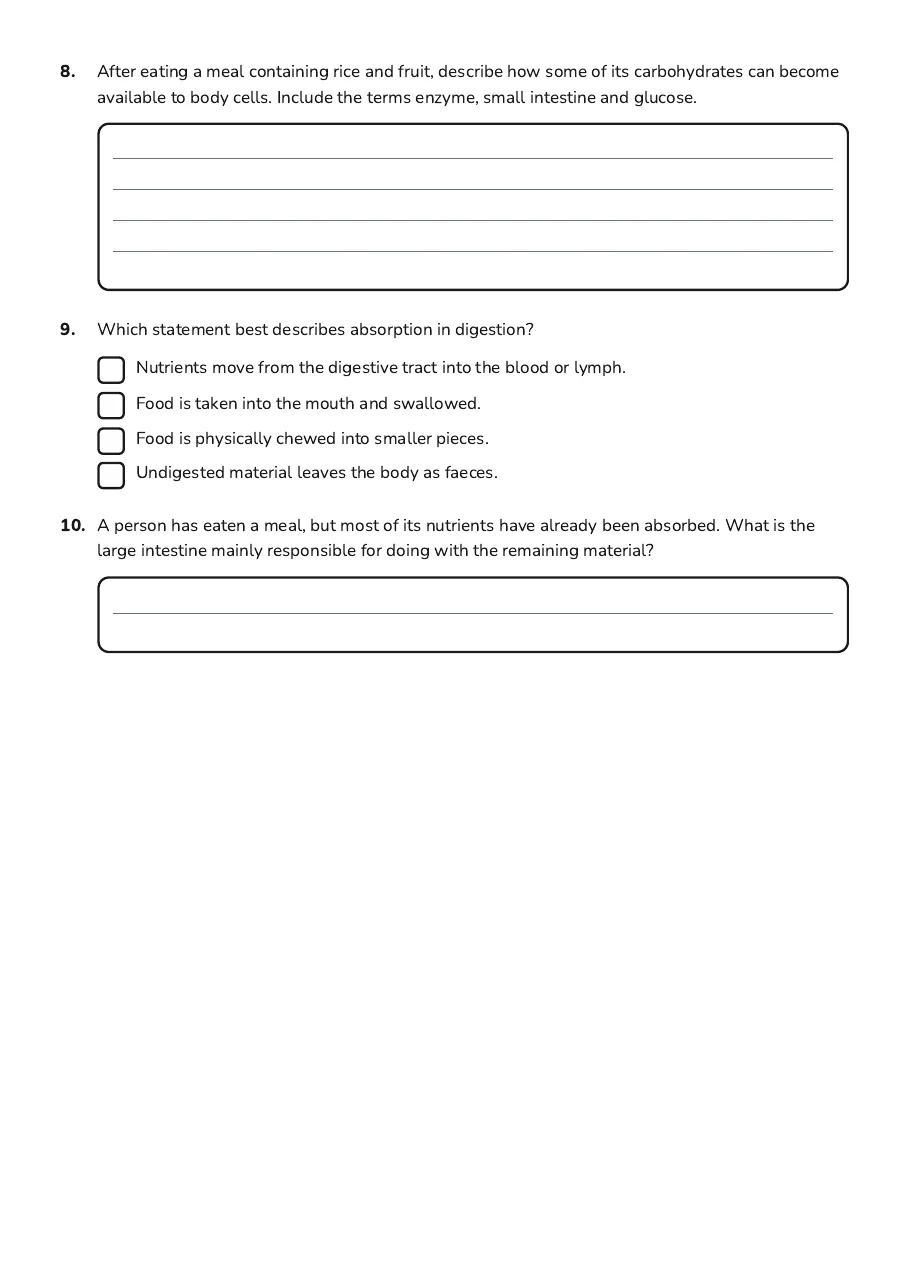
8.After eating a meal containing rice and fruit, describe how some of its carbohydrates can become available to body cells. Include the terms enzyme, small intestine and glucose.
9.Which statement best describes absorption in digestion?
- Nutrients move from the digestive tract into the blood or lymph.
- Food is taken into the mouth and swallowed.
- Food is physically chewed into smaller pieces.
- Undigested material leaves the body as faeces.
10.A person has eaten a meal, but most of its nutrients have already been absorbed. What is the large intestine mainly responsible for doing with the remaining material?
3 printable pages
Page 1
Page 2
Page 3
About This Worksheet
Free in Kuraplan
Sign up free, grab the PDF, and customize it for your class.
Print-Ready
Formatted for standard paper. Clean layout, easy to read.
AI-Generated
Created with Kuraplan's AI, designed for real classroom use.
For Teachers & Parents
Use in classrooms, for homework, tutoring, or homeschool.
Need a custom version of this worksheet?
Kuraplan's AI generates custom worksheets in seconds — differentiated for every learner, aligned to your curriculum.
Generate Custom Worksheets — Free No credit card Curriculum-aligned Under 60 seconds