ScienceFreePrintable

Atmospheric Gas Composition

A free science worksheet ready for your classroom. Open in Kuraplan to grab the print-ready PDF, customize it for your students, or generate a fresh version in seconds.
Atmospheric Gas Composition worksheet preview
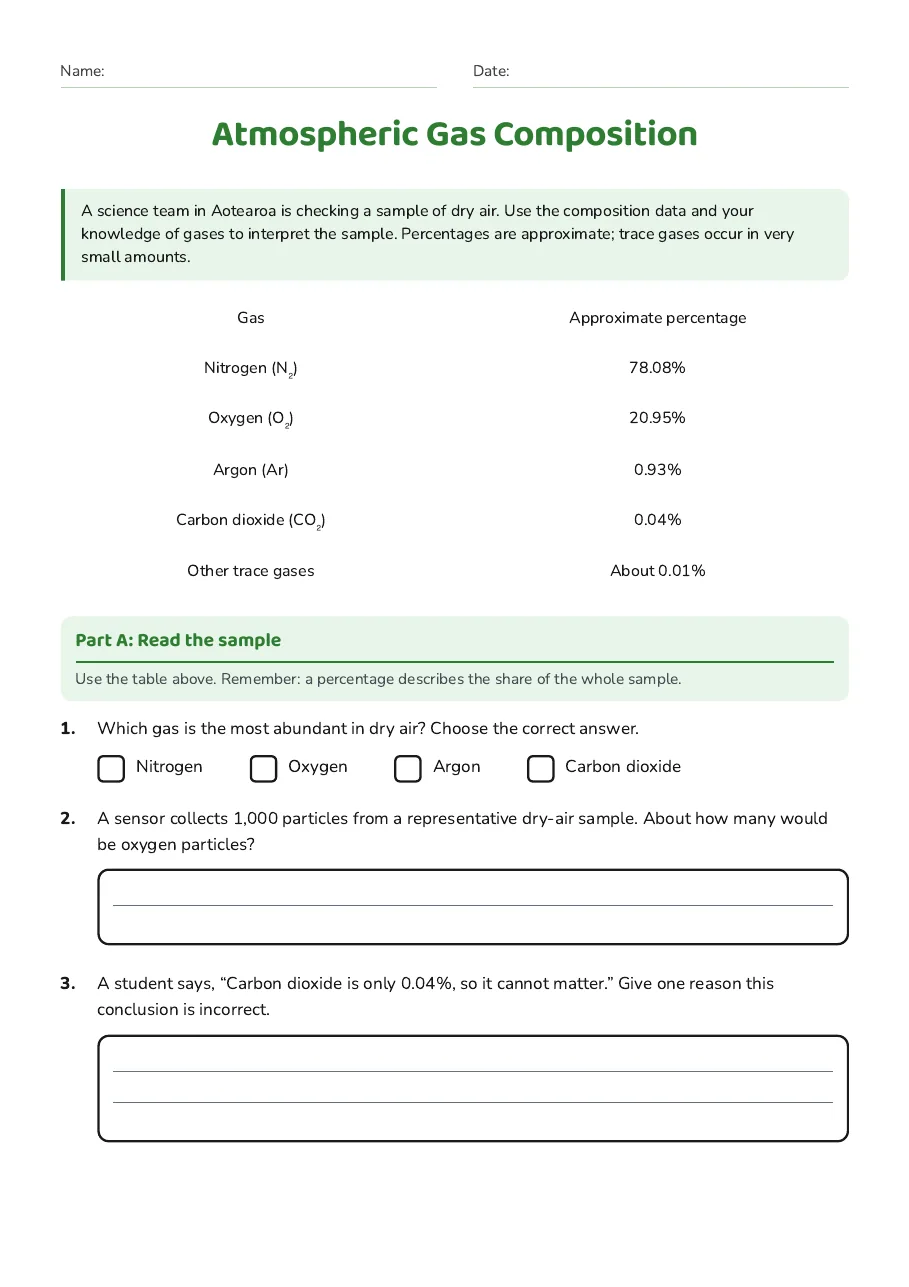
Name:Date:

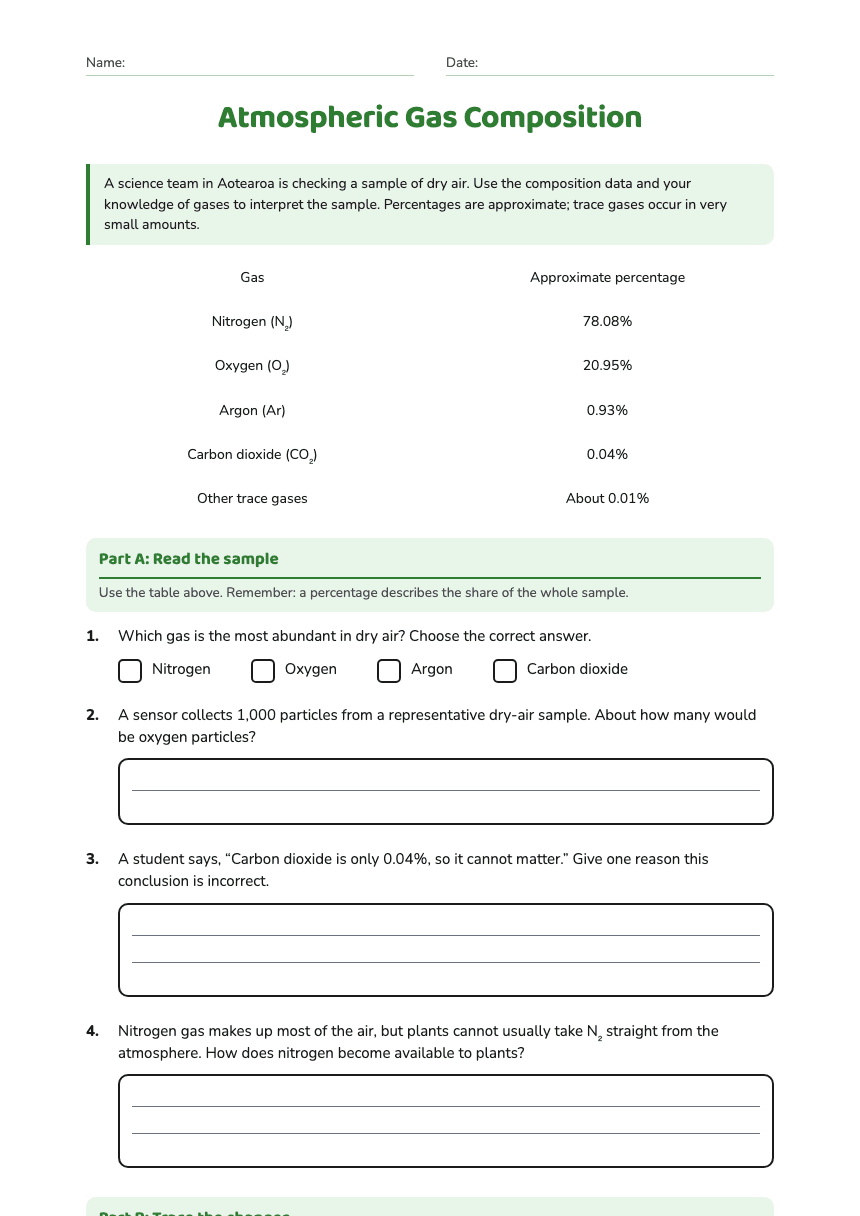
Atmospheric Gas Composition

A science team in Aotearoa is checking a sample of dry air. Use the composition data and your knowledge of gases to interpret the sample. Percentages are approximate; trace gases occur in very small amounts.

Gas

Approximate percentage

Nitrogen (N₂)

78.08%

Oxygen (O₂)

20.95%

Argon (Ar)

0.93%

Carbon dioxide (CO₂)

0.04%

Other trace gases

About 0.01%

Part A: Read the sample

Use the table above. Remember: a percentage describes the share of the whole sample.

1.Which gas is the most abundant in dry air? Choose the correct answer.
  • Nitrogen
  • Oxygen
  • Argon
  • Carbon dioxide
2.A sensor collects 1,000 particles from a representative dry-air sample. About how many would be oxygen particles?
3.A student says, “Carbon dioxide is only 0.04%, so it cannot matter.” Give one reason this conclusion is incorrect.
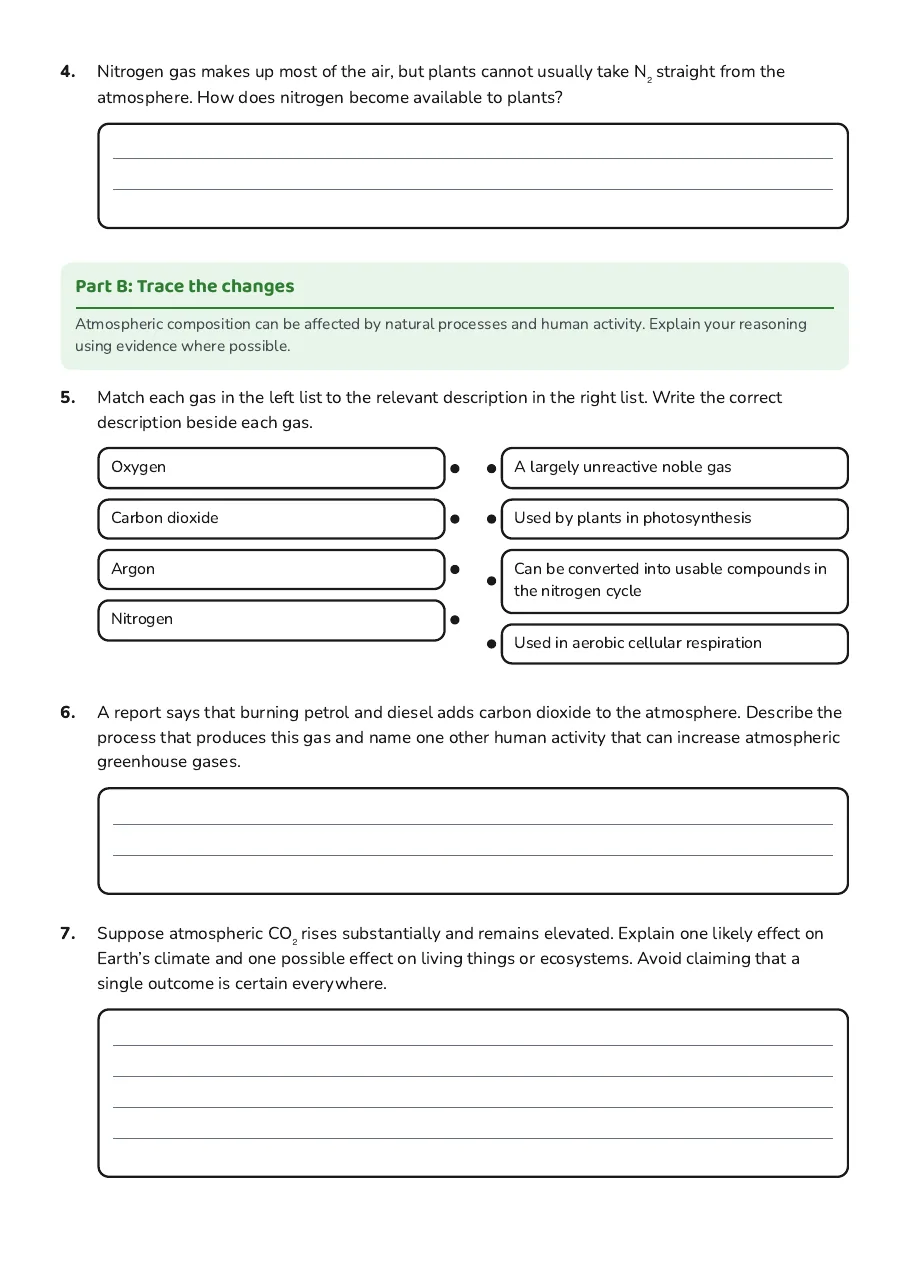
4.Nitrogen gas makes up most of the air, but plants cannot usually take N₂ straight from the atmosphere. How does nitrogen become available to plants?

Part B: Trace the changes

Atmospheric composition can be affected by natural processes and human activity. Explain your reasoning using evidence where possible.

5.Match each gas in the left list to the relevant description in the right list. Write the correct description beside each gas.
  • Oxygen
  • Carbon dioxide
  • Argon
  • Nitrogen
  • A largely unreactive noble gas
  • Used by plants in photosynthesis
  • Can be converted into usable compounds in the nitrogen cycle
  • Used in aerobic cellular respiration
6.A report says that burning petrol and diesel adds carbon dioxide to the atmosphere. Describe the process that produces this gas and name one other human activity that can increase atmospheric greenhouse gases.
7.Suppose atmospheric CO₂ rises substantially and remains elevated. Explain one likely effect on Earth’s climate and one possible effect on living things or ecosystems. Avoid claiming that a single outcome is certain everywhere.
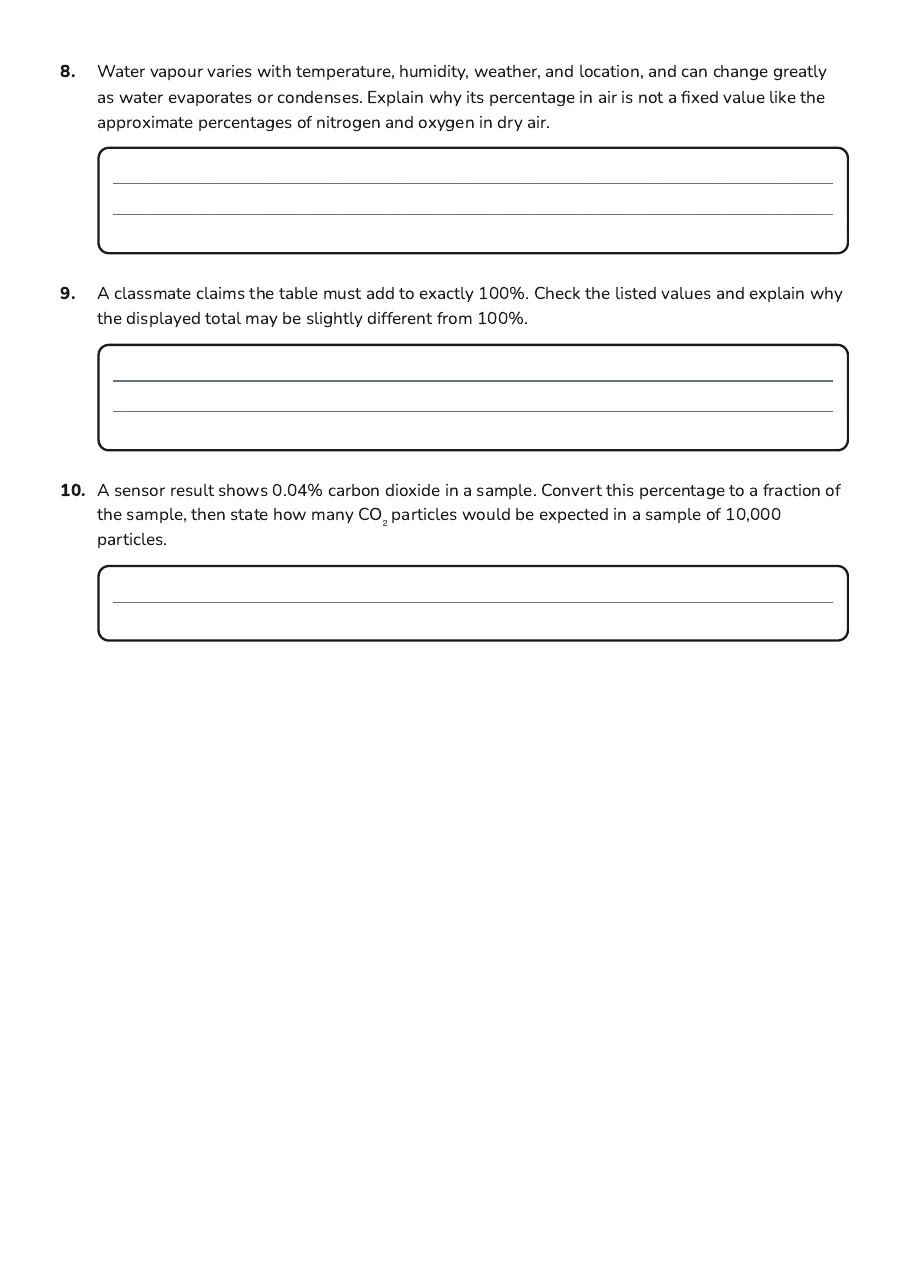
8.Water vapour varies with temperature, humidity, weather, and location, and can change greatly as water evaporates or condenses. Explain why its percentage in air is not a fixed value like the approximate percentages of nitrogen and oxygen in dry air.
9.A classmate claims the table must add to exactly 100%. Check the listed values and explain why the displayed total may be slightly different from 100%.
10.A sensor result shows 0.04% carbon dioxide in a sample. Convert this percentage to a fraction of the sample, then state how many CO₂ particles would be expected in a sample of 10,000 particles.

3 printable pages

  • Atmospheric Gas Composition, page 1 of 3: Part A: Read the sample

    Page 1

  • Atmospheric Gas Composition, page 2 of 3: Part B: Trace the changes

    Page 2

  • Atmospheric Gas Composition, page 3 of 3: 8. Water vapour varies with temperature, humidity, weather, and location, and can change…

    Page 3

About This Worksheet

Free in Kuraplan

Sign up free, grab the PDF, and customize it for your class.

Print-Ready

Formatted for standard paper. Clean layout, easy to read.

AI-Generated

Created with Kuraplan's AI, designed for real classroom use.

For Teachers & Parents

Use in classrooms, for homework, tutoring, or homeschool.

Need a custom version of this worksheet?

Kuraplan's AI generates custom worksheets in seconds — differentiated for every learner, aligned to your curriculum.

Generate Custom Worksheets — Free
No credit card Curriculum-aligned Under 60 seconds