States of Matter
A free science worksheet ready for your classroom. Open in Kuraplan to grab the print-ready PDF, customize it for your students, or generate a fresh version in seconds.
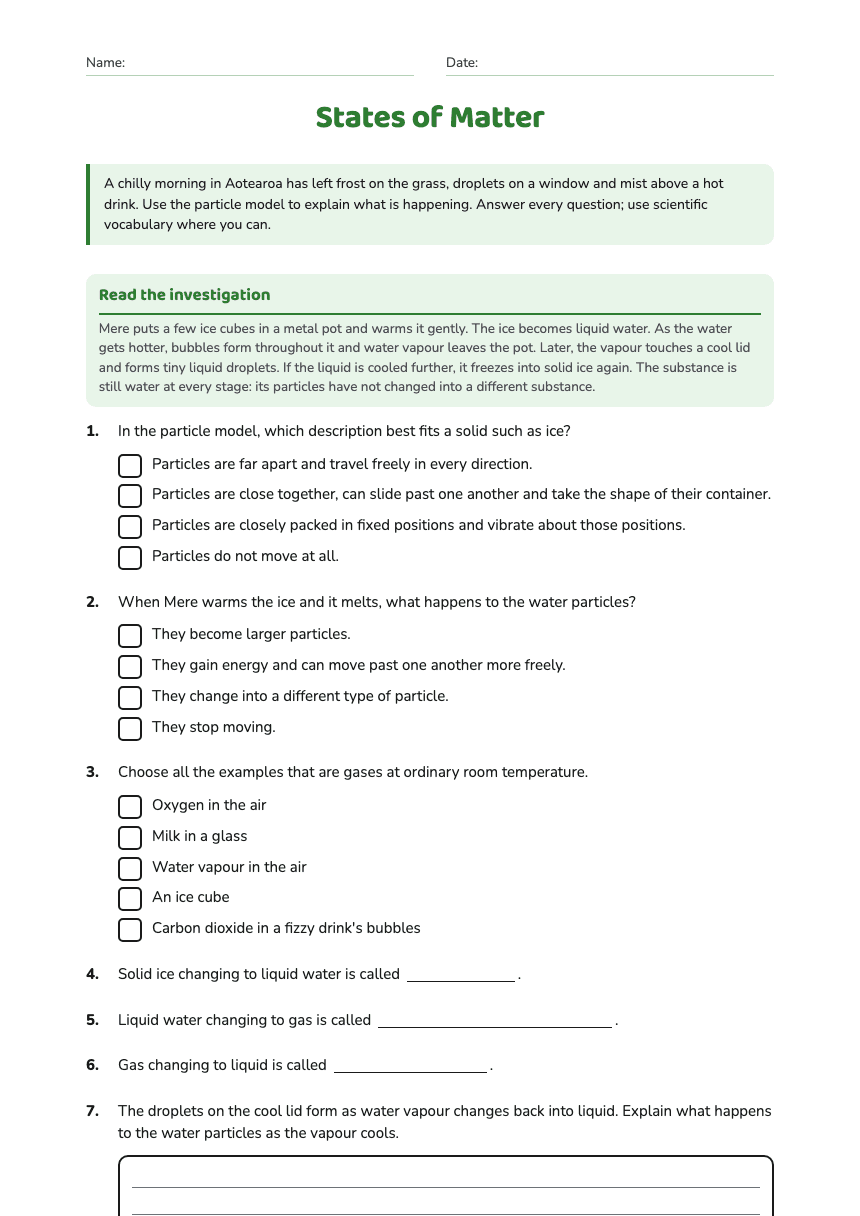
States of Matter
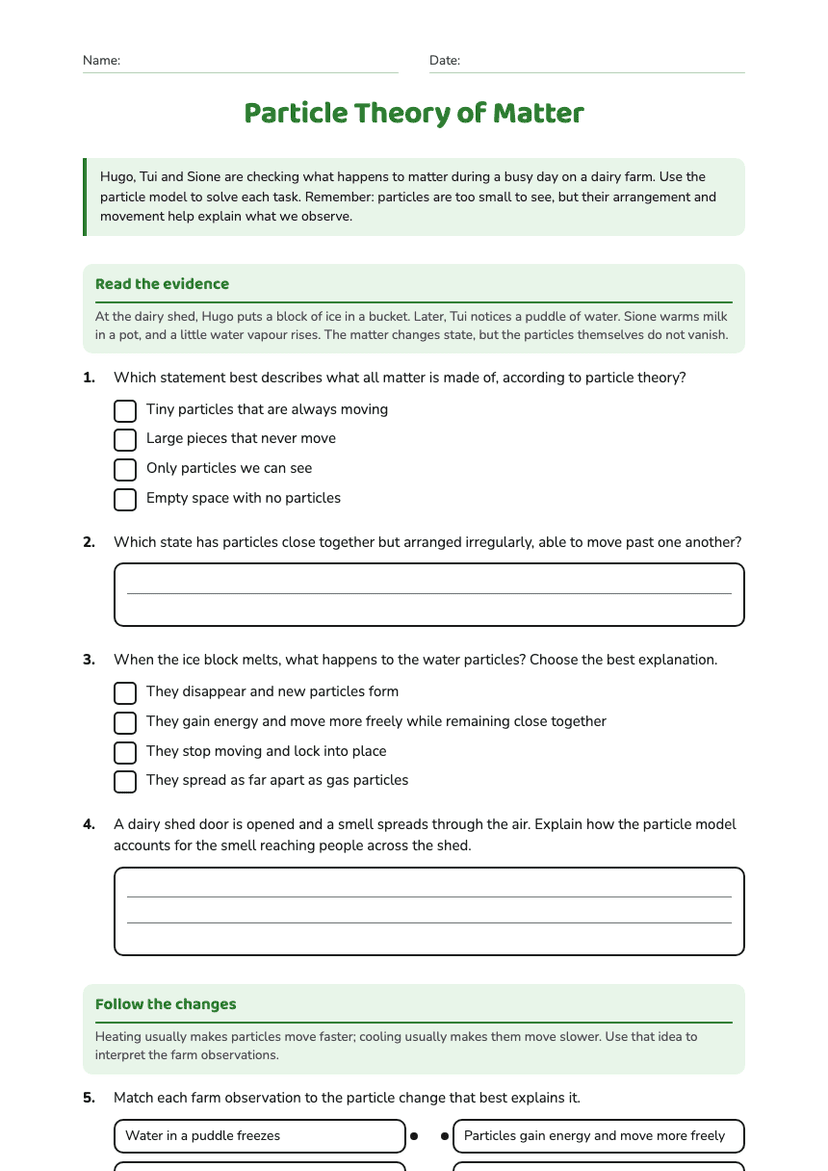
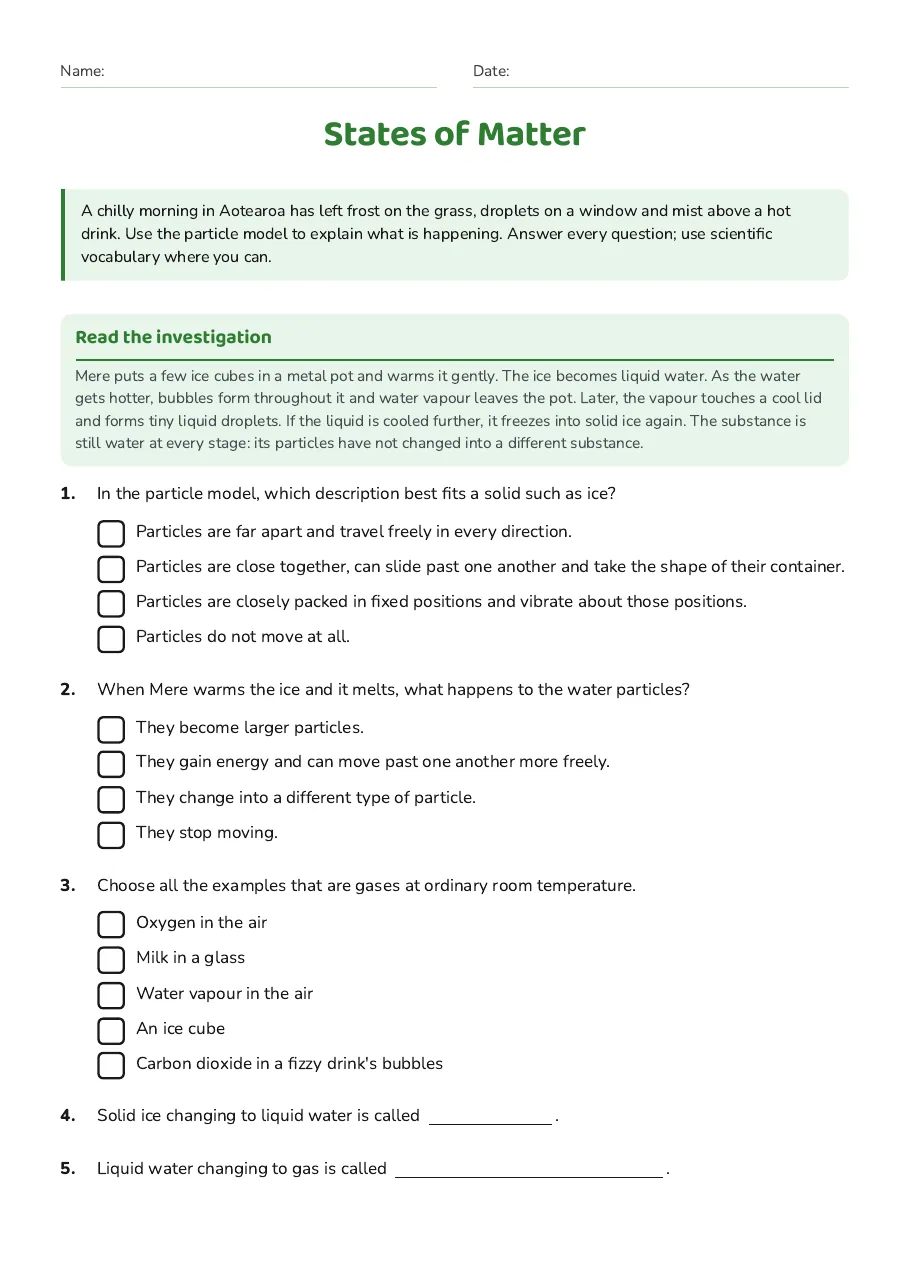
Read the investigation
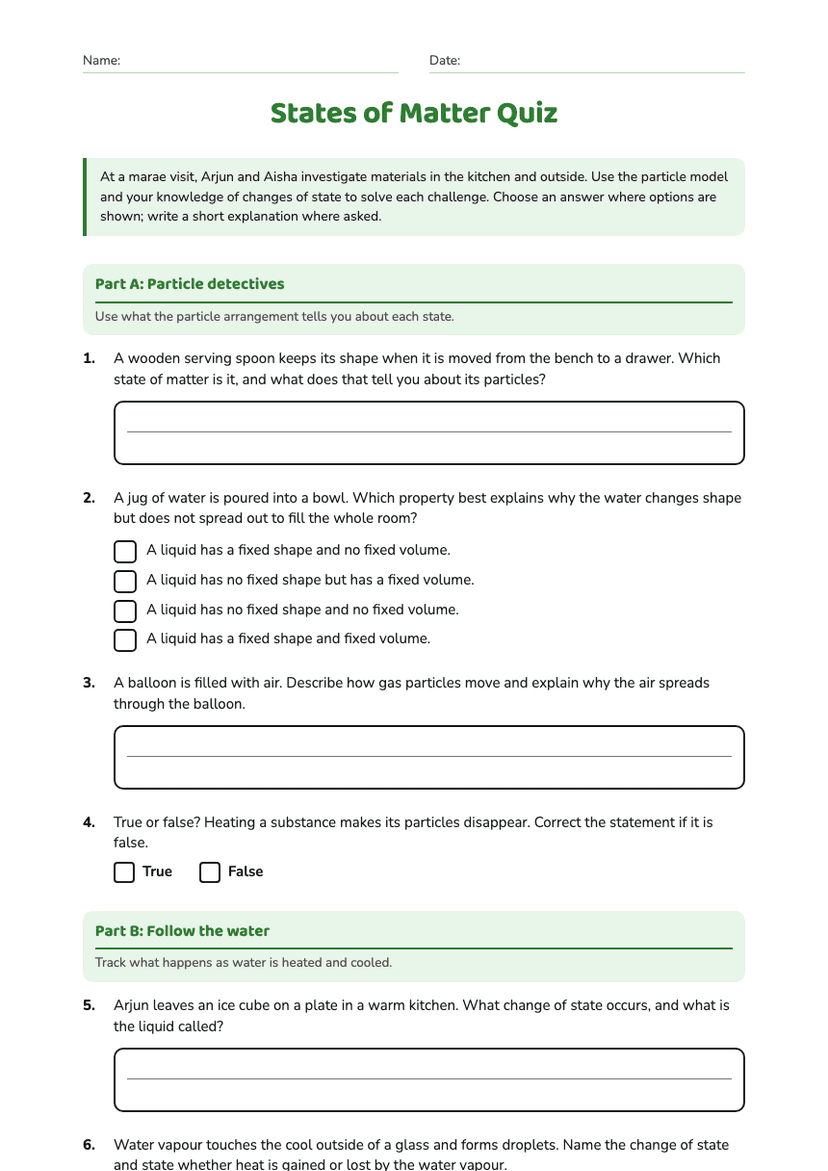
Mere puts a few ice cubes in a metal pot and warms it gently. The ice becomes liquid water. As the water gets hotter, bubbles form throughout it and water vapour leaves the pot. Later, the vapour touches a cool lid and forms tiny liquid droplets. If the liquid is cooled further, it freezes into solid ice again. The substance is still water at every stage: its particles have not changed into a different substance.
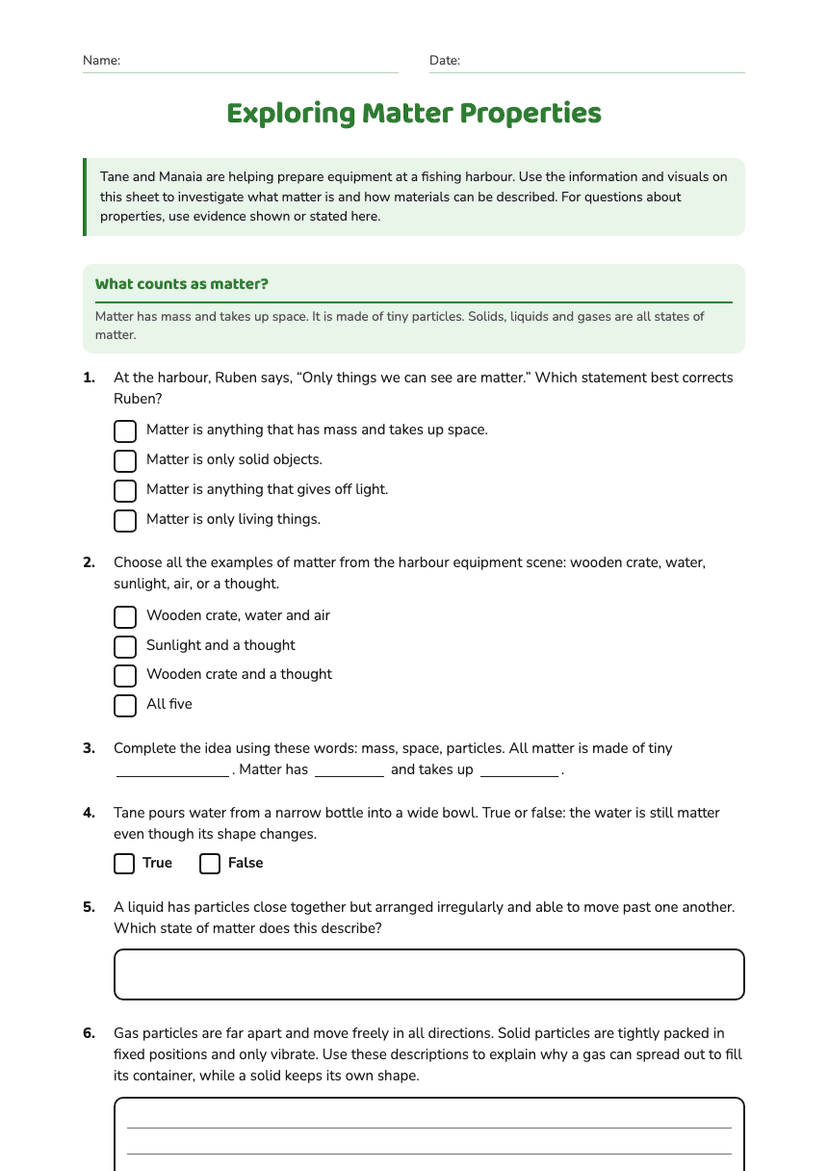
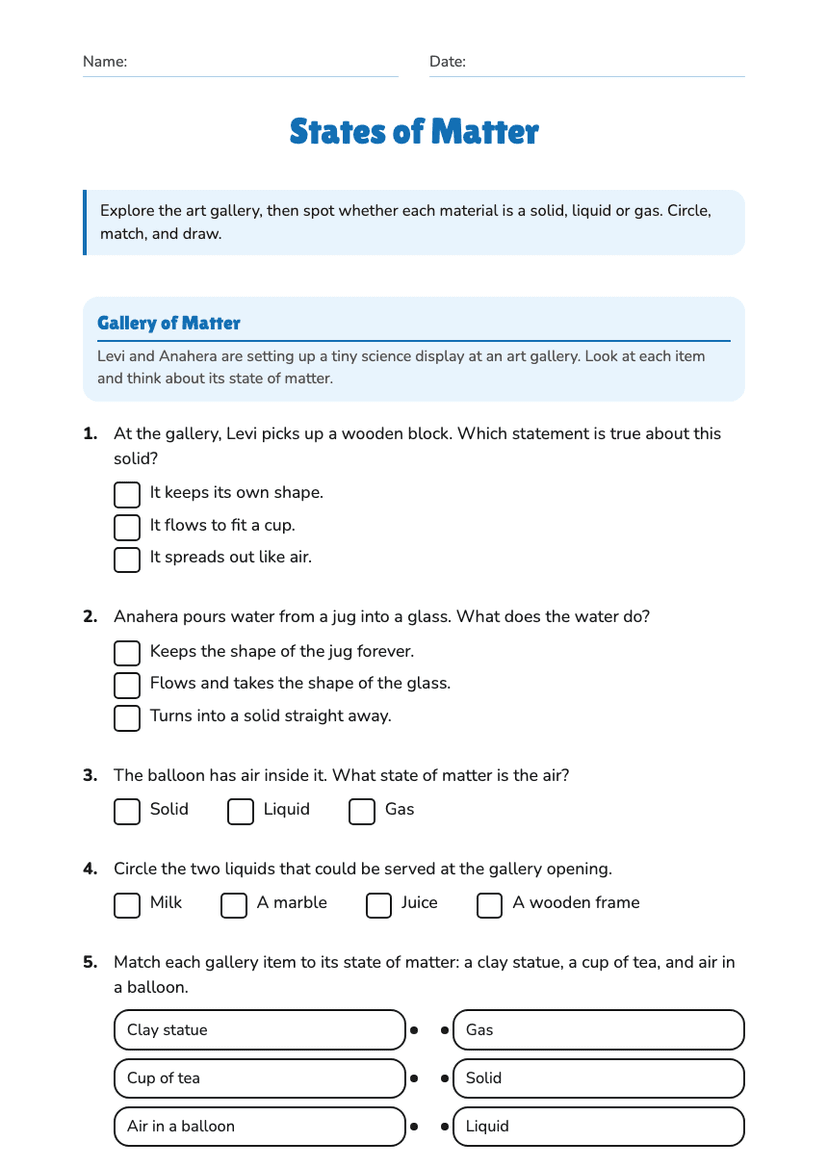
- Particles are far apart and travel freely in every direction.
- Particles are close together, can slide past one another and take the shape of their container.
- Particles are closely packed in fixed positions and vibrate about those positions.
- Particles do not move at all.
- They become larger particles.
- They gain energy and can move past one another more freely.
- They change into a different type of particle.
- They stop moving.
- Oxygen in the air
- Milk in a glass
- Water vapour in the air
- An ice cube
- Carbon dioxide in a fizzy drink's bubbles
2 printable pages
Page 1
Page 2
About This Worksheet
Free in Kuraplan
Sign up free, grab the PDF, and customize it for your class.
Print-Ready
Formatted for standard paper. Clean layout, easy to read.
AI-Generated
Created with Kuraplan's AI, designed for real classroom use.
For Teachers & Parents
Use in classrooms, for homework, tutoring, or homeschool.
Need a custom version of this worksheet?
Kuraplan's AI generates custom worksheets in seconds — differentiated for every learner, aligned to your curriculum.
Generate Custom Worksheets — Free