Bones in Dance Movement
A free science worksheet ready for your classroom. Open in Kuraplan to grab the print-ready PDF, customize it for your students, or generate a fresh version in seconds.
Bones in Dance Movement
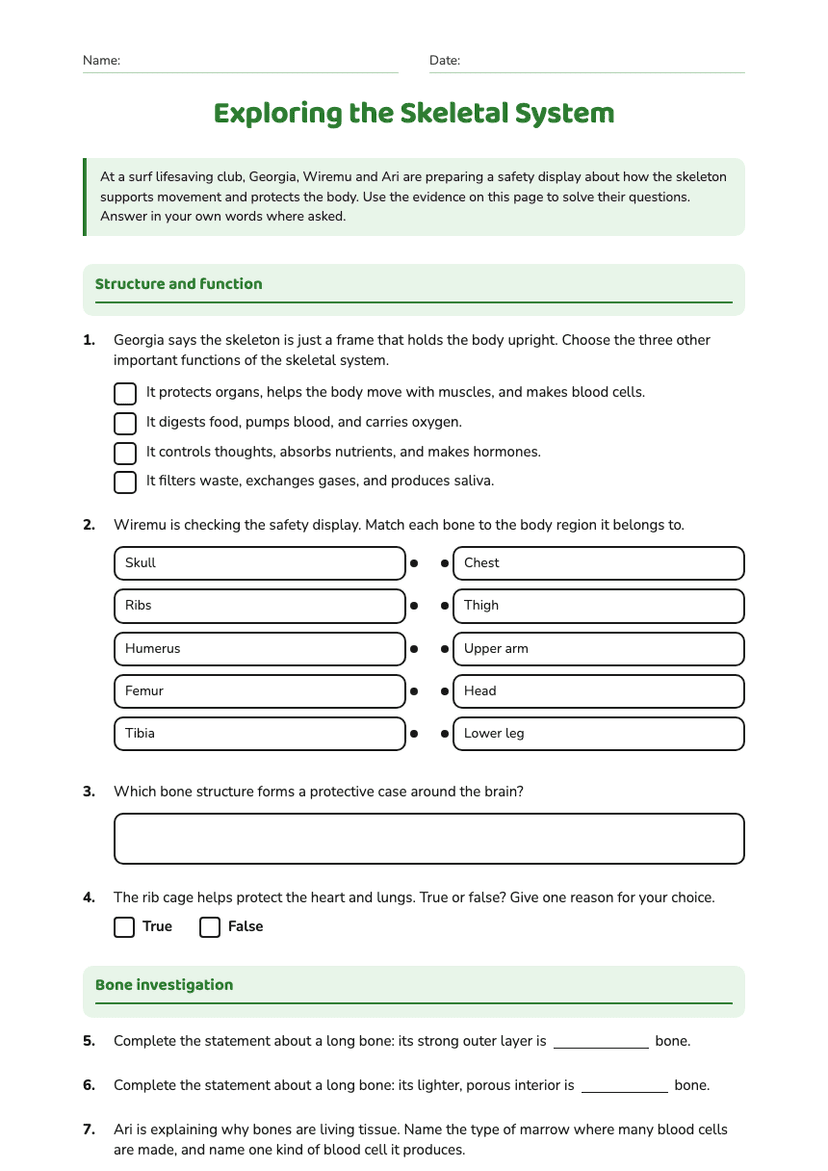
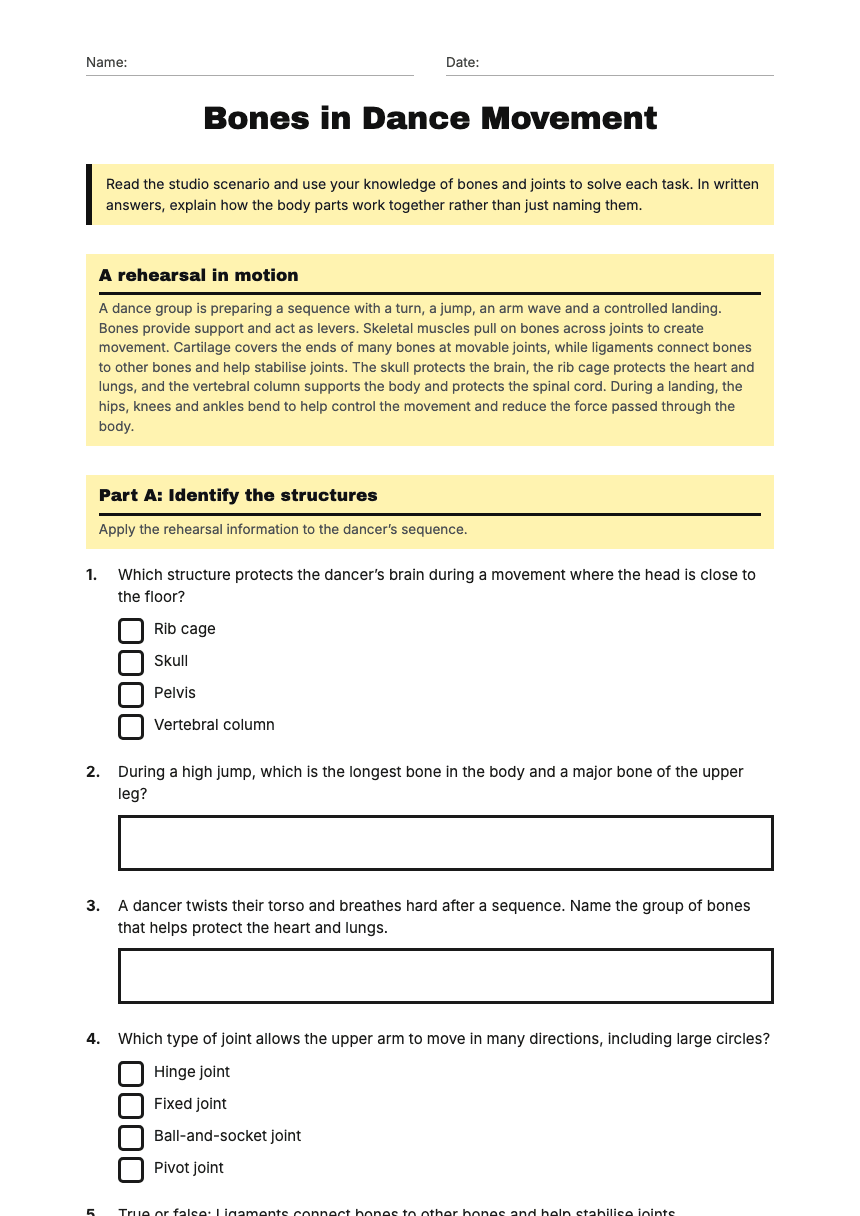
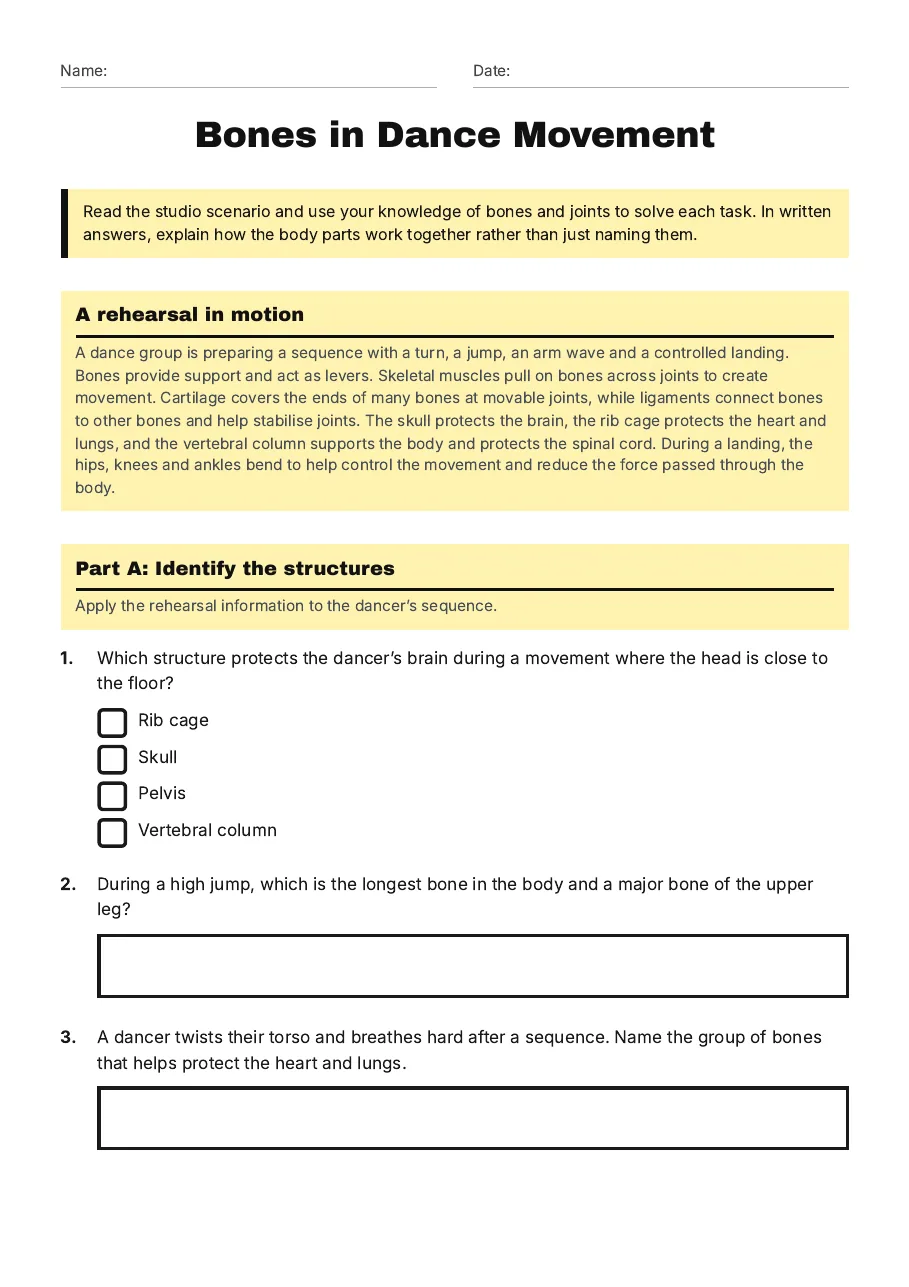
A rehearsal in motion
A dance group is preparing a sequence with a turn, a jump, an arm wave and a controlled landing. Bones provide support and act as levers. Skeletal muscles pull on bones across joints to create movement. Cartilage covers the ends of many bones at movable joints, while ligaments connect bones to other bones and help stabilise joints. The skull protects the brain, the rib cage protects the heart and lungs, and the vertebral column supports the body and protects the spinal cord. During a landing, the hips, knees and ankles bend to help control the movement and reduce the force passed through the body.
Part A: Identify the structures
Apply the rehearsal information to the dancer’s sequence.
- Rib cage
- Skull
- Pelvis
- Vertebral column
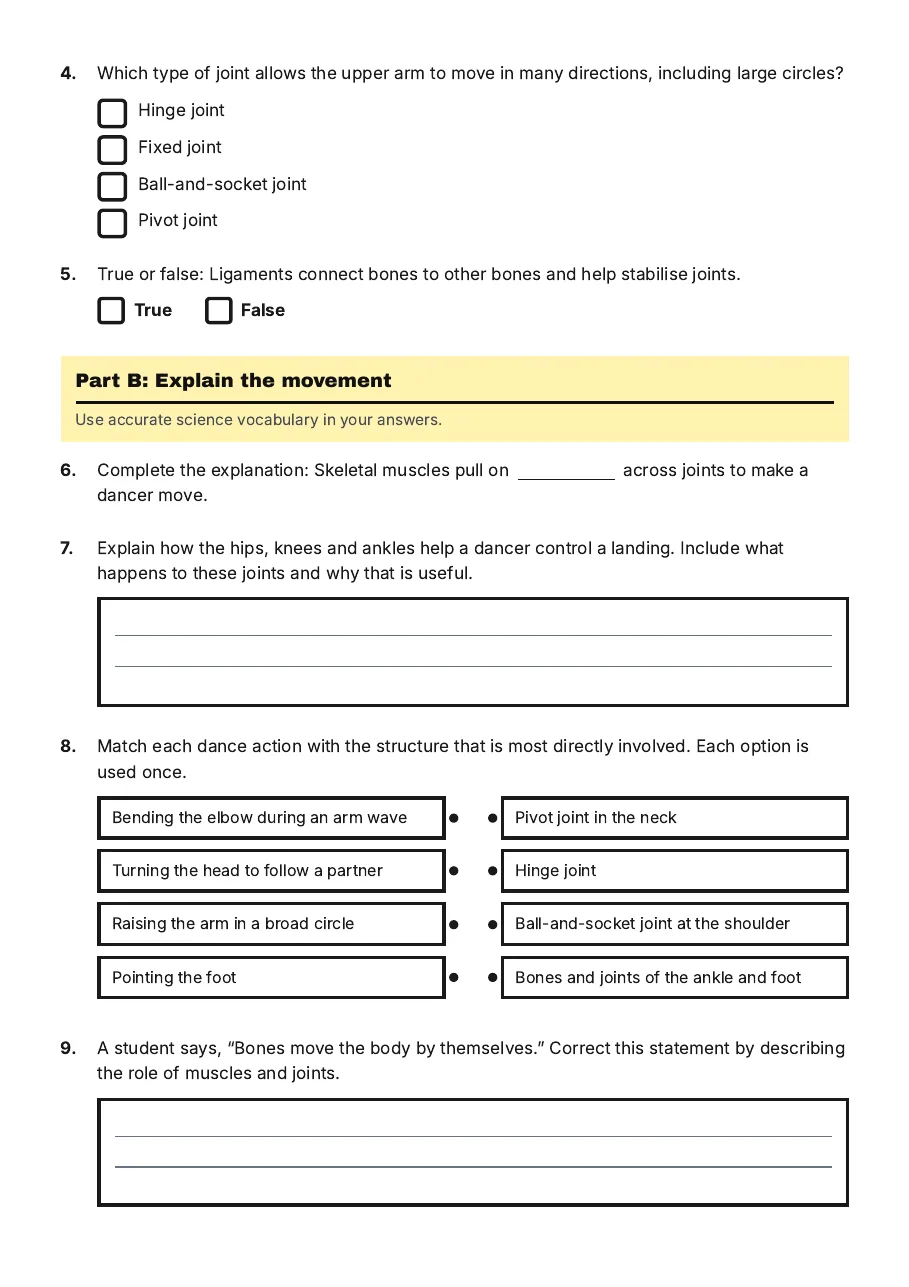
- Hinge joint
- Fixed joint
- Ball-and-socket joint
- Pivot joint
Part B: Explain the movement
Use accurate science vocabulary in your answers.
- Bending the elbow during an arm wave
- Turning the head to follow a partner
- Raising the arm in a broad circle
- Pointing the foot
- Pivot joint in the neck
- Hinge joint
- Ball-and-socket joint at the shoulder
- Bones and joints of the ankle and foot
3 printable pages
Page 1
Page 2
Page 3
About This Worksheet
Free in Kuraplan
Sign up free, grab the PDF, and customize it for your class.
Print-Ready
Formatted for standard paper. Clean layout, easy to read.
AI-Generated
Created with Kuraplan's AI, designed for real classroom use.
For Teachers & Parents
Use in classrooms, for homework, tutoring, or homeschool.
Need a custom version of this worksheet?
Kuraplan's AI generates custom worksheets in seconds — differentiated for every learner, aligned to your curriculum.
Generate Custom Worksheets — Free