ScienceFreePrintable
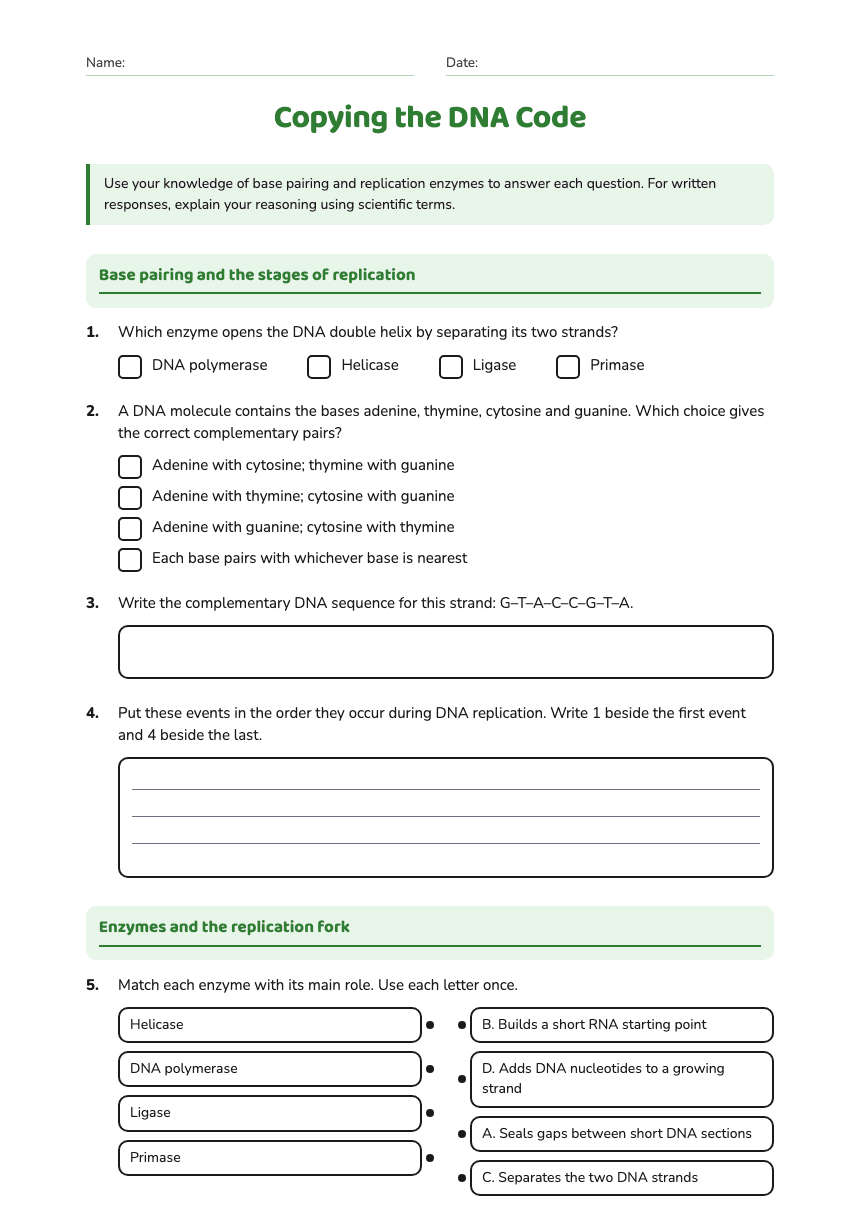
Copying the DNA Code
A free science worksheet ready for your classroom. Open in Kuraplan to grab the print-ready PDF, customize it for your students, or generate a fresh version in seconds.
Name:Date:
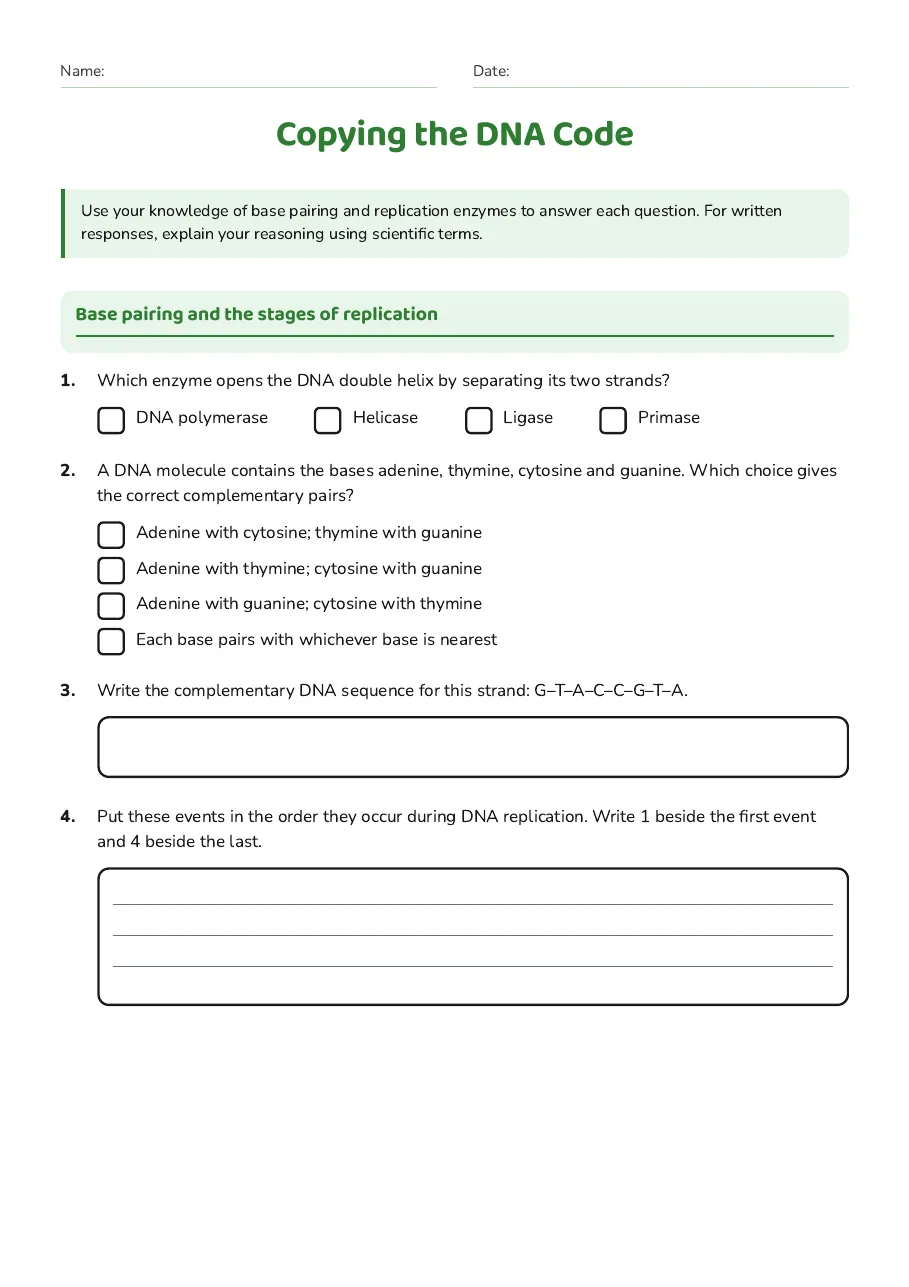
Copying the DNA Code
Use your knowledge of base pairing and replication enzymes to answer each question. For written responses, explain your reasoning using scientific terms.
Base pairing and the stages of replication
1.Which enzyme opens the DNA double helix by separating its two strands?
- DNA polymerase
- Helicase
- Ligase
- Primase
2.A DNA molecule contains the bases adenine, thymine, cytosine and guanine. Which choice gives the correct complementary pairs?
- Adenine with cytosine; thymine with guanine
- Adenine with thymine; cytosine with guanine
- Adenine with guanine; cytosine with thymine
- Each base pairs with whichever base is nearest
3.Write the complementary DNA sequence for this strand: G–T–A–C–C–G–T–A.
4.Put these events in the order they occur during DNA replication. Write 1 beside the first event and 4 beside the last.
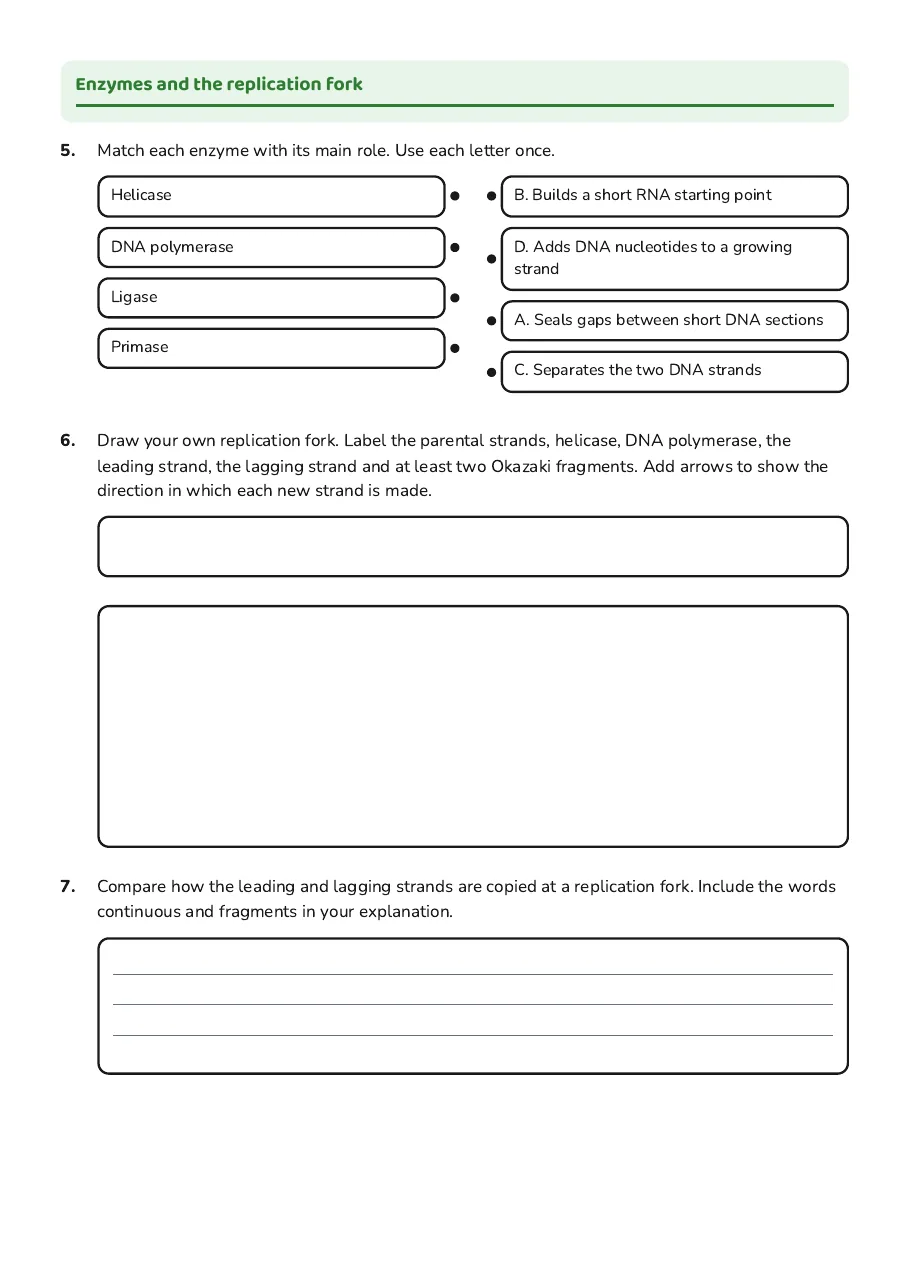
Enzymes and the replication fork
5.Match each enzyme with its main role. Use each letter once.
- Helicase
- DNA polymerase
- Ligase
- Primase
- B. Builds a short RNA starting point
- D. Adds DNA nucleotides to a growing strand
- A. Seals gaps between short DNA sections
- C. Separates the two DNA strands
6.Draw your own replication fork. Label the parental strands, helicase, DNA polymerase, the leading strand, the lagging strand and at least two Okazaki fragments. Add arrows to show the direction in which each new strand is made.
7.Compare how the leading and lagging strands are copied at a replication fork. Include the words continuous and fragments in your explanation.
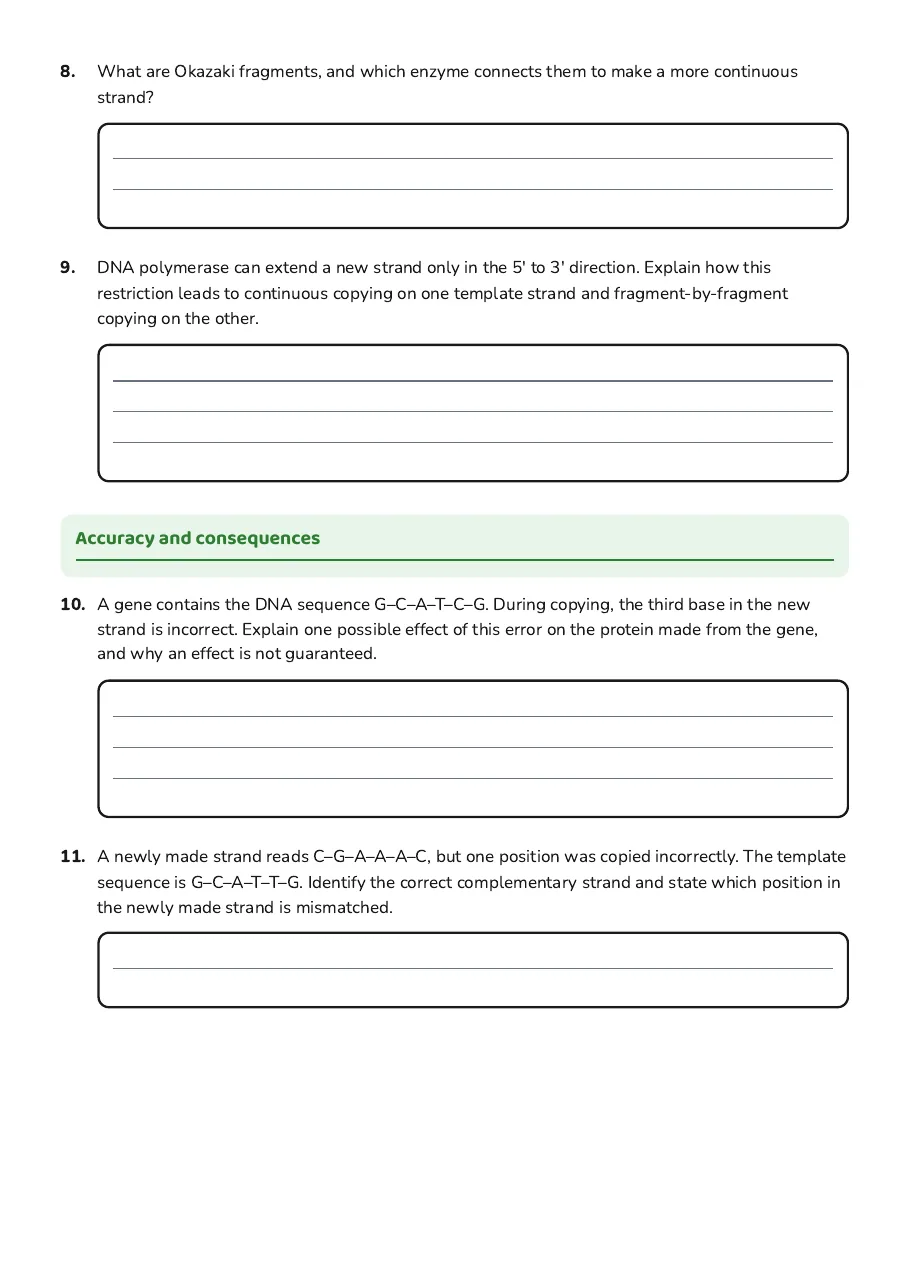
8.What are Okazaki fragments, and which enzyme connects them to make a more continuous strand?
9.DNA polymerase can extend a new strand only in the 5′ to 3′ direction. Explain how this restriction leads to continuous copying on one template strand and fragment-by-fragment copying on the other.
Accuracy and consequences
10.A gene contains the DNA sequence G–C–A–T–C–G. During copying, the third base in the new strand is incorrect. Explain one possible effect of this error on the protein made from the gene, and why an effect is not guaranteed.
11.A newly made strand reads C–G–A–A–A–C, but one position was copied incorrectly. The template sequence is G–C–A–T–T–G. Identify the correct complementary strand and state which position in the newly made strand is mismatched.
3 printable pages
Page 1
Page 2
Page 3
About This Worksheet
Free in Kuraplan
Sign up free, grab the PDF, and customize it for your class.
Print-Ready
Formatted for standard paper. Clean layout, easy to read.
AI-Generated
Created with Kuraplan's AI, designed for real classroom use.
For Teachers & Parents
Use in classrooms, for homework, tutoring, or homeschool.
Need a custom version of this worksheet?
Kuraplan's AI generates custom worksheets in seconds — differentiated for every learner, aligned to your curriculum.
Generate Custom Worksheets — Free No credit card Curriculum-aligned Under 60 seconds