Current and Resistance Experiment
A free science worksheet ready for your classroom. Open in Kuraplan to grab the print-ready PDF, customize it for your students, or generate a fresh version in seconds.
Current and Resistance Experiment
Year 9 Science Practical Activity
🎯 WALT & Success Criteria
WALT (We Are Learning To): Investigate how changing resistance affects the electric current in a series circuit using a variable resistor.
Success Criteria — I can:
☐ Set up a simple series circuit safely using a power source, ammeter, bulb, and variable resistor.
☐ Read an ammeter accurately and record current measurements in amperes (A).
☐ Describe the relationship between resistance and current using evidence from my results.
🧪 Objective
To measure how the electric current in a series circuit changes when a variable resistor is adjusted, and to identify the relationship between resistance and current.
🛠️ Materials Needed
• 1 x battery pack (4.5 V or 6 V) • 1 x ammeter • 1 x light bulb (globe)
• 1 x variable resistor • Connecting wires • Switch
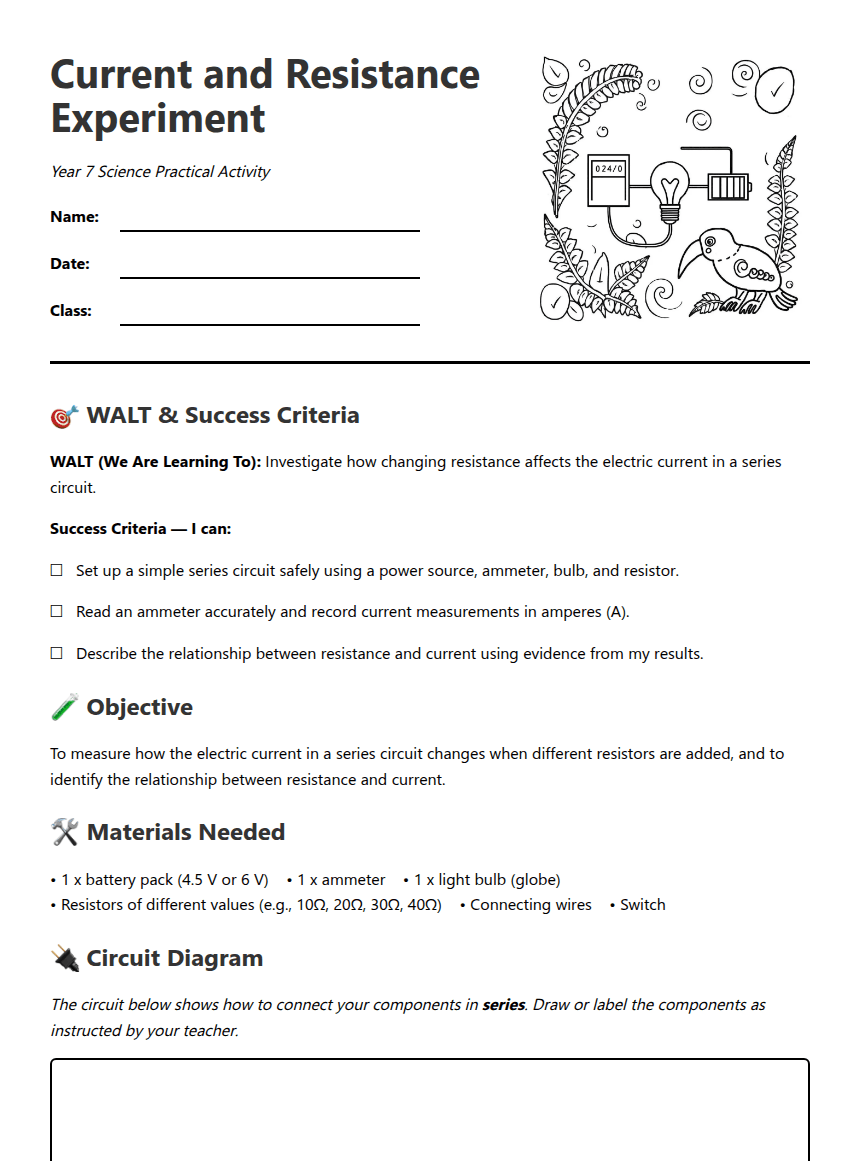
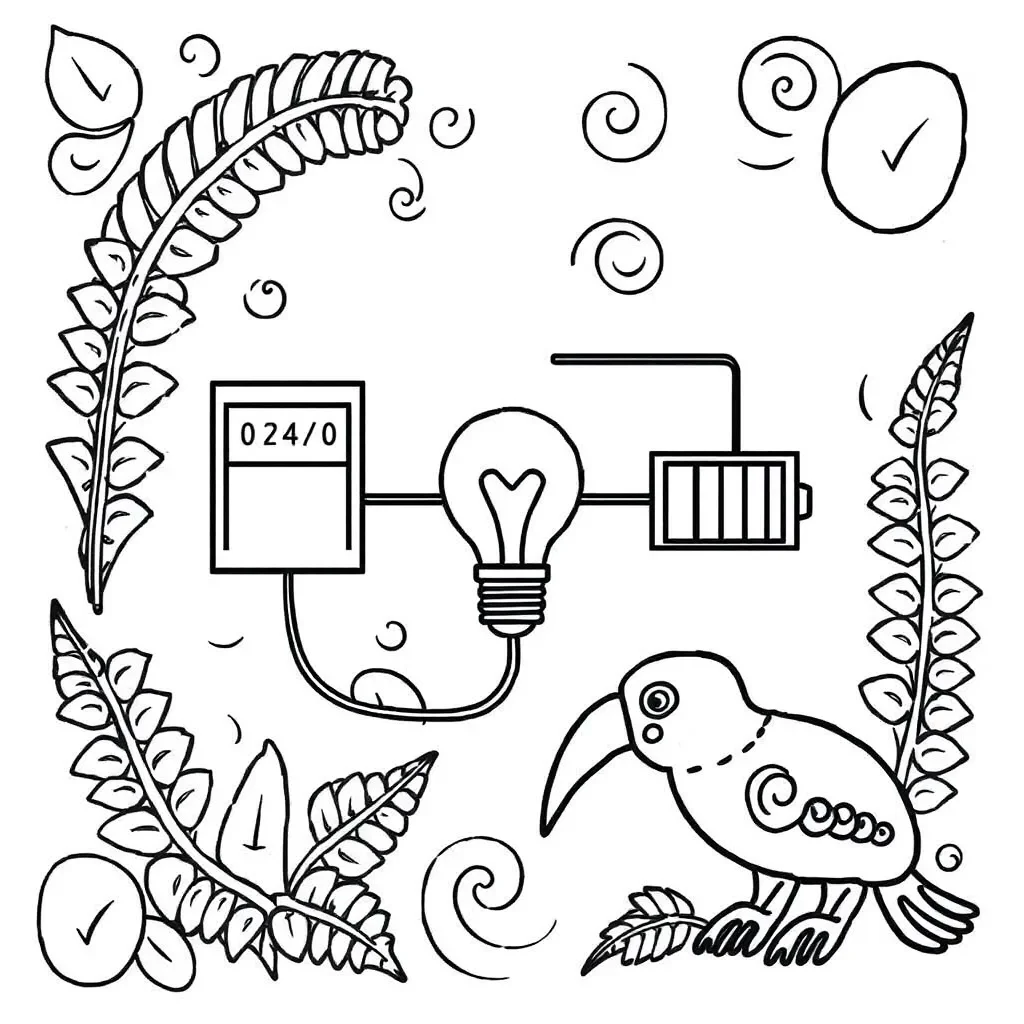
🔌 Circuit Diagram
The circuit below shows how to connect your components in series. Draw or label the components as instructed by your teacher.
Label the following on your diagram: Power Source | Switch | Variable Resistor | Ammeter (A) | Light Bulb
📋 Step-by-Step Procedure
Step 1: Set up your series circuit following the diagram above. Ask your teacher to check it before switching on.
Step 2: Adjust the variable resistor to its maximum resistance. Turn on the switch.
Step 3: Read the ammeter carefully. Record the current (in amperes) in the results table below.
Step 4: Gradually decrease the resistance of the variable resistor. After each adjustment, record the current reading.
Step 5: Observe the brightness of the bulb each time you adjust the resistance. Note your observations.
📊 Results Table
Record your measurements in the table below. Write the current reading from the ammeter for each resistance setting.
| Resistance Setting (Ω) | Current Reading (A) | Bulb Brightness (bright / dim / very dim) |
|————————————|————————————|————————————————————————————|
| Max Resistance | _______________ | _________________________________________|
| Medium Resistance | _______________ | _________________________________________|
| Low Resistance | _______________ | _________________________________________|
📝 Analysis Questions
When resistance decreases, the current in the circuit _________________ because _______________________________________.
🌟 Extension Activity
Challenge: Look up Ohm's Law (V = I × R). Use the voltage of your battery pack and one of your resistance values to calculate the expected current. How close was your measured result?
♿ Differentiation & Support Notes
🔵 For students who need extra support:
• Work with a partner to set up the circuit. • Use a pre-drawn circuit diagram to label rather than drawing from scratch. • Focus on completing the results table and Question 3 only.
🟢 For dyslexia-friendly access:
• This worksheet is best printed on cream or light yellow paper to reduce visual stress. • Use a font such as OpenDyslexic or Arial (size 14+) when printing digitally. • Allow verbal responses recorded by a scribe or voice recorder for analysis questions.
🟡 For English Language Learners:
• Key vocabulary: current, resistance, ammeter, variable resistor, series circuit, ampere (A), ohm (Ω) — ask your teacher for a glossary card. • Draw diagrams or use arrows to support written answers.
🔴 For advanced learners:
• Complete the Extension Activity above. • Design your own investigation: What happens to current if you change the voltage instead of the resistance? Write a hypothesis and plan.
About This Worksheet
Free in Kuraplan
Sign up free, grab the PDF, and customize it for your class.
Print-Ready
Formatted for standard paper. Clean layout, easy to read.
AI-Generated
Created with Kuraplan's AI, designed for real classroom use.
For Teachers & Parents
Use in classrooms, for homework, tutoring, or homeschool.
Need a custom version of this worksheet?
Kuraplan's AI generates custom worksheets in seconds — differentiated for every learner, aligned to your curriculum.
Generate Custom Worksheets — FreeMore Science Worksheets

Glitter Trace Evidence Worksheet
Free
Dancing Raisins Experiment
Free
Dancing Raisins Investigation
Free
Science Skills Made Simple
Free
Microscope Parts Labeling Worksheet
Free
The Microscope Basics
Free
Ginger Bug Observation Worksheet
Free