MathsFreePrintable

Data Collection Methods

A free maths worksheet ready for your classroom. Open in Kuraplan to grab the print-ready PDF, customize it for your students, or generate a fresh version in seconds.
Data Collection Methods worksheet preview
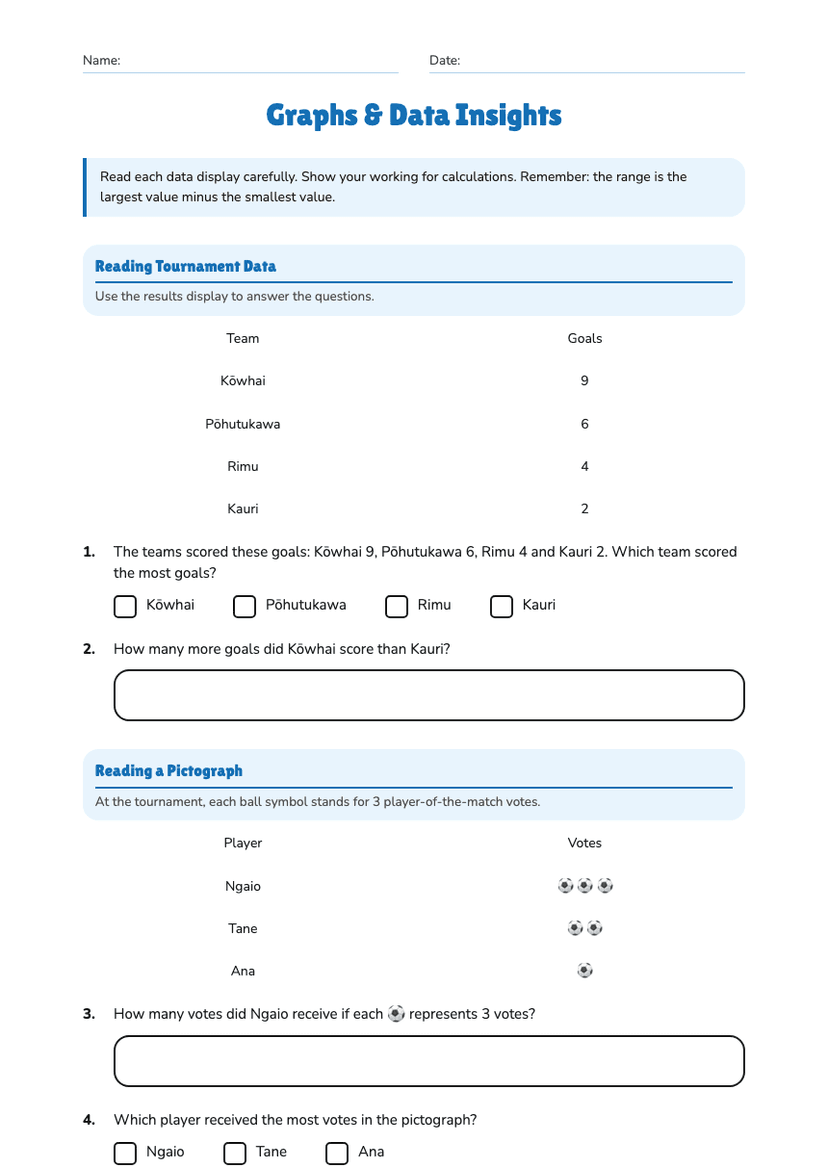
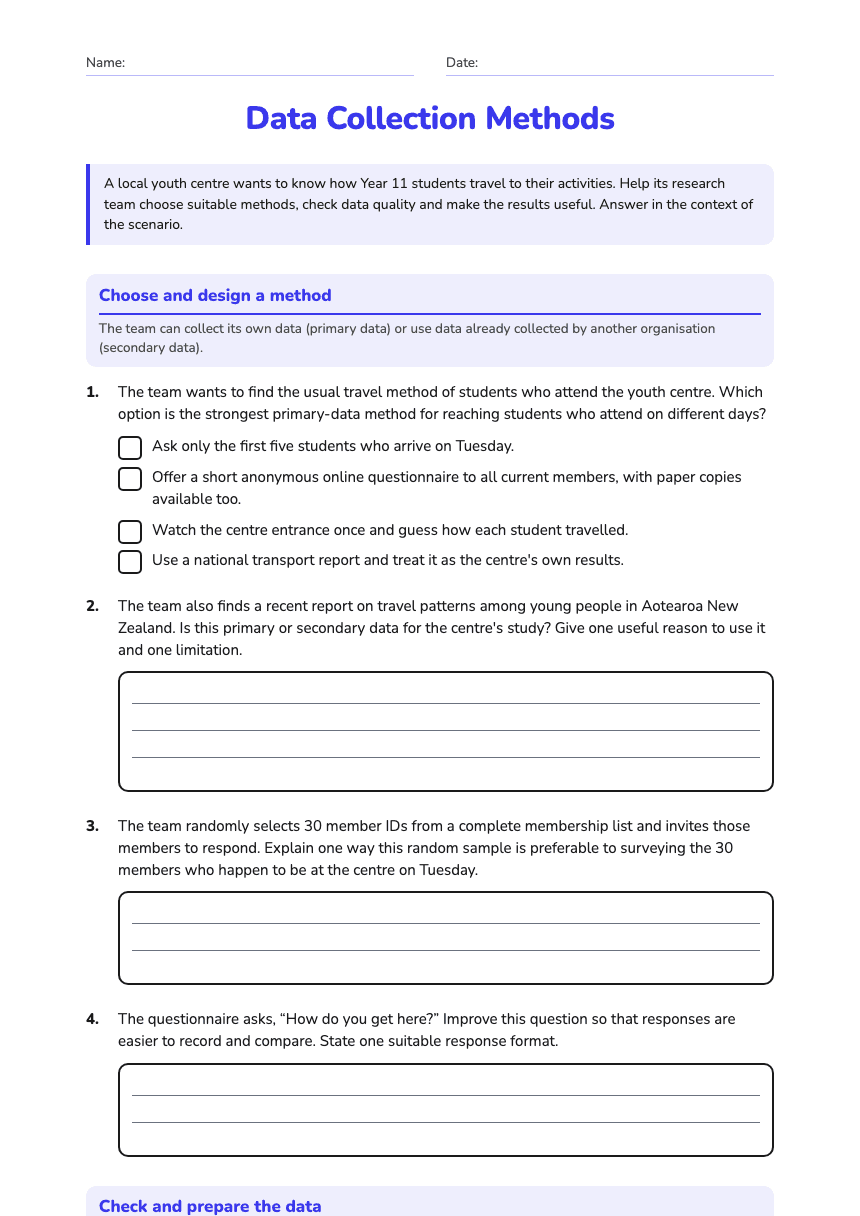
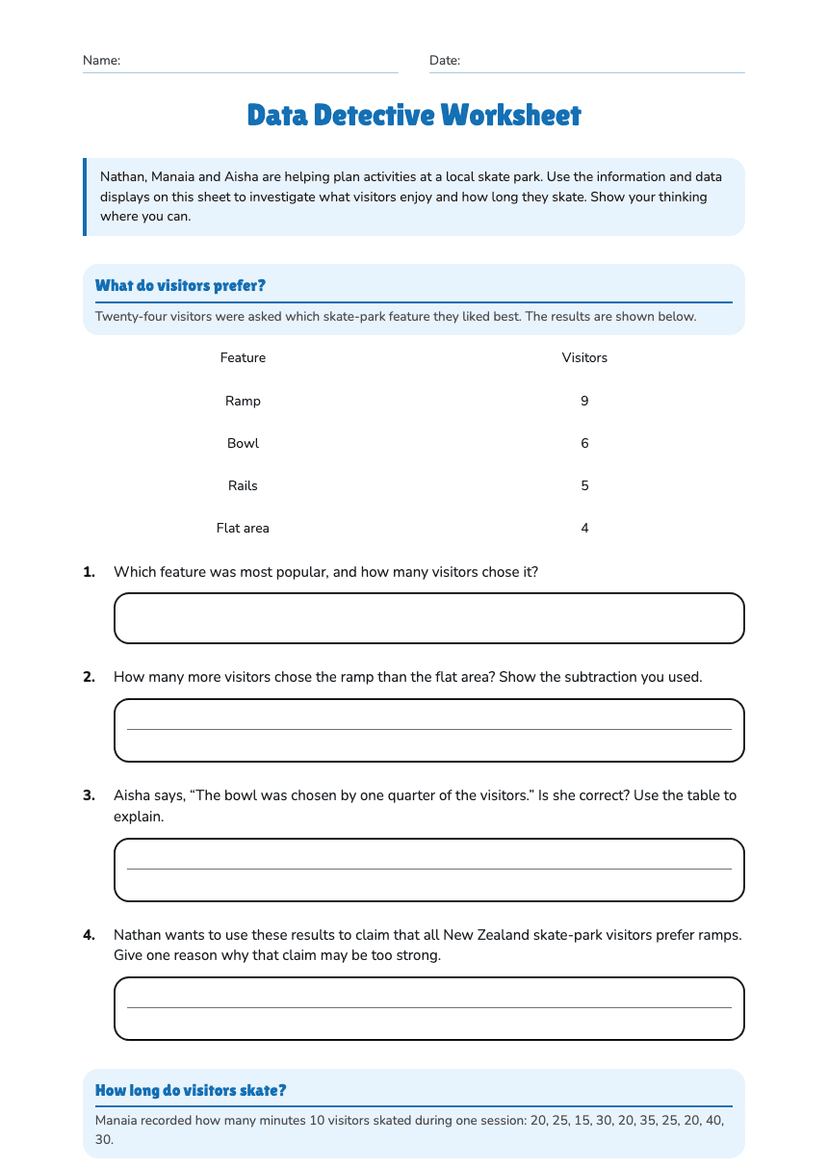
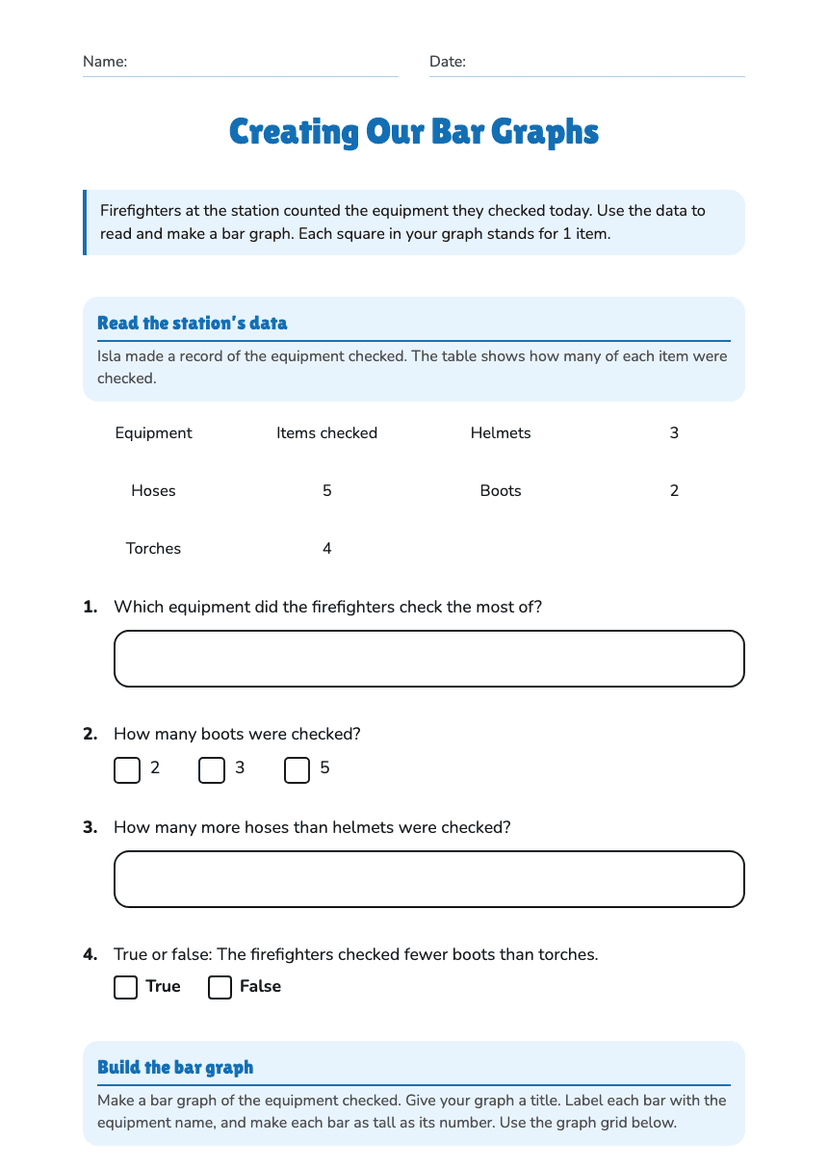
Name:Date:

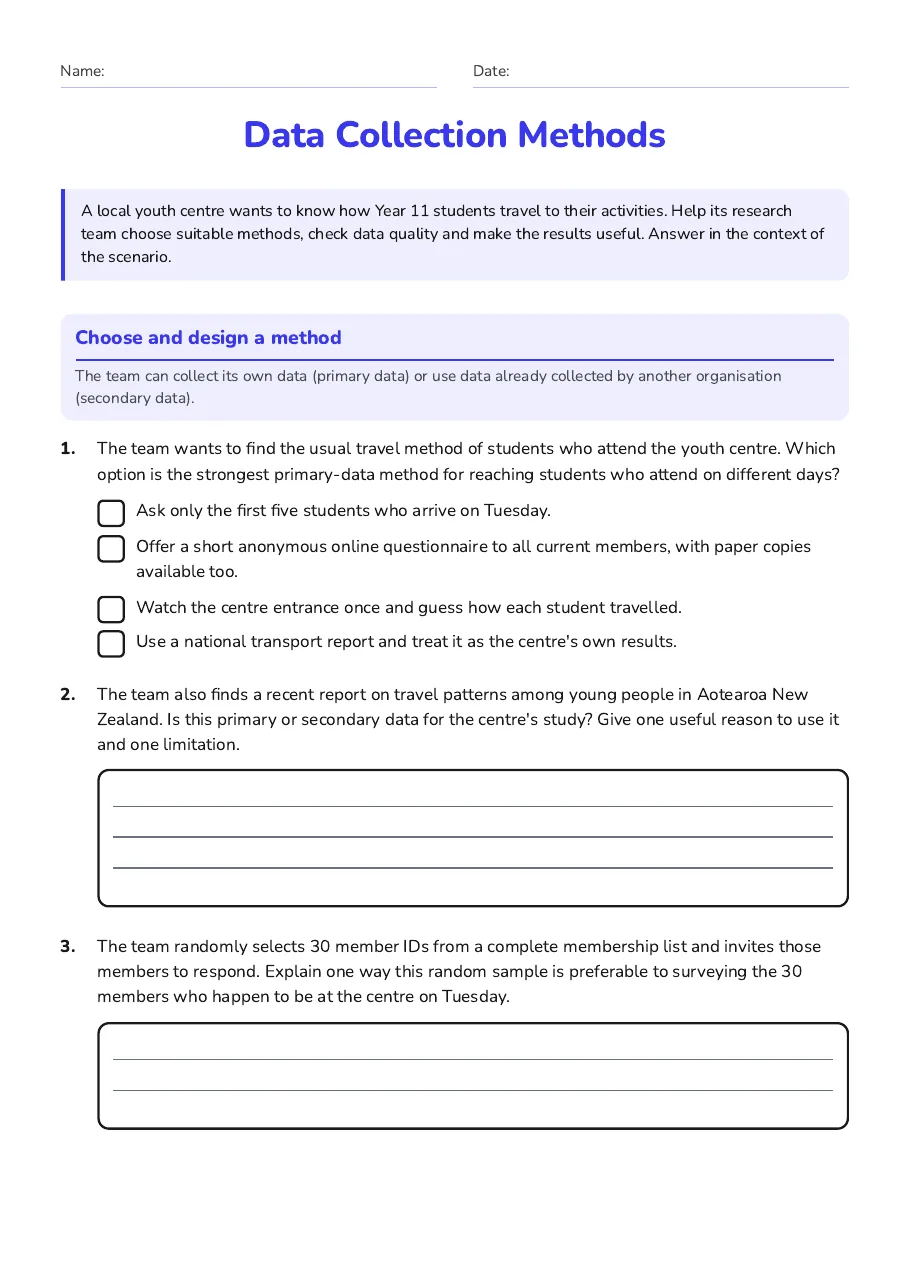
Data Collection Methods

A local youth centre wants to know how Year 11 students travel to their activities. Help its research team choose suitable methods, check data quality and make the results useful. Answer in the context of the scenario.

Choose and design a method

The team can collect its own data (primary data) or use data already collected by another organisation (secondary data).

1.The team wants to find the usual travel method of students who attend the youth centre. Which option is the strongest primary-data method for reaching students who attend on different days?
  • Ask only the first five students who arrive on Tuesday.
  • Offer a short anonymous online questionnaire to all current members, with paper copies available too.
  • Watch the centre entrance once and guess how each student travelled.
  • Use a national transport report and treat it as the centre's own results.
2.The team also finds a recent report on travel patterns among young people in Aotearoa New Zealand. Is this primary or secondary data for the centre's study? Give one useful reason to use it and one limitation.
3.The team randomly selects 30 member IDs from a complete membership list and invites those members to respond. Explain one way this random sample is preferable to surveying the 30 members who happen to be at the centre on Tuesday.
4.The questionnaire asks, “How do you get here?” Improve this question so that responses are easier to record and compare. State one suitable response format.

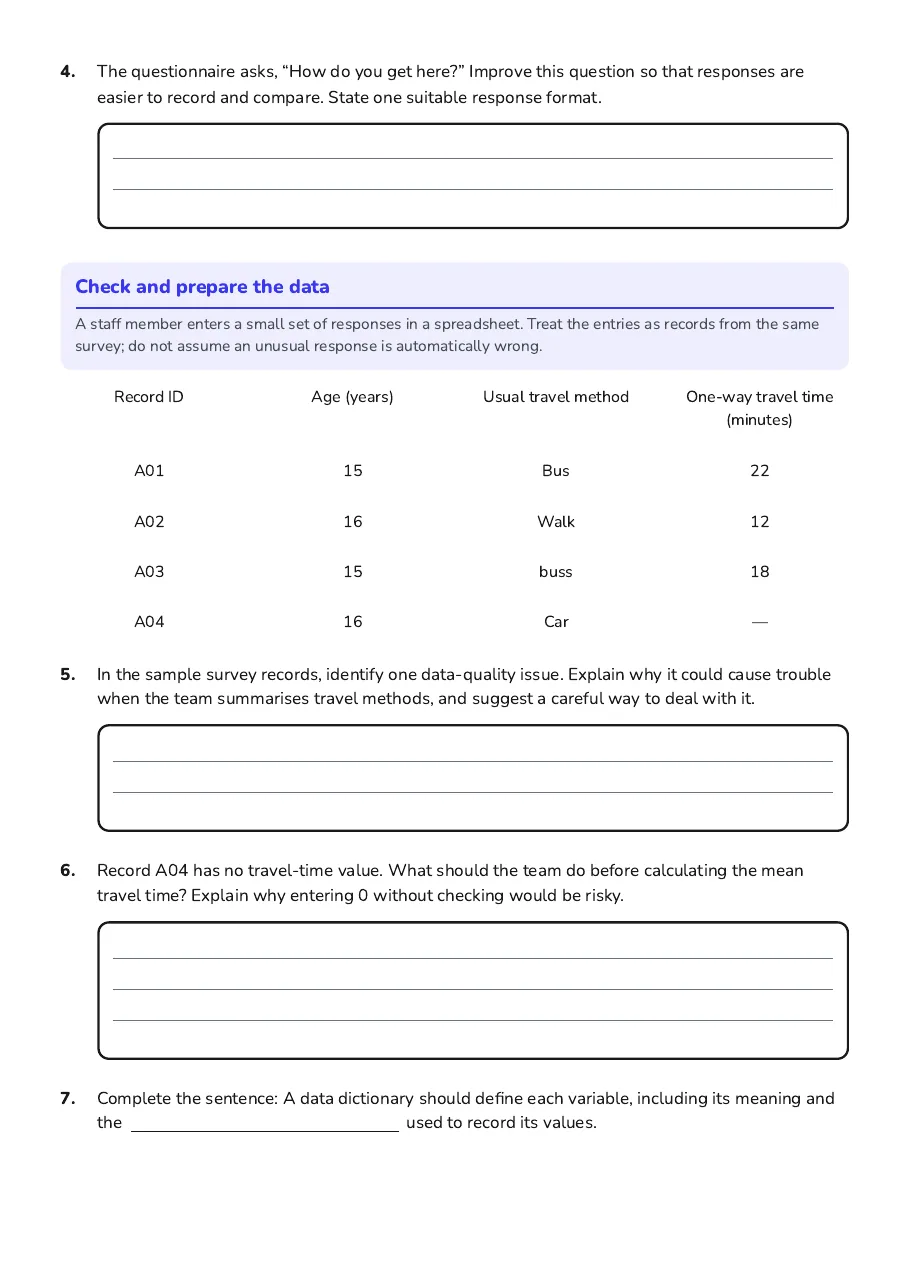
Check and prepare the data

A staff member enters a small set of responses in a spreadsheet. Treat the entries as records from the same survey; do not assume an unusual response is automatically wrong.

Record ID

Age (years)

Usual travel method

One-way travel time (minutes)

A01

15

Bus

22

A02

16

Walk

12

A03

15

buss

18

A04

16

Car

—

5.In the sample survey records, identify one data-quality issue. Explain why it could cause trouble when the team summarises travel methods, and suggest a careful way to deal with it.
6.Record A04 has no travel-time value. What should the team do before calculating the mean travel time? Explain why entering 0 without checking would be risky.
7.Complete the sentence: A data dictionary should define each variable, including its meaning and the used to record its values.
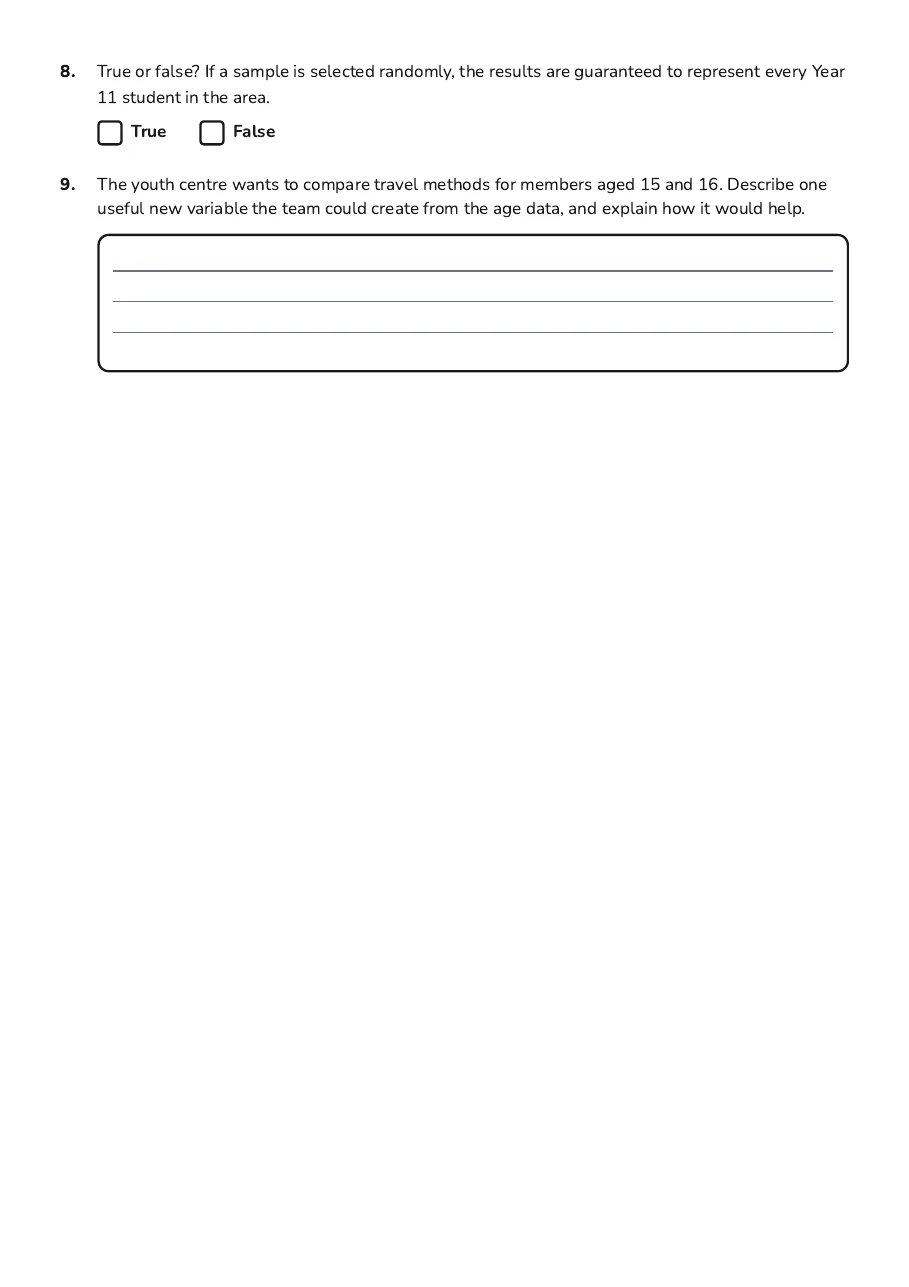
8.True or false? If a sample is selected randomly, the results are guaranteed to represent every Year 11 student in the area.
TrueFalse
9.The youth centre wants to compare travel methods for members aged 15 and 16. Describe one useful new variable the team could create from the age data, and explain how it would help.

3 printable pages

  • Data Collection Methods, page 1 of 3: Choose and design a method

    Page 1

  • Data Collection Methods, page 2 of 3: Check and prepare the data

    Page 2

  • Data Collection Methods, page 3 of 3: 8. True or false? If a sample is selected randomly, the results are guaranteed to…

    Page 3

About This Worksheet

Free in Kuraplan

Sign up free, grab the PDF, and customize it for your class.

Print-Ready

Formatted for standard paper. Clean layout, easy to read.

AI-Generated

Created with Kuraplan's AI, designed for real classroom use.

For Teachers & Parents

Use in classrooms, for homework, tutoring, or homeschool.

Need a custom version of this worksheet?

Kuraplan's AI generates custom worksheets in seconds — differentiated for every learner, aligned to your curriculum.

Generate Custom Worksheets — Free
No credit card Curriculum-aligned Under 60 seconds