Introduction to Sound Waves
A free science worksheet ready for your classroom. Open in Kuraplan to grab the print-ready PDF, customize it for your students, or generate a fresh version in seconds.
Introduction to Sound Waves
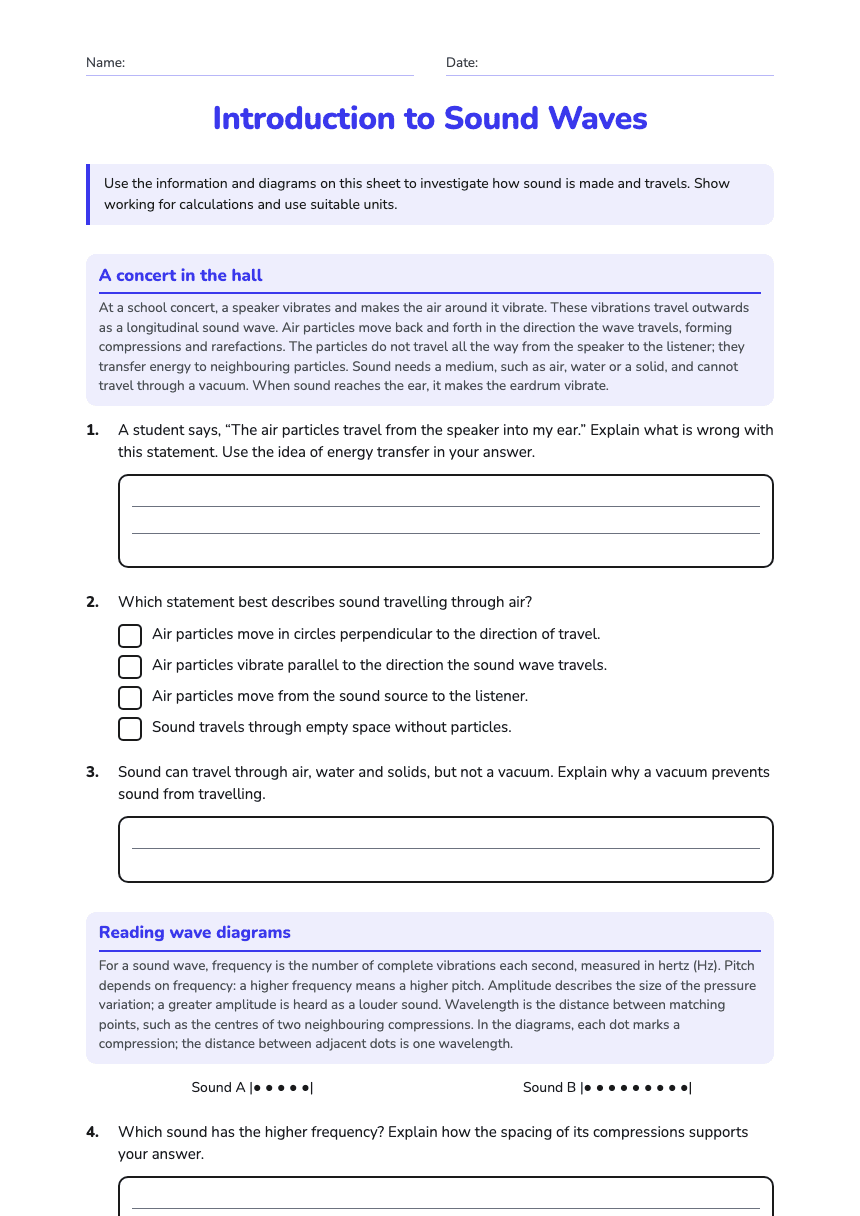
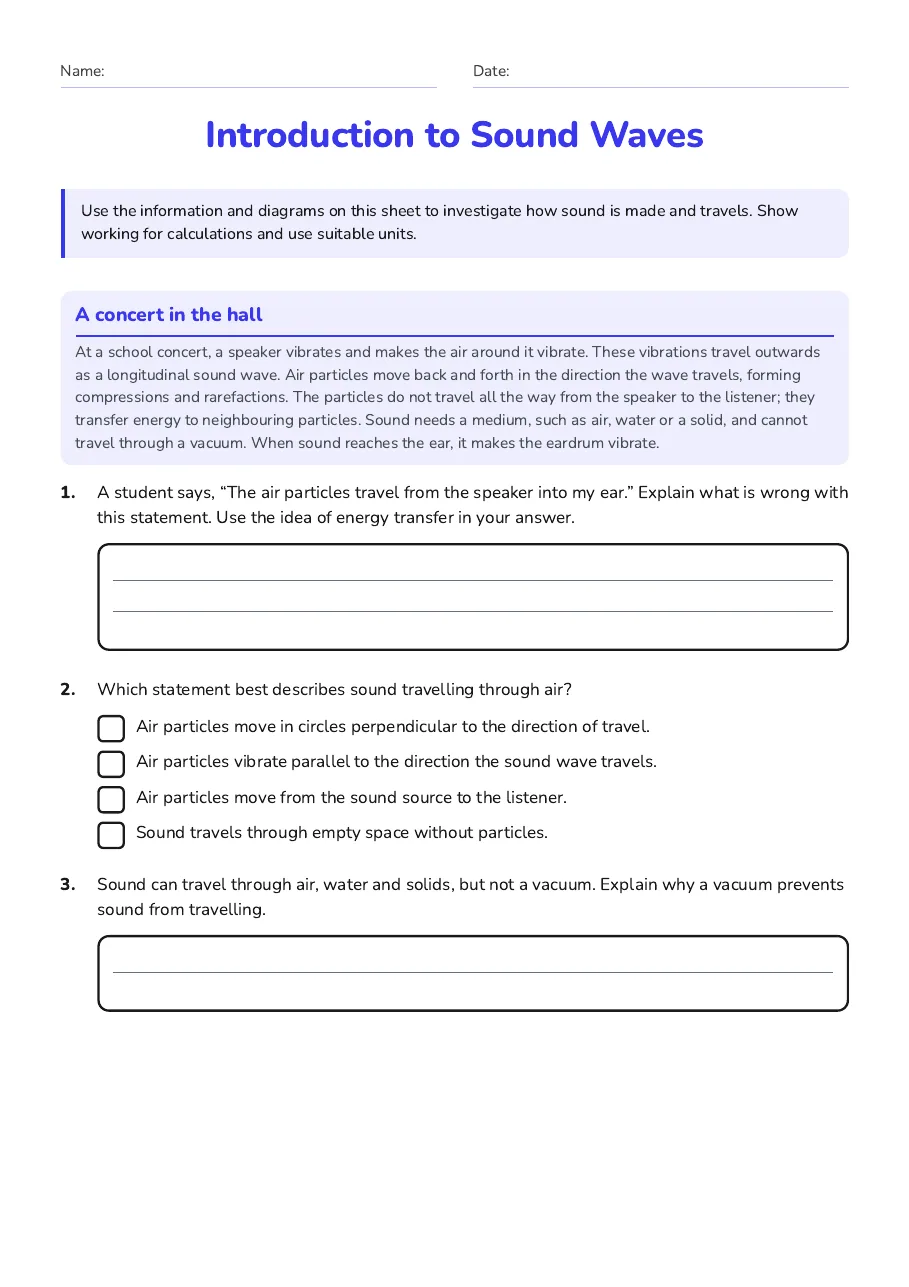
A concert in the hall
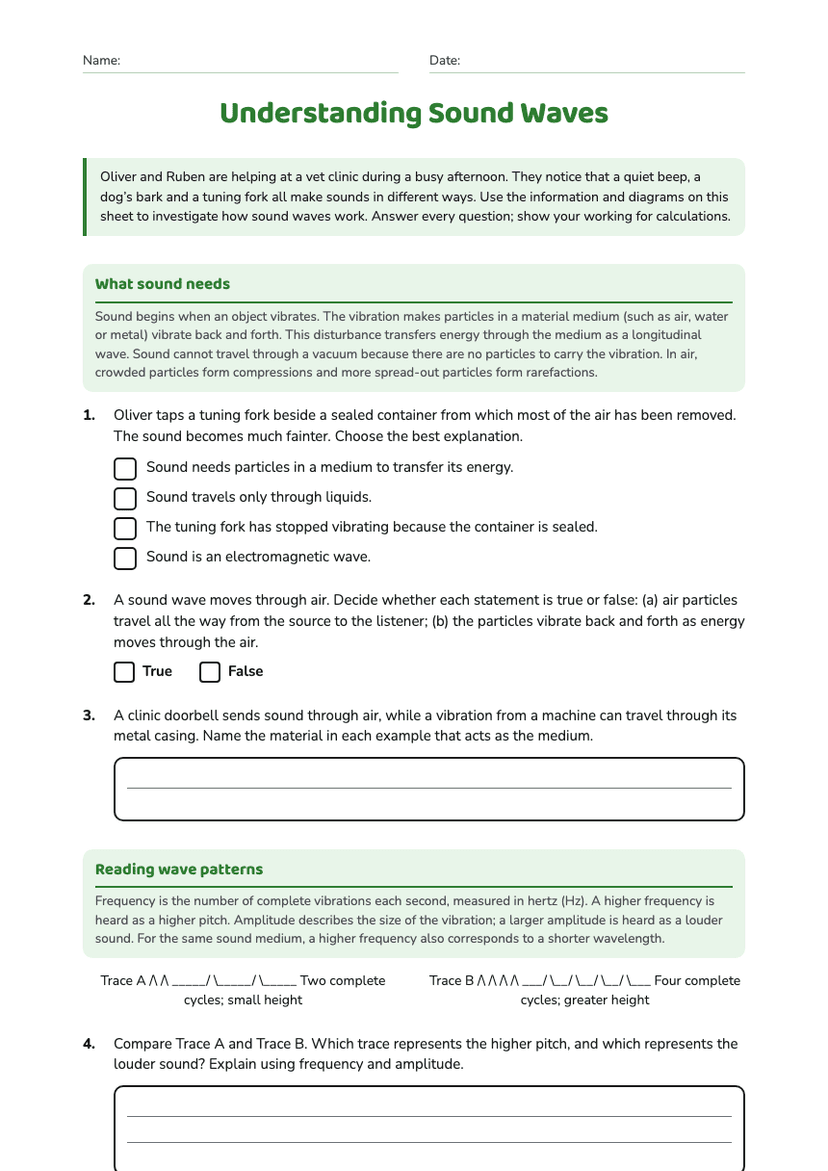
At a school concert, a speaker vibrates and makes the air around it vibrate. These vibrations travel outwards as a longitudinal sound wave. Air particles move back and forth in the direction the wave travels, forming compressions and rarefactions. The particles do not travel all the way from the speaker to the listener; they transfer energy to neighbouring particles. Sound needs a medium, such as air, water or a solid, and cannot travel through a vacuum. When sound reaches the ear, it makes the eardrum vibrate.
- Air particles move in circles perpendicular to the direction of travel.
- Air particles vibrate parallel to the direction the sound wave travels.
- Air particles move from the sound source to the listener.
- Sound travels through empty space without particles.
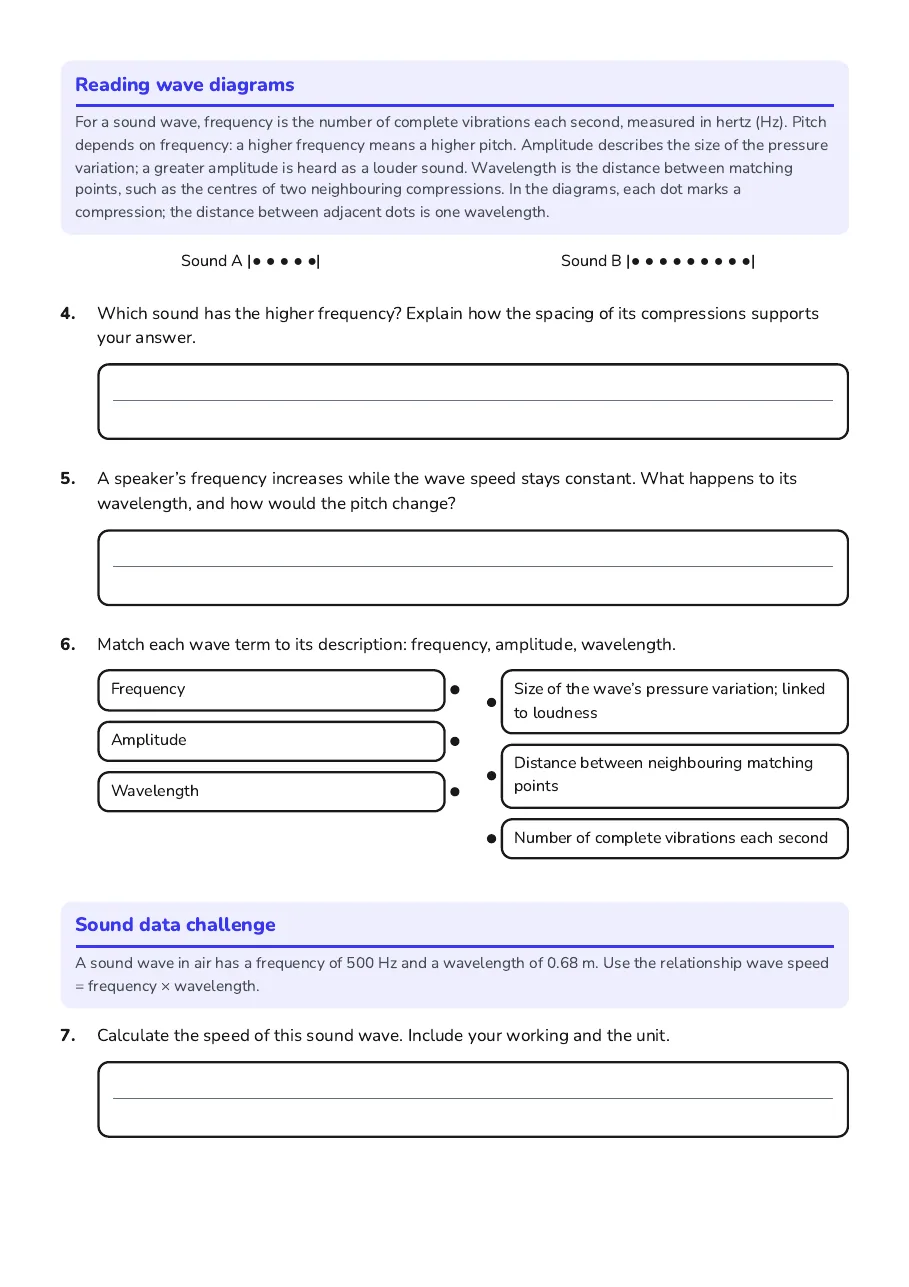
Reading wave diagrams
For a sound wave, frequency is the number of complete vibrations each second, measured in hertz (Hz). Pitch depends on frequency: a higher frequency means a higher pitch. Amplitude describes the size of the pressure variation; a greater amplitude is heard as a louder sound. Wavelength is the distance between matching points, such as the centres of two neighbouring compressions. In the diagrams, each dot marks a compression; the distance between adjacent dots is one wavelength.
Sound A |● ● ● ● ●|
Sound B |● ● ● ● ● ● ● ● ●|
- Frequency
- Amplitude
- Wavelength
- Size of the wave’s pressure variation; linked to loudness
- Distance between neighbouring matching points
- Number of complete vibrations each second
Sound data challenge
A sound wave in air has a frequency of 500 Hz and a wavelength of 0.68 m. Use the relationship wave speed = frequency × wavelength.
3 printable pages
Page 1
Page 2
Page 3
About This Worksheet
Free in Kuraplan
Sign up free, grab the PDF, and customize it for your class.
Print-Ready
Formatted for standard paper. Clean layout, easy to read.
AI-Generated
Created with Kuraplan's AI, designed for real classroom use.
For Teachers & Parents
Use in classrooms, for homework, tutoring, or homeschool.
Need a custom version of this worksheet?
Kuraplan's AI generates custom worksheets in seconds — differentiated for every learner, aligned to your curriculum.
Generate Custom Worksheets — Free