ScienceFreePrintable

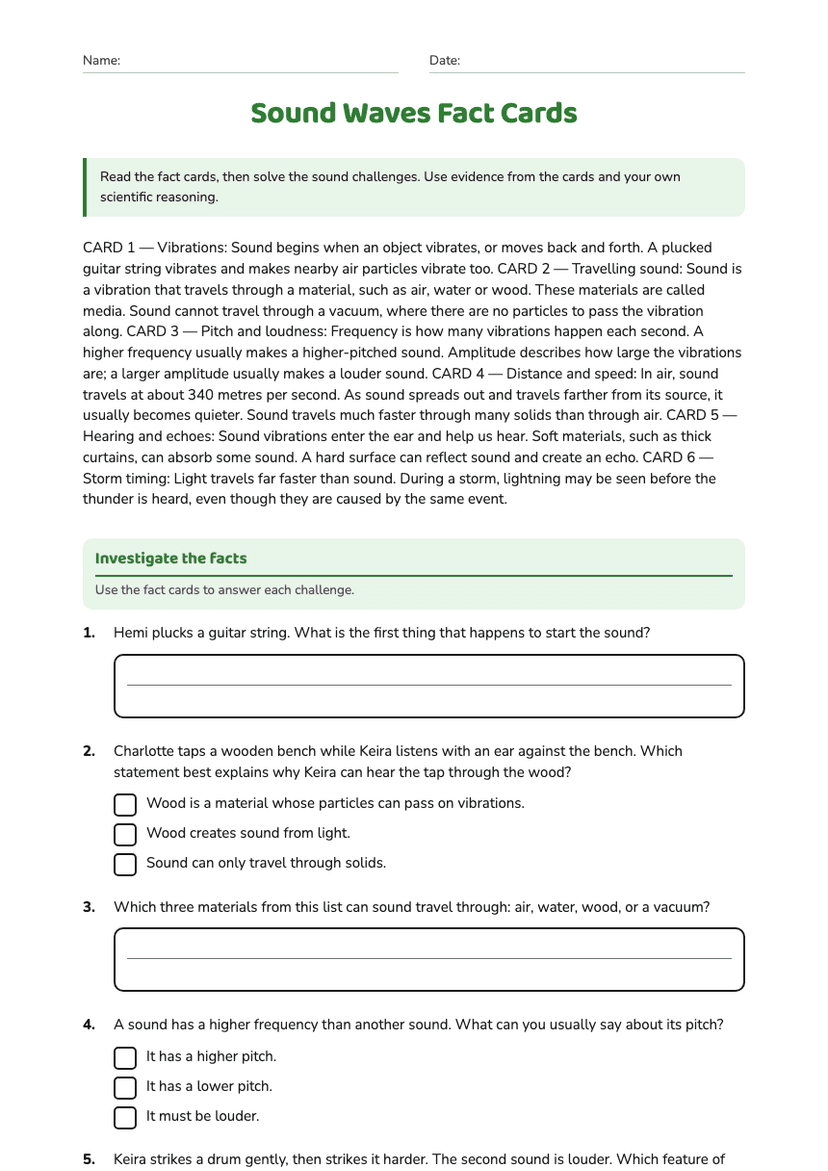
Understanding Sound Waves

A free science worksheet ready for your classroom. Open in Kuraplan to grab the print-ready PDF, customize it for your students, or generate a fresh version in seconds.
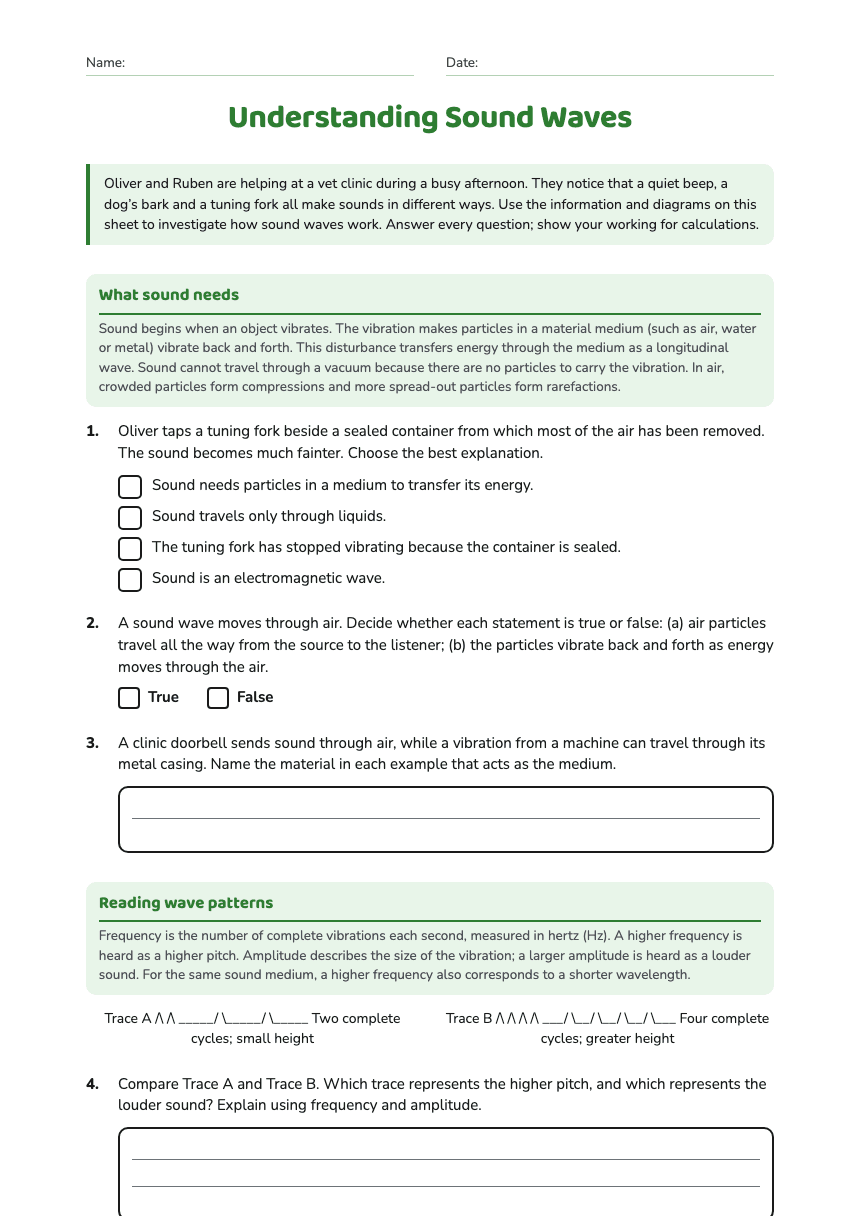
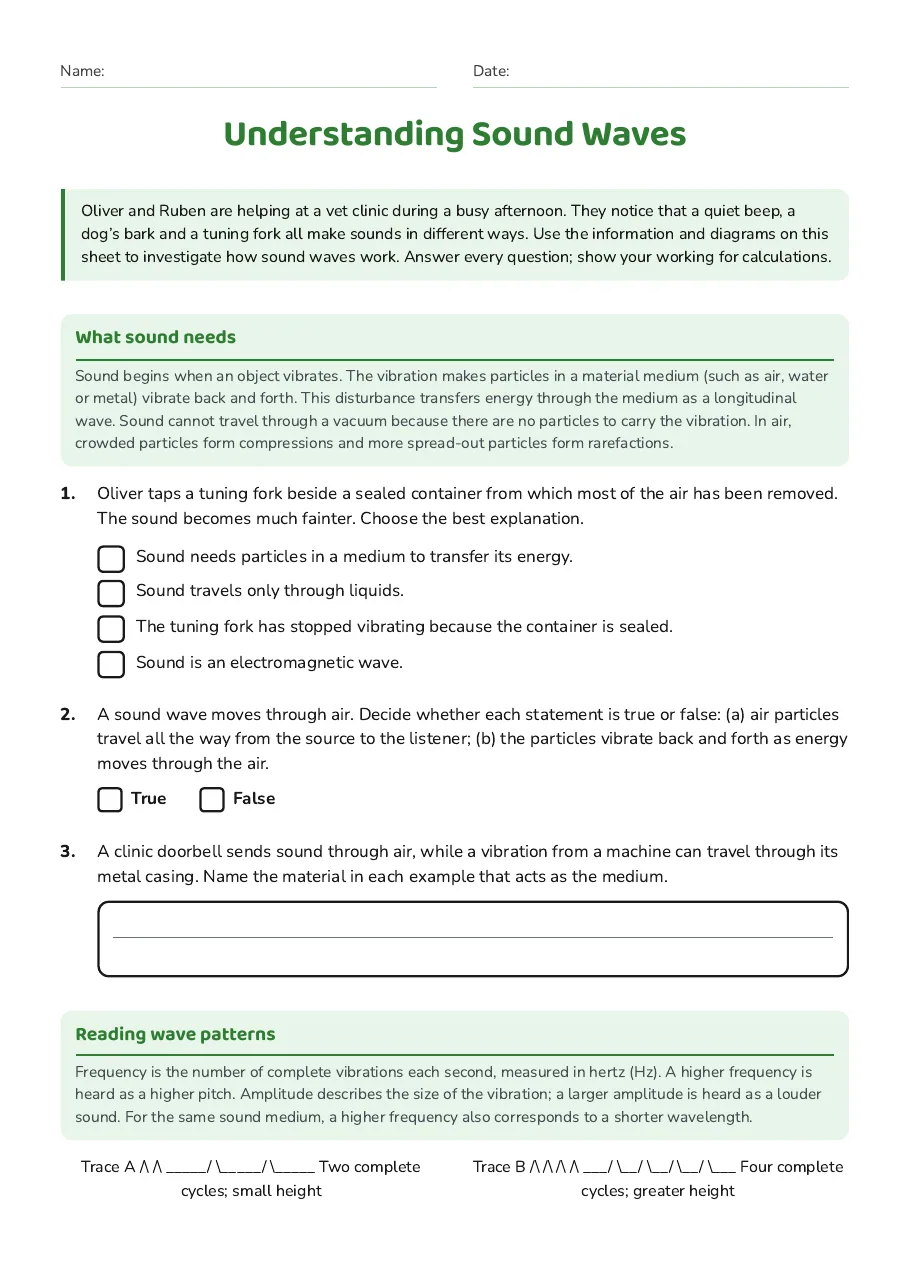
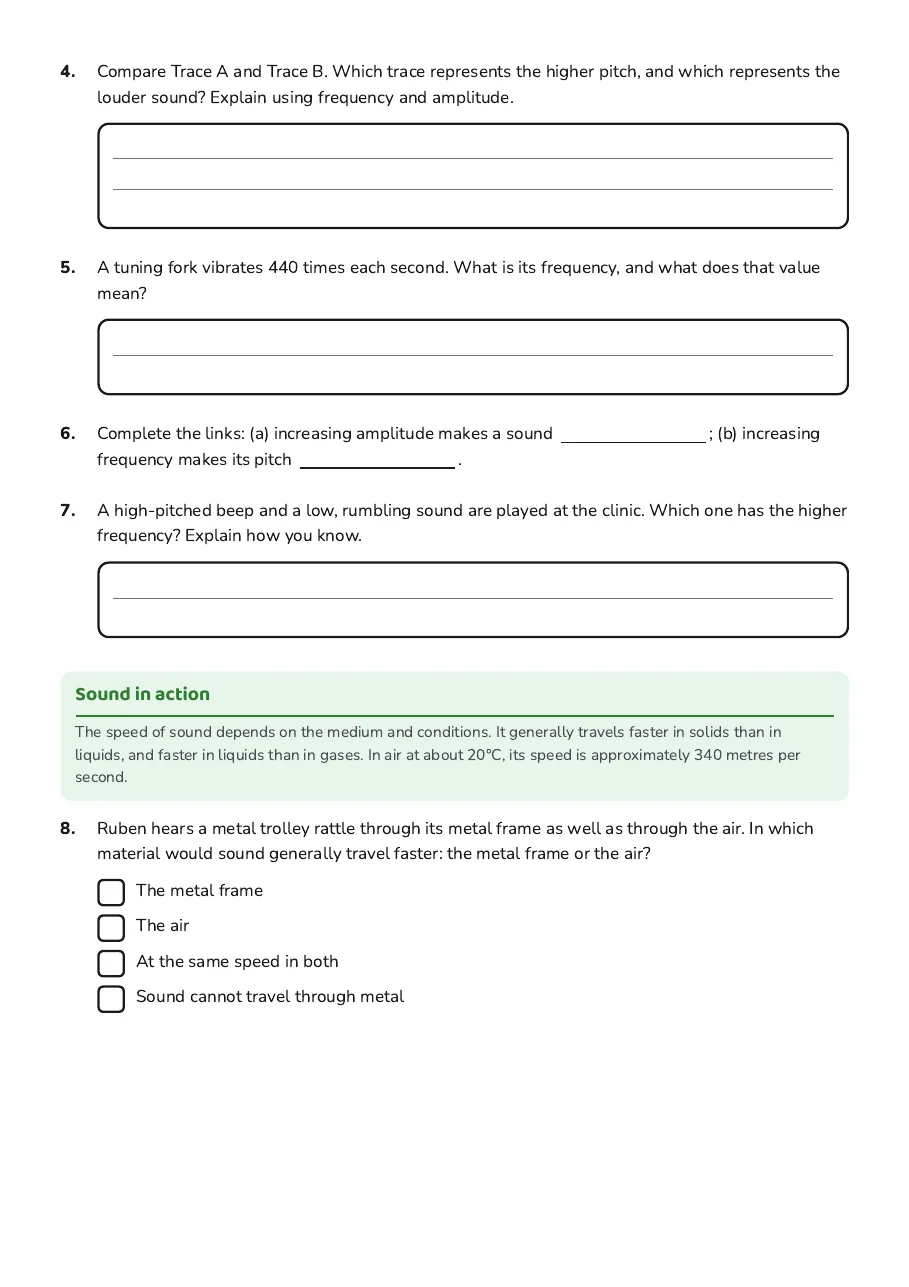
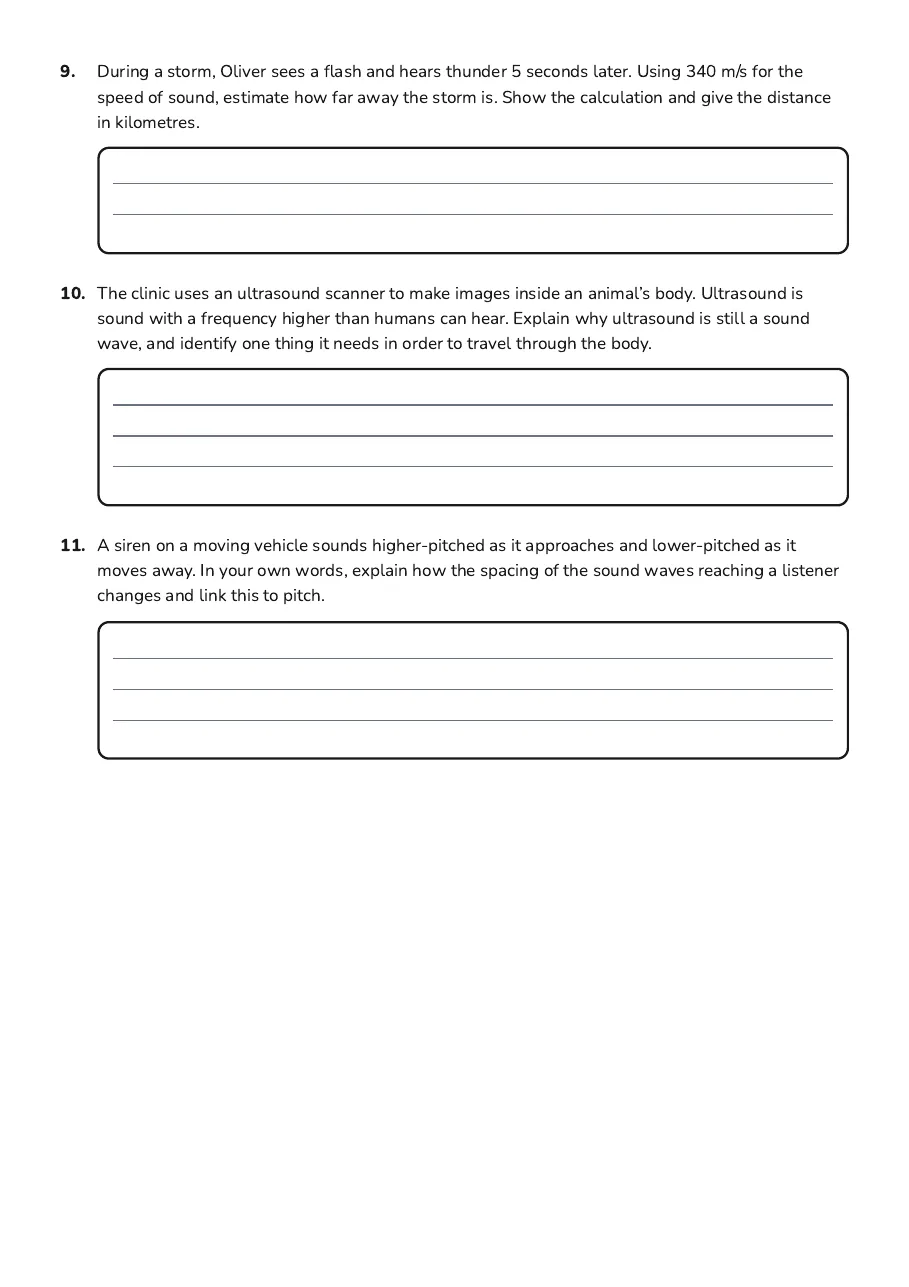
Understanding Sound Waves worksheet preview

Understanding Sound Waves

Sound wave illustration

🎯 WALT (We Are Learning To): Understand the properties of sound waves, including how sound travels, frequency, pitch, amplitude, and volume, and apply this knowledge to real-life situations.

✅ Success Criteria — I can:

▸ Explain that sound is a mechanical, longitudinal wave that requires a medium to travel through.
▸ Describe how frequency relates to pitch and amplitude relates to volume.
▸ Label a sound wave diagram with key properties.
▸ Apply my understanding of sound waves to real-world examples.

💡 Dyslexia-friendly tip: Read each question aloud quietly to yourself before answering. Use a ruler to track each line as you read.

🔬 Part 1: Knowledge Check — Multiple Choice & True/False

Circle the best answer for each question.

1. Sound is best described as which type of wave?

A transverse wave that travels through a vacuum

A longitudinal wave that requires a medium to travel

An electromagnetic wave like light

A wave that only travels through solids

2. In which medium does sound travel the fastest?

Air at 20°C

Water

Steel

A vacuum

3. A sound wave with a higher frequency will have a:

Lower pitch and shorter wavelength

Higher pitch and shorter wavelength

Higher pitch and longer wavelength

Lower pitch and longer wavelength

4. Which of the following statements are TRUE about sound waves? (Select ALL that apply)

Sound cannot travel through a vacuum

Increasing amplitude makes a sound louder

Sound travels faster in cold air than warm air

Compressions and rarefactions are features of longitudinal waves

The speed of sound in air is approximately 343 metres per second

📊 Part 2: Diagram — Label the Sound Wave

The diagram below represents a longitudinal sound wave. Use the word bank to label the four parts marked with arrows.

Word Bank:   Compression  |  Rarefaction  |  Wavelength  |  Amplitude

🖊️ In the box above, draw a simple longitudinal wave showing at least two compressions and two rarefactions, then label the four features from the word bank. Add arrows to show the direction of wave travel.

5. On your diagram, how would you change the wave to show a louder sound? Describe what changes.
6. How would you change the wave to show a higher pitched sound? Describe what changes.

✏️ Part 3: Short Answer — Concepts & Real-Life Applications

7. A kea (New Zealand mountain parrot) calls out on a hillside. Explain the process by which the sound reaches your ears 50 metres away. Use the terms vibration, compression, medium, and energy transfer in your answer.
8. A whale communicates with another whale 200 kilometres away underwater. Why is water a better medium for this than air? Refer to particle spacing in your answer.
9. A guitar string is plucked and produces a note at 440 Hz (the note A). What does 440 Hz mean in terms of wave behaviour?
10. 🌟 Challenge: Thunder is heard 6 seconds after a lightning flash. Using the speed of sound as 340 metres per second, calculate how far away the storm is in kilometres. Show your working.

The storm is approximately _________ kilometres away.

🚀 Extension Activity — For Advanced Learners

Complete this section if you have finished the worksheet and want an extra challenge.

11. 🌟🌟 Extension: The Doppler Effect describes how the perceived pitch of a sound changes when the source is moving. A police siren sounds higher-pitched as it moves towards you and lower-pitched as it moves away. Using your understanding of frequency and wavelength, explain why this happens. Draw a simple diagram to support your explanation.

🔎 Differentiation Strategies:

Support: Use your textbook glossary to find definitions for frequency, amplitude, compression, and rarefaction before answering.
Standard: Complete all sections independently using your class notes.
Extension: Complete Question 11 and research one real-world technology (e.g., sonar, ultrasound, noise-cancelling headphones) that uses sound wave properties. Write a 3–4 sentence explanation on the back of this sheet.

About This Worksheet

Free in Kuraplan

Sign up free, grab the PDF, and customize it for your class.

Print-Ready

Formatted for standard paper. Clean layout, easy to read.

AI-Generated

Created with Kuraplan's AI, designed for real classroom use.

For Teachers & Parents

Use in classrooms, for homework, tutoring, or homeschool.

Need a custom version of this worksheet?

Kuraplan's AI generates custom worksheets in seconds — differentiated for every learner, aligned to your curriculum.

Generate Custom Worksheets — Free
No credit card Curriculum-aligned Under 60 seconds